
BuddhistCatholicContemplativeEvangelicalGeneral ChristianHinduJewishLatter-day SaintMuslimNew VisionsProgressive Christian
Beliefs
- Buddhist
- Catholic
- Contemplative
- Evangelical
- General Christian
- Hindu
- Jewish
- Latter-day Saint
- More Voices
- Muslim
- New Visions
- Pagan
- Progressive Christian
Topics
- Religion News
- Food and Religion
- Sports and Religion
- Religious Art
- Religious Music and Entertainment
- Religious Events
- History and Religion
- Style and Religion
- Politics and Religion
- Women in Religion
- Recreation Outdoors and Religion
- Business Finance and Religion
- Careers Workplace and Religion
- Education and Religion
- Family Parenting and Religion
- Health Fitness and Religion
- Home and Religion
- Relationships and Religion
- Technology and Religion
- Travel and Religion
Columnists
- Buddhist Columnists
- Business Finance and Religion Columnists
- Careers Workplace and Religion Columnists
- Catholic Columnists
- Contemplative Columnists
- Education and Religion Columnists
- Evangelists Columnists
- Family Parenting and Religion Columnists
- General Christian Columnists
- Health Fitness and Religion Columnists
- Hindu Columnists
- History and Religion Columnists
- Home and Religion Columnists
- Jewish Columnists
- More Voices Columnists
- Latter Day Columnists
- Muslim Columnists
- New Visions Columnists
- Nonreligious Columnists
- Pagan Columnists
- Politics and Religion Columnists
- Progressive Columnists
- Recreation Outdoors and Religion Columnists
- Relationships and Religion Columnists
- Religion News Columnists
- Religious Art Columnists
- Religious Events Columnists
- Religious Music and Entertainment Columnists
- Sports and Religion Columnists
- Style and Religion Columnists
- Technology and Religion Columnists
- Travel and Religion Columnists
- Women in Religion Columnists
Resource Library
- 2026 Calendar
- Library of World Religions
- The 100 Most Holy Places on Earth
- Patheos Answers
- Podcasts
- Videos
- Faith Leaders Database
- Anglican Episcopalian
- Bahai
- Baptist
- Buddhism
- Christianity
- Confucianism
- Eastern Orthodoxy
- Hinduism
- Holiness and Pentecostal
- ISKCON
- Islam
- Judaism
- Lutheran
- Methodist
- The Church of Jesus Christ of Latter-day Saints
- New Age
- Paganism
- Presbytarian and Reformed
- Protestantism
- Religion Behind the Scenes
- Roman Catholic
- Scientology
- Shia Islam
- Sikhism
- Sufism
- Sunni Islam
- Taoism
- Zen
- See all religions
Research Tools
 Ad-Free & Subscriber Log-In Subscription Support
Ad-Free & Subscriber Log-In Subscription Support
Follow Patheos 

- Trending:
- Forgiveness
- |
- Marriage
- |
- Consciousness
- |
- Death Penalty
- |
- Election
- |
- Halloween

- Home
- Pagan
- Irish-American Witchcraft: Oak, Ash, and Thorn – the Evolution of Belief
Irish-American Witchcraft: Oak, Ash, and Thorn – the Evolution of Belief
Last updated on: May 23, 2017 at 10:13 pm by Morgan Daimler
Irish-American Witchcraft: Oak, Ash, and Thorn – the Evolution of Belief 2017-05-23T22:13:42+00:00 Morgan Daimler
Patheos Explore the world's faith through different perspectives on religion and spirituality! Patheos has the views of the prevalent religions and spiritualities of the world.
If you’ve spent any time in either Celtic paganism or around modern pagans with an interest in the Fair Folk you may have run across the phrase “by oak, ash, and thorn” usually either tied to the idea that these three are signs of fairy presence or that they ward off fairy mischief when branches or twigs of each are tied together. I have certainly heard the phrase repeated many times over the last several decades and I’d honestly never thought to question it. However I’d recently started to wonder about this and in particular how the ash, which (in Irish folklore anyway) is usually a protection against fairies might be considered instead a sign of their presence and which thorn, exactly, was meant, so I decided to start looking into it. This sort of curiosity is exactly what landed me in Reconstructionism by the way, because I’m that kid who always has to know the why of things.
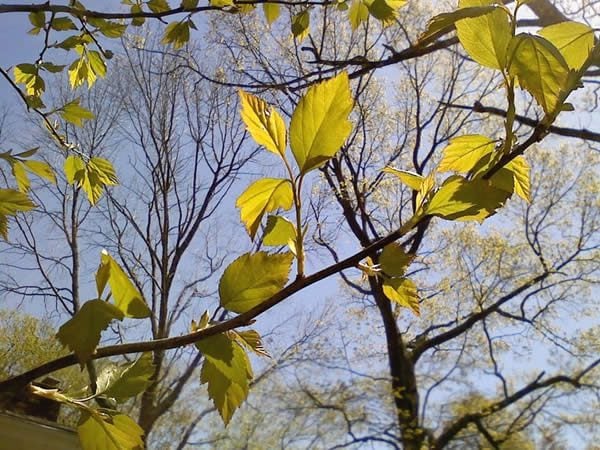
Hawthorn in the sun with ash and oak in the background / M Daimler circa 2012
So my first step was to go to my bookshelf and start pulling references. I was sadly disappointed, as none of the books on Fairylore that I own had a single reference to the ‘fairy triad’ either by that name or as a grouping mentioned under listings for the individual trees. Oak has some ties to the Other Crowd and specifically to certain types of fairies called ‘oakmen’. The thorns, both blackthorn and hawthorn, are very strongly linked to fairies and lone thorn trees are often seen as fairy trees; many believe that it is dangerous to harm such a tree. Ash however has a somewhat anti-fairy reputation from what I could find, being seen as a strong protection against fairy presence and interference.
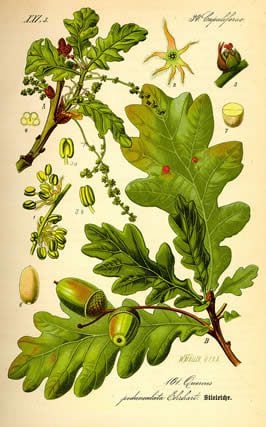
Illustration of Oak by Prof. Dr. Otto Wilhelm Thomé / Flora von Deutschland, Österreich und der Schweiz 1885, Gera, Germany – www.biolib.de / Public Domain via Wikimedia Commons
My google-fu failed to provide any useful insight as well. I was frustrated by the internet which provided nothing but a seemingly endless list of modern sources, mostly fairy-themed or Druidic websites which talked about the three trees but gave no source for the idea. I am only too well aware that it takes a very short amount of time for a new idea to enter the community and be absorbed and incorporated as an ‘ancient’ one. For example a good number of Celtic pagans, in my experience, will say that Brighid was the Dagda’s wife in the Celtic creation story, believing this is genuinely old mythology and not realizing it was written in 1989 by a modern author named Peter Berresford Ellis.¹
My second step was to go to an Irish spirituality discussion group I belong to and ask there, since logically if this is indeed deep seated folk belief I assumed someone there would know something about it. No one was familiar with it, outside of modern Druidry. One friend did mention that those three trees were the ones most likely found around holy wells, and another pointed me towards Rudyard Kipling’s ‘A Tree Song‘ from the 1906 book Puck of Pook’s Hill (this poem was later turned into a folk song that some may be familiar with as it gets a lot of midsummer play, by the name of ‘Oak, Ash, and Thorn’). The poem is pretty cool actually and I quite like it but while it glorifies the three trees it has nothing at all to do with fairies. Lora O’Brien, suggested looking into Fergus Kelly’s article ‘Trees in Early Ireland‘ and added that she, like the others I’d talked to, had never heard of the idea outside of modern Druidry. Kelly’s article was helpful in establishing the Irish view of the trees and reinforcing that the three seemed to have little in common as a grouping.
So, at this point at least, unless I find anything else² to indicate it predates Kipling, it looks like the idea of oak, ash, and thorn as a ‘fairy triad’ is a modern concept.
Now before the hate mail – or at least comments – start flowing in, let me be clear about something. Modern isn’t necessarily bad. Lots of concepts in neopaganism are modern and they still work just fine. Neopaganism gets some of its significant theology,³ for example, from Robert Graves book The White Goddess which was published in 1948 and that doesn’t make those things any less valid. Generally these new concepts and ideas are built on older ones just with a new interpretation or understanding. So the idea of a triad of fairy trees may not be much more than a hundred years old, but it obviously is drawn from something else – perhaps the observation that these three trees often grow around holy wells, or perhaps the same thing that inspired Kipling’s poem.
Beliefs are not static things, they grow and they evolve. Some beliefs can be traced back to genuinely old roots; sometimes they have been formed within our own generation. Often there is an assumption that only the old has value, and there is a certain logic to that, as the old has been time tested and proved. Because of this it is common to justify new beliefs with an older backstory, which can then muddy the waters of the actual history. But the new is not necessarily bad, and sometimes the new represents evolutions in old beliefs – although only time will tell which new beliefs last and which ones fade. I’m obviously a big believer in the value of the older beliefs and traditions myself, but I’m also an innovator and modifier as well, because I try to remember that the old beliefs were new once too.
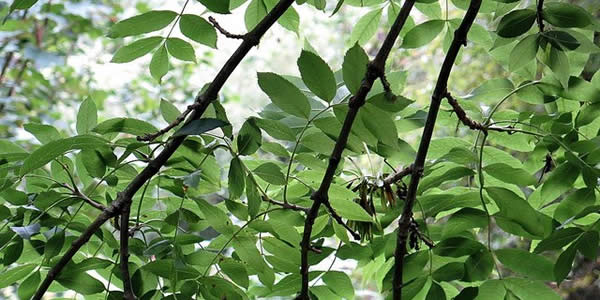
Ash trees © Copyright Andrew Curtis and licensed for reuse under this Creative Commons Licence.
I don’t necessarily agree with all the changes and directions that the new beliefs are taking, and in some cases I outright argue against them, but nonetheless belief is a fluid thing. I’ve mentioned before when discussing the twee-ification of modern fairy beliefs that I may not like it but I can see that in some way or other it has a purpose. In the same way I’m sure not everyone likes the adaptations and changes made to the old beliefs to make them better fit new places and environments, but that doesn’t make them less necessary or important. My own personal form of witchcraft is itself a hybrid of the old and the new, an evolution of sorts in belief. Everything that is living is growing and adapting to the world around it, and that is a good thing; but as we grow and adapt we should always remember the truth of our roots, whether those roots are old or new.
I’m still not sure I entirely understand the concept behind the so-called fairy triad, of the oak, ash, and thorn, but it is clearly a belief that has value to many people and which many have seized onto and incorporated into their own spirituality. There is something about the idea of the three trees that appeals to people on what can only be a deep level, in the same way that other newer beliefs appeal to people. Whether it is new or old oak, ash, and thorn together have become an important concept in many different traditions, and for the people who believe in its value, ultimately, its source should matter less than its efficacy.
References
- Ellis is a scholar who has written many academic works on the Celts, however he also wrote one which is a series of creative re-tellings of myths, in which he takes enough liberties with the stories to have basically fictionalized many of them beyond recognition. Many people do not realize this and take his work as original mythology and so there has been much confusion about his versions being authentic. (back)
- I’m open to new evidence of such, and am still investigating. I just haven’t yet found anything older than 1906. (back)
- Graves book includes the ideas for the Maiden/Mother/Crone goddess, the Oak and Holly Kings, and the tree calendar, to name a few concepts. (back)

Click here to like
Patheos Pagan on Facebook.

Click here to like
the Agora on Facebook
Irish-American Witchcraft is published bi-monthly on Tuesdays here on the Agora. Subscribe via RSS or e-mail!
Please use the links to the right to keep on top of activities here on the Agora as well as across the entire Patheos Pagan channel.
Previous Post

May 2, 2016
Seeking the Grail: Beltane Blues
Next Post

May 4, 2016 Dandelion Seeds: So You Want to be a Pagan Farmer
Browse Our Archives
Select a Category A Lakeside Hearth Adventures in Wortcunning Alone In Her Presence Arts, Crafts & Cooking Birthing Hereditary Witchcraft Book of Blackbirds Book Reviews Born-Again Witch Cauldron, Sword, Spear, & Stone Cermony and Liturgy Columns Community Dandelion Seeds Dear Jasmine Druid Thoughts Editor's Picks Everyday Pagan Family & Household Practice Family Traditions Full Frontal Magic Gateway Goddess Guest Articles Happily Heathen Health and Wellness Hearth of Hellenism Heathen Woman Hills of the Horizon History Holidays Horse Goddesses Interfaith Interviews Irish-American Witchcraft Jewish Witch Lamp & Labyrinth Letters from Midgard Literature, Media, Film, Music Loop of Brighid Love, Sex & Relationships Magic or Magick Making Light Naturalistic Traditions Nature News Outside The Circle Pantheisticon Politics Prayers, Poems, Blessings & Stories Queer Femme Mystic Queer of Swords Recipes Ritual and Practice Science and Research Seekers and Guides Seeking the Grail Socially Responsible Magic Spear of Athena Star Made Witch Syncretic Electric Technology The Blooming Staff The Busy Witch The Cartomancer The Crow's Nest The Dance of Pagan Recovery The Hearth of Hellenism The Lady's Quill The Other Side of the Hedge The Path of She The Rantin' Raven The Witches Next Door The Zen Pagan Theology, Ethics, Philosophy Tree City Witch Urban Earthwitch Wayfaring Woman Witch on Fire Wyrd Words
Select a Month January 2026 March 2025 December 2024 June 2024 April 2024 March 2024 January 2024 December 2023 November 2023 October 2023 August 2023 July 2023 May 2023 April 2023 March 2023 February 2023 January 2023 December 2022 November 2022 October 2022 September 2022 August 2022 July 2022 June 2022 May 2022 March 2022 February 2022 January 2022 December 2021 November 2021 October 2021 September 2021 August 2021 July 2021 June 2021 May 2021 April 2021 March 2021 February 2021 January 2021 December 2020 November 2020 October 2020 September 2020 August 2020 July 2020 June 2020 May 2020 April 2020 March 2020 February 2020 January 2020 December 2019 November 2019 October 2019 September 2019 August 2019 July 2019 June 2019 May 2019 April 2019 March 2019 February 2019 January 2019 December 2018 November 2018 October 2018 September 2018 August 2018 July 2018 June 2018 May 2018 April 2018 March 2018 February 2018 January 2018 December 2017 November 2017 October 2017 September 2017 August 2017 July 2017 June 2017 May 2017 April 2017 March 2017 February 2017 January 2017 December 2016 November 2016 October 2016 September 2016 August 2016 July 2016 June 2016 May 2016 April 2016 March 2016 February 2016 January 2016 December 2015 November 2015 October 2015 September 2015 August 2015 July 2015 June 2015 May 2015 April 2015 March 2015 February 2015 January 2015 December 2014 November 2014 October 2014 September 2014 August 2014 July 2014 June 2014 May 2014 April 2014 March 2014 February 2014 January 2014 December 2013 November 2013 October 2013 September 2013 August 2013 July 2013 June 2013 May 2013 April 2013 March 2013 February 2013 January 2013 December 2012 November 2012 October 2012 September 2012 August 2012 July 2012 June 2012 May 2012 April 2012 March 2012 February 2012 January 2012
Follow Us!
TAKE THE
Religious Wisdom Quiz
What was Jesus' first miracle?
Select your answer to see how you score.
Walking on water Healing a blind man Turning water into wine Feeding the 5,000
Related posts from Agora

Irish-American Witchcraft: Top 5 Favourite Fairy Fiction Series

Irish-American Witchcraft: Why the Roots of Your Fairy...
Irish-American Witchcraft: Fairies, Hoaxes, Gaffs, and Quest for...

Irish-American Witchcraft: Fairies and Modern Technology
TRENDING AT PATHEOS Pagan

When we talk about Greek religion, we often begin with the dodekatheion—the...

I was recently chatting with someone on Instagram. She asked me what...

While there are many people who share their results, the end of...

On July 23, I saw Christopher Nolan's The Odyssey which is Homer’s...

As I write this two big events have just finished up. One...

Restoring the Watershed of Divine Love
Perhaps cooperation is not something we manufacture through legislation, ideology, or moral...
view all Pagan blogs
Ad-Free & Subscriber Log-In Subscription Support
- About Us
- 2026 Calendar
- Videos
- Podcasts
- Library of World Religions
- Faith In Media Tracker
- Advertise With Us
- Write for Us
- Privacy Policy
- Terms of Service
- Do Not Sell My Data
- Contact Us
- Radiant Digital
- Manage Newsletter Subscriptions
- Unsubscribe From Notifications
- Sitemap
Copyright 2008-2026, Patheos. All rights reserved.
Subscription Support Ad-Free & Subscriber Log-In
Follow Patheos