
BuddhistCatholicContemplativeEvangelicalGeneral ChristianHinduJewishLatter-day SaintMuslimNew VisionsProgressive Christian
Beliefs
- Buddhist
- Catholic
- Contemplative
- Evangelical
- General Christian
- Hindu
- Jewish
- Latter-day Saint
- More Voices
- Muslim
- New Visions
- Pagan
- Progressive Christian
Topics
- Religion News
- Food and Religion
- Sports and Religion
- Religious Art
- Religious Music and Entertainment
- Religious Events
- History and Religion
- Style and Religion
- Politics and Religion
- Women in Religion
- Recreation Outdoors and Religion
- Business Finance and Religion
- Careers Workplace and Religion
- Education and Religion
- Family Parenting and Religion
- Health Fitness and Religion
- Home and Religion
- Relationships and Religion
- Technology and Religion
- Travel and Religion
Columnists
- Buddhist Columnists
- Business Finance and Religion Columnists
- Careers Workplace and Religion Columnists
- Catholic Columnists
- Contemplative Columnists
- Education and Religion Columnists
- Evangelists Columnists
- Family Parenting and Religion Columnists
- General Christian Columnists
- Health Fitness and Religion Columnists
- Hindu Columnists
- History and Religion Columnists
- Home and Religion Columnists
- Jewish Columnists
- More Voices Columnists
- Latter Day Columnists
- Muslim Columnists
- New Visions Columnists
- Nonreligious Columnists
- Pagan Columnists
- Politics and Religion Columnists
- Progressive Columnists
- Recreation Outdoors and Religion Columnists
- Relationships and Religion Columnists
- Religion News Columnists
- Religious Art Columnists
- Religious Events Columnists
- Religious Music and Entertainment Columnists
- Sports and Religion Columnists
- Style and Religion Columnists
- Technology and Religion Columnists
- Travel and Religion Columnists
- Women in Religion Columnists
Resource Library
- 2026 Calendar
- Library of World Religions
- The 100 Most Holy Places on Earth
- Patheos Answers
- Podcasts
- Videos
- Faith Leaders Database
- Anglican Episcopalian
- Bahai
- Baptist
- Buddhism
- Christianity
- Confucianism
- Eastern Orthodoxy
- Hinduism
- Holiness and Pentecostal
- ISKCON
- Islam
- Judaism
- Lutheran
- Methodist
- The Church of Jesus Christ of Latter-day Saints
- New Age
- Paganism
- Presbytarian and Reformed
- Protestantism
- Religion Behind the Scenes
- Roman Catholic
- Scientology
- Shia Islam
- Sikhism
- Sufism
- Sunni Islam
- Taoism
- Zen
- See all religions
Research Tools
 Ad-Free & Subscriber Log-In Subscription Support
Ad-Free & Subscriber Log-In Subscription Support
Follow Patheos 

- Trending:
- Forgiveness
- |
- Marriage
- |
- Consciousness
- |
- Death Penalty
- |
- Election
- |
- Halloween

- Home
- Pagan
- Dandelion Seeds: How Do We Become Indigenous?
Dandelion Seeds: How Do We Become Indigenous?
Last updated on: April 30, 2016 at 6:00 pm by Melissa Hill
Dandelion Seeds: How Do We Become Indigenous? 2016-04-30T12:24:07+00:00 Melissa Hill
Patheos Explore the world's faith through different perspectives on religion and spirituality! Patheos has the views of the prevalent religions and spiritualities of the world.
We are called to belong. Humans evolved from communally living apes, our closest relatives in the Earth Mother’s family are the chimpanzees and the bonobos of the African continent. We live, love, eat, and sleep in groups. We tend to congregate in villages and cities. But no matter how we live, or where we go, we have one thing in common. The Earth. The land we walk on, the food grown from her. Except for the astronauts we fling from the earth into the vast and hazardous reaches of space, we all live here.
In my last post on the importance of European Indigenous Religions (yes, plural, thanks to those who commented and gave me feedback.) I spoke about how those of us who check the “White” box on the race question need to both develop those spiritualities that come from “White” culture while making sure to be clear that anyone of any color or creed is welcome to participate in that process. There’s been a lively conversation in the comments about this idea, both from those who have decided to scrap cultural history altogether and start fresh, and a gratifying number of people who are aware of the issues of cultural appropriation.
There was a question underlying a number of well thought out and earnest responses: how do we practice European Indigenous Spiritualities when we don’t live in Europe?
The shape of the land forms the shape of the spirits and the relationships we have with them. The smell of the sea or the dry wind off the mesas will inform the texture of our vision. What does it mean when we call to Brighid away from the moist mossy earth of a land dotted with sacred wells?
Would it not be easier to call out to the land in the shape and form that it is used to?
My answer is, “Yes, it would be easier,” but my question in turn would be, “Is it the most correct option?”
I would say no. Sometimes the right answer isn’t the easiest answer.
And this is where knowing your ancient lore can be incredibly useful, because even though the ancients didn’t always have calculus (though they came a long way with mathematics) they did have a lot of experience with moving to new places and learning how to interact successfully with them. In fact, that’s one of the things that the Proto-Indo-Europeans did really well.
It’s clear those ancient people knew something about how to get around. The Proto-Indo Europeans spoke the language that would eventually split off into English, Spanish, Greek, Danish, German and even Sanskrit. There’s this idea that they did that by wreaking havoc and destroying matriarchal cultures. Frankly, the research doesn’t really pan out. There’s a ton a books about this stuff, one of my faves is The Horse, The Wheel, and Language. It’s pretty clear that the Indo-Europeans did fight, but they also made friends, and sometimes came upon giant empty cities where the previous civilization had just disappeared into the ether. So, if it wasn’t that they were the baddest asses around, what made them so wildly successful?
They had the best travel technology. They had horses and spoked wheels first.

Votive wheels called Rouelles, thought to correspond to the cult of Taranis. Thousands of such wheels have been found in sanctuaries in Belgic Gaul, dating from 50 BC to 50 AD / PHGCOM – Own work by uploader, photographed at the Musee d’Archeologie Nationale / Public Domain via Wikimedia Commons
That’s right, the answer wasn’t the best weapons or tactics. It was the fact that they were travelers. But we know they honored the Earth Mother everywhere they went, We see variations on the theme all over, Aine and Eire in Ireland, Gaia, Rhea, and Demeter in the Greek, Nerthus, Zemenya, Hannahannas and Sarasvati. There are river goddesses, mountain goddesses, goddesses of grain, land, and peace. The Bee, the Swan, and the Black Sow are some of their symbols.
We know that the sacred pillar was how they marked their home. We do that still with flagpoles. But the tradition goes back a very long time indeed. Research laid out in a long and somewhat tedious book called Indo-European Sacred Space: Vedic and Roman Cult, shows that both the Romans and the pre-Hindu peoples had sacred poles. Basically they moved with their poles. When the Romans stopped moving and settled down in Rome they kept their sacred pole in one place. (Go ahead, make a sacred pole joke in your brain. I won’t stop you. I did too.)
The sacred pole was everywhere. There was this Icelandic guy, his name was Thorulf Mostrarskegg (which translates as “That guy from Most with a beard”). He was a super religious pagan dude from an island called Most off of Norway. Because the king, Harald Fairhair was a jerk, Thorulf decided, after taking an omen, to leave for Iceland. He packed up his household and his shrine of Thor including the “high seat pillars” timber, and soil from beneath the timbers. When his ship got close to Iceland he tossed the sacred poles overboard and followed them to shore. He built his home where they came to land.
There are a lot of great stories from the immigration to Iceland about how people related to this new land and slowly became indigenous. Because Icelanders are a people now, but long ago, there were no people there. Long ago, there were no Celts in Ireland. No Swedes in Sweden. Long ago those people slowly, over time, learned how to be indigenous to those places. We can learn those lessons here too.
In many ways these European Indegenous Religions that are being practiced far from the lands of their origin are only doing what religions have always done, because religions are tied to people, language, and culture. They move, flow, and ebb. They change. We change.
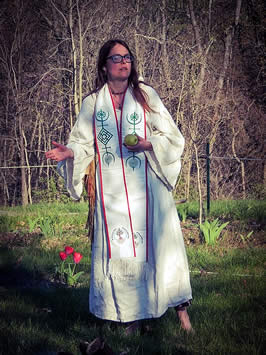
Photo of Melissa Hill courtesy of Rev. Michael J Dangler
I am convinced that practicing a new version of the ancient religions of the Eurasian continent is an honorable path for me and for others. I believe in our ability to come into a true reciprocity with the land and build relationships with the spirits that live where we are without taking anything else from the native peoples of the lands we have found ourselves in. I hope that by doing so we might be able to come into a better, more even relationship with those people, and with other people who have been marginalized in the name of progress. Certainly there are flaws within this method. Ancient people didn’t know a damn thing about post-industrial feminist ethics, peak oil, or the information age. I believe that it’s worth the work of learning our history so that we may improve upon the mistakes they made and use the hard won knowledge of our religious forebears in order to live better.
So, to answer the question: “How do we practice European Indigenous Spiritualities when we don’t live in Europe?”
We build new practices slowly and with persistence. We keep an open and scholarly mind, learning from the best of what archeology, linguistics, anthropology, and sociology have to offer. We learn about the land we find ourselves in: the climate, the flora and fauna, the geology and water patterns. We ask the gods and spirits to reveal themselves in this new land, with new stories, and new ways to give and accept offerings. We record all this and share it with each other, and slowly we build a new way with echoes of the old resonating through us and through the land.
Because this is home, wherever we are. We can’t go back, and we can’t change history. All we can do is live here and now the best way we can and hope to give those who come after us what we have learned so that they might do better yet.

Click here to like
Patheos Pagan on Facebook.

Click here to like
the Agora on Facebook
Dandelion Seeds is published on bi-monthly on the first and third Wednesday. Subscribe via RSS or e-mail!
Please use the links to the right to keep on top of activities here on the Agora as well as across the entire Patheos Pagan channel.
Previous Post
April 29, 2016
Hills of the Horizon: A Defense of Sacred Kingship
Next Post

May 1, 2016 Full Frontal Magic: A Practical Mantra Enchantment
Browse Our Archives
Select a Category A Lakeside Hearth Adventures in Wortcunning Alone In Her Presence Arts, Crafts & Cooking Birthing Hereditary Witchcraft Book of Blackbirds Book Reviews Born-Again Witch Cauldron, Sword, Spear, & Stone Cermony and Liturgy Columns Community Dandelion Seeds Dear Jasmine Druid Thoughts Editor's Picks Everyday Pagan Family & Household Practice Family Traditions Full Frontal Magic Gateway Goddess Guest Articles Happily Heathen Health and Wellness Hearth of Hellenism Heathen Woman Hills of the Horizon History Holidays Horse Goddesses Interfaith Interviews Irish-American Witchcraft Jewish Witch Lamp & Labyrinth Letters from Midgard Literature, Media, Film, Music Loop of Brighid Love, Sex & Relationships Magic or Magick Making Light Naturalistic Traditions Nature News Outside The Circle Pantheisticon Politics Prayers, Poems, Blessings & Stories Queer Femme Mystic Queer of Swords Recipes Ritual and Practice Science and Research Seekers and Guides Seeking the Grail Socially Responsible Magic Spear of Athena Star Made Witch Syncretic Electric Technology The Blooming Staff The Busy Witch The Cartomancer The Crow's Nest The Dance of Pagan Recovery The Hearth of Hellenism The Lady's Quill The Other Side of the Hedge The Path of She The Rantin' Raven The Witches Next Door The Zen Pagan Theology, Ethics, Philosophy Tree City Witch Urban Earthwitch Wayfaring Woman Witch on Fire Wyrd Words
Select a Month January 2026 March 2025 December 2024 June 2024 April 2024 March 2024 January 2024 December 2023 November 2023 October 2023 August 2023 July 2023 May 2023 April 2023 March 2023 February 2023 January 2023 December 2022 November 2022 October 2022 September 2022 August 2022 July 2022 June 2022 May 2022 March 2022 February 2022 January 2022 December 2021 November 2021 October 2021 September 2021 August 2021 July 2021 June 2021 May 2021 April 2021 March 2021 February 2021 January 2021 December 2020 November 2020 October 2020 September 2020 August 2020 July 2020 June 2020 May 2020 April 2020 March 2020 February 2020 January 2020 December 2019 November 2019 October 2019 September 2019 August 2019 July 2019 June 2019 May 2019 April 2019 March 2019 February 2019 January 2019 December 2018 November 2018 October 2018 September 2018 August 2018 July 2018 June 2018 May 2018 April 2018 March 2018 February 2018 January 2018 December 2017 November 2017 October 2017 September 2017 August 2017 July 2017 June 2017 May 2017 April 2017 March 2017 February 2017 January 2017 December 2016 November 2016 October 2016 September 2016 August 2016 July 2016 June 2016 May 2016 April 2016 March 2016 February 2016 January 2016 December 2015 November 2015 October 2015 September 2015 August 2015 July 2015 June 2015 May 2015 April 2015 March 2015 February 2015 January 2015 December 2014 November 2014 October 2014 September 2014 August 2014 July 2014 June 2014 May 2014 April 2014 March 2014 February 2014 January 2014 December 2013 November 2013 October 2013 September 2013 August 2013 July 2013 June 2013 May 2013 April 2013 March 2013 February 2013 January 2013 December 2012 November 2012 October 2012 September 2012 August 2012 July 2012 June 2012 May 2012 April 2012 March 2012 February 2012 January 2012
Follow Us!
TAKE THE
Religious Wisdom Quiz
What famous basilica is in Vatican City?
Select your answer to see how you score.
St. Basil's St. Peter's Basilica St. Paul's Notre Dame
Related posts from Agora

Simple Witchery: To Keep Silent

Simple Witchery: Leaning On The Four Pillars


Simple Witchery: Resistance and Resilience in Hard Times
TRENDING AT PATHEOS Pagan

I was recently chatting with someone on Instagram. She asked me what...

While there are many people who share their results, the end of...

On July 23, I saw Christopher Nolan's The Odyssey which is Homer’s...

As I write this two big events have just finished up. One...

Restoring the Watershed of Divine Love
Perhaps cooperation is not something we manufacture through legislation, ideology, or moral...

Many UUs don’t pray because of bad experiences in a previous religion,...
view all Pagan blogs
Ad-Free & Subscriber Log-In Subscription Support
- About Us
- 2026 Calendar
- Videos
- Podcasts
- Library of World Religions
- Faith In Media Tracker
- Advertise With Us
- Write for Us
- Privacy Policy
- Terms of Service
- Do Not Sell My Data
- Contact Us
- Radiant Digital
- Manage Newsletter Subscriptions
- Unsubscribe From Notifications
- Sitemap
Copyright 2008-2026, Patheos. All rights reserved.
Subscription Support Ad-Free & Subscriber Log-In
Follow Patheos