
BuddhistCatholicContemplativeEvangelicalGeneral ChristianHinduJewishLatter-day SaintMuslimNew VisionsProgressive Christian
Beliefs
- Buddhist
- Catholic
- Contemplative
- Evangelical
- General Christian
- Hindu
- Jewish
- Latter-day Saint
- More Voices
- Muslim
- New Visions
- Pagan
- Progressive Christian
Topics
- Religion News
- Food and Religion
- Sports and Religion
- Religious Art
- Religious Music and Entertainment
- Religious Events
- History and Religion
- Style and Religion
- Politics and Religion
- Women in Religion
- Recreation Outdoors and Religion
- Business Finance and Religion
- Careers Workplace and Religion
- Education and Religion
- Family Parenting and Religion
- Health Fitness and Religion
- Home and Religion
- Relationships and Religion
- Technology and Religion
- Travel and Religion
Columnists
- Buddhist Columnists
- Business Finance and Religion Columnists
- Careers Workplace and Religion Columnists
- Catholic Columnists
- Contemplative Columnists
- Education and Religion Columnists
- Evangelists Columnists
- Family Parenting and Religion Columnists
- General Christian Columnists
- Health Fitness and Religion Columnists
- Hindu Columnists
- History and Religion Columnists
- Home and Religion Columnists
- Jewish Columnists
- More Voices Columnists
- Latter Day Columnists
- Muslim Columnists
- New Visions Columnists
- Nonreligious Columnists
- Pagan Columnists
- Politics and Religion Columnists
- Progressive Columnists
- Recreation Outdoors and Religion Columnists
- Relationships and Religion Columnists
- Religion News Columnists
- Religious Art Columnists
- Religious Events Columnists
- Religious Music and Entertainment Columnists
- Sports and Religion Columnists
- Style and Religion Columnists
- Technology and Religion Columnists
- Travel and Religion Columnists
- Women in Religion Columnists
Resource Library
- 2026 Calendar
- Library of World Religions
- The 100 Most Holy Places on Earth
- Patheos Answers
- Podcasts
- Videos
- Faith Leaders Database
- Anglican Episcopalian
- Bahai
- Baptist
- Buddhism
- Christianity
- Confucianism
- Eastern Orthodoxy
- Hinduism
- Holiness and Pentecostal
- ISKCON
- Islam
- Judaism
- Lutheran
- Methodist
- The Church of Jesus Christ of Latter-day Saints
- New Age
- Paganism
- Presbytarian and Reformed
- Protestantism
- Religion Behind the Scenes
- Roman Catholic
- Scientology
- Shia Islam
- Sikhism
- Sufism
- Sunni Islam
- Taoism
- Zen
- See all religions
Research Tools
 Ad-Free & Subscriber Log-In Subscription Support
Ad-Free & Subscriber Log-In Subscription Support
Follow Patheos 

- Trending:
- Forgiveness
- |
- Marriage
- |
- Consciousness
- |
- Death Penalty
- |
- Election
- |
- Halloween

- Home
- Pagan
- The Cartomancer: “Know Thyself,” but what does it really mean?
The Cartomancer: “Know Thyself,” but what does it really mean?
Last updated on: March 15, 2016 at 8:56 pm by Camelia Elias
The Cartomancer: “Know Thyself,” but what does it really mean? 2016-03-15T20:56:58+00:00 Camelia Elias
Patheos Explore the world's faith through different perspectives on religion and spirituality! Patheos has the views of the prevalent religions and spiritualities of the world.
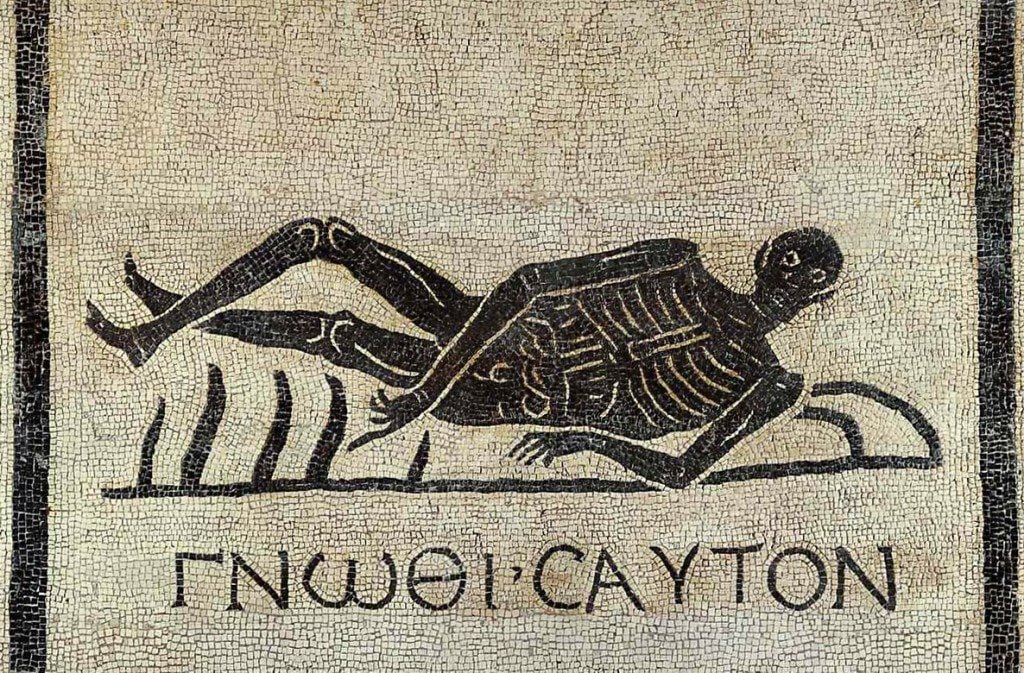
Roman mosaic: Know Thyself. CC0, Public Domain
Today I felt like asking the cards the following question: What’s up with the “Know Thyself” project that’s associated with the oracle at Delphi? This oracular saying, inscribed at the entrance to the temple of Apollo, has both fascinated people and given them something to fear, the implicit statement being one of warning: “Know Thyself”, or else… But what does it mean?
I asked my cards, as I don’t have the time to launch into an ancient discussion that keeps changing form and content all according to the general public opinion shifting faster than the wind.
The Empress, The Pope, The Sun Showed Up
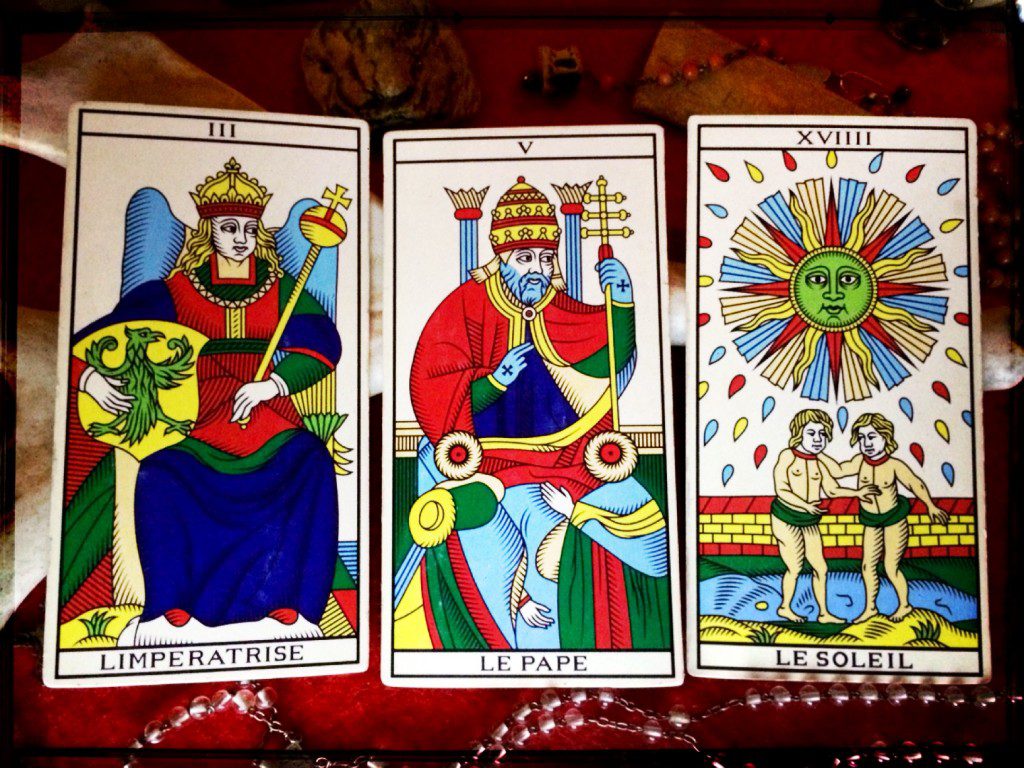
Marseille Tarot, Editions Millenium, Wilfried Houdoin (Photo: Camelia Elias)
The imperial woman commands. The man of church instructs. And the naked ones play.
Well, that’s a good message, especially the part that suggests ditching your clothes, culture, and couture. Welcome to the realm of relations. The woman of power has her eyes on the preacher whose eyes are on the sun. How close is she to that illumination? Some stripping is required. The children always get there first. “Be like the children,” Jesus said. “Go back to your fairytales,” the modern shamans say. The light from the sun just happens everyday. It cares little about you.
I like this as it aligns with my Zen Buddhist, nondualist orientation of the non-essentialist and non-absolutist direction. Phew, I said it, whatever it means. The bottom line is pretty simple though: There is no identity, only language about it. An emblem on your shield. But language is not reality.
What is reality? Reality is life as it happens completely independently of what we think of it. Reality is the experience of the now, the now such as it is, its truth always running naked under the sun, independent of cultural modifications through quantifiers, qualifiers, evaluations, measurements, conclusions, and delusions.
Ah, the warmth… At least the Pope is wearing gloves while holding on to his staff. What would they look like, without their clothes, The Empress and the Pope? They would just be. They would not be that, a function of their professions. The Sun knows what the truth is.
Know thy Classics
But let’s have a quick look. The classical view on the maxim “Know Thyself” associates it with the notion of temperance, suggesting a relational process of being in the world that doesn’t lead to things blowing up in your face, or making your hands sweat from holding your possessions too tight (see the 10th-century Byzantine encyclopaedia, Suda).
To begin with, there is no “YOU” to blow up, as “you” are part of a web of connections. Whoever holds your possessions is not “you.” They are there by virtue of grace and faith and all the other intangibles that you wish were concrete. Hence it makes sense that in the classical view we have balance in focus, not the self.
I’m interested in this view to the extent that it doesn’t presuppose that the “Know Thyself” anthem is an ode to the self, but rather a song of connection. That is to say, insofar as “you” are everything already, both the connection and the connector – or in more contemporary scientific parlance, you are both the observer and the observed – there are no self-oriented worries or identity crisis to be concerned with. If you want illumination, go straight to the sun, and let it happen. That’s where we’re always at. We don’t negotiate for awareness. We’re in it as naked as in our hearts.
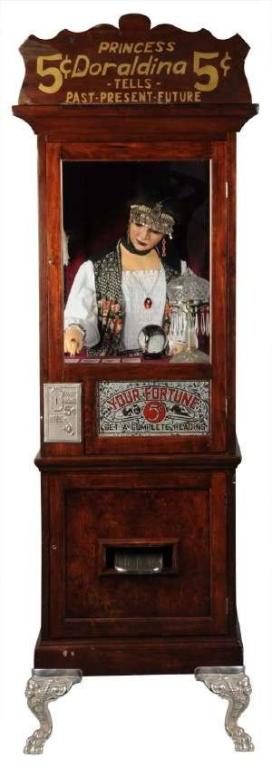
Image source: Pinterest
… And thy Time
At the other end of the spectrum, we find the “Know Thyself” maxim as a manifestation of personal effort and individual expression. In our contemporary setting, “Know Thyself” has become a currency you can exchange at the spiritual supermarket. A fortunetelling dispenser: In goes a coin, and out pops a self.
What the Oracle Says
But here’s what I think: The reason why I personally live with oracles is not because they supposedly give me access to life’s mysteries, but because they function as a constant reminder of how my “self” is never more than a thought.
I use oracles in the form of divination with the cards, bibliomancy, runes, the casting of bones and other such devices because they help me destabilize my “self.” All the time.
As soon as I think, “hmmm, I’m so clever today, I feel like a true magician,” the cards say, “think again.” Or better yet, “stop thinking, for today, today you’re Death.”
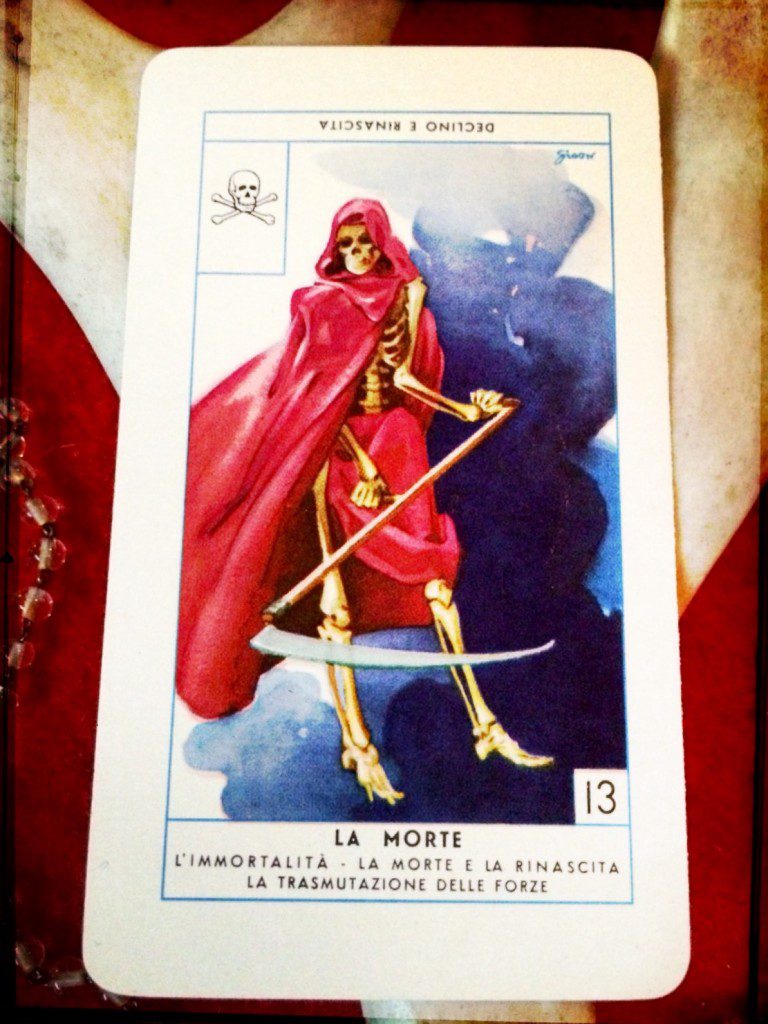
Cartomanzia 184, Trieste, 1955 (Photo: Camelia Elias)
Indeed, how many times do we say that every time we lay down three cards a new story emerges? This includes the story of the self. But why must the enunciation of I AM be followed by THAT? – as some nondualist masters have asked – and hence require constant packing and unpacking? New clothes all the time, some the famous Emperor’s New Clothes, the “no clothes,” but still clothes, invisible as they were in the fairytale of all fairytales about the self, for THAT emperor also suffered from the delusion of identity and self-affirmation: “I am the Emperor, even though I’m naked.” Yep. That one knew himself.
The cards can tell a story about anything, particularly about the mythologized self. The ever booming card industry participates eagerly in charting the Fool’s Journey, or that of the Hero with a Thousand Faces. But ME, however enchantedly crafted, is still just that, a story, a cloud as cold as the blade in Death’s hands. As this is a fact that’s incontestable, ask yourselves this question: To what extent does it actually make sense to think of the cards as tools for teaching you about the self? What self?
Test Thyself – Not
In my teachings on how to read cards with view to getting inspiration on how we can concretely and coherently solve a problem, I run personality tests. Not because I’m interested in human nature, but because I’m interested in freedom.
The underlying teaching in the test is about getting people to free themselves from their fears and desires. With your attention liberated from worries about the self – which does not exist other than as a story in your head – you can do many more things, like nothing, just breathing, and celebrating life as it happens. You can approach others from a position that’s completely devoid of self-interest, judgment, and personal involvement. That’s the space where I find true compassion, the space that’s empty of the delusions of the mind and its related concepts of the self and other.
Read thy Nothing
In this sense, reading cards for me is very much an exercise in recalibrating my focus. It helps to know when I Am. . . the Empress, the Hermit, the Star, or Temperance, for as soon as I see those possibilities articulated in the visual imagery of the cards, I bring my focus back to the awareness of “no such thing” beyond story level, beyond thought level. I liberate myself of self-manifestations.
This allows me to start my days with a good laugh. As I look into the mirror, or the cards reflecting back at “me”, I laugh at the idea of “myself.” I laugh and laugh and laugh at myself until I get a bellyache. This laughter ensures that whatever comes my way during the day will be received just as it presents itself to me in all its forms. I may have an opinion about what comes my way, I may be happy for it, or I may even be appalled or enraged, but I try to never get involved.
This is simply because I practice seeing the truth, seeing things as they really are; seeing how everything else in the face of impermanence is nothing and amounts to nothing. This “nothing” is not the negation of existence, as some would have it. Quite the contrary. It is a celebration of it.
What we think we are is exactly that, a thought, not reality. Our identity is not what we make of it, or how we cling to it. Reality is whatever stares us in the face the moment we see things as they really are, the moment we can penetrate the most impenetrable mystery, which is always the obvious. As soon as we grasp this simple truth, that there is no ME, we are quite free of having to devise strategies for the SELF, and how to make this “self” happy.
This is what I urge others to do with their cards. Seek the obvious, not the self. Bathe in that impenetrable mystery, and see how the obvious leaves your skin. As smooth and shiny as the illuminations from the sun.
Thyself, a Poet
Here is a small practice: Next time you come across this line, “Know Thyself,” think of nothing. You are nothing, so there’s nothing to know. Go out. Smell a flower. Stay together. If it rains, open your mouth and taste the water. Stand there in the wind, or the warmth of the sun.
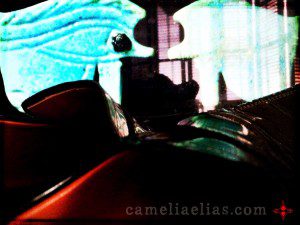
Photo: Camelia Elias
When you’re done, go home. Feel the realization of how blissful and peaceful you can be, when you’re empty of fear, desire, envy, rage, addiction, and aversion.
Place your shoes on your altar, and venerate your feet. Light a candle. Your thoughts, vanished without a trace in the night, leave your yearning for the Absolute and Divine Love disfigured. Stand there, naked and transformed, and sing a song to your penetrating eye.
§
For penetrating vision, join my free newsletter. All cool stuff.

Click here to like
Patheos Pagan on Facebook.

Click here to like
the Agora on Facebook
The Cartomancer is published bi-monthly on the second and fourth Wednesday here on the Agora. Subscribe via RSS or e-mail!
Please use the links to the right to keep on top of activities here on the Agora as well as across the entire Patheos Pagan channel.

Next Post
March 10, 2016 The Lady's Quill: Religious Virtues and Gods
Browse Our Archives
Select a Category A Lakeside Hearth Adventures in Wortcunning Alone In Her Presence Arts, Crafts & Cooking Birthing Hereditary Witchcraft Book of Blackbirds Book Reviews Born-Again Witch Cauldron, Sword, Spear, & Stone Cermony and Liturgy Columns Community Dandelion Seeds Dear Jasmine Druid Thoughts Editor's Picks Everyday Pagan Family & Household Practice Family Traditions Full Frontal Magic Gateway Goddess Guest Articles Happily Heathen Health and Wellness Hearth of Hellenism Heathen Woman Hills of the Horizon History Holidays Horse Goddesses Interfaith Interviews Irish-American Witchcraft Jewish Witch Lamp & Labyrinth Letters from Midgard Literature, Media, Film, Music Loop of Brighid Love, Sex & Relationships Magic or Magick Making Light Naturalistic Traditions Nature News Outside The Circle Pantheisticon Politics Prayers, Poems, Blessings & Stories Queer Femme Mystic Queer of Swords Recipes Ritual and Practice Science and Research Seekers and Guides Seeking the Grail Socially Responsible Magic Spear of Athena Star Made Witch Syncretic Electric Technology The Blooming Staff The Busy Witch The Cartomancer The Crow's Nest The Dance of Pagan Recovery The Hearth of Hellenism The Lady's Quill The Other Side of the Hedge The Path of She The Rantin' Raven The Witches Next Door The Zen Pagan Theology, Ethics, Philosophy Tree City Witch Urban Earthwitch Wayfaring Woman Witch on Fire Wyrd Words
Select a Month January 2026 March 2025 December 2024 June 2024 April 2024 March 2024 January 2024 December 2023 November 2023 October 2023 August 2023 July 2023 May 2023 April 2023 March 2023 February 2023 January 2023 December 2022 November 2022 October 2022 September 2022 August 2022 July 2022 June 2022 May 2022 March 2022 February 2022 January 2022 December 2021 November 2021 October 2021 September 2021 August 2021 July 2021 June 2021 May 2021 April 2021 March 2021 February 2021 January 2021 December 2020 November 2020 October 2020 September 2020 August 2020 July 2020 June 2020 May 2020 April 2020 March 2020 February 2020 January 2020 December 2019 November 2019 October 2019 September 2019 August 2019 July 2019 June 2019 May 2019 April 2019 March 2019 February 2019 January 2019 December 2018 November 2018 October 2018 September 2018 August 2018 July 2018 June 2018 May 2018 April 2018 March 2018 February 2018 January 2018 December 2017 November 2017 October 2017 September 2017 August 2017 July 2017 June 2017 May 2017 April 2017 March 2017 February 2017 January 2017 December 2016 November 2016 October 2016 September 2016 August 2016 July 2016 June 2016 May 2016 April 2016 March 2016 February 2016 January 2016 December 2015 November 2015 October 2015 September 2015 August 2015 July 2015 June 2015 May 2015 April 2015 March 2015 February 2015 January 2015 December 2014 November 2014 October 2014 September 2014 August 2014 July 2014 June 2014 May 2014 April 2014 March 2014 February 2014 January 2014 December 2013 November 2013 October 2013 September 2013 August 2013 July 2013 June 2013 May 2013 April 2013 March 2013 February 2013 January 2013 December 2012 November 2012 October 2012 September 2012 August 2012 July 2012 June 2012 May 2012 April 2012 March 2012 February 2012 January 2012
Follow Us!
TAKE THE
Religious Wisdom Quiz
Who was King Zedekiah, and what did he do to anger God and ensure Jerusalem's fall?
Select your answer to see how you score.
He killed Jeremiah He rebelled against Babylon He burned the scroll He built an idol
Related posts from Agora

Simple Witchery: To Keep Silent

Simple Witchery: Leaning On The Four Pillars

Pergamum Unfurled: Magic with the Greek Gods (Book...

Pergamum Unfurled: Cunning Words (Review)
TRENDING AT PATHEOS Pagan

I was recently chatting with someone on Instagram. She asked me what...

While there are many people who share their results, the end of...

On July 23, I saw Christopher Nolan's The Odyssey which is Homer’s...

As I write this two big events have just finished up. One...

Restoring the Watershed of Divine Love
Perhaps cooperation is not something we manufacture through legislation, ideology, or moral...

Many UUs don’t pray because of bad experiences in a previous religion,...
view all Pagan blogs
Ad-Free & Subscriber Log-In Subscription Support
- About Us
- 2026 Calendar
- Videos
- Podcasts
- Library of World Religions
- Faith In Media Tracker
- Advertise With Us
- Write for Us
- Privacy Policy
- Terms of Service
- Do Not Sell My Data
- Contact Us
- Radiant Digital
- Manage Newsletter Subscriptions
- Unsubscribe From Notifications
- Sitemap
Copyright 2008-2026, Patheos. All rights reserved.
Subscription Support Ad-Free & Subscriber Log-In
Follow Patheos