
BuddhistCatholicContemplativeEvangelicalGeneral ChristianHinduJewishLatter-day SaintMuslimNew VisionsProgressive Christian
Beliefs
- Buddhist
- Catholic
- Contemplative
- Evangelical
- General Christian
- Hindu
- Jewish
- Latter-day Saint
- More Voices
- Muslim
- New Visions
- Pagan
- Progressive Christian
Topics
- Religion News
- Food and Religion
- Sports and Religion
- Religious Art
- Religious Music and Entertainment
- Religious Events
- History and Religion
- Style and Religion
- Politics and Religion
- Women in Religion
- Recreation Outdoors and Religion
- Business Finance and Religion
- Careers Workplace and Religion
- Education and Religion
- Family Parenting and Religion
- Health Fitness and Religion
- Home and Religion
- Relationships and Religion
- Technology and Religion
- Travel and Religion
Columnists
- Buddhist Columnists
- Business Finance and Religion Columnists
- Careers Workplace and Religion Columnists
- Catholic Columnists
- Contemplative Columnists
- Education and Religion Columnists
- Evangelists Columnists
- Family Parenting and Religion Columnists
- General Christian Columnists
- Health Fitness and Religion Columnists
- Hindu Columnists
- History and Religion Columnists
- Home and Religion Columnists
- Jewish Columnists
- More Voices Columnists
- Latter Day Columnists
- Muslim Columnists
- New Visions Columnists
- Nonreligious Columnists
- Pagan Columnists
- Politics and Religion Columnists
- Progressive Columnists
- Recreation Outdoors and Religion Columnists
- Relationships and Religion Columnists
- Religion News Columnists
- Religious Art Columnists
- Religious Events Columnists
- Religious Music and Entertainment Columnists
- Sports and Religion Columnists
- Style and Religion Columnists
- Technology and Religion Columnists
- Travel and Religion Columnists
- Women in Religion Columnists
Resource Library
- 2026 Calendar
- Library of World Religions
- The 100 Most Holy Places on Earth
- Patheos Answers
- Podcasts
- Videos
- Faith Leaders Database
- Anglican Episcopalian
- Bahai
- Baptist
- Buddhism
- Christianity
- Confucianism
- Eastern Orthodoxy
- Hinduism
- Holiness and Pentecostal
- ISKCON
- Islam
- Judaism
- Lutheran
- Methodist
- The Church of Jesus Christ of Latter-day Saints
- New Age
- Paganism
- Presbytarian and Reformed
- Protestantism
- Religion Behind the Scenes
- Roman Catholic
- Scientology
- Shia Islam
- Sikhism
- Sufism
- Sunni Islam
- Taoism
- Zen
- See all religions
Research Tools
 Ad-Free & Subscriber Log-In Subscription Support
Ad-Free & Subscriber Log-In Subscription Support
Follow Patheos 

- Trending:
- Forgiveness
- |
- Marriage
- |
- Consciousness
- |
- Death Penalty
- |
- Election
- |
- Halloween

- Home
- Pagan
- Birthing Hereditary Witchcraft: Why Your Family Coven Should Watch THE PASSION and How
Birthing Hereditary Witchcraft: Why Your Family Coven Should Watch THE PASSION and How
Last updated on: March 17, 2016 at 4:00 pm by Lydia MN Crabtree
Birthing Hereditary Witchcraft: Why Your Family Coven Should Watch THE PASSION and How 2016-03-16T11:53:02+00:00 Lydia MN Crabtree
Patheos Explore the world's faith through different perspectives on religion and spirituality! Patheos has the views of the prevalent religions and spiritualities of the world.
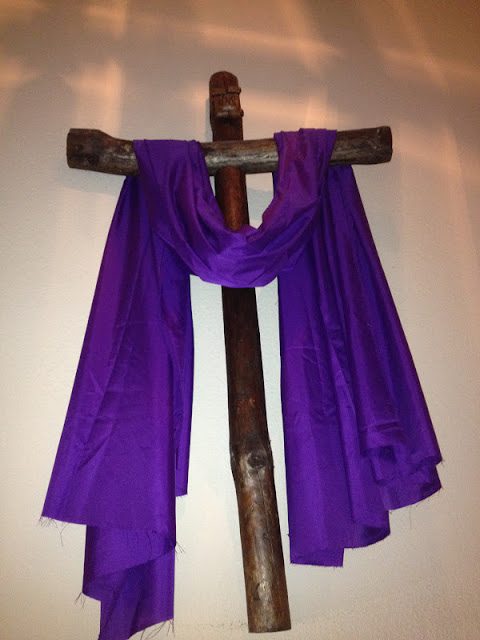
The purple drape on a cross is related to the idea that in Jesus Christ’s day, purple was to be worn by royalty only. This symbol then says, “Jesus Christ is King of Kings.”
This Sunday, March 20, 2016 at 8 PM EST on Fox The Passion, A Musical, will portray the story of Jesus Christ from his last supper, to betrayal by Judas, to trial, conviction and crucifixion. I think as a Pagan parent you should watch it.
Here is the thing: your child is being raised in a society dominated by Christianity. You have an opportunity to watch an entertaining show and discuss the religious meaning behind that show so that your child receives an inoculation against rigid Christian indoctrination in the future.
An inoculation against rigid Christian indoctrination is the best way to ensure that you have raised a child who is tolerant and open minded. Through deliberate exposure to Christian ideals you can introduce inoculating truths. As Pagans, we often complain about the lack of understanding by others about our religion. How much effort, however, do we put into understanding other religions?
Below, I am going to explain the story of The Passion and Jesus Christ and some inoculating ideas you can introduce. This piece ends with questions you can ask to start conversation with your children. Please don’t let age limit your discussion with your children. Be willing to ask these questions to any age and see what answers come back, you might be surprised.
Inoculating Idea: The Jesus Story is a Myth
What Christians tell the under-educated is that the Jesus Christ story is real and true and accurate and actually happened. Most adults who have only been exposed to Christianity have never encountered the idea that the Christ myth is a myth, a myth that we can find in many different religions and cultures throughout history. Although the Christ Myth in Christianity has enjoyed a popularity not experienced by other Christ myths, it is still one of the many myths of a dying God or King who is resurrected on the third day and whose death is seen as a sacrifice so that others do not have to sacrifice.
The Jesus Christ Story Portrayed in the Passion Follows a Specific Plot with Alleged Spiritual Implications
Christians believe that all of us are born into sin. Sin is a condition of having been born. Paganism sees human nature as neutral at birth – we are neither bad nor good as a baby, we are a baby. As we grow, we determine what our values, ethics, and morals will be. We are limited only by the confines of the natural order into which we have been born. This is an inoculating idea: that sin is not a condition we are born into.
Because Christians believe we are born into sin, they believe there must be a sacrifice–a blood sacrifice–to overcome the taint of sinning. In the Old Testament of the Bible, these sacrifices were cattle, birds, and other animals ritually slaughtered as a blood offering to God, The Father. In the Old Testament a prophecy predicted the birth of a man whose father was God, whose mother was a virgin, and who would die and be the final blood sacrifice so that the slaughtering of animals was no longer needed.

Ecce homo By Antonio Ciseri – http://www.most-famous-paintings.org/Ecce-Homo-large.html, Public Domain via Wikimedia Commons
This sets up the plot and spiritual path of Christianity.
- Jesus is born of a Virgin Mary
- Jesus lives his entire life (33 years) without ever sinning. He never lied to his mother. He never swore. He never broke any of the ten commandments of the Old Testament.
- Jesus performs miracles and galvanizes both Jews and Gentiles (i.e. people who were not Jewish).
- This angers the state, depicted by Pontius Pilate, who sees Jesus as a threat to the authority of the state and also sees Jesus destabilizing the status quo of the Jewish Community.
- Judas, a disciple of Jesus, betrays him to Pontius Pilate and Jesus knew he would and wanted him to. Jesus knew he was the final blood sacrifice that fulfilled the prophecy of the Old Testament.
- Jesus stands trial and remains without sin (or blameless).
- Jesus is beaten and crucified.
- Jesus raises on the third day from the sealed tomb.
- Jesus ascends into heaven.
- Because of his sacrifice, Christians believe that only the belief in Jesus is necessary to obtain heaven and avoid hell.
Problems with Christian Doctrine: More Inoculating Ideas
Interpretation is a problem with Christianity. Is hell simply a separation from God or a fiery pit of endless torture and pain? Depends on which Christian sect you talk with. If Jesus is the final sacrifice, then are the laws of the Old Testament supposed to be followed anymore? Depends on the Christian denomination you follow. Was Jesus Christ an actual person or a myth? Depends on the type of Christianity you follow.
This all comes down to interpretation. Each denomination and sect of Christianity will interpret the specific meanings of the events in The Passion a little differently, to say nothing of the differences between Protestant doctrine and Catholic doctrine.
Free will versus predestination is another important issue in Christianity. The majority of protestant churches will say that humankind has the ability to accept or reject Jesus Christ. It is this acceptance or rejection that determines their afterlife: heaven or hell. Further, they believe that once Jesus Christ has been accepted by a person it will change them radically. This is called the conversion experience through salvation. Salvation means that Jesus Christ died for everyone’s sins so that individuals would not have to. By accepting Jesus Christ and believing only in his myth, you are converted to Christianity. On the other hand, there are some protestant sects who believe that God’s Chosen People were predestined upon birth. Often these groups see baptism as the ticket to secure this predestination.

The divine nature of God is another issue Christianity must face. If God (which in the New Testament is seen as a three-part being called God the Father, Jesus Christ, and the Holy Spirit), is all powerful, all knowing and is a part of everything, then where does evil come from? For Evangelicals, evil is manifested in the story of Lucifer or Satan. They visualize an angel that has chosen to fall from grace and rebel against God’s divinely good nature. All sin and evil are rooted in Satan. Interestingly, some also say that God is not divinely good. Just like in the Old Testament, God is judgmental and will cause horrible things to happen to those who do not live within the will of God. They believe not only will bad things be forced upon wicked people after death, but they believe that bad things will happen to wicked people in life.
Conversely, good people will prosper. This is part of a very popular movement called Prosperity Teaching or Prosperity Gospel. It teaches that if you are a good Christian then God will give you money in relationship to how much money you give. As the song taught to children goes, “Read your Bible, Pray Every Day, And You’ll Grow Grow Grow [your bank account].”
What Paganism Says about Christianity
Generally speaking, Paganism answers Christianity with alternate opinions on everything. Jesus Christ can be an actual god to some Pagans, in the same way that Buddha and Odin are gods. To other Pagans, Jesus Christ is a mythical representation of the sacrificial god like the Oak and Holly King Myth. Because Paganism isn’t hung up on The Bible being the ONLY sacred text, many Pagans will agree with things in the Bible that mirror other sacred texts like “love thy neighbor” which is an almost universal teaching throughout all religious paths.
Pagans will argue about free will and predestination, too. Some will say that you are born predestined to be a witch and some will say you make that choice. However, most Pagans will not see this argument as very important in the grand scheme of things.
Evil, though, is viewed very differently. As I have already said, Pagans see babies as babies – neither good nor evil, just born. Like the wild wood that is dangerous but not evil or the raging storm that is deadly but not evil, Pagans have learned that good and bad simply exist as two sides of the coin of life. There is no judgement attached to the existence of either. Sometimes thing burn, wind blows, water flows, the earth moves. These things just happened and do not have to be because some divine being got angry or because a person wasn’t “good” enough.
Paganism is highly attached to the idea of personal responsibility and consequences. Sometimes bad things happen because a person has created a situation for the bad thing. For example, someone who robs stores on a regular basis eventually gets shot by a store owner. The consequence of stealing was death and in Paganism this is seen as one of the potential outcomes of that behavior. However, even the most personally responsible human being in the world may still have unfortunate things happen to them because that is a law of nature and not a judgement on the nature of that human.
Pagans interrupt prayer as a type of energy work in the same vein as spells. Pagans would say that when you pray you are sending energy into the universe and that energy is affecting the change. Christians will attribute these changes to God and Pagans would attribute these changes to a combination of personal power, God, and the Universal Laws of Magick.
The Conversion Experience can happen in Paganism too, typically this is a time of connection with Divinity. For Pagans, this experience doesn’t have to be relegated to one singular event, it can be experienced over and over through trance, ritual and meditation. The Conversion Experience is understood by most Pagans to be a significant spiritual event that is not unique to Christianity. Christians would most likely disagree.
Discussion Questions for Family Covens After The Passion

Monkey Business Images / Shutterstock.com
I would ask these questions without judgement. The idea is to simply discuss and explore.
- Do you think humans need salvation?
- Do you think there is only one god?
- Do you think that if you don’t believe in Christianity you will go to hell? What do you think hell is like and why?
- If Christianity is the only religion – then does that mean Jesus Christ wants everyone else go to hell?
- Should there be separation between Church and State? Why or why not?
- Where do you go when you die?
- Tornadoes, hurricanes, lightening – acts of the gods or natural occurrences? Why?
- What would you say if someone asked you if you had “accepted Jesus Christ into your heart” or had a conversion experience? Can Pagans have conversion experiences?
- What is prayer? Energy? Spell? A request made to a greater being? All of the above?
- What is something good about Christianity?
- What is something bad about Christianity?
- What is something good about Paganism?
- What is something bad about Paganism?
The best way to avoid raising radical religious zealots is to encourage independent thinking while providing exposure to as many different religious ideas with equal voracity. Watching The Passion provides an opportunity to give exposure to Christian ideals while ensuring that you have the ability to provide inoculation against mindless acceptance of one religious path over another. Like all inoculations though, this is optional, and the disease you risk your child catching is radical religious righteousness that may have terrible lifelong consequences for you and your family coven.

Click here to like
Patheos Pagan on Facebook.

Click here to like
the Agora on Facebook
Birthing Hereditary Witchcraft is published occasionally on Agora. Subscribe via RSS or e-mail!
Please use the links to the right to keep on top of activities here on the Agora as well as across the entire Patheos Pagan channel.
Birthing Hereditary Witchcraft
Previous Post

March 16, 2016
Dandelion Seeds: Leadership When Leading gets Nasty
Next Post
March 18, 2016 Adventures in Wortcunning: A Little Help-er
Browse Our Archives
Select a Category A Lakeside Hearth Adventures in Wortcunning Alone In Her Presence Arts, Crafts & Cooking Birthing Hereditary Witchcraft Book of Blackbirds Book Reviews Born-Again Witch Cauldron, Sword, Spear, & Stone Cermony and Liturgy Columns Community Dandelion Seeds Dear Jasmine Druid Thoughts Editor's Picks Everyday Pagan Family & Household Practice Family Traditions Full Frontal Magic Gateway Goddess Guest Articles Happily Heathen Health and Wellness Hearth of Hellenism Heathen Woman Hills of the Horizon History Holidays Horse Goddesses Interfaith Interviews Irish-American Witchcraft Jewish Witch Lamp & Labyrinth Letters from Midgard Literature, Media, Film, Music Loop of Brighid Love, Sex & Relationships Magic or Magick Making Light Naturalistic Traditions Nature News Outside The Circle Pantheisticon Politics Prayers, Poems, Blessings & Stories Queer Femme Mystic Queer of Swords Recipes Ritual and Practice Science and Research Seekers and Guides Seeking the Grail Socially Responsible Magic Spear of Athena Star Made Witch Syncretic Electric Technology The Blooming Staff The Busy Witch The Cartomancer The Crow's Nest The Dance of Pagan Recovery The Hearth of Hellenism The Lady's Quill The Other Side of the Hedge The Path of She The Rantin' Raven The Witches Next Door The Zen Pagan Theology, Ethics, Philosophy Tree City Witch Urban Earthwitch Wayfaring Woman Witch on Fire Wyrd Words
Select a Month January 2026 March 2025 December 2024 June 2024 April 2024 March 2024 January 2024 December 2023 November 2023 October 2023 August 2023 July 2023 May 2023 April 2023 March 2023 February 2023 January 2023 December 2022 November 2022 October 2022 September 2022 August 2022 July 2022 June 2022 May 2022 March 2022 February 2022 January 2022 December 2021 November 2021 October 2021 September 2021 August 2021 July 2021 June 2021 May 2021 April 2021 March 2021 February 2021 January 2021 December 2020 November 2020 October 2020 September 2020 August 2020 July 2020 June 2020 May 2020 April 2020 March 2020 February 2020 January 2020 December 2019 November 2019 October 2019 September 2019 August 2019 July 2019 June 2019 May 2019 April 2019 March 2019 February 2019 January 2019 December 2018 November 2018 October 2018 September 2018 August 2018 July 2018 June 2018 May 2018 April 2018 March 2018 February 2018 January 2018 December 2017 November 2017 October 2017 September 2017 August 2017 July 2017 June 2017 May 2017 April 2017 March 2017 February 2017 January 2017 December 2016 November 2016 October 2016 September 2016 August 2016 July 2016 June 2016 May 2016 April 2016 March 2016 February 2016 January 2016 December 2015 November 2015 October 2015 September 2015 August 2015 July 2015 June 2015 May 2015 April 2015 March 2015 February 2015 January 2015 December 2014 November 2014 October 2014 September 2014 August 2014 July 2014 June 2014 May 2014 April 2014 March 2014 February 2014 January 2014 December 2013 November 2013 October 2013 September 2013 August 2013 July 2013 June 2013 May 2013 April 2013 March 2013 February 2013 January 2013 December 2012 November 2012 October 2012 September 2012 August 2012 July 2012 June 2012 May 2012 April 2012 March 2012 February 2012 January 2012
Follow Us!
TAKE THE
Religious Wisdom Quiz
Who taught Apollos about the gospel of Jesus Christ.
Select your answer to see how you score.
Paul Aquila and Priscilla Barnabas Timothy
Related posts from Agora

Simple Witchery: To Keep Silent

Simple Witchery: Leaning On The Four Pillars

Pergamum Unfurled: Magic with the Greek Gods (Book...

Pergamum Unfurled: Cunning Words (Review)
TRENDING AT PATHEOS Pagan

I was recently chatting with someone on Instagram. She asked me what...

While there are many people who share their results, the end of...

On July 23, I saw Christopher Nolan's The Odyssey which is Homer’s...

As I write this two big events have just finished up. One...

Restoring the Watershed of Divine Love
Perhaps cooperation is not something we manufacture through legislation, ideology, or moral...

Many UUs don’t pray because of bad experiences in a previous religion,...
view all Pagan blogs
Ad-Free & Subscriber Log-In Subscription Support
- About Us
- 2026 Calendar
- Videos
- Podcasts
- Library of World Religions
- Faith In Media Tracker
- Advertise With Us
- Write for Us
- Privacy Policy
- Terms of Service
- Do Not Sell My Data
- Contact Us
- Radiant Digital
- Manage Newsletter Subscriptions
- Unsubscribe From Notifications
- Sitemap
Copyright 2008-2026, Patheos. All rights reserved.
Subscription Support Ad-Free & Subscriber Log-In
Follow Patheos