
BuddhistCatholicContemplativeEvangelicalGeneral ChristianHinduJewishLatter-day SaintMuslimNew VisionsProgressive Christian
Beliefs
- Buddhist
- Catholic
- Contemplative
- Evangelical
- General Christian
- Hindu
- Jewish
- Latter-day Saint
- More Voices
- Muslim
- New Visions
- Pagan
- Progressive Christian
Topics
- Religion News
- Food and Religion
- Sports and Religion
- Religious Art
- Religious Music and Entertainment
- Religious Events
- History and Religion
- Style and Religion
- Politics and Religion
- Women in Religion
- Recreation Outdoors and Religion
- Business Finance and Religion
- Careers Workplace and Religion
- Education and Religion
- Family Parenting and Religion
- Health Fitness and Religion
- Home and Religion
- Relationships and Religion
- Technology and Religion
- Travel and Religion
Columnists
- Buddhist Columnists
- Business Finance and Religion Columnists
- Careers Workplace and Religion Columnists
- Catholic Columnists
- Contemplative Columnists
- Education and Religion Columnists
- Evangelists Columnists
- Family Parenting and Religion Columnists
- General Christian Columnists
- Health Fitness and Religion Columnists
- Hindu Columnists
- History and Religion Columnists
- Home and Religion Columnists
- Jewish Columnists
- More Voices Columnists
- Latter Day Columnists
- Muslim Columnists
- New Visions Columnists
- Nonreligious Columnists
- Pagan Columnists
- Politics and Religion Columnists
- Progressive Columnists
- Recreation Outdoors and Religion Columnists
- Relationships and Religion Columnists
- Religion News Columnists
- Religious Art Columnists
- Religious Events Columnists
- Religious Music and Entertainment Columnists
- Sports and Religion Columnists
- Style and Religion Columnists
- Technology and Religion Columnists
- Travel and Religion Columnists
- Women in Religion Columnists
Resource Library
- 2026 Calendar
- Library of World Religions
- The 100 Most Holy Places on Earth
- Patheos Answers
- Podcasts
- Videos
- Faith Leaders Database
- Anglican Episcopalian
- Bahai
- Baptist
- Buddhism
- Christianity
- Confucianism
- Eastern Orthodoxy
- Hinduism
- Holiness and Pentecostal
- ISKCON
- Islam
- Judaism
- Lutheran
- Methodist
- The Church of Jesus Christ of Latter-day Saints
- New Age
- Paganism
- Presbytarian and Reformed
- Protestantism
- Religion Behind the Scenes
- Roman Catholic
- Scientology
- Shia Islam
- Sikhism
- Sufism
- Sunni Islam
- Taoism
- Zen
- See all religions
Research Tools
 Ad-Free & Subscriber Log-In Subscription Support
Ad-Free & Subscriber Log-In Subscription Support
Follow Patheos 

- Trending:
- Forgiveness
- |
- Marriage
- |
- Consciousness
- |
- Death Penalty
- |
- Election
- |
- Halloween

- Home
- Pagan
- Happily Heathen: Frithweaving At Yule – A Heathen ADF Ritual For Frigga And Freyr
Happily Heathen: Frithweaving At Yule – A Heathen ADF Ritual For Frigga And Freyr
Last updated on: December 25, 2015 at 5:00 pm by Cara Freyasdaughter
Happily Heathen: Frithweaving At Yule – A Heathen ADF Ritual For Frigga And Freyr 2015-12-25T13:56:34+00:00 Cara Freyasdaughter
Patheos Explore the world's faith through different perspectives on religion and spirituality! Patheos has the views of the prevalent religions and spiritualities of the world.
The Coziness that is the Yule Season
Modern Heathens celebrate a wide variety of holidays, from the birthdays of Viking heroes to birthdays of modern heroes to the changing of the seasons, and everything in between. My favorite Heathen holiday has always been Yule. Like many other people, I love the nip of frost in the air; the ever-present scent of cinnamon and oranges and pine needles; the cozy winter clothes and lit fireplaces; and the fact that it is a special time for family and friends to come together to share meals, give presents, and, in general, “Drive the cold winter away”. (I also love the fact that, being the Freyr devotee that I am, the days finally start to become longer again; these 4:30pm evenings kill me.) Though it can be a stressful time in many ways, overall, in my mind it’s still the best time of the year.
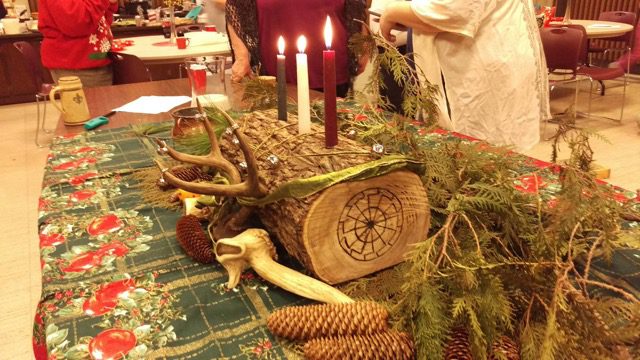
Yule Log Created and Photographed by Kara Sigrun
I had these kinds of experiences growing up as a Christian, and as an adult Heathen celebrating Yule, absolutely none of these wonderful things have been taken away. I don’t feel that anything of real import has been taken from my enjoyment of this season. It probably helps that much of what modern Americans think of as “Christmas traditions” are actually carry-overs from Germanic pre-Christian traditions (the Yule log and Christmas tree, for example) or are basic elements that are included in many religious celebrations (such as getting together with kith and kin to share meals or give gifts). And it’s even near Christmas (or, to be more precise, Christmas is near it) so my non-Heathen kith and kin are doing essentially the same thing as I am. We’re all pulling together to celebrate the season.
This year, I had the chance to celebrate Yule in a bigger way than I’ve ever done in the past. I organized an opportunity for the local pagan community to come together as a family, despite our many differences, and to worship together. With my co-leader Mary Diamond, I wrote and led a large, Heathen-focused public Yule ritual, including a three-round sumbel, in honor of Frigga and Freyr, the Norse frithweavers.
It the first event of its kind, co-sponsored by the local ADF Sinnisippi Tuath Grove and the CUUPs White Oak Grove, As this was a public ritual, the ADF grove took on the ritual planning and much of the logistics, while the CUUPs provided the space and took care of the rest of the logistics. Several others and I are members of both groups, and due to the fact that the larger local community had gone through some fissures and changes in the last few years, this seemed like the perfect opportunity to start bringing the local community back together. It took a lot of work and juggling of interests, priorities, and expectations, but it came off wonderfully. Frith was woven; community was served; and the Gods, ancestors and landvaettir were honored. All in all it was a successful ritual, and I’m proud to have helped make it happen.
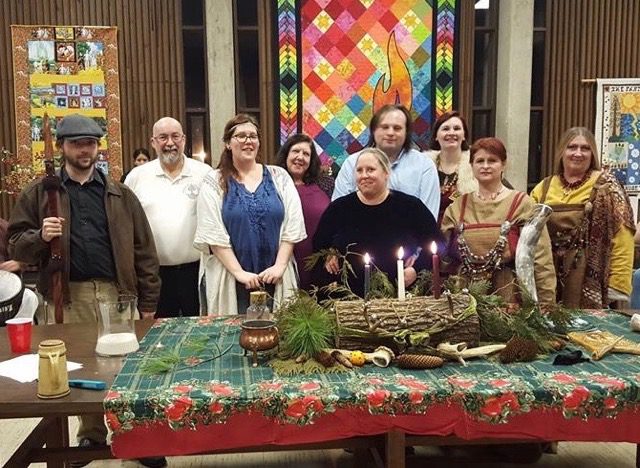
Sinnisippi Tuath Grove / Photo by Kara Sigrun
What is “Frith?”
One of our main goals from the with this ritual was to build frith.
“Frith” is an Old Norse concept that I’d really love to bring into modern usage; we Heathens use it pretty regularly already. (And once you know what it means, you will too!) Unfortunately, the term doesn’t scan cleanly into modern English. Though it is often translated as “peace”, the concept really is much more complex. My favorite definition of it comes from Ann Groa Sheffield’s book Frey: God of the World, where she identifies it as one of Freyr’s key roles. She translates frith as “sacred inviolability”. My working definition based on her translation is this: “We who are members of this family (or who are gathered at this temple or event) agree to treat each other respectfully and proactively look after each other’s health and well-being, because it would be sacrilegious to do otherwise”. (A bit wordy, but still a lovely concept, no?)
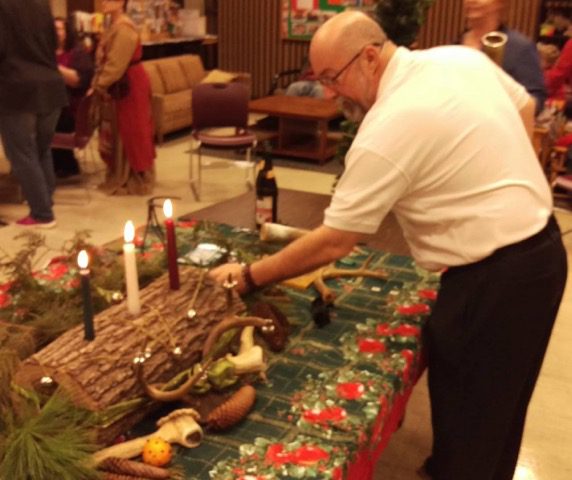
Oengus Sea Eagle, Senior druid of the Sinnisippi Tuath Grove, adjusting our Yule log / Photo by Kara Sigrun
Back in the day, “frith” described a level of social behavior that was expected while within Freyr’s temple or at special events like the Thing. Keeping the frith meant not just that you agreed to not to harm anyone with weapons or words (weapons were not allowed in Freyr’s temple or at the Thing). It also meant helping out and taking care of each other. Frith was such a deeply embedded social agreement that we really ever hear about it in the sags when the storytellers vividly describe the other attendees’ mass outrage and shock when the frith is broken.
Among the Norse deities, the two main “frith-weavers” are Frigga, the wife of Odin, Queen of the Aesir, and a goddess of family and social bonds; and Freyr, a Lord of Alfheim, Vanaheim, and Asgard, and a god of kingship, frith, and prosperity. They both work toward creating and maintaining peace and stability in their own areas of influence. In addition, Freyr is historically honored with feasting at yule, and Frigga is associated with Anglo-Saxon holiday Mōdraniht (Mother’s Night), celebrated on or near December 24th. As such, they seemed to be the perfect Deities for the occasion.
Putting it all together

Mary Diamond and the author, co-leaders of the Yule ritual / Photo by Kara Sigrun
It turned out that our ritual had one other goal: figuring out how to make a basic Heathen ritual fit into the much-more-formalized ADF ritual structure. Even after several weeks of discussions, I was struggling to find a way to weave frith and to make my experience with Heathen rituals fit into my understanding of the ADF structured. I honestly wasn’t having much luck with it until a Heathen ADF member sat down with me and went through the ADF ritual structure, comparing each step with what I would already do in my usual Heathen rituals. It turned out there wasn’t much difference, really. It came down to just adding in a part to specifically call out and honor the Well of the Norns (the Well); Yggdrasil (the Tree); and Sunna, as symbolized by the Yule Log (the Fire), in a section that ADF calls “Recreating the Cosmos”. Otherwise, the basic Heathen ritual is ADF-ready. Given that the Norse/Germanic cultures are one of the main Indo-European “Hearth Cultures” from which ADF has drawn its ritual structure, this isn’t too surprising.
So, ok–ritual structure: check. But what about the frith? How would we build the frith within this structure? That’s when my friends suggested, “You can always sumbel.” Of course! Sumbel!
Are You Ready To Sumbel???
In any Heathen ritual, the blot or the sumbel is really the key to the whole thing. That is where the magic happens. One form of “magic” (however you want to spell it) that Heathens are really good at is building community—with each other, with the landspirits, and with the Gods. And we do this via the blot or the sumbel.
A sumbel consists of three rounds of ritualized toasting. It can have many more—as many rounds as you have energy or bottles of mead, really–but the base structure has three rounds.
Our three rounds were as follows:
- Round One: Toasting the Gods of the occasion (Freyr and Frigga), as well as other Gods, and asking for their blessings;
- Round Two: Toasting the Ancestors or other Honored Dead, and asking for their blessings;
- Round Three: Boasts of our own successes and Toasts to another person’s success. (Some people also include “Oaths” in this round; I omitted it because this ritual was open to the general public, and while I am an idealist, I am not interested in tempting fate by having random people swear sacred oaths at a public ritual.)
Not unexpectedly, many attendees did not do much more than say “Hail!” each round and drink from the horn, as people often do when new to a Heathen ritual, but even so, by participating and witnessing other people’s toasts, they were still part of the magic. Other people hailed everyone from Lilith to Tyr; we even had a hail to Quetzalcoatl. In the past, I’ve even been in sumbels were Jesus was hailed. This was fine by me; Heathen rituals, particularly like this Yule ritual, are meant to be open and welcoming. Hospitality: that’s the key. In my opinion, it’s neither realistic nor hospitable to demand that only Norse deities are honored in a public sumbel. As long as the Norse gods are also honored, I think it’s fine.
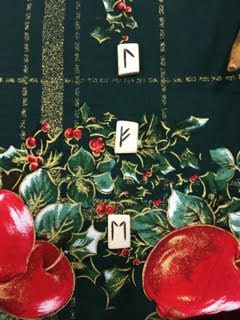
Ritual rune pull / Photo by the Author
After the sumbel, we did a divination, as in all ADF rituals. Our first question was: “Have our offerings been accepted?” to which we received the Laguz rune (water, fluidity; generally seen as a positive rune). Our second question was “What gifts to you offer in return?” to which we received Fehu (movable wealth; very fortuitous!). Our last question was “What wisdom do you have for our community?” to which we received Ehwaz (horse and rider; partnerships). Very good advice, I’d say.
The event was not without its flaws; one thing we did learn was that with as large of a group as we had (fifty people, including children), we really needed to have someone be in charge of the potluck and someone in charge of the gift exchange. But as for the ritual itself, and the sense of coming together to worship as a community—that goal, I think, was achieved, and achieved well.
Hail!

Click here to like
Patheos Pagan on Facebook.

Click here to like
the Agora on Facebook
Happily Heathen is posted on alternate Fridays here at the Agora. Subscribe by RSS or e-mail!
Please use the links to the right to keep on top of activities here on the Agora as well as across the entire Patheos Pagan channel.
Previous Post

December 23, 2015
The Cartomancer: 12 Days of Omens
Next Post

December 26, 2015 The Path of She: Why Women Can Heal Our World
Browse Our Archives
Select a Category A Lakeside Hearth Adventures in Wortcunning Alone In Her Presence Arts, Crafts & Cooking Birthing Hereditary Witchcraft Book of Blackbirds Book Reviews Born-Again Witch Cauldron, Sword, Spear, & Stone Cermony and Liturgy Columns Community Dandelion Seeds Dear Jasmine Druid Thoughts Editor's Picks Everyday Pagan Family & Household Practice Family Traditions Full Frontal Magic Gateway Goddess Guest Articles Happily Heathen Health and Wellness Hearth of Hellenism Heathen Woman Hills of the Horizon History Holidays Horse Goddesses Interfaith Interviews Irish-American Witchcraft Jewish Witch Lamp & Labyrinth Letters from Midgard Literature, Media, Film, Music Loop of Brighid Love, Sex & Relationships Magic or Magick Making Light Naturalistic Traditions Nature News Outside The Circle Pantheisticon Politics Prayers, Poems, Blessings & Stories Queer Femme Mystic Queer of Swords Recipes Ritual and Practice Science and Research Seekers and Guides Seeking the Grail Socially Responsible Magic Spear of Athena Star Made Witch Syncretic Electric Technology The Blooming Staff The Busy Witch The Cartomancer The Crow's Nest The Dance of Pagan Recovery The Hearth of Hellenism The Lady's Quill The Other Side of the Hedge The Path of She The Rantin' Raven The Witches Next Door The Zen Pagan Theology, Ethics, Philosophy Tree City Witch Urban Earthwitch Wayfaring Woman Witch on Fire Wyrd Words
Select a Month January 2026 March 2025 December 2024 June 2024 April 2024 March 2024 January 2024 December 2023 November 2023 October 2023 August 2023 July 2023 May 2023 April 2023 March 2023 February 2023 January 2023 December 2022 November 2022 October 2022 September 2022 August 2022 July 2022 June 2022 May 2022 March 2022 February 2022 January 2022 December 2021 November 2021 October 2021 September 2021 August 2021 July 2021 June 2021 May 2021 April 2021 March 2021 February 2021 January 2021 December 2020 November 2020 October 2020 September 2020 August 2020 July 2020 June 2020 May 2020 April 2020 March 2020 February 2020 January 2020 December 2019 November 2019 October 2019 September 2019 August 2019 July 2019 June 2019 May 2019 April 2019 March 2019 February 2019 January 2019 December 2018 November 2018 October 2018 September 2018 August 2018 July 2018 June 2018 May 2018 April 2018 March 2018 February 2018 January 2018 December 2017 November 2017 October 2017 September 2017 August 2017 July 2017 June 2017 May 2017 April 2017 March 2017 February 2017 January 2017 December 2016 November 2016 October 2016 September 2016 August 2016 July 2016 June 2016 May 2016 April 2016 March 2016 February 2016 January 2016 December 2015 November 2015 October 2015 September 2015 August 2015 July 2015 June 2015 May 2015 April 2015 March 2015 February 2015 January 2015 December 2014 November 2014 October 2014 September 2014 August 2014 July 2014 June 2014 May 2014 April 2014 March 2014 February 2014 January 2014 December 2013 November 2013 October 2013 September 2013 August 2013 July 2013 June 2013 May 2013 April 2013 March 2013 February 2013 January 2013 December 2012 November 2012 October 2012 September 2012 August 2012 July 2012 June 2012 May 2012 April 2012 March 2012 February 2012 January 2012
Follow Us!
TAKE THE
Religious Wisdom Quiz
Which letter contains a section on taming the tongue?
Select your answer to see how you score.
Galatians Romans James Titus
Related posts from Agora

Simple Witchery: To Keep Silent

Simple Witchery: Leaning On The Four Pillars

Pergamum Unfurled: Magic with the Greek Gods (Book...

Pergamum Unfurled: Cunning Words (Review)
TRENDING AT PATHEOS Pagan

I was recently chatting with someone on Instagram. She asked me what...

While there are many people who share their results, the end of...

On July 23, I saw Christopher Nolan's The Odyssey which is Homer’s...

As I write this two big events have just finished up. One...

Restoring the Watershed of Divine Love
Perhaps cooperation is not something we manufacture through legislation, ideology, or moral...

Many UUs don’t pray because of bad experiences in a previous religion,...
view all Pagan blogs
Ad-Free & Subscriber Log-In Subscription Support
- About Us
- 2026 Calendar
- Videos
- Podcasts
- Library of World Religions
- Faith In Media Tracker
- Advertise With Us
- Write for Us
- Privacy Policy
- Terms of Service
- Do Not Sell My Data
- Contact Us
- Radiant Digital
- Manage Newsletter Subscriptions
- Unsubscribe From Notifications
- Sitemap
Copyright 2008-2026, Patheos. All rights reserved.
Subscription Support Ad-Free & Subscriber Log-In
Follow Patheos