
BuddhistCatholicContemplativeEvangelicalGeneral ChristianHinduJewishLatter-day SaintMuslimNew VisionsProgressive Christian
Beliefs
- Buddhist
- Catholic
- Contemplative
- Evangelical
- General Christian
- Hindu
- Jewish
- Latter-day Saint
- More Voices
- Muslim
- New Visions
- Pagan
- Progressive Christian
Topics
- Religion News
- Food and Religion
- Sports and Religion
- Religious Art
- Religious Music and Entertainment
- Religious Events
- History and Religion
- Style and Religion
- Politics and Religion
- Women in Religion
- Recreation Outdoors and Religion
- Business Finance and Religion
- Careers Workplace and Religion
- Education and Religion
- Family Parenting and Religion
- Health Fitness and Religion
- Home and Religion
- Relationships and Religion
- Technology and Religion
- Travel and Religion
Columnists
- Buddhist Columnists
- Business Finance and Religion Columnists
- Careers Workplace and Religion Columnists
- Catholic Columnists
- Contemplative Columnists
- Education and Religion Columnists
- Evangelists Columnists
- Family Parenting and Religion Columnists
- General Christian Columnists
- Health Fitness and Religion Columnists
- Hindu Columnists
- History and Religion Columnists
- Home and Religion Columnists
- Jewish Columnists
- More Voices Columnists
- Latter Day Columnists
- Muslim Columnists
- New Visions Columnists
- Nonreligious Columnists
- Pagan Columnists
- Politics and Religion Columnists
- Progressive Columnists
- Recreation Outdoors and Religion Columnists
- Relationships and Religion Columnists
- Religion News Columnists
- Religious Art Columnists
- Religious Events Columnists
- Religious Music and Entertainment Columnists
- Sports and Religion Columnists
- Style and Religion Columnists
- Technology and Religion Columnists
- Travel and Religion Columnists
- Women in Religion Columnists
Resource Library
- 2026 Calendar
- Library of World Religions
- The 100 Most Holy Places on Earth
- Patheos Answers
- Podcasts
- Videos
- Faith Leaders Database
- Anglican Episcopalian
- Bahai
- Baptist
- Buddhism
- Christianity
- Confucianism
- Eastern Orthodoxy
- Hinduism
- Holiness and Pentecostal
- ISKCON
- Islam
- Judaism
- Lutheran
- Methodist
- The Church of Jesus Christ of Latter-day Saints
- New Age
- Paganism
- Presbytarian and Reformed
- Protestantism
- Religion Behind the Scenes
- Roman Catholic
- Scientology
- Shia Islam
- Sikhism
- Sufism
- Sunni Islam
- Taoism
- Zen
- See all religions
Research Tools
 Ad-Free & Subscriber Log-In Subscription Support
Ad-Free & Subscriber Log-In Subscription Support
Follow Patheos 

- Trending:
- Forgiveness
- |
- Marriage
- |
- Consciousness
- |
- Death Penalty
- |
- Election
- |
- Halloween

- Home
- Pagan
- The Rantin’ Raven: An Old Witch Responds to the Young Ones
The Rantin’ Raven: An Old Witch Responds to the Young Ones
Last updated on: January 31, 2017 at 7:27 pm by Dana Corby
The Rantin’ Raven: An Old Witch Responds to the Young Ones 2017-01-31T19:27:50+00:00 Dana Corby
Patheos Explore the world's faith through different perspectives on religion and spirituality! Patheos has the views of the prevalent religions and spiritualities of the world.
[Editor’s Note: This article was originally written by Dana in 2009.]
Over the years, I’ve often heard complaints from teens that older Wiccans don’t take them seriously. You say that we don’t listen and that we don’t respect you, and that we too often refuse to teach you. I know that has to rankle, and I’m truly sorry, but please hear me out.
Now, this is not going to be one of those “When I was your age I had to walk 10 miles through a blizzard every day to go to school” lectures. But I would like for you to understand why our eyes glaze over and we wander away going “Eep! Gloik!” when you attempt to tell us what you know about Wicca. What you know about Wicca and what we know about Wicca are poles apart.

Minerva Studio / Shutterstock.com
In the years since I first began studying in 1971, the definition of Wicca has changed radically. The kind of person who’s attracted to it has changed radically. And to the older Witch, what you youngsters are talking about when you say “Wicca” does not look or sound anything like what we’re talking about when we say the same word. And both groups believe that their definition is the correct one.
Let’s say that it’s 1971 and some guy is interviewed on the evening news talking about something he calls “Witchcraft.” Not Wicca; nobody was using the word Wicca in public yet. But this witchcraft that this guy on TV described sounds really fascinating. How do you go about satisfying your urge to learn more?
Well, you get yourself down to your local bookstore, and you ask the proprietor where the books on witchcraft are kept. And he gives you this really odd look, and takes you into the back left corner where there’s a shelf marked anthropology. You look at a couple of books about Yoruba and Navajo tribal customs and decide that he must not have understood what you wanted, so you go back and say “No, I mean modern witchcraft.” And he gives you an even odder look and takes you to the back right corner, and sure enough, there are books with the word witchcraft on the spines. But the authors are all Father Somebody and the books all talk about demonology and eating babies and other gross stuff you know can’t be right. So you go home.
Now what? Remember, the Internet isn’t going to go public for another 15 years. The publisher who’ll start putting out all those teen-oriented books on Wicca at the turn of the century is still mostly just doing astrology books. And you don’t know anybody else who’s interested in something this weird.
So you phone the TV station and ask them for the contact information to write to the guy who was talking about witchcraft. After being put on hold forever a secretary reads it off to you. You’re on your way!
Well, no. You write to the guy and ask him how to learn about Witchcraft. And if you’re lucky, in a few months you get a letter back that says:
Dear Teen;
Thank you for your letter. Unfortunately, I cannot help you, as legitimate teachers of the Craft do not accept underage students. I recommend that you read books on mythology, metaphysics and parapsychology, and perhaps when you are old enough, a teacher will appear.
Best Wishes,
Joe Authority
So that’s what you do. You immerse yourself in Theosophy and Rosicrucianism and UFOs, you dabble in Zen and go to the new Hari Krishna Temple that recently opened in a slummy part of downtown. You check out mythology books from the library, and discover that the theme of Atlantis runs through them and most everything else you’re reading as well. You go back and read those books on Yoruba and Navajo tribal customs, and they’re fascinating. You learn to meditate and start having really interesting dreams. You and your best friend do telepathy experiments at night when you’re supposed to be asleep and you think you might have read each other’s minds once. You discover an East Indian import store and start buying incense cones. In bulk. (Your mother worries that you might be smoking pot.)
And you graduate from high school, and you go off to college or get a job or get drafted, and in general get on with your life. But you never really forget your fascination with the occult, as all these interrelated studies are called. You keep reading and meditating, and by now you’ve actually found a useful book or two about what you mean by witchcraft, the stuff that guy on TV talked about.
Then one day when you’re in your twenties you’re in a store or at a movie, and a total stranger looks at you funny and asks, “Are you a Witch?” and you find yourself saying, to this total stranger, “Y’know, I think I am.” And the next Saturday night there you are, at this person’s house, or sitting around a big table at a restaurant, and there are all these other people smiling expectantly at you. They start asking you questions. Why do you want to be a witch? What have you read? And if you’re lucky–if they like you and think you might be a good fit for their group–this time you really are on your way.
They invite you to parties and discussion groups where the conversation is always fascinating but it’s never about politics or movies or sports. You find that most of the members of the group have quite a lot of experience in one or more areas of the occult or metaphysics, the ones you’ve been reading about. Most of them not only read mythology but anthropology and archeology, and at least one is an astronomy geek. They practice herbal medicine and make their own wine. They sit around singing old folk songs you never heard of but they all know by heart. Pretty soon you know them, too. And a year or so later your friend, the one who seems to run things, calls you up and says, “Go to the Army-Navy store and buy yourself a dagger. You’re getting initiated Sunday night.”
Fast forward. It’s 2009. Books on Wicca (as it’s now called) are not only easy to find, they’re hard to avoid. And with perhaps a half-dozen exceptions, there’s nothing in them that would look familiar to that 1971 teen. Where are the references back to the rest of the Western Metaphysical Tradition? The old songs and poems that turned out to have the layers of hidden meaning? What about Atlantis, or the starry wheel of the heavens, or the lost lands of Hy Breasal and Ys? What happened to the work of turning the Wheel? Where are the living Gods and the Mysteries? Where is the frisson of awe? Not in these books, that’s for sure.
The Internet is now a commonplace part of life, taken for granted by most of its users, especially its young users, as the place to find information. Google witchcraft and you could sit there for days following links; the only problem is that the majority of site-owners are obviously just parroting books–too often just one book–and a lot of them appear to have been plagiarized from each other. And they’re mostly all saying that Wicca is whatever you make of it, that the Gods are symbolic constructs that you can mix and match to suit your purpose, that initiation is just a mechanism to keep people out of Wicca, and that the main purpose of it all is to make you feel good about yourself.
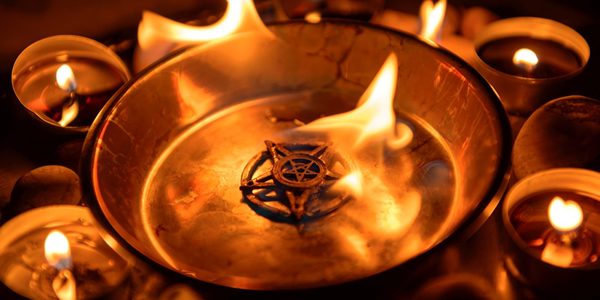
The Wicca of 2009 is not the same thing as the Wicca of 1969. In fact, to those of us who have been practicing it for a generation or more what’s called Wicca these days isn’t Wicca at all. It’s NeoPaganism. And we don’t understand why people seem reluctant to call it by that marvelous name.
NeoPaganism is the new religion of the Old Gods, celebrating the Wheel of the Year and the phases of the Moon. It may or may not include the practice of spells and other forms of magic, though even among those who don’t practice it the possibility is always there. It’s something anyone can celebrate, anyone can do, and as the old top-down ‘revealed’ religions thrash about in their death-throes, NeoPaganism is uniquely positioned to emerge as the Religion of the People and of the Earth. It’s amazing.
Wicca, on the other hand, is not even necessarily a religion, not in the sense most people mean. All Wiccans are Pagans, but not all Pagans are Wiccans. Rather than working from a palette of the world’s native deities, Wicca is a priest(ess)hood of a specific God & Goddess whose Names we don’t reveal, but Who can be traced back to certain families in one little corner of the British Isles, the New Forest. It engages in specific small-group rites meant to channel Divine energies to humanity and human energies back to the Divine, and thus maintain the cosmic balance. It has links to the rest of the Western Metaphysical Tradition as well as to the history & mythology of preChristian Britain. It isn’t even actually Celtic except in the sense in which Britons of the 19th Century meant it: that is, natively British and wilder than Saxon. It’s no intrinsically better, or more important or impressive, than any other form of Paganism. And it was never meant to have a lot of members or be popular.
The dismissal some Teen Wiccans perceive coming from some Elder Wiccans has little to do with age and everything to do with definitions and attitudes. By everything you know, Wicca is about Mother Nature and Father Sky and worshipping Them. By everything we know, that’s just the tip of the iceberg: Wicca is an occult path practicing both deific and practical magic. By everything you know, Wicca is light-hearted, anyone who says they’re a Wiccan is one, and anyone who leads a ritual is entitled to call themselves a High Priest or High Priestess. By everything we know, the study of Wicca is long and intense, only initiates are entitled to call themselves a Wiccan, and only those ready and willing to write the Gods a blank check are fit to be a High Priest or High Priestess. And because we were here first, with that definition, we’re not likely to change it. If we did, it wouldn’t be Traditional Wicca any more, and we’re duty-bound to preserve the Craft as it was given to us.
That doesn’t mean we can’t have common ground, or that there’s no room for mutual respect. Treat us and our ways with respect, and you’ll be surprised at the result: most of us Old Farts™ are friendly and eager to teach anyone who’s eager to learn. Just don’t expect us to embrace someone–of any age–as a Craft brother or sister, much less a fellow HP or HPS, who hasn’t been through a Traditional initiation, because by our definition that’s what makes a Wiccan. It’s not discrimination, and it’s not aimed at any one in particular, certainly not you. It makes sure that only those prepared for it are introduced to those Mysteries specific to our Traditions, so that no harm can occur on any plane. And it helps to preserve the Craft and its Mysteries, something that’s more important to us than anyone’s feelings — including our own. You think it doesn’t hurt to have to turn nice people away?
We want to make friends with the Teens in our communities, to mentor you within the limits we’re allowed. But for most of us, our experience has been that the majority of Teen ‘Wiccans’ are so certain that they already know everything about it that they reject what we have to say before they’ve even heard it. Even when you say you want to be taught, when we tell you that part of the process is waiting, most Teens are outta there.
And about that waiting: the truth is that many teens are emotionally and intellectually capable of studying Wicca. But the majority of Wiccan teachers still do not accept underage students. Before you protest, as teens so often do, that it’s unfair, please hear me out. Your ability is not at issue, nor your worthiness.
Part of the reason for a minimum age is tradition, which is very important to us. Part of the reason for that tradition is that specific ages have occult meanings. That’s right: Few people realize it, but there are ancient occult reasons why, in Western culture, the age of majority is specifically twenty-one and not twenty or twenty-two.
Part of the reason is concern for the would-be student: it’s very easy to get totally absorbed into something as fascinating and open-ended as Wicca studies and practice. It’s very easy to let it interfere with what you should be doing in your teens: that is, getting your education and setting out on your life as an independent, self-supporting adult. Not only is allowing that to happen not doing the young student any favors, their teacher/initiator is in part karmically responsible if that student never gets their act together on the material level and winds up impoverished.
But another part of the reason for a minimum age is self-protection. Traditional Wicca initiates cross-sexually; that is, male candidates are brought in by female initiates and vice versa. This, too, is traditional, and there are sound magical reasons as well. The law doesn’t care about tradition or magic. Wicca teachers can run afoul of laws about corruption of minors and custodial interference, and there are cultural and often legal assumptions that the only reason an older person could possibly have for befriending a younger person of the opposite gender is sexual exploitation. Especially in what’s often called a fertility religion! Sigh…
But in the meantime:
Don’t Wait.
Don’t wait for someone else to give you permission or approval to begin actually practicing the things you’ve been reading about. Realize that there’s no better time than now, and begin doing it. The best preparation for any practice, after all, is the practice itself. If you have to take books into your Circle and read aloud as you perform the ritual, if you’re not sure you totally understand what you’re doing (by the way — nobody ever does), it doesn’t matter at this point. The important thing is to be doing the practices. The Gods are not going to smite you for flubbing your lines (if they did, my entire Tradition would be in trouble!) and you’re not going to accidentally invoke something awful.
Do it.
Experience it.
Internalize it.
Become it.

Click here to like
Patheos Pagan on Facebook.

Click here to like
the Agora on Facebook
The Rantin’ Raven is published on alternate Saturdays here on the Agora. Subscribe via RSS or e-mail!
Please use the links to the right to keep on top of activities here on the Agora as well as across the entire Patheos Pagan channel.
Previous Post
September 4, 2015
Adventures in Wortcunning: Spelling as Witchery
Next Post

September 6, 2015 The Other Side of the Hedge: Being Neighborly
Browse Our Archives
Select a Category A Lakeside Hearth Adventures in Wortcunning Alone In Her Presence Arts, Crafts & Cooking Birthing Hereditary Witchcraft Book of Blackbirds Book Reviews Born-Again Witch Cauldron, Sword, Spear, & Stone Cermony and Liturgy Columns Community Dandelion Seeds Dear Jasmine Druid Thoughts Editor's Picks Everyday Pagan Family & Household Practice Family Traditions Full Frontal Magic Gateway Goddess Guest Articles Happily Heathen Health and Wellness Hearth of Hellenism Heathen Woman Hills of the Horizon History Holidays Horse Goddesses Interfaith Interviews Irish-American Witchcraft Jewish Witch Lamp & Labyrinth Letters from Midgard Literature, Media, Film, Music Loop of Brighid Love, Sex & Relationships Magic or Magick Making Light Naturalistic Traditions Nature News Outside The Circle Pantheisticon Politics Prayers, Poems, Blessings & Stories Queer Femme Mystic Queer of Swords Recipes Ritual and Practice Science and Research Seekers and Guides Seeking the Grail Socially Responsible Magic Spear of Athena Star Made Witch Syncretic Electric Technology The Blooming Staff The Busy Witch The Cartomancer The Crow's Nest The Dance of Pagan Recovery The Hearth of Hellenism The Lady's Quill The Other Side of the Hedge The Path of She The Rantin' Raven The Witches Next Door The Zen Pagan Theology, Ethics, Philosophy Tree City Witch Urban Earthwitch Wayfaring Woman Witch on Fire Wyrd Words
Select a Month January 2026 March 2025 December 2024 June 2024 April 2024 March 2024 January 2024 December 2023 November 2023 October 2023 August 2023 July 2023 May 2023 April 2023 March 2023 February 2023 January 2023 December 2022 November 2022 October 2022 September 2022 August 2022 July 2022 June 2022 May 2022 March 2022 February 2022 January 2022 December 2021 November 2021 October 2021 September 2021 August 2021 July 2021 June 2021 May 2021 April 2021 March 2021 February 2021 January 2021 December 2020 November 2020 October 2020 September 2020 August 2020 July 2020 June 2020 May 2020 April 2020 March 2020 February 2020 January 2020 December 2019 November 2019 October 2019 September 2019 August 2019 July 2019 June 2019 May 2019 April 2019 March 2019 February 2019 January 2019 December 2018 November 2018 October 2018 September 2018 August 2018 July 2018 June 2018 May 2018 April 2018 March 2018 February 2018 January 2018 December 2017 November 2017 October 2017 September 2017 August 2017 July 2017 June 2017 May 2017 April 2017 March 2017 February 2017 January 2017 December 2016 November 2016 October 2016 September 2016 August 2016 July 2016 June 2016 May 2016 April 2016 March 2016 February 2016 January 2016 December 2015 November 2015 October 2015 September 2015 August 2015 July 2015 June 2015 May 2015 April 2015 March 2015 February 2015 January 2015 December 2014 November 2014 October 2014 September 2014 August 2014 July 2014 June 2014 May 2014 April 2014 March 2014 February 2014 January 2014 December 2013 November 2013 October 2013 September 2013 August 2013 July 2013 June 2013 May 2013 April 2013 March 2013 February 2013 January 2013 December 2012 November 2012 October 2012 September 2012 August 2012 July 2012 June 2012 May 2012 April 2012 March 2012 February 2012 January 2012
Follow Us!
TAKE THE
Religious Wisdom Quiz
What miraculous catch did Peter witness after obeying Jesus?
Select your answer to see how you score.
A boat sinking A sea turning red A gold coin A net full of fish
Related posts from Agora

Simple Witchery: To Keep Silent

Simple Witchery: Leaning On The Four Pillars


Simple Witchery: Resistance and Resilience in Hard Times
TRENDING AT PATHEOS Pagan

I was recently chatting with someone on Instagram. She asked me what...

While there are many people who share their results, the end of...

On July 23, I saw Christopher Nolan's The Odyssey which is Homer’s...

As I write this two big events have just finished up. One...

Restoring the Watershed of Divine Love
Perhaps cooperation is not something we manufacture through legislation, ideology, or moral...

Many UUs don’t pray because of bad experiences in a previous religion,...
view all Pagan blogs
Ad-Free & Subscriber Log-In Subscription Support
- About Us
- 2026 Calendar
- Videos
- Podcasts
- Library of World Religions
- Faith In Media Tracker
- Advertise With Us
- Write for Us
- Privacy Policy
- Terms of Service
- Do Not Sell My Data
- Contact Us
- Radiant Digital
- Manage Newsletter Subscriptions
- Unsubscribe From Notifications
- Sitemap
Copyright 2008-2026, Patheos. All rights reserved.
Subscription Support Ad-Free & Subscriber Log-In
Follow Patheos