
BuddhistCatholicContemplativeEvangelicalGeneral ChristianHinduJewishLatter-day SaintMuslimNew VisionsProgressive Christian
Beliefs
- Buddhist
- Catholic
- Contemplative
- Evangelical
- General Christian
- Hindu
- Jewish
- Latter-day Saint
- More Voices
- Muslim
- New Visions
- Pagan
- Progressive Christian
Topics
- Religion News
- Food and Religion
- Sports and Religion
- Religious Art
- Religious Music and Entertainment
- Religious Events
- History and Religion
- Style and Religion
- Politics and Religion
- Women in Religion
- Recreation Outdoors and Religion
- Business Finance and Religion
- Careers Workplace and Religion
- Education and Religion
- Family Parenting and Religion
- Health Fitness and Religion
- Home and Religion
- Relationships and Religion
- Technology and Religion
- Travel and Religion
Columnists
- Buddhist Columnists
- Business Finance and Religion Columnists
- Careers Workplace and Religion Columnists
- Catholic Columnists
- Contemplative Columnists
- Education and Religion Columnists
- Evangelists Columnists
- Family Parenting and Religion Columnists
- General Christian Columnists
- Health Fitness and Religion Columnists
- Hindu Columnists
- History and Religion Columnists
- Home and Religion Columnists
- Jewish Columnists
- More Voices Columnists
- Latter Day Columnists
- Muslim Columnists
- New Visions Columnists
- Nonreligious Columnists
- Pagan Columnists
- Politics and Religion Columnists
- Progressive Columnists
- Recreation Outdoors and Religion Columnists
- Relationships and Religion Columnists
- Religion News Columnists
- Religious Art Columnists
- Religious Events Columnists
- Religious Music and Entertainment Columnists
- Sports and Religion Columnists
- Style and Religion Columnists
- Technology and Religion Columnists
- Travel and Religion Columnists
- Women in Religion Columnists
Resource Library
- 2026 Calendar
- Library of World Religions
- The 100 Most Holy Places on Earth
- Patheos Answers
- Podcasts
- Videos
- Faith Leaders Database
- Anglican Episcopalian
- Bahai
- Baptist
- Buddhism
- Christianity
- Confucianism
- Eastern Orthodoxy
- Hinduism
- Holiness and Pentecostal
- ISKCON
- Islam
- Judaism
- Lutheran
- Methodist
- The Church of Jesus Christ of Latter-day Saints
- New Age
- Paganism
- Presbytarian and Reformed
- Protestantism
- Religion Behind the Scenes
- Roman Catholic
- Scientology
- Shia Islam
- Sikhism
- Sufism
- Sunni Islam
- Taoism
- Zen
- See all religions
Research Tools
 Ad-Free & Subscriber Log-In Subscription Support
Ad-Free & Subscriber Log-In Subscription Support
Follow Patheos 

- Trending:
- Forgiveness
- |
- Marriage
- |
- Consciousness
- |
- Death Penalty
- |
- Election
- |
- Halloween

- Home
- Pagan
- The Cartomancer: The Art of Curiosity
The Cartomancer: The Art of Curiosity
Last updated on: August 12, 2015 at 5:17 pm by Camelia Elias
The Cartomancer: The Art of Curiosity 2015-08-12T17:17:43+00:00 Camelia Elias
Patheos Explore the world's faith through different perspectives on religion and spirituality! Patheos has the views of the prevalent religions and spiritualities of the world.
A pack of cards is like a cabinet of curiosities. You find the same objects in it, but every time you open it the arrangement is different: ‘Eating your own tears’ is not the same as saying, ‘The Witch is cooking her magic brew.’
The other day I got to stick my nose into my playing-cards cabinet, and twice in a row I got the same cards on the table, but in a different order. Whereas the first set referred to a young woman’s situation, the second set referred to a concrete situation of giving advice to a young witch.
In the first instance I have imposed on the cards a mundane, straightforward reading, in which I simply associated the cards with the cunning-folk system I’m working with, in addition to observing what happens in the cards at the visual level – for instance, the 5 of Diamonds equals the body and fire, the 7 of Spades tears, and the Queen of Spades a sharp and cold woman.
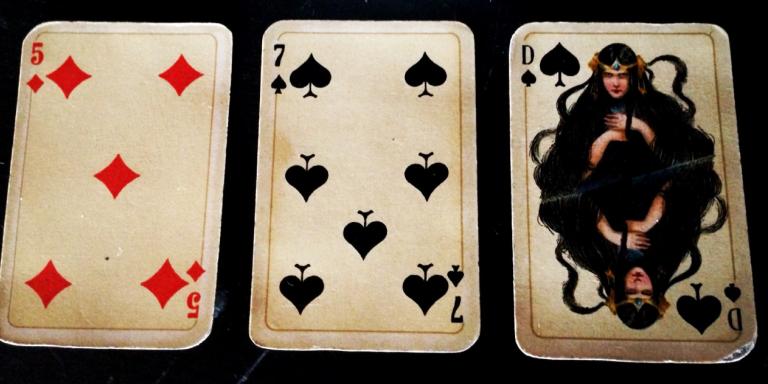
Otto Tragy playing cards for Altenburger Spielkartenfabrik, 1910, in my collection (Photo: Camelia Elias)
In the second instance I have imposed a magical reading on the cards – in which the Queen of Spades is the witch, the 5 of Diamonds her kitchen, and the 7 of Spades her hexing. Same cards, different narratives.
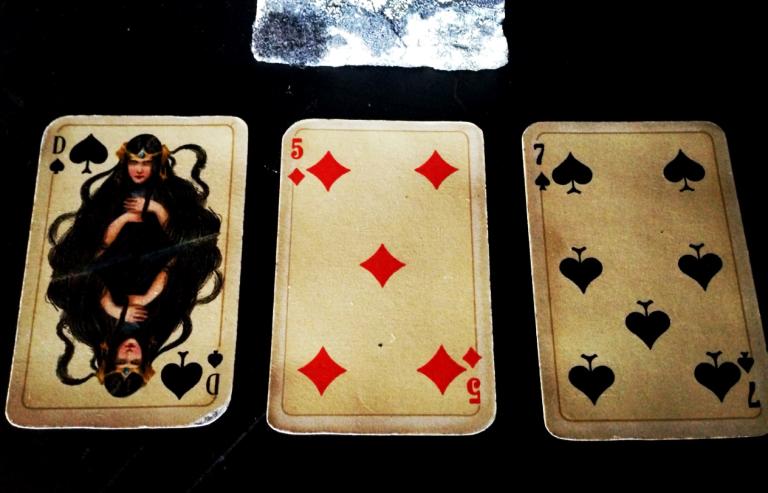
Otto Tragy playing cards for Altenburger Spielkartenfabrik, 1910, in my collection (Photo: Camelia Elias)
Which reading applies is always given by the context of the question, as without a question there’s no divination. Here, it has always been my contention that reading cards is a matter of contemplating images, rather than interpreting according to any one set of meanings that someone somewhere has arbitrarily decided upon. Some card readers resist the idea that contemplating the geometrical arrangement of elements on the playing-cards or the pip cards in a Marseille Tarot pack is possible, calling for the imposition on the cards of traditional meanings related to the various cartomantic systems we are familiar with, but the truth is that what we have come to know as ‘meanings’ connected with these cards come from logical stylizations of the cycles in nature that cunning folks have made.
One of my friends, cartomancer extraordinaire, Enrique Enriquez, teaches a simple method: ‘Lay down three cards, and just look. Don’t state an opinion about what you see. Just look.’ He then asks: ‘What is happening in the cards, and how does what you see make you feel?’ I find affinity with Enrique’s approach, as his questions are the same questions that I’ve been teaching every semester in my critical theory class at the university since 1998.
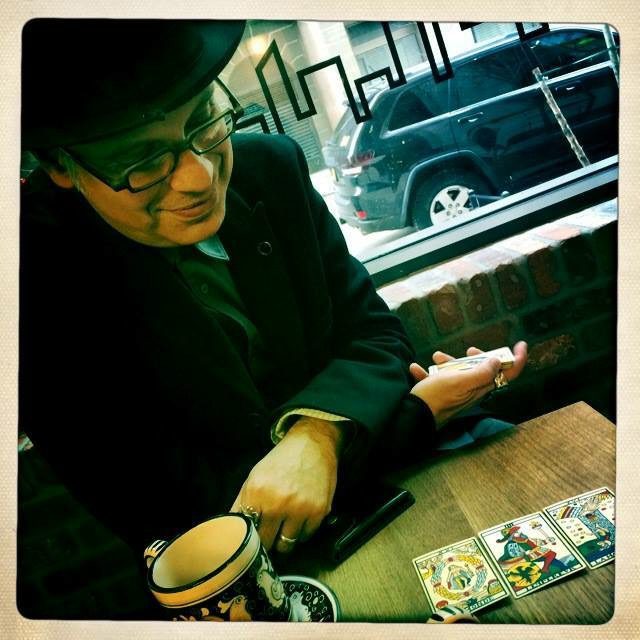
Enrique Enriquez in New York (Photo: Nadia Cohen)
Does what we see in images or the verbal texts that depict an image make us smarter? It does. But there’s a catch. You cannot see anything worth the while unless you approach the image or the text from a position of curiosity that’s devoid of prejudice. In contemplating an image we look at what’s there, what stares us in the face, rather than at ourselves. We may see our situation reflected in the cards, but, as a general rule, if we want an honest answer to our question posed to the cards, we must begin with looking at the cards, not with looking at our own good selves. That’s the art: To let our curiosity do the reading, and in that reading discover that we may possess a different cultural competence than the one we bring to the fortuneteller’s table.
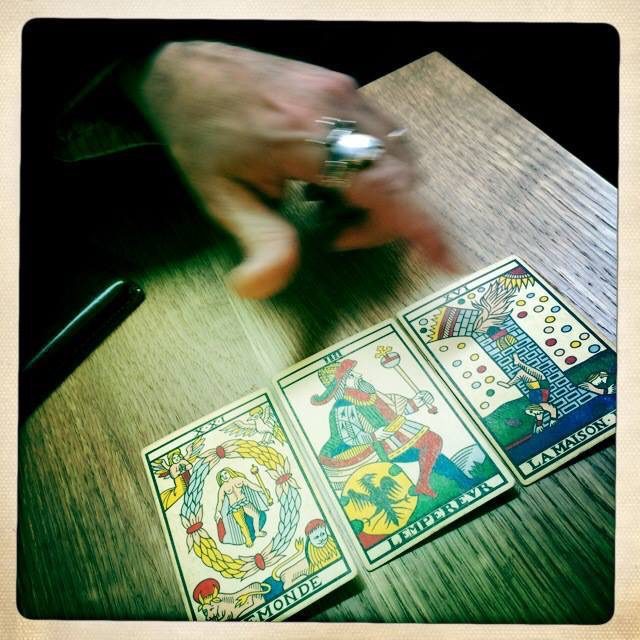
Enrique Enriquez in New York (Photo: Nadia Cohen)
One of my favorite poets, Serbian-American Charles Simic, made an apt observation about what we do when we engage our curiosity in an encounter with chance in his critical study of American surrealist artist Joseph Cornell, who was famous for making mysterious boxes of found objects:
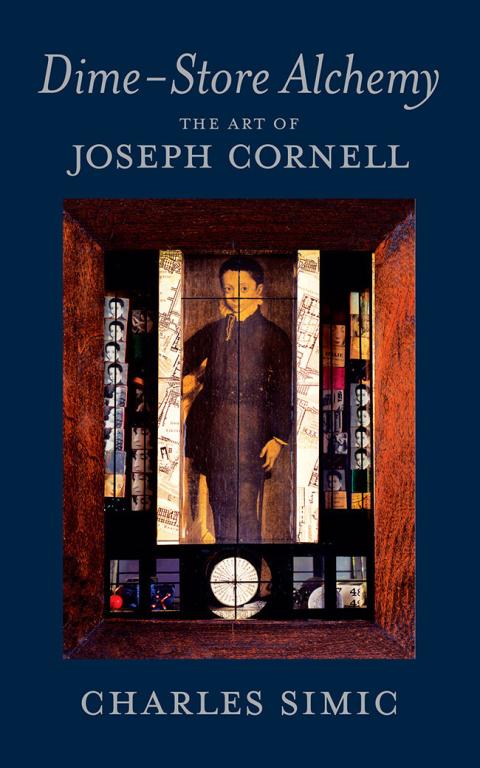
Photo: Amazon Books
What Cornell sought in his walks in the city, the fortune-tellers already practiced in their parlors. Faces bent over cards, coffee dregs, crystals; divination by contemplation of surfaces which stimulate inner visions and poetic faculties.
De Chirico says: “One can deduce and conclude that every object has two aspects: one current one, which we see nearly always and which is seen by men in general; and the other, which is spectral and metaphysical and seen only by rare individuals in moments of clairvoyance …”
He’s right. Here comes the bruja, dressed in black, her lips and fingernails painted blood-red. She saw into the murderer’s lovesick heart, and now it’s your turn, mister.
What enables the fortuneteller to look and then pass judgment on what she sees is her ability to rise above the suspicious glance. Her business is not founded on rhetoric of suspicion, but rather, on curiosity, cunning-ness, and courage.
But this is my idea of an articulated philosophy of reading the cards. What if I left it up to the cards themselves to answer this question: ‘What is the best way of looking at something?’
A beautiful set of three cards have graced my parlor:
The Tower, The Priestess, The Hanged Man
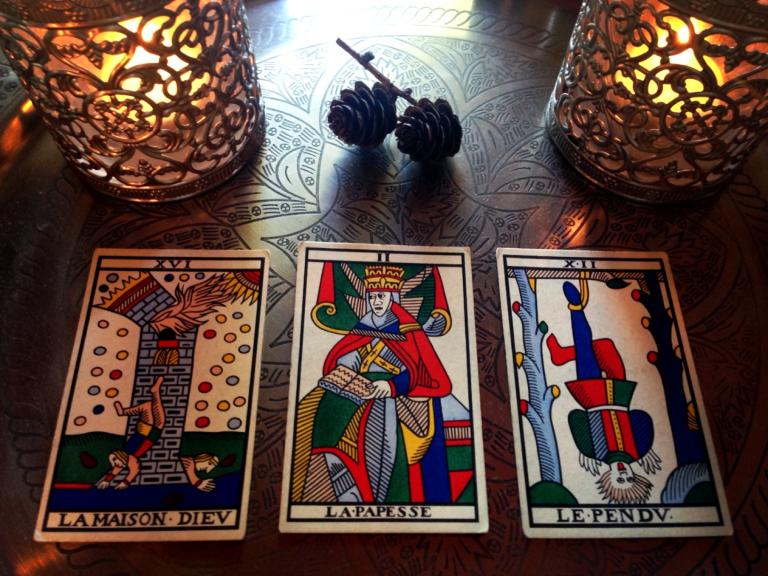
Jean Noblet Marseille Tarot, 1650, reconstructed by Jean-Claude Flornoy (hand stencilled set) (Photo: Camelia Elias)
I’m rather glad to see that all three corroborate my theory, yet adding a world of subtleties to what I was saying.
As the Priestess contemplates from some distance the busted Tower, observing that man-made constructions don’t last, the Hanged Man suggests that we must let it all hang, all our possessions, that is. The best way of looking at something is seeing it both as a construction and as its dismantling. You may have a book in your hands that teaches you a method, but when it comes down to it, you contemplate on what you see, not articulate what you read in a book. You do what the Priestess does here: Hold the book, but look past it. Suspend your customary ways of seeing, suspend what you think you know, and with your head in the ground, like that of the Hanged Man, venture to see the world upside down.
The Priestess mediates between brick and bone. The Tower’s flaming hair becomes the mystic’s coiffe. As to the book, so to the reading.
Be curious.

Click here to like
Patheos Pagan on Facebook.

Click here to like
the Agora on Facebook
The Cartomancer is published on the second and fourth Wednesdays of a month. Subscribe via RSS or e-mail!
Please use the links to the right to keep on top of activities here on the Agora as well as across the entire Patheos Pagan channel.
Previous Post

August 11, 2015
Witch on Fire: Why I am Still a Witch
Next Post

August 13, 2015 Birthing Hereditary Witchcraft: Pagan Parenting and Divorce
Browse Our Archives
Select a Category A Lakeside Hearth Adventures in Wortcunning Alone In Her Presence Arts, Crafts & Cooking Birthing Hereditary Witchcraft Book of Blackbirds Book Reviews Born-Again Witch Cauldron, Sword, Spear, & Stone Cermony and Liturgy Columns Community Dandelion Seeds Dear Jasmine Druid Thoughts Editor's Picks Everyday Pagan Family & Household Practice Family Traditions Full Frontal Magic Gateway Goddess Guest Articles Happily Heathen Health and Wellness Hearth of Hellenism Heathen Woman Hills of the Horizon History Holidays Horse Goddesses Interfaith Interviews Irish-American Witchcraft Jewish Witch Lamp & Labyrinth Letters from Midgard Literature, Media, Film, Music Loop of Brighid Love, Sex & Relationships Magic or Magick Making Light Naturalistic Traditions Nature News Outside The Circle Pantheisticon Politics Prayers, Poems, Blessings & Stories Queer Femme Mystic Queer of Swords Recipes Ritual and Practice Science and Research Seekers and Guides Seeking the Grail Socially Responsible Magic Spear of Athena Star Made Witch Syncretic Electric Technology The Blooming Staff The Busy Witch The Cartomancer The Crow's Nest The Dance of Pagan Recovery The Hearth of Hellenism The Lady's Quill The Other Side of the Hedge The Path of She The Rantin' Raven The Witches Next Door The Zen Pagan Theology, Ethics, Philosophy Tree City Witch Urban Earthwitch Wayfaring Woman Witch on Fire Wyrd Words
Select a Month January 2026 March 2025 December 2024 June 2024 April 2024 March 2024 January 2024 December 2023 November 2023 October 2023 August 2023 July 2023 May 2023 April 2023 March 2023 February 2023 January 2023 December 2022 November 2022 October 2022 September 2022 August 2022 July 2022 June 2022 May 2022 March 2022 February 2022 January 2022 December 2021 November 2021 October 2021 September 2021 August 2021 July 2021 June 2021 May 2021 April 2021 March 2021 February 2021 January 2021 December 2020 November 2020 October 2020 September 2020 August 2020 July 2020 June 2020 May 2020 April 2020 March 2020 February 2020 January 2020 December 2019 November 2019 October 2019 September 2019 August 2019 July 2019 June 2019 May 2019 April 2019 March 2019 February 2019 January 2019 December 2018 November 2018 October 2018 September 2018 August 2018 July 2018 June 2018 May 2018 April 2018 March 2018 February 2018 January 2018 December 2017 November 2017 October 2017 September 2017 August 2017 July 2017 June 2017 May 2017 April 2017 March 2017 February 2017 January 2017 December 2016 November 2016 October 2016 September 2016 August 2016 July 2016 June 2016 May 2016 April 2016 March 2016 February 2016 January 2016 December 2015 November 2015 October 2015 September 2015 August 2015 July 2015 June 2015 May 2015 April 2015 March 2015 February 2015 January 2015 December 2014 November 2014 October 2014 September 2014 August 2014 July 2014 June 2014 May 2014 April 2014 March 2014 February 2014 January 2014 December 2013 November 2013 October 2013 September 2013 August 2013 July 2013 June 2013 May 2013 April 2013 March 2013 February 2013 January 2013 December 2012 November 2012 October 2012 September 2012 August 2012 July 2012 June 2012 May 2012 April 2012 March 2012 February 2012 January 2012
Follow Us!
TAKE THE
Religious Wisdom Quiz
According to Romans 3:23, who has sinned?
Select your answer to see how you score.
Those who do not accept Christ The Gentiles Only those who break the Ten Commandments Everyone
Related posts from Agora

Simple Witchery: To Keep Silent

Simple Witchery: Leaning On The Four Pillars

Pergamum Unfurled: Magic with the Greek Gods (Book...

Pergamum Unfurled: Cunning Words (Review)
TRENDING AT PATHEOS Pagan

I was recently chatting with someone on Instagram. She asked me what...

While there are many people who share their results, the end of...

On July 23, I saw Christopher Nolan's The Odyssey which is Homer’s...

As I write this two big events have just finished up. One...

Restoring the Watershed of Divine Love
Perhaps cooperation is not something we manufacture through legislation, ideology, or moral...

Many UUs don’t pray because of bad experiences in a previous religion,...
view all Pagan blogs
Ad-Free & Subscriber Log-In Subscription Support
- About Us
- 2026 Calendar
- Videos
- Podcasts
- Library of World Religions
- Faith In Media Tracker
- Advertise With Us
- Write for Us
- Privacy Policy
- Terms of Service
- Do Not Sell My Data
- Contact Us
- Radiant Digital
- Manage Newsletter Subscriptions
- Unsubscribe From Notifications
- Sitemap
Copyright 2008-2026, Patheos. All rights reserved.
Subscription Support Ad-Free & Subscriber Log-In
Follow Patheos