
BuddhistCatholicContemplativeEvangelicalGeneral ChristianHinduJewishLatter-day SaintMuslimNew VisionsProgressive Christian
Beliefs
- Buddhist
- Catholic
- Contemplative
- Evangelical
- General Christian
- Hindu
- Jewish
- Latter-day Saint
- More Voices
- Muslim
- New Visions
- Pagan
- Progressive Christian
Topics
- Religion News
- Food and Religion
- Sports and Religion
- Religious Art
- Religious Music and Entertainment
- Religious Events
- History and Religion
- Style and Religion
- Politics and Religion
- Women in Religion
- Recreation Outdoors and Religion
- Business Finance and Religion
- Careers Workplace and Religion
- Education and Religion
- Family Parenting and Religion
- Health Fitness and Religion
- Home and Religion
- Relationships and Religion
- Technology and Religion
- Travel and Religion
Columnists
- Buddhist Columnists
- Business Finance and Religion Columnists
- Careers Workplace and Religion Columnists
- Catholic Columnists
- Contemplative Columnists
- Education and Religion Columnists
- Evangelists Columnists
- Family Parenting and Religion Columnists
- General Christian Columnists
- Health Fitness and Religion Columnists
- Hindu Columnists
- History and Religion Columnists
- Home and Religion Columnists
- Jewish Columnists
- More Voices Columnists
- Latter Day Columnists
- Muslim Columnists
- New Visions Columnists
- Nonreligious Columnists
- Pagan Columnists
- Politics and Religion Columnists
- Progressive Columnists
- Recreation Outdoors and Religion Columnists
- Relationships and Religion Columnists
- Religion News Columnists
- Religious Art Columnists
- Religious Events Columnists
- Religious Music and Entertainment Columnists
- Sports and Religion Columnists
- Style and Religion Columnists
- Technology and Religion Columnists
- Travel and Religion Columnists
- Women in Religion Columnists
Resource Library
- 2026 Calendar
- Library of World Religions
- The 100 Most Holy Places on Earth
- Patheos Answers
- Podcasts
- Videos
- Faith Leaders Database
- Anglican Episcopalian
- Bahai
- Baptist
- Buddhism
- Christianity
- Confucianism
- Eastern Orthodoxy
- Hinduism
- Holiness and Pentecostal
- ISKCON
- Islam
- Judaism
- Lutheran
- Methodist
- The Church of Jesus Christ of Latter-day Saints
- New Age
- Paganism
- Presbytarian and Reformed
- Protestantism
- Religion Behind the Scenes
- Roman Catholic
- Scientology
- Shia Islam
- Sikhism
- Sufism
- Sunni Islam
- Taoism
- Zen
- See all religions
Research Tools
 Ad-Free & Subscriber Log-In Subscription Support
Ad-Free & Subscriber Log-In Subscription Support
Follow Patheos 

- Trending:
- Forgiveness
- |
- Marriage
- |
- Consciousness
- |
- Death Penalty
- |
- Election
- |
- Halloween

- Home
- Pagan
- All Wands Are Different
All Wands Are Different
Last updated on: August 7, 2015 at 12:42 am by Gypsey Elaine Teague
All Wands Are Different 2015-08-07T00:42:43+00:00 Gypsey Elaine Teague
Patheos Explore the world's faith through different perspectives on religion and spirituality! Patheos has the views of the prevalent religions and spiritualities of the world.
Wand Basics
One simply does not serve soup with a butter knife!
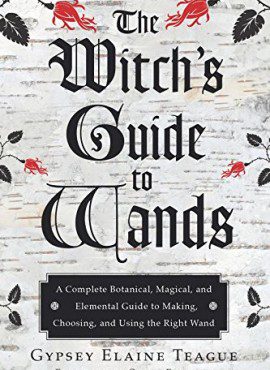
(We are honored to have Gypsey Elaine Teague as a guest here at Agora and Patheos Pagan. Not only are we running an excerpt from her latest book The Witch’s Guide to Wands, but we’ve also got a little guest post in the middle of the excerpt. You can order Gypsey’s latest book here and read a review of the book at this link. Thanks to Red Wheel/Weiser for contributing here at Patheos Pagan! -Jason, Editor & Harmless Drudge)
Wands. Without them we would be missing a great part of our tool kit. Scott Cunningham says in his book Wicca: A Guide for the Solitary Practitioner that you can even use a wooden dowel purchased from a hardware store as a wand. While that is true, and any piece of wood works under general conditions, it really is important to know the source of your mate¬rial and the conditions under which that piece was obtained.
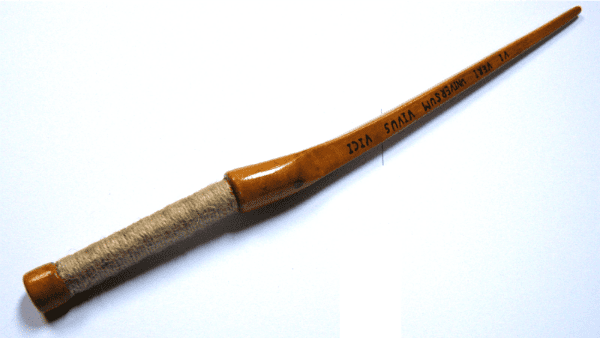
Photo by Martin Brož, from WikiMedia.
Another staple reference book of witchcraft is Raymond Buckland’s Complete Book of Witchcraft. Here, Buckland says that the power of the wand comes from the witch and not necessarily from the wand. I agree with that to a point. While you may practice magic naked with your index finger, it is important that you understand the power of the tools if you are going to use them. Therefore, I believe you should choose your wand more carefully than either Buckland or Cunningham suggest.
There is a partnership between the witch and the wand. Any witch who has his or her favorite or working wand will tell you the energy gener¬ated between the wand and the witch is significant and prevalent. Wands are like shoes or jeans or shirts or your favorite little black dress. When it’s right, it’s just right and you know it. Therefore, when you craft your first or third or ninth wand and it doesn’t respond to you, don’t worry. A piece of wood in the wild or in the lumberyard is very different once you begin talking to it and crafting it. Think of building your relationship with your wand as dating. You may go out on a number of dates with a number of different people before you get the right spark. And even then, after mar¬riage the spark may still not be right. So it is with your wand. Work for the spark, but don’t expect overnight success.
For a more detailed approach to wands, I recommend Dorothy Morrison’s book The Craft: A Witch’s Book of Shadows. Morrison goes into detail about the particular properties of wands and explains that it’s just not about wandering aimlessly, gathering sticks and twigs in the hopes that one might become a wand. She explains the harvesting of the wand, which I think is an essential part of all witch’s training. She also goes into detail about personalizing your wand after you have procured the material. These are all important aspects of the training young witches should receive.
Most authors agree that a wand should be approximately the length from the tip of your middle finger to the crook of your arm. This makes it the length of your hand and forearm. To me, that is a little long, and I personally like a shorter wand of about fourteen inches. But this book is not about length as much as it’s about substance, so I’m not going to lay down some grand law to follow in making your wand.
“All Wands Are Different?”
This is a question I get a lot when traveling and talking about wands and their properties. Many folks think that wood is just wood and if they think of the types at all many of them stay within the pantheon that they practice. In actuality all woods are different and therefore carry energy unique to their structure and thusly carry magic the same way.
Many times I have said that one simply does not serve soup with a butter knife. It’s a silly statement if you think of it since you would never attempt to serve a liquid with a flat surface but in reality we do that with our wands. A dense wood such as Ebony or Lignum Vitae will feel much different than a lighter wood like Wisteria or Basswood. While they are all vascular their structures are so different that it would be like trying to compare a car battery and a jar with two electrodes in salt water. They both create power but don’t try starting your car with a jar and some salt.
To that end I wrote a book. I think it’s a very good book but I’m a little, okay a lot, biased. What the book is, though, is an explanation of wands from a number of points of view. The book is first and foremost a book on the spiritual properties of woods and metals used in wands. However each item starts out with a number of other areas covered.
First each wood and metal is discussed in terms of origin. Where did the item come from? What kind of place is it found and what does it look like? As a Landscape Architect I talk about the wood itself, the taxonomy, the families and other woods of like mind.
I am also a wood worker, therefore next I discuss the hardness and how that lends itself to being made into a wand. Do you use a lathe or hand tools? Is the hardness scale so high or low that you must practice caution when applying tools to the wood? Ebony and Ipe are wonderful woods to work with but depending on the grain and the humidity may be heinous to turn on a lathe. And even though Eastern Red Cedar is a wonderful soft wood it is the worst wood to try to turn on a lathe because there are so many knots and the wood is exceptionally soft that even the slightest catch of the chisel will split the wand in two.
What myths and legends are concerned with the wood or metal? Each specimen has a section of legends and myths that may or may not affect the properties of the wand and the wand’s temperament. Please remember that wands are like people. Some are pretty, some are not. Some are fat, some are not. Some are straight and some are not. Some are nice and some, well some are not.
Finally the properties for the wood. What does the wand do and how well may you anticipate the results. If you want a healing wand then you don’t want a Black Walnut wand. Or if you want a wand for cooking then don’t expect a White Willow wand to be your best choice. The properties are just not there for those uses. That’s the nature of wands. The more you work with them the better you understand them; but again that’s also like people.
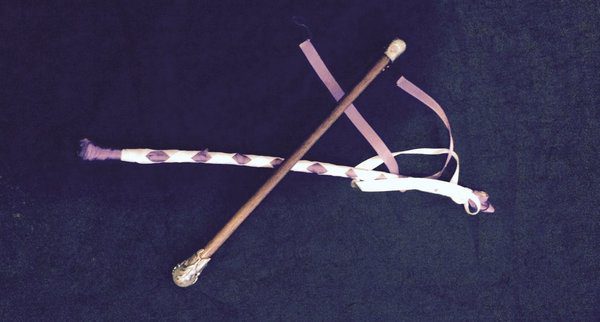
It is important to understand that there are wands and then there are wands. With the popularity of Harry Potter, wands have gained an elevated status in pop culture. An entire generation has grown up with a renewed sense of wand appreciation not seen since Disney’s Cinderella of 1960. Now, not just witches and fairy godmothers wield wands—every young child who has read Rowling’s books and envisioned him- or herself as a wizard at Hogwarts has a wand in hand.
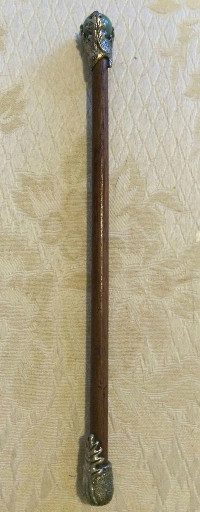 Unfortunately, these same children grow up not understanding the difference between a play stick called a wand and a wand as held by an actual magician. These children and adults believe that you can put a phoenix feather or a unicorn hair into a wand to gain more power against the Dark Lord. So is the way of popular culture, I suppose. However, for a detailed explanation of the wands of the Harry Potter books and how they correspond to the characters they chose, see the section later in this book.
There is a saying that one simply does not serve soup with a butter knife. This means we do not use the same tool for every occasion. In construction, people say that if all you have is a hammer, then everything begins to look like a nail. That is very true with wands. If we have one and only one wand, then I believe we can only do spells or rituals that accommodate that one particular wand. You can’t successfully perform a vast array of spells with a single wand any more than you can cook and serve an entire feast with a single butter knife. You must have more than one. This is a book of choices.
This book is also a book of construction. Each wand discussed will include how the wand was made. The lathe is just a tool; but then again, so is a wand. Some wands should be crafted at specific times and days of the month or even the year. If you cast a variety of spells and perform a pleth¬ora of rituals, then you should, and I say “should” since I don’t want to be accused of being dogmatic, have a wand for each area within which you are working. And not all wands should be from a single material. Wands are like anything else you use. If you must have two or three traits for a spell, then why not turn a wand out of two or three different woods?
Wands are also like batteries; there is a positive end and a negative end. I polled my witch community to ask how they use their wands. Over 90 percent said they use the pointy end only, which we will refer to as the head of the wand. A good friend added that if the wand is unidirectional—that is, one end is pointier than the other—then he will only cast with the head, but if he has a wand that has no head, then he considers it a bidirectional wand and either end will do. I agree with that wholeheartedly for him, but I contend that even if there is a head and a base, you still may use both ends.
A battery is powerful from both ends, and you must connect a wire to each end to draw the current from it. So is it with a wand. However, do not think of the metaphor of the battery as a discussion of good and evil. The positive and negative ends of the battery are just two sides of the same force, like two sides of the same coin. Neither is better or worse. They are used in conjunction to be a complete whole. Sort of like the yin and yang of the power you are holding.
If you are using a peach wand, the properties are both positive—love and fertility—as well as negative—exorcism. For love and fertility you would hold the base and direct your energy with the head. If you were working an exorcism or banishing spell, then you would need more of a negative power, the power of the base, and therefore you would turn the wand around and hold the head and use the base.
The section of the wand between the base and the head is the shaft. Some bases are ornamental or embellished. In a metal wand, the base may be large and fashioned around a crystal. In an organic wand, the base may be finely tooled or turned and marked with sigils or other symbols import¬ant to its user. Therefore, the base may extend far into the shaft, but that is what the wand dictates.
__________
Gypsey Elaine Teague is the author of The Witch’s Guide to Wands and Steampunk Magic, both published by Weiser Books. She is the Branch Head of the Gunnin Architecture Library at Clemson University as well as a member of the National Board of Certified Counselors, an Elder and High Priestess in the Georgian tradition, a High Priestess in the Icelandic Norse tradition, and a High Priestess and originator of Steampunk Magic. Teague is published in a number of areas and presents nationally on Steampunk history, literature, and popular culture.
Excerpt from The Witch’s Guide to Wands reprinted with kind permission from Red Wheel/Weiser, LLC.
Previous Post
August 5, 2015
Dandelion Seeds: A Guide to Involving Kids in Ritual
Next Post

August 8, 2015 Adventures in Wortcunning: The Goddesses - Finding Home
Browse Our Archives
Select a Category A Lakeside Hearth Adventures in Wortcunning Alone In Her Presence Arts, Crafts & Cooking Birthing Hereditary Witchcraft Book of Blackbirds Book Reviews Born-Again Witch Cauldron, Sword, Spear, & Stone Cermony and Liturgy Columns Community Dandelion Seeds Dear Jasmine Druid Thoughts Editor's Picks Everyday Pagan Family & Household Practice Family Traditions Full Frontal Magic Gateway Goddess Guest Articles Happily Heathen Health and Wellness Hearth of Hellenism Heathen Woman Hills of the Horizon History Holidays Horse Goddesses Interfaith Interviews Irish-American Witchcraft Jewish Witch Lamp & Labyrinth Letters from Midgard Literature, Media, Film, Music Loop of Brighid Love, Sex & Relationships Magic or Magick Making Light Naturalistic Traditions Nature News Outside The Circle Pantheisticon Politics Prayers, Poems, Blessings & Stories Queer Femme Mystic Queer of Swords Recipes Ritual and Practice Science and Research Seekers and Guides Seeking the Grail Socially Responsible Magic Spear of Athena Star Made Witch Syncretic Electric Technology The Blooming Staff The Busy Witch The Cartomancer The Crow's Nest The Dance of Pagan Recovery The Hearth of Hellenism The Lady's Quill The Other Side of the Hedge The Path of She The Rantin' Raven The Witches Next Door The Zen Pagan Theology, Ethics, Philosophy Tree City Witch Urban Earthwitch Wayfaring Woman Witch on Fire Wyrd Words
Select a Month January 2026 March 2025 December 2024 June 2024 April 2024 March 2024 January 2024 December 2023 November 2023 October 2023 August 2023 July 2023 May 2023 April 2023 March 2023 February 2023 January 2023 December 2022 November 2022 October 2022 September 2022 August 2022 July 2022 June 2022 May 2022 March 2022 February 2022 January 2022 December 2021 November 2021 October 2021 September 2021 August 2021 July 2021 June 2021 May 2021 April 2021 March 2021 February 2021 January 2021 December 2020 November 2020 October 2020 September 2020 August 2020 July 2020 June 2020 May 2020 April 2020 March 2020 February 2020 January 2020 December 2019 November 2019 October 2019 September 2019 August 2019 July 2019 June 2019 May 2019 April 2019 March 2019 February 2019 January 2019 December 2018 November 2018 October 2018 September 2018 August 2018 July 2018 June 2018 May 2018 April 2018 March 2018 February 2018 January 2018 December 2017 November 2017 October 2017 September 2017 August 2017 July 2017 June 2017 May 2017 April 2017 March 2017 February 2017 January 2017 December 2016 November 2016 October 2016 September 2016 August 2016 July 2016 June 2016 May 2016 April 2016 March 2016 February 2016 January 2016 December 2015 November 2015 October 2015 September 2015 August 2015 July 2015 June 2015 May 2015 April 2015 March 2015 February 2015 January 2015 December 2014 November 2014 October 2014 September 2014 August 2014 July 2014 June 2014 May 2014 April 2014 March 2014 February 2014 January 2014 December 2013 November 2013 October 2013 September 2013 August 2013 July 2013 June 2013 May 2013 April 2013 March 2013 February 2013 January 2013 December 2012 November 2012 October 2012 September 2012 August 2012 July 2012 June 2012 May 2012 April 2012 March 2012 February 2012 January 2012
Follow Us!
TAKE THE
Religious Wisdom Quiz
At a well in Samaria, I asked a woman for a drink and told her about living water. How many husbands had she had?
Select your answer to see how you score.
Two Seven Five Three
Related posts from Agora

Simple Witchery: To Keep Silent

Simple Witchery: Leaning On The Four Pillars


Simple Witchery: Resistance and Resilience in Hard Times
TRENDING AT PATHEOS Pagan

I was recently chatting with someone on Instagram. She asked me what...

While there are many people who share their results, the end of...

On July 23, I saw Christopher Nolan's The Odyssey which is Homer’s...

As I write this two big events have just finished up. One...

Restoring the Watershed of Divine Love
Perhaps cooperation is not something we manufacture through legislation, ideology, or moral...

Many UUs don’t pray because of bad experiences in a previous religion,...
view all Pagan blogs
Ad-Free & Subscriber Log-In Subscription Support
- About Us
- 2026 Calendar
- Videos
- Podcasts
- Library of World Religions
- Faith In Media Tracker
- Advertise With Us
- Write for Us
- Privacy Policy
- Terms of Service
- Do Not Sell My Data
- Contact Us
- Radiant Digital
- Manage Newsletter Subscriptions
- Unsubscribe From Notifications
- Sitemap
Copyright 2008-2026, Patheos. All rights reserved.
Subscription Support Ad-Free & Subscriber Log-In
Follow Patheos