
BuddhistCatholicContemplativeEvangelicalGeneral ChristianHinduJewishLatter-day SaintMuslimNew VisionsProgressive Christian
Beliefs
- Buddhist
- Catholic
- Contemplative
- Evangelical
- General Christian
- Hindu
- Jewish
- Latter-day Saint
- More Voices
- Muslim
- New Visions
- Pagan
- Progressive Christian
Topics
- Religion News
- Food and Religion
- Sports and Religion
- Religious Art
- Religious Music and Entertainment
- Religious Events
- History and Religion
- Style and Religion
- Politics and Religion
- Women in Religion
- Recreation Outdoors and Religion
- Business Finance and Religion
- Careers Workplace and Religion
- Education and Religion
- Family Parenting and Religion
- Health Fitness and Religion
- Home and Religion
- Relationships and Religion
- Technology and Religion
- Travel and Religion
Columnists
- Buddhist Columnists
- Business Finance and Religion Columnists
- Careers Workplace and Religion Columnists
- Catholic Columnists
- Contemplative Columnists
- Education and Religion Columnists
- Evangelists Columnists
- Family Parenting and Religion Columnists
- General Christian Columnists
- Health Fitness and Religion Columnists
- Hindu Columnists
- History and Religion Columnists
- Home and Religion Columnists
- Jewish Columnists
- More Voices Columnists
- Latter Day Columnists
- Muslim Columnists
- New Visions Columnists
- Nonreligious Columnists
- Pagan Columnists
- Politics and Religion Columnists
- Progressive Columnists
- Recreation Outdoors and Religion Columnists
- Relationships and Religion Columnists
- Religion News Columnists
- Religious Art Columnists
- Religious Events Columnists
- Religious Music and Entertainment Columnists
- Sports and Religion Columnists
- Style and Religion Columnists
- Technology and Religion Columnists
- Travel and Religion Columnists
- Women in Religion Columnists
Resource Library
- 2026 Calendar
- Library of World Religions
- The 100 Most Holy Places on Earth
- Patheos Answers
- Podcasts
- Videos
- Faith Leaders Database
- Anglican Episcopalian
- Bahai
- Baptist
- Buddhism
- Christianity
- Confucianism
- Eastern Orthodoxy
- Hinduism
- Holiness and Pentecostal
- ISKCON
- Islam
- Judaism
- Lutheran
- Methodist
- The Church of Jesus Christ of Latter-day Saints
- New Age
- Paganism
- Presbytarian and Reformed
- Protestantism
- Religion Behind the Scenes
- Roman Catholic
- Scientology
- Shia Islam
- Sikhism
- Sufism
- Sunni Islam
- Taoism
- Zen
- See all religions
Research Tools
 Ad-Free & Subscriber Log-In Subscription Support
Ad-Free & Subscriber Log-In Subscription Support
Follow Patheos 

- Trending:
- Forgiveness
- |
- Marriage
- |
- Consciousness
- |
- Death Penalty
- |
- Election
- |
- Halloween

- Home
- Pagan
- Spear of Athena: Books for the Curious and New
Spear of Athena: Books for the Curious and New
Last updated on: July 24, 2015 at 1:15 am by Conor Warren
Spear of Athena: Books for the Curious and New 2015-07-24T01:15:37+00:00 Conor Warren
Patheos Explore the world's faith through different perspectives on religion and spirituality! Patheos has the views of the prevalent religions and spiritualities of the world.
A new face shows up in the message boards, “where should I begin?” they inquire. It is rather painfully true that Hellenism has a dearth of “starter” material available, and what is available is often written by people who think they have the one “true” iteration of Hellenism. So most people just list primary and secondary resources with a sentence or two about them, which is good but perhaps not sufficient. Shifting to a polytheistic theology takes more than just reading a couple of books; it helps to learn about models which have persisted into the modern world too. So here is my slightly different “starter” books, two for historical background and two for just starting to foment a new perspective.
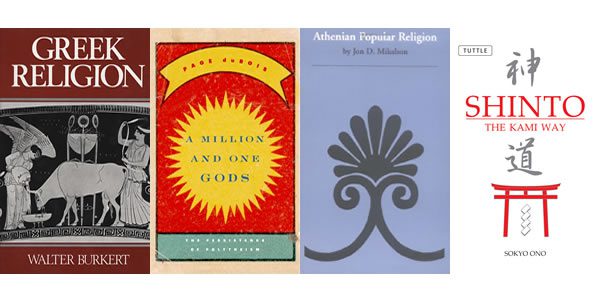
Images courtesy of (left to right)
Harvard University Press / Harvard University Press
The University of North Carolina Press / Simon and Schuster
Walter Burket, Greek Religion
Greek Religion is considered by many to be Burkert’s magnum opus, providing a detailed interpretation of the available archaeological data at the time. Greek Religion is an ambitious work. Beginning with the roots of the cultic practices as they emerged during the Mycenaean period and going to the end of the Classical age, Burkert provides a holistic look at the religious practices of the ancient Greeks. He examines major festivals, types of offerings, deities and how perceptions changed over time (as well as a cautious etymology for some names), and even a view of how philosophical schools interacted with and changed public perceptions of the gods and what we would call “religion.”
Burkert’s work is by no means perfect. He was not a polytheist himself. He was an academic and his interpretations of data are done to support the theories of ritual sacrifice that he put forward (as discussed and outlined in his work Homo Necans). So one must keep in mind these facts when reading his interpretations and explanations of data. His work, of course, tends to also be quite dry. Bearing these in mind will allow one to read one of the most important works available to modern day Hellenists and develop a broad historical background.
Paige duBois, A Million and One Gods: The Persistence of Polytheism
A Million and One Gods provides a brilliant examination of both how polytheism and polytheistic ideas have survived in the West and how they persist in even the Abrahamic faiths as well as a reasonable defense for polytheism. Part of her argument is based upon the tolerance that polytheistic faiths typically allow for and how this may be better suited for today’s pluralistic and multicultural societies. Her argument is sound, well-formed, and interesting and I recommend this book to everybody–polytheist and monotheist alike–it can provide a great foundation for getting rid of some monotheistic baggage.
Most importantly, the book makes a great case for the importance of polytheism and can give one hope for the long term viability of polytheism in today’s society. While it likely won’t directly inform any sort of practice, it will definitely expand your intellectual horizons regardless of theological position.
Jon D. Mikalson, Athenian Popular Religion
It is unfortunately true that much of what we know about ancient Greek theological concepts are those presented to us in the works of various philosophers, especially Plato. Thus the average citizen is viewed by some as a theological non-entity, an individual who offers to the gods but gives little thought to the machinations or nature of the deities. Unfortunately due to this dearth many folks have insisted that developing Western polytheistic schools of theology is completely unimportant due to the unimportance in ancient days. Mikalson’s work shows us just the contrary. While the average person was by no means a theologian, his work Athenian Popular Religion deftly demonstrates that ideas the average citizen had about the gods, the afterlife, and the ancestors had a profound effect upon their lives. At times these ideas would soothe their anxieties, at times they would heighten them especially in regards to what lies beyond the veil of this life.
The modern practitioner will be able to discern some important cultic concepts, this is true, but most importantly they will be able to determine for themselves how important developing these concepts and what makes the most sense to believe and practice in a modern setting as informed by the historical setting.
Sokyo Ono, Shinto: The Kami Way
Many Western polytheists carry around a lot of strange, dangerous, or contradictory concepts about how they should engage in their tradition and carry on with being a polytheist because of the lack of role models in our Protestant Christian society. While I am hesitant to refer to Shinto as polytheistic (kami, from what I have read and studied, are divine beings of degrees of power; calling them gods isn’t exactly a great translation). Many of the practices in the ethnoreligious tradition will be extremely familiar to most Western polytheists. For those of us engaging in reconstructionist efforts this short examination can be vitally useful in helping us determine what is worth reconstructing and what may be better left in the museums.
Sokyo Ono explains basic concepts in Shinto: the Kami Way such as shrines, worship styles, festivals theological concepts, and even how Shinto has interacted with Japan’s political and social climate over the years. This work is a true treasure for the Western polytheist and can really help us identify areas that may be problematic for us and ways in which we can remedy them. More importantly you get to learn about a really cool, ancient, and continuous tradition that has survived interactions with both Buddhist and Christian missionaries.
Things to Remember
- It is helpful to remember, as Rabbi Mordecai Kaplan put it “the past has a vote, not a veto.” Just because something was or was not done in a particular way in ancient times doesn’t mean that you must do or not do it that way. Think about things critically and make your decisions carefully.
- Be patient. A lot of this material can be difficult for some individuals to process and even exceptionally intelligent people have to chew on this information to properly apply it. You may wind up reading a book two or three times. Personally, I make an effort to read the books I listed once a year. Rereading, while it can be tedious, can be immensely helpful and yield new insights.
- Synthesize information. Don’t simply say to yourself “well Burkert said …” read as many books as you can get your hands on and synthesize the information for your conclusions. It’ll help you and those you discuss praxis and theology with get an even better handle on concepts.
- Amidst your reading don’t forget to practice. Reading and getting a grasp on how all of this stuff works is pretty important but you cannot replace doing with studying. Part of being in a living tradition is well … living! Experience the gods and spirits and use that knowledge in conjunction with what you’ve been studying and you will do well.

Click here to like
Patheos Pagan on Facebook.

Click here to like
the Agora on Facebook
Spear of Athena is posted on alternate Thursdays here at the Agora. Subscribe by RSS or e-mail!
Please use the links to the right to keep on top of activities here on the Agora as well as across the entire Patheos Pagan channel.
Previous Post

July 8, 2015
Socially Responsible Magic: Values, Assumptions, and Internal Work
Next Post
July 10, 2015 Personal Gnosis: A Conversation
Browse Our Archives
Select a Category A Lakeside Hearth Adventures in Wortcunning Alone In Her Presence Arts, Crafts & Cooking Birthing Hereditary Witchcraft Book of Blackbirds Book Reviews Born-Again Witch Cauldron, Sword, Spear, & Stone Cermony and Liturgy Columns Community Dandelion Seeds Dear Jasmine Druid Thoughts Editor's Picks Everyday Pagan Family & Household Practice Family Traditions Full Frontal Magic Gateway Goddess Guest Articles Happily Heathen Health and Wellness Hearth of Hellenism Heathen Woman Hills of the Horizon History Holidays Horse Goddesses Interfaith Interviews Irish-American Witchcraft Jewish Witch Lamp & Labyrinth Letters from Midgard Literature, Media, Film, Music Loop of Brighid Love, Sex & Relationships Magic or Magick Making Light Naturalistic Traditions Nature News Outside The Circle Pantheisticon Politics Prayers, Poems, Blessings & Stories Queer Femme Mystic Queer of Swords Recipes Ritual and Practice Science and Research Seekers and Guides Seeking the Grail Socially Responsible Magic Spear of Athena Star Made Witch Syncretic Electric Technology The Blooming Staff The Busy Witch The Cartomancer The Crow's Nest The Dance of Pagan Recovery The Hearth of Hellenism The Lady's Quill The Other Side of the Hedge The Path of She The Rantin' Raven The Witches Next Door The Zen Pagan Theology, Ethics, Philosophy Tree City Witch Urban Earthwitch Wayfaring Woman Witch on Fire Wyrd Words
Select a Month January 2026 March 2025 December 2024 June 2024 April 2024 March 2024 January 2024 December 2023 November 2023 October 2023 August 2023 July 2023 May 2023 April 2023 March 2023 February 2023 January 2023 December 2022 November 2022 October 2022 September 2022 August 2022 July 2022 June 2022 May 2022 March 2022 February 2022 January 2022 December 2021 November 2021 October 2021 September 2021 August 2021 July 2021 June 2021 May 2021 April 2021 March 2021 February 2021 January 2021 December 2020 November 2020 October 2020 September 2020 August 2020 July 2020 June 2020 May 2020 April 2020 March 2020 February 2020 January 2020 December 2019 November 2019 October 2019 September 2019 August 2019 July 2019 June 2019 May 2019 April 2019 March 2019 February 2019 January 2019 December 2018 November 2018 October 2018 September 2018 August 2018 July 2018 June 2018 May 2018 April 2018 March 2018 February 2018 January 2018 December 2017 November 2017 October 2017 September 2017 August 2017 July 2017 June 2017 May 2017 April 2017 March 2017 February 2017 January 2017 December 2016 November 2016 October 2016 September 2016 August 2016 July 2016 June 2016 May 2016 April 2016 March 2016 February 2016 January 2016 December 2015 November 2015 October 2015 September 2015 August 2015 July 2015 June 2015 May 2015 April 2015 March 2015 February 2015 January 2015 December 2014 November 2014 October 2014 September 2014 August 2014 July 2014 June 2014 May 2014 April 2014 March 2014 February 2014 January 2014 December 2013 November 2013 October 2013 September 2013 August 2013 July 2013 June 2013 May 2013 April 2013 March 2013 February 2013 January 2013 December 2012 November 2012 October 2012 September 2012 August 2012 July 2012 June 2012 May 2012 April 2012 March 2012 February 2012 January 2012
Follow Us!
TAKE THE
Religious Wisdom Quiz
How long did the judges rule before kings?
Select your answer to see how you score.
300 years 200 years Approximately 350 years 400 years
Related posts from Agora

Simple Witchery: To Keep Silent

Simple Witchery: Leaning On The Four Pillars

Pergamum Unfurled: Magic with the Greek Gods (Book...

Pergamum Unfurled: Cunning Words (Review)
TRENDING AT PATHEOS Pagan

I was recently chatting with someone on Instagram. She asked me what...

While there are many people who share their results, the end of...

On July 23, I saw Christopher Nolan's The Odyssey which is Homer’s...

As I write this two big events have just finished up. One...

Restoring the Watershed of Divine Love
Perhaps cooperation is not something we manufacture through legislation, ideology, or moral...

Many UUs don’t pray because of bad experiences in a previous religion,...
view all Pagan blogs
Ad-Free & Subscriber Log-In Subscription Support
- About Us
- 2026 Calendar
- Videos
- Podcasts
- Library of World Religions
- Faith In Media Tracker
- Advertise With Us
- Write for Us
- Privacy Policy
- Terms of Service
- Do Not Sell My Data
- Contact Us
- Radiant Digital
- Manage Newsletter Subscriptions
- Unsubscribe From Notifications
- Sitemap
Copyright 2008-2026, Patheos. All rights reserved.
Subscription Support Ad-Free & Subscriber Log-In
Follow Patheos