
BuddhistCatholicContemplativeEvangelicalGeneral ChristianHinduJewishLatter-day SaintMuslimNew VisionsProgressive Christian
Beliefs
- Buddhist
- Catholic
- Contemplative
- Evangelical
- General Christian
- Hindu
- Jewish
- Latter-day Saint
- More Voices
- Muslim
- New Visions
- Pagan
- Progressive Christian
Topics
- Religion News
- Food and Religion
- Sports and Religion
- Religious Art
- Religious Music and Entertainment
- Religious Events
- History and Religion
- Style and Religion
- Politics and Religion
- Women in Religion
- Recreation Outdoors and Religion
- Business Finance and Religion
- Careers Workplace and Religion
- Education and Religion
- Family Parenting and Religion
- Health Fitness and Religion
- Home and Religion
- Relationships and Religion
- Technology and Religion
- Travel and Religion
Columnists
- Buddhist Columnists
- Business Finance and Religion Columnists
- Careers Workplace and Religion Columnists
- Catholic Columnists
- Contemplative Columnists
- Education and Religion Columnists
- Evangelists Columnists
- Family Parenting and Religion Columnists
- General Christian Columnists
- Health Fitness and Religion Columnists
- Hindu Columnists
- History and Religion Columnists
- Home and Religion Columnists
- Jewish Columnists
- More Voices Columnists
- Latter Day Columnists
- Muslim Columnists
- New Visions Columnists
- Nonreligious Columnists
- Pagan Columnists
- Politics and Religion Columnists
- Progressive Columnists
- Recreation Outdoors and Religion Columnists
- Relationships and Religion Columnists
- Religion News Columnists
- Religious Art Columnists
- Religious Events Columnists
- Religious Music and Entertainment Columnists
- Sports and Religion Columnists
- Style and Religion Columnists
- Technology and Religion Columnists
- Travel and Religion Columnists
- Women in Religion Columnists
Resource Library
- 2026 Calendar
- Library of World Religions
- The 100 Most Holy Places on Earth
- Patheos Answers
- Podcasts
- Videos
- Faith Leaders Database
- Anglican Episcopalian
- Bahai
- Baptist
- Buddhism
- Christianity
- Confucianism
- Eastern Orthodoxy
- Hinduism
- Holiness and Pentecostal
- ISKCON
- Islam
- Judaism
- Lutheran
- Methodist
- The Church of Jesus Christ of Latter-day Saints
- New Age
- Paganism
- Presbytarian and Reformed
- Protestantism
- Religion Behind the Scenes
- Roman Catholic
- Scientology
- Shia Islam
- Sikhism
- Sufism
- Sunni Islam
- Taoism
- Zen
- See all religions
Research Tools
 Ad-Free & Subscriber Log-In Subscription Support
Ad-Free & Subscriber Log-In Subscription Support
Follow Patheos 

- Trending:
- Forgiveness
- |
- Marriage
- |
- Consciousness
- |
- Death Penalty
- |
- Election
- |
- Halloween

- Home
- Pagan
- The Zen Pagan: Ares and Athena in the #BaltimoreUprising
The Zen Pagan: Ares and Athena in the #BaltimoreUprising
Last updated on: May 8, 2015 at 4:00 pm by Tom Swiss
The Zen Pagan: Ares and Athena in the #BaltimoreUprising 2015-05-08T15:09:28+00:00 Tom Swiss
Patheos Explore the world's faith through different perspectives on religion and spirituality! Patheos has the views of the prevalent religions and spiritualities of the world.
Sometimes I hate being right. Months ago, I wrote
“The anger over Ferguson and these other incidents of police brutality, and over the unjust social structure that precipitates them, will not go away. Almost certainly it will be fed by fresh incidents. There will be fear and terror and horror.”
But, I didn’t think that it would hit quite so close to home so soon. I suppose that piece on wrathful deities was my Zen take on the topic of state violence; this week, my Pagan take and some Baltimorean reflections.
As a middle class white guy who has survived into his forties and whose criminal activity is pretty minor, I don’t have a lot of interaction with the police. There have been a handful of traffic tickets over the years and a few times I’ve filled out police reports on stolen property (fruitlessly). There was the time my housemate was being stalked, and I talked to the Baltimore County police as a witness and testified in court; there was also the time I was illegally stopped by the Baltimore City police while I was walking to a park that they claimed did not exist, part of the city’s harassment of the PowWow and the DIY arts scene — which is pretty small beer compared to their other crimes.

Baltimore Inner Harbor
Photo credit: Kevin Labianco / Foter / CC BY-NC-ND
For those not familiar with the area, I should explain that Baltimore is the largest “independent city” in the U.S. Baltimore City and Baltimore County are entirely separate political entities, with their own governments and police forces. I grew up and currently live in Baltimore County but am somewhat active in the city’s cultural life. I’m a white kid from the suburbs and I don’t claim to speak for the people of Sandtown or any other Baltimore neighborhood; but I do understand that what happens within the city limits affects me both directly and indirectly, so I’ve been watching the problems with the Baltimore City police for years.
(Not that the County cops don’t have problems too, like breaking into a house and killing a resident in a blitzkrieg “no knock” raid in search of a suspect who wasn’t even there and who was later acquitted of the original charges against him. [Anderson; “Rasheed Standford…”] One of the invading cops was killed, and of course the mainstream media coverage has portrayed him as a hero, never mind that he was engaged in unjustified police violence and was shot by a man defending his home. Need I point out that this happened in a heavily African-American neighborhood, and that it’s very unlikely to have gone down that way on my very very white street just two miles away? One does have to wonder if the attitudes and practices of the city police filter out to their colleagues in the suburbs, or if its just the same general rot at the heart of American policing affecting both groups.)
The first time I met a Baltimore City police officer socially, I was introduced by his daughter’s boyfriend. I guess that identified me as friendly, because within few minutes that member of Baltimore’s finest was telling me about his recent arrest of a petty criminal — a purse snatcher, if I remember correctly. “And when I caught the guy,” he said, “of course I gave him one” — he pantomimed punching — “for trying to get away.” (At least that’s the best I can remember his statement twenty-some years later.) It wasn’t a reluctant admission, not something that had happened in the excitement of a physical struggle, it was a proud claim.
Honestly, if a purse snatcher had happened to get punched an extra time or three by a victim I’d hardly be troubled about it. After all, I teach people how to punch and kick and stomp people who might try to rob them. I’ve even taught basic self-defense classes at the Free Spirit Gathering and Starwood. While I teach the principle of only using the necessary and proportionate force for self-defense, if a student happened to go a tiny bit over that line I wouldn’t be inclined to judge it a sin. I might even wag my finger about it while smiling on the inside. Or, even if a police officer got a little overheated in a physical struggle and threw an extra punch or two and then acknowledged the error, I’d file it under de minimis and let it go.
But, this was a cop bragging about some deliberate “street justice” that he’d dealt out to a bad guy. Someone who was supposed to be a trained and dispassionate professional with a duty to respect the rights of a criminal suspect, but who instead administered extrajudicial physical punishment to a suspect for trying to run.
I’ve been thinking about that quite a bit these past weeks, as Baltimore deals with the killing of Freddie Gray by police after an encounter which seems to have been provoked by nothing more than Gray trying to run away from a group of cops. A group, by the way, that included one officer with a disturbing history of violence including threats of murder. [Laughland]
If you find it incredible that the Baltimore City Police Department would continue to employ a man who had made drunken threats of murder, you don’t know the BCPD. This is the force that kept Gahji Tshamba on the roster after he shot a man while drunk in 2005; he stayed a Baltimore cop until he murdered an unarmed veteran in 2010.[“Off Duty…”] BCPD cops are arrested for personal or professional charges at a rate that one researcher estimated to be eight times the national average.[Bialik]
After Gray’s death, minor violence broke out on April 25th when a protest march headed towards the baseball stadium at Camden Yards. One factor in the violence seems to have been how protesters were harassed by drunken sports fans.[Soderberg] (The rest of the city was quiet that night. I was in Station North that evening, and everyone at Joe Squared had a frustrated laugh over the exaggerated news coverage.)
The shit didn’t really hit the fan until two days later, when paranoid police overreacted to rumors of planned youth violence, shut down a public transit hub immediately after schools let out, then began to be aggressive with students. Unsurprisingly, students returned the aggression, and things spiraled out of control for the rest of the night.[Brodey]
In Baltimore, police killed Freddie Gray, and police provoked the rioting. Across the nation, we’ve seen the story of police aggression play out again and again.
Do ancient Pagan spiritual traditions have anything to say about this?
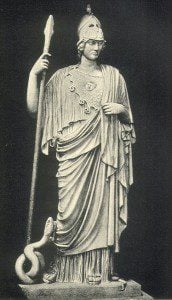
Statue of Athena, image via Wikimedia Commons
Many people don’t realize that the whole concept of a police force as we know it, as a large standing force of full-time enforcers for the state, is a recent invention. London’s Metropolitan Police Service, generally regarded as the first modern force, wasn’t established until 1829, under a plan drawn up by Sir Robert Peele.
These first modern police tried to walk a fine line between the necessary structure and discipline, and a desire to avoid being seen as an army enforcing the dictates of the government. [Balko, 29] The “Peelers” were issued a set of general instructions that included an admonishment that they were “To maintain at all times a relationship with the public that gives reality to the historic tradition that the police are the public and that the public are the police, the police being only members of the public who are paid to give full time attention to duties which are incumbent on every citizen in the interests of community welfare and existence.”[Home Office]
The first modern police force in the United States was established in New York City in 1845. These early American forces had some aspects that seem amazing today–they tried to adopt an even more democratic model than the Peelers, with police nominated by ward leaders of the neighborhood where they lived and worked, and acting more as public service agencies than law enforcers. This went to the point of the police including among their duties sheltering the homeless and feeding the hungry.
But, the “democracy” of the time was corrupted by political machines, and policing jobs became patronage positions. In the first half of the 20th century American policing moved in a more “professional” direction which isolated cops from ordinary citizens [Balko, 30-32], broke the Peelean principle the police and the public are one, and set the stage to the militarization of policing of the past few decades.
And so policing as we know it is too new for any traditional pantheons or mythologies to address directly. But there are more general lessons about violence, aggression, and defense that can be applied.
One such lesson is found in the contrast between the two ancient Greek deities of war: Athena and Ares.
Athena, goddess of wisdom, was not only full-grown but fully armed and armored when she sprang from the head of Zeus. Called “valiant in war” by Homer, she was the tutelary deity of Athens and second only to her father in the devotions of that city-state. Classicist Jane Harrison notes that “The rising democracy took the ancient figure of the local Korê and set her as rival and counterpoise to Poseidon, the old god of the aristocracy;” [Harrison, 16] her origins seem to be tied to those of democracy itself. She was not only a warrior but a jurist, known for her sense of justice; also the inventor of weaving. She taught humanity how to make not just such useful mechanisms as sails, the plow, the axe, and the wheel, but also the flute and the trumpet.[Gibson, 56] Truly she was and is a goddess of many sorts of craft and creativity, and when she fights, it is to protect that which has been created.

“VOA Baltimore Rifle.” Digital art by the author
Compare her with Ares, the aggressive bringer of death not only in war but in famine and pestilence, the thoughtless destroyer of whom Harrison says “He is splendid and forceful, but never really respected….Ares is a god, but he is unhonoured by the orthodox gods, the Olympians.” [Harrison, 40] In sharp contrast to Athena — and all too reminiscent of American police today — Ares was known for his lack of good judgment and his disregard of justice. At various times he finds himself humiliated by Hephaestus and by Otus and Ephialtes, the sons of Poseidon.
Every time Ares and Athena opposed each other–including during the Trojan War, one of the defining events of Ancient Greek civilization–it was Ares who lost.[Gibson, 41-42] The lesson of the myths is clear: aggression leads to failure; it falls to wisdom.
It’s not entirely accurate to see the Greek and Roman gods as equivalent, as we sometimes do in discussing classical mythology. As Padraic Colum wrote,
It is important to separate the Greek and Latin mythologies: Iuppiter, though akin to, is not the same as Zeus; Iuno is not the same as Hera. Minerva is not the same as Athena, Neptune is not the same as Poseidon. “The Romans worshipped not gods, not dei,” writes Miss Jane Harrison, “but powers, numina”:
These numina were only dim images of activities. They had no attributes, no life histories; in a word, no mythology.[Colum, xv]

“Riot Flowers.” Digital art by the author
But with that warning in mind, it’s noteworthy that where the Greeks had an almost disdainful attitude toward Ares, the Romans had Mars as the central figure of their worship[Colum, xv], claiming him as the father of their founders Romulus and Remus.[Colum, 107-108]
And, given the American Founding Fathers fondness for Rome, their preference for a Republic that ended in Empire over the original Democracy, perhaps we see here one of the faults at the very heart of our nation.
Aggression and brutality in the fashion of Ares have marked our foreign policy since the late 19th century. And that came home starting with the Nixon administration and coming into full flower with the Reagan era — the birth-time of so many of our contemporary national ills. It was Reagan’s Attorney General, William French Smith, who said that “The Justice Department is not a domestic agency. It is the internal arm of the national defense.”[Balko, 139] We have here the American government bringing the brutality of war fully and consciously and deliberately into our law enforcement.
Our society is too much Aresian and too little Athenian. We are too ready to give in to the easy mindless rage that ends in defeat and humiliation for the aggressor and destruction for their victims, rather than the difficult, judicious, creative — but still valiant and strong — way of wisdom. The problem is not merely political: it reaches to the deep spiritual level of how we see our relation with ourselves and the world.
But in the history of policing, in those Peelean principles and in the early American police who took care of citizens in need, we can see another way, one that follows the democratic maiden Athena.

“Mercy, Justice, Love.” Digital art by the author
References
Anderson, Jessica. “Family member criticizes raid that killed Balto. Co. officer, relative.” The Baltimore Sun. 29 Jan 2014. <http://articles.baltimoresun.com/2014-01-29/news/bs-md-co-rasheed-stanford-20140129_1_rasheed-stanford-officer-jason-schneider-tevon-smith>
Balko, Radley. Rise of the Warrior Cop : the militarization of America’s police forces. New York: PublicAffairs, 2013.
Bialik, Carl. “Baltimore’s Police Officers Have Been Arrested At High Rates.” FiveThirtyEight. <http://fivethirtyeight.com/datalab/baltimores-police-officers-have-been-arrested-at-high-rates/>
Brodey, Sam and Jenna McLaughlin. “Eyewitnesses: The Baltimore Riots Didn’t Start the Way You Think.” Mother Jones. 28 Apr 2015. <http://www.motherjones.com/politics/2015/04/how-baltimore-riots-began-mondawmin-purge>
Colum, Padraic. Orpheus: Myths of the World. New York: Macmillan, 1930. <http://www.sacred-texts.com/etc/omw/index.htm>
Gibson, Michael, and Giovanni Caselli. Gods, men & monsters from the Greek myths. New York: P. Bedrick, 1991.
Harrison, Jane. Myths of Greece and Rome. New York: Doubleday, Doran & Company, 1928. <http://www.sacred-texts.com/cla/mgr/index.htm>
Home Office [UK]. “Policing by consent.” GOV.UK. 10 Dec 2012. <https://www.gov.uk/government/publications/policing-by-consent>
Laughland, Oliver and Jon Swaine. “Baltimore police officer who chased Freddie Gray had pattern of violence – court filings.” The Guardian. 23 Apr 2015. <http://www.theguardian.com/us-news/2015/apr/23/baltimore-officer-who-chased-freddie-gray-had-pattern-of-violence-court-filings>
“Off-Duty Officer Fatally Shoots Unarmed Marine.” WBALTV. 7 Jun 2010. <http://www.wbaltv.com/Off-Duty-Officer-Fatally-Shoots-Unarmed-Marine/8927622>
“Rasheed Standford found not guilty in officer’s death.” WBALTV. 23 May 2014. <http://www.wbaltv.com/news/rasheed-standford-found-not-guilty-in-officers-death/26120334>
Soderberg, Brandon. “How drunk sports fans helped spark Saturday night’s post-protest violence.” City Paper [Baltimore]. 28 Apr 2015. <http://www.citypaper.com/bcpnews-how-drunk-sports-fans-helped-spark-saturday-nights-violence-20150428,0,75331.story>
“The Zen Pagan” appears every other Friday…for now. Changes are afoot! Watch this space! You can keep up by subscribing via RSS or e-mail.
My next scheduled events are the Free Spirit Gathering in June and Starwood in July.
If you do Facebook, you might choose to join a group on “Zen Paganism” I’ve set up there. And don’t forget to “like” Patheos Pagan over there, too.
Previous Post

May 7, 2015
The Hearth is for Warriors Too
Next Post

May 9, 2015 The Path of She: The Path of the Dark Goddess
Browse Our Archives
Select a Category A Lakeside Hearth Adventures in Wortcunning Alone In Her Presence Arts, Crafts & Cooking Birthing Hereditary Witchcraft Book of Blackbirds Book Reviews Born-Again Witch Cauldron, Sword, Spear, & Stone Cermony and Liturgy Columns Community Dandelion Seeds Dear Jasmine Druid Thoughts Editor's Picks Everyday Pagan Family & Household Practice Family Traditions Full Frontal Magic Gateway Goddess Guest Articles Happily Heathen Health and Wellness Hearth of Hellenism Heathen Woman Hills of the Horizon History Holidays Horse Goddesses Interfaith Interviews Irish-American Witchcraft Jewish Witch Lamp & Labyrinth Letters from Midgard Literature, Media, Film, Music Loop of Brighid Love, Sex & Relationships Magic or Magick Making Light Naturalistic Traditions Nature News Outside The Circle Pantheisticon Politics Prayers, Poems, Blessings & Stories Queer Femme Mystic Queer of Swords Recipes Ritual and Practice Science and Research Seekers and Guides Seeking the Grail Socially Responsible Magic Spear of Athena Star Made Witch Syncretic Electric Technology The Blooming Staff The Busy Witch The Cartomancer The Crow's Nest The Dance of Pagan Recovery The Hearth of Hellenism The Lady's Quill The Other Side of the Hedge The Path of She The Rantin' Raven The Witches Next Door The Zen Pagan Theology, Ethics, Philosophy Tree City Witch Urban Earthwitch Wayfaring Woman Witch on Fire Wyrd Words
Select a Month January 2026 March 2025 December 2024 June 2024 April 2024 March 2024 January 2024 December 2023 November 2023 October 2023 August 2023 July 2023 May 2023 April 2023 March 2023 February 2023 January 2023 December 2022 November 2022 October 2022 September 2022 August 2022 July 2022 June 2022 May 2022 March 2022 February 2022 January 2022 December 2021 November 2021 October 2021 September 2021 August 2021 July 2021 June 2021 May 2021 April 2021 March 2021 February 2021 January 2021 December 2020 November 2020 October 2020 September 2020 August 2020 July 2020 June 2020 May 2020 April 2020 March 2020 February 2020 January 2020 December 2019 November 2019 October 2019 September 2019 August 2019 July 2019 June 2019 May 2019 April 2019 March 2019 February 2019 January 2019 December 2018 November 2018 October 2018 September 2018 August 2018 July 2018 June 2018 May 2018 April 2018 March 2018 February 2018 January 2018 December 2017 November 2017 October 2017 September 2017 August 2017 July 2017 June 2017 May 2017 April 2017 March 2017 February 2017 January 2017 December 2016 November 2016 October 2016 September 2016 August 2016 July 2016 June 2016 May 2016 April 2016 March 2016 February 2016 January 2016 December 2015 November 2015 October 2015 September 2015 August 2015 July 2015 June 2015 May 2015 April 2015 March 2015 February 2015 January 2015 December 2014 November 2014 October 2014 September 2014 August 2014 July 2014 June 2014 May 2014 April 2014 March 2014 February 2014 January 2014 December 2013 November 2013 October 2013 September 2013 August 2013 July 2013 June 2013 May 2013 April 2013 March 2013 February 2013 January 2013 December 2012 November 2012 October 2012 September 2012 August 2012 July 2012 June 2012 May 2012 April 2012 March 2012 February 2012 January 2012
Follow Us!
TAKE THE
Religious Wisdom Quiz
How long did the judges rule before kings?
Select your answer to see how you score.
300 years 200 years Approximately 350 years 400 years
Related posts from Agora

Salt City Pagan: The Tale of Theism

Salt City Pagan: Expanding on Disbelief

The Corner Crone: The Infinite Possibility of Twilight

The Corner Crone: Lift Every Voice
TRENDING AT PATHEOS Pagan

I was recently chatting with someone on Instagram. She asked me what...

While there are many people who share their results, the end of...

On July 23, I saw Christopher Nolan's The Odyssey which is Homer’s...

As I write this two big events have just finished up. One...

Restoring the Watershed of Divine Love
Perhaps cooperation is not something we manufacture through legislation, ideology, or moral...

Many UUs don’t pray because of bad experiences in a previous religion,...
view all Pagan blogs
Ad-Free & Subscriber Log-In Subscription Support
- About Us
- 2026 Calendar
- Videos
- Podcasts
- Library of World Religions
- Faith In Media Tracker
- Advertise With Us
- Write for Us
- Privacy Policy
- Terms of Service
- Do Not Sell My Data
- Contact Us
- Radiant Digital
- Manage Newsletter Subscriptions
- Unsubscribe From Notifications
- Sitemap
Copyright 2008-2026, Patheos. All rights reserved.
Subscription Support Ad-Free & Subscriber Log-In
Follow Patheos