
BuddhistCatholicContemplativeEvangelicalGeneral ChristianHinduJewishLatter-day SaintMuslimNew VisionsProgressive Christian
Beliefs
- Buddhist
- Catholic
- Contemplative
- Evangelical
- General Christian
- Hindu
- Jewish
- Latter-day Saint
- More Voices
- Muslim
- New Visions
- Pagan
- Progressive Christian
Topics
- Religion News
- Food and Religion
- Sports and Religion
- Religious Art
- Religious Music and Entertainment
- Religious Events
- History and Religion
- Style and Religion
- Politics and Religion
- Women in Religion
- Recreation Outdoors and Religion
- Business Finance and Religion
- Careers Workplace and Religion
- Education and Religion
- Family Parenting and Religion
- Health Fitness and Religion
- Home and Religion
- Relationships and Religion
- Technology and Religion
- Travel and Religion
Columnists
- Buddhist Columnists
- Business Finance and Religion Columnists
- Careers Workplace and Religion Columnists
- Catholic Columnists
- Contemplative Columnists
- Education and Religion Columnists
- Evangelists Columnists
- Family Parenting and Religion Columnists
- General Christian Columnists
- Health Fitness and Religion Columnists
- Hindu Columnists
- History and Religion Columnists
- Home and Religion Columnists
- Jewish Columnists
- More Voices Columnists
- Latter Day Columnists
- Muslim Columnists
- New Visions Columnists
- Nonreligious Columnists
- Pagan Columnists
- Politics and Religion Columnists
- Progressive Columnists
- Recreation Outdoors and Religion Columnists
- Relationships and Religion Columnists
- Religion News Columnists
- Religious Art Columnists
- Religious Events Columnists
- Religious Music and Entertainment Columnists
- Sports and Religion Columnists
- Style and Religion Columnists
- Technology and Religion Columnists
- Travel and Religion Columnists
- Women in Religion Columnists
Resource Library
- 2026 Calendar
- Library of World Religions
- The 100 Most Holy Places on Earth
- Patheos Answers
- Podcasts
- Videos
- Faith Leaders Database
- Anglican Episcopalian
- Bahai
- Baptist
- Buddhism
- Christianity
- Confucianism
- Eastern Orthodoxy
- Hinduism
- Holiness and Pentecostal
- ISKCON
- Islam
- Judaism
- Lutheran
- Methodist
- The Church of Jesus Christ of Latter-day Saints
- New Age
- Paganism
- Presbytarian and Reformed
- Protestantism
- Religion Behind the Scenes
- Roman Catholic
- Scientology
- Shia Islam
- Sikhism
- Sufism
- Sunni Islam
- Taoism
- Zen
- See all religions
Research Tools
 Ad-Free & Subscriber Log-In Subscription Support
Follow Patheos 

- Trending:
- Advent
- |
- Forgiveness
- |
- Thanksgiving
- |
- Election
- |
- Seasonal Holidays
- |
- Marriage

- Home
- Pagan
- The Zen Pagan: What Does It Mean For the Gods to Exist?
The Zen Pagan: What Does It Mean For the Gods to Exist?
Last updated on: February 27, 2015 at 5:00 pm by Tom Swiss
The Zen Pagan: What Does It Mean For the Gods to Exist? 2015-02-27T14:55:33+00:00 Tom Swiss
Patheos Explore the world's faith through different perspectives on religion and spirituality! Patheos has the views of the prevalent religions and spiritualities of the world.
Super-Kings With Special Substance
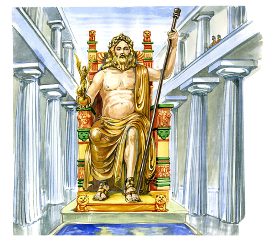
Courtesy ShutterStock.
Imagine that we could grab a sample of typical citizens off the streets of various civilizations throughout history, from the Sumerians to today, and quiz them about ontology — the branch of philosophy that studies existence. I think we would get a naive sort of realism. This brick? It exists, our subject replies, what a stupid question. The unicorn that the town drunk said he saw behind the tavern? It does not exist, it’s a fiction or a delusion or a lie. A good story, though, the bit about that unicorn and the blacksmith’s daughter is true even if it’s not, you know, “factual”. The number three? It exists — see, I have three coins in my pocket. (You think I can’t count or something?) People like you and me? Of course we exist, we’re standing here talking to each other.
And if we also asked them about theology, if we asked them to describe the primary deity of their culture’s pantheon, I think the picture that would emerge is that of a king but even moreso — a super-king, a magic king. Indeed, in some cultures a king could be promoted to godhood.
The idea of kings is central to the hierarchical social structure that has been with us since we became farmers and city-dwellers. Every citizen controls some bit of land, from the peasant’s plot to the lord’s realm; and each man has power over some number of people, from the head of the peasant household ruling his wife and children to the chief of the whole nation. The kings are the ones on the top of their various heaps, the ones who rule the most land and the most people.
And even though I’m a Zenarchist who looks forward to Universal Enlightenment and the subsequent abolition of the state, I have to acknowledge that a lot of people find that hierarchy very comforting. Someone is in charge. People can know their place in the social order.
But why stop there? It’s an obvious extrapolation to follow that curve upward: there must be a ruler of the whole world and everything we see, the sun and the moon and the sea and the rains. It would take power far beyond what any mortal has to rule all that. Magic power. And this ruler would have a royal court, of course. There’s your head deity and your pantheon.
And that heavenly king is comforting to a lot of people too. There is not just a social order but a cosmological order. God is in his heaven and all’s right with the world.
Even most citizens of the nominally democratic United States believe in the heavenly King of Kings — and we’ll leave for another time the problematic implications of spiritual monarchy in a democracy. (The Athenians at least had Zeus’s kingship of the gods be subject to limitations.)
The point I want to emphasize here is that there is a common and unsophisticated notion of deity which I think at least in part comes from projecting hierarchical social structure upwards. As below, so above.
And it’s worth pointing out that only as that agricultural social structure has started to fall apart the past few centuries — starting with the humanism of the Renaissance and moving through the birth of modern science in the Enlightenment and the whole-scale social change of the Industrial Revolution — has atheism been able to find any sort of social opening. It would be interesting to trace the parallels between the rise of philosophical atheism and the rise of philosophical anarchism. Maybe as we’re figuring out that we don’t need kings on earth, we don’t need them in heaven. Again, as below, so above.
Put this “common sense” ideas of deities and of existence together you get the gods — and goddesses, but let’s be honest, the power dynamic in religion has historically been as sexist as it is in politics — as super-powered super-royalty. Kings (and Queens) and Princes of the Universe, Lords (and Ladies) of All, possessed of the power to bend and shape the world to their liking, as real and as independent of human beings as bricks are (at least according to our common sense), but made of a more rarefied sort of substance not subject to the constraints of normal matter.
Under that set of definitions, I confidently assert that reason leads us to conclude that no gods exist, that they are like the town drunk’s unicorn: fiction, delusion, or lies, perhaps useful as metaphors, but not real. Not only that, but not being a big fan of kings I’m downright glad to say that no such gods exist. Ha! I thumb my nose at the empty heavens!
But these are not the only notions of “realness” or of deity out there.
I want to look at some alternative ideas, but I want to be clear that I’m just pointing out a vast range of possibilities, not claiming that I have the True Understanding of the nature of existence and of the gods. (Not yet, at least.)
What Does It Mean to Exist? Anatman…
Existence is a weirder thing than we think of in our day-to-day life. Let’s consider for a moment the existence of a subject near and dear to my heart: me. According to the teachings of Buddhism, in a sense I do not exist.
I don’t mean that there’s some conspiracy to present a fake author, or that everything we experience is a dream or a simulation a la The Matrix. The teaching called anatman (Sanskrit) or anatta (the Pali equivalent) says: okay, your physical body exists, you have emotional reactions and senses like sight and hearing and touch and time, and you perceive the world and you have memory and intellect. But nowhere in these piles of stuff, these skandhas, is there a self that’s separate from it all, an atman.[Keown, 734-738; Hahn, 9] If you take me apart there’s no self in there, any more than if you disassemble an old style mechanical watch you’ll find the “watchness” in there somewhere.
The “watchness” of the watch exists only as a relationship of the pieces and of the external world — mostly the owner who keeps winding it and uses it to tell time, but also the watchmaker, the owner’s wife who gave it to him as a gift, and so on. The “me-ness” of the thing we call by convention “Tom Swiss” exists only as a relationship of the pieces — body, memories, perceptions — and of the world, both physical and social. “Dependent arising”, as the Buddhists say.
“I” exist only as a set of relationships that includes the food I eat, the air I breathe, the sunlight that powers the photosynthesis that makes all that possible; and also all the other humans with whom I participate in the social interaction that makes thought possible. (No interaction, no language; no language, no thought as we usually understand it.) The Zen teacher Thich Nhat Hahn often speaks of “interbeing”.[Hahn, 3]
It’s like the punchline of a famous Mullah Nasrudin story: “I am here because of you, and you are here because of me.”[Shah,2]
If “my” existence is so conditional on the world around me and on other people…what should we expect about the deities?
…and the Ouija Board
And if that’s a puzzler, consider for a moment the Ouija board. Or any sort of automatic writing controlled by more than one person at the same time, but Charles Kennard’s good old “talking board” (a brand originally made in Baltimore,[McRobbie] hometown pride) is probably familiar to American Pagan readers. Odds are good that you played around with one a little when you were a kid, or at least knew someone who did.
If you’re using a Ouija board solo and holding a conversation with some sort of Other, from a skeptical perspective it’s easy to say that the Other is an aspect of your own subconscious mind, that you’ve worked yourself into a disassociative state. It’s weird and tells us some interesting things about the mind, but doesn’t bring up any ontological issues.
But if you’ve ever experimented with using one with a partner (or several people, a Ouija-a-trois) and you’ve been able to have some sort of sensible conservation with some sort of something…what was it?

Courtesy WikiMedia Commons.
If, as skeptical atheist types, we discount supernatural disembodied spirits, and if we assume our fellow Ouijaers weren’t engaged in some conspiracy to fool us, what was on the other end of the line? It seems that these conversations were held with a mind whose physical correlate was not a single brain, but a shifting collection of the neurons of two or more brains, linked not only by the usual synapses but by non-conscious verbal and non-verbal communication between the people holding the planchette. A weak sort of group mind — “weak” in the sense of not absorbing the participants. Not a mob, not a Borg.
I don’t mean that this “group mind” is anything supernatural or paranormal or telepathic, just more subtle than we usually encounter.
So, consider: what sort of weak group minds might arise in the subconscious minds of an entire society over a long time? Could the right sort of ritual function as a talking board to let them communicate?
Previous Post
February 25, 2015
Alone In Her Presence: An Open Heart and a Naked Soul
Next Post

March 3, 2015 The Busy Witch: Snow and Stillness
Browse Our Archives
Select a Category A Lakeside Hearth Adventures in Wortcunning Alone In Her Presence Arts, Crafts & Cooking Birthing Hereditary Witchcraft Book of Blackbirds Book Reviews Born-Again Witch Cauldron, Sword, Spear, & Stone Cermony and Liturgy Columns Community Dandelion Seeds Dear Jasmine Druid Thoughts Editor's Picks Everyday Pagan Family & Household Practice Family Traditions Full Frontal Magic Gateway Goddess Guest Articles Happily Heathen Health and Wellness Hearth of Hellenism Heathen Woman Hills of the Horizon History Holidays Horse Goddesses Interfaith Interviews Irish-American Witchcraft Jewish Witch Lamp & Labyrinth Letters from Midgard Literature, Media, Film, Music Loop of Brighid Love, Sex & Relationships Magic or Magick Making Light Naturalistic Traditions Nature News Outside The Circle Pantheisticon Politics Prayers, Poems, Blessings & Stories Queer Femme Mystic Queer of Swords Recipes Ritual and Practice Science and Research Seekers and Guides Seeking the Grail Socially Responsible Magic Spear of Athena Star Made Witch Syncretic Electric Technology The Blooming Staff The Busy Witch The Cartomancer The Crow's Nest The Dance of Pagan Recovery The Hearth of Hellenism The Lady's Quill The Other Side of the Hedge The Path of She The Rantin' Raven The Witches Next Door The Zen Pagan Theology, Ethics, Philosophy Tree City Witch Urban Earthwitch Wayfaring Woman Witch on Fire Wyrd Words
Select a Month January 2026 March 2025 December 2024 June 2024 April 2024 March 2024 January 2024 December 2023 November 2023 October 2023 August 2023 July 2023 May 2023 April 2023 March 2023 February 2023 January 2023 December 2022 November 2022 October 2022 September 2022 August 2022 July 2022 June 2022 May 2022 March 2022 February 2022 January 2022 December 2021 November 2021 October 2021 September 2021 August 2021 July 2021 June 2021 May 2021 April 2021 March 2021 February 2021 January 2021 December 2020 November 2020 October 2020 September 2020 August 2020 July 2020 June 2020 May 2020 April 2020 March 2020 February 2020 January 2020 December 2019 November 2019 October 2019 September 2019 August 2019 July 2019 June 2019 May 2019 April 2019 March 2019 February 2019 January 2019 December 2018 November 2018 October 2018 September 2018 August 2018 July 2018 June 2018 May 2018 April 2018 March 2018 February 2018 January 2018 December 2017 November 2017 October 2017 September 2017 August 2017 July 2017 June 2017 May 2017 April 2017 March 2017 February 2017 January 2017 December 2016 November 2016 October 2016 September 2016 August 2016 July 2016 June 2016 May 2016 April 2016 March 2016 February 2016 January 2016 December 2015 November 2015 October 2015 September 2015 August 2015 July 2015 June 2015 May 2015 April 2015 March 2015 February 2015 January 2015 December 2014 November 2014 October 2014 September 2014 August 2014 July 2014 June 2014 May 2014 April 2014 March 2014 February 2014 January 2014 December 2013 November 2013 October 2013 September 2013 August 2013 July 2013 June 2013 May 2013 April 2013 March 2013 February 2013 January 2013 December 2012 November 2012 October 2012 September 2012 August 2012 July 2012 June 2012 May 2012 April 2012 March 2012 February 2012 January 2012
Follow Us!
TAKE THE
Religious Wisdom Quiz
What is the name of the tree whose fruit Adam and Eve were forbidden to eat?
Select your answer to see how you score.
Tree of Life Fig Tree Tree of the Knowledge of Good and Evil Olive Tree
Related posts from Agora

Simple Witchery: To Keep Silent

Simple Witchery: Leaning On The Four Pillars
Pergamum Unfurled: Review - Magic for Troubled Times

Simple Witchery: Don’t Be That Witch
TRENDING AT PATHEOS Pagan

To help with the upcoming holiday season, I'm introducing the Holiday Helper...

10 years of the Power Sigil & Moving...
Last week while reorganizing my studio space, I found the sketchbook that...

Why are younger seekers drawn to Paganism and...
One of the things I've noticed the most is that I'm far...

When we talk about Greek religion, we often begin with the dodekatheion—the...

I was recently chatting with someone on Instagram. She asked me what...

On July 23, I saw Christopher Nolan's The Odyssey which is Homer’s...
view all Pagan blogs
Ad-Free & Subscriber Log-In Subscription Support
- About Us
- 2026 Calendar
- Videos
- Podcasts
- Library of World Religions
- Faith In Media Tracker
- Advertise With Us
- Write for Us
- Privacy Policy
- Terms of Service
- Do Not Sell My Data
- Contact Us
- Radiant Digital
- Manage Newsletter Subscriptions
- Unsubscribe From Notifications
- Sitemap
Copyright 2008-2026, Patheos, part of the Radiant Digital network of media brands. All rights reserved.
Subscription Support Ad-Free & Subscriber Log-In
Follow Patheos