
BuddhistCatholicContemplativeEvangelicalGeneral ChristianHinduJewishLatter-day SaintMuslimNew VisionsProgressive Christian
Beliefs
- Buddhist
- Catholic
- Contemplative
- Evangelical
- General Christian
- Hindu
- Jewish
- Latter-day Saint
- More Voices
- Muslim
- New Visions
- Pagan
- Progressive Christian
Topics
- Religion News
- Food and Religion
- Sports and Religion
- Religious Art
- Religious Music and Entertainment
- Religious Events
- History and Religion
- Style and Religion
- Politics and Religion
- Women in Religion
- Recreation Outdoors and Religion
- Business Finance and Religion
- Careers Workplace and Religion
- Education and Religion
- Family Parenting and Religion
- Health Fitness and Religion
- Home and Religion
- Relationships and Religion
- Technology and Religion
- Travel and Religion
Columnists
- Buddhist Columnists
- Business Finance and Religion Columnists
- Careers Workplace and Religion Columnists
- Catholic Columnists
- Contemplative Columnists
- Education and Religion Columnists
- Evangelists Columnists
- Family Parenting and Religion Columnists
- General Christian Columnists
- Health Fitness and Religion Columnists
- Hindu Columnists
- History and Religion Columnists
- Home and Religion Columnists
- Jewish Columnists
- More Voices Columnists
- Latter Day Columnists
- Muslim Columnists
- New Visions Columnists
- Nonreligious Columnists
- Pagan Columnists
- Politics and Religion Columnists
- Progressive Columnists
- Recreation Outdoors and Religion Columnists
- Relationships and Religion Columnists
- Religion News Columnists
- Religious Art Columnists
- Religious Events Columnists
- Religious Music and Entertainment Columnists
- Sports and Religion Columnists
- Style and Religion Columnists
- Technology and Religion Columnists
- Travel and Religion Columnists
- Women in Religion Columnists
Resource Library
- 2026 Calendar
- Library of World Religions
- The 100 Most Holy Places on Earth
- Patheos Answers
- Podcasts
- Videos
- Faith Leaders Database
- Anglican Episcopalian
- Bahai
- Baptist
- Buddhism
- Christianity
- Confucianism
- Eastern Orthodoxy
- Hinduism
- Holiness and Pentecostal
- ISKCON
- Islam
- Judaism
- Lutheran
- Methodist
- The Church of Jesus Christ of Latter-day Saints
- New Age
- Paganism
- Presbytarian and Reformed
- Protestantism
- Religion Behind the Scenes
- Roman Catholic
- Scientology
- Shia Islam
- Sikhism
- Sufism
- Sunni Islam
- Taoism
- Zen
- See all religions
Research Tools
 Ad-Free & Subscriber Log-In Subscription Support
Ad-Free & Subscriber Log-In Subscription Support
Follow Patheos 

- Trending:
- Forgiveness
- |
- Marriage
- |
- Consciousness
- |
- Death Penalty
- |
- Election
- |
- Halloween

- Home
- Pagan
- The Zen Pagan: Wild Naked Minds
The Zen Pagan: Wild Naked Minds
Last updated on: October 10, 2014 at 2:22 pm by Tom Swiss
The Zen Pagan: Wild Naked Minds 2014-10-10T14:22:12+00:00 Tom Swiss
Patheos Explore the world's faith through different perspectives on religion and spirituality! Patheos has the views of the prevalent religions and spiritualities of the world.
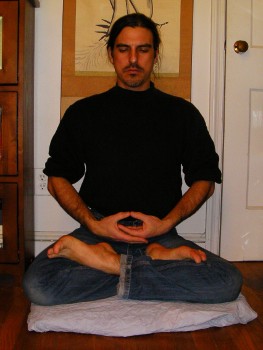 Wild, wild, wild…
So the last edition of “The Zen Pagan”, on “Wild Naked Pagans”, attracted a few thousand hits the first weekend it was up. I don’t know if we’ll draw that sort of crowd this month. We’re going to be a little bit more sedate, at least on the outside, as we focus on the “Zen” part of “Zen Paganism” and discuss the wild practice of getting in touch with the naked mind… by sitting perfectly still.
That might seem like a contradiction. And perhaps it is — this is Zen we’re talking about after all, a path known for paradox. But anyone who thinks meditation practice is tame should consult the legends of the Buddha’s enlightenment. Here’s how Paul Carus, an early Western scholar of Buddhism, summarized the legendary encounter between the meditating Buddha and the tempter demon Mara:
Mara caused a whirlwind to blow, but in vain; he caused a rain-storm to come in order to drown the Buddha, but not a drop wetted his robes; he caused a shower of rocks to come down, but the rocks changed into bouquets; he caused a shower of weapons–swords, spears, and arrows–to rush against him, but they became celestial flowers; he caused a shower of live coals to come down from the sky, but they, too, fell down harmless. In the same way hot ashes, a shower of sand, and a shower of mud were transmuted into celestial ointments. At last he caused a darkness, but the darkness disappeared before Buddha, as the night vanishes before the sun. Mara shouted: “Siddhattha, arise from the seat. It does not belong to you. It belongs to me.” Buddha replied: “Mara, you have not fulfilled the ten perfections. This seat does not belong to you, but to me, who have fulfilled the ten perfections.” Mara denied Buddha’s assertion and called upon his army as witnesses, while Buddha declared: “I have no animate witnesses present;” but, stretching out his right hand towards the mighty earth, he said: “Will you bear me witness?” And the mighty earth thundered: “I bear you witness.” And Mara’s elephant fell upon its knees, and all the followers of Mara fled away in all directions. When the hosts of the gods saw the army of Mara flee, they cried out: “Mara is defeated! Prince Siddhattha has conquered! Let us celebrate the victory!”[Carus]
(The idea of the Buddha appealing to the Earth for support is certainly interesting for people interested in so-called “Earth religion”, isn’t it? We’ll come back to that some other time. Or, if it’s not too crass a suggestion, you could buy and read my book. )
We don’t need to believe that demons like Mara have a physical existence outside of our own minds and culture in order to recognize the truth of this encounter. There’s some wild stuff inside our heads, beautiful and terrible to behold. And there are many systems that claim to offer guides to the territory, or that claim to have a sure-fire way to tame the wild. From ancient yogic practices to Western ritual magic to Timothy Leary’s Eight Circuit model of the brain, detailed maps and systems abound.
But there’s another way to approach the wild. That’s to go in without paying too much attention to the reports of others and take a look for yourself, to appreciate it for what it is.
There’s both a risk and a reward to that. You might miss someone’s advice about a must-see sight, or their warning about a hazard. But you also won’t be bound by outdated or inaccurate reports. You won’t fall prey to rumor, or be biased and see only what you’re told to see. You’ll have a chance to see for yourself things as they are, without a narrative or values imposed by someone else.
To do this takes some trust both in our own ability and in the nature of the territory. We can’t do this if we’re afraid of the wild.
Should we be afraid?
That is certainly the message of some religious paths and philosophical schools. You, in the wild state, are wretched. (That’s why nakedness is sinful. Cover your shame!) The universe is wretched. Left to its own nature life is solitary, poor, nasty, brutish, and short, a war of all against all, sinners in the hand of an angry God, headed straight for Hell at any moment, and only Divine — i.e., Super-Natural, Unwild — Intervention can save us.
Zen, thank goodness, takes a different view. Yes, the Buddha started with the premise that life is dukkha — a word usually taken as meaning “suffering” but which has also been translated as “out of joint”, in the sense of a slipped axle or a dislocated shoulder. That could sound like an echo of the “wretched universe” school, but the Buddha proceeded immediately to see the end of suffering as within our reach through a fairly simple (difficult, certainly, but simple) program of right living and right thinking, without Divine Intervention.
And Zen draws also on roots in the naturalist philosophy of Taoism, which found perfection in untamed nature and sin in the artifice of civilization. Between its Indian Buddhist and Chinese Taoist roots (and a bit of spice thrown in from Japan) Zen has developed the attitude that our fundamental nature, just as it is, is enlightened Buddha nature.
As one of my favorite Zen lunatics, Ikkyū, put it, “don’t worry please please how many times do I have to say it / there’s no way not to be who you are and where”.[Ikkyū, 33] Or as the 20th century Zen master Shunryu Sukuki once told his students, “Each of you is perfect the way you are…and you can use a little improvement.”[Chadwick, 1] There’s a little Zen paradox for you, but the important thing is that there is nothing to worry about. You are already perfectly who and where you are.
And so we can trust the wild of our own mind, without imposing someone else’s structure on it. As Gary Snyder said, “[Wild] means self-organizing. It means elegantly self-disciplined, self-regulating, self-maintained. That’s what wilderness is. Nobody has to do the management plan for it. So I say to people, “let’s trust in the self-disciplined elegance of wild mind”.[Carolan]
If we have trust in the wild mind, then we don’t have to do anything to it, we don’t have to fear it, we don’t have to learn some special system to be able to see and understand it.
We can go into the wild and just sit and watch.
References:
Carolan, Trevor. “The Wild Mind of Gary Snyder”. Shambhala Sun, May 1996. <http://www.shambhalasun.com/index.php?option=content&task=view&id=2071&Itemid=0&limit=1&limitstart=2>
Carus, Paul. The History of the Devil and the Idea of Evil. Open Court, 1900. <http://www.sacred-texts.com/evil/hod/hod10.htm>
Ikkyū, and Stephen Berg. Crow With No Mouth. Port Townsend, WA: Copper Canyon Press, 1989.
Chadwick, David. Zen is Right Here: teaching stories and anecdotes of Shunryu Suzuki. Boston: Shambhala, 2007.
If this has whetted your appetite for more information about meditation in the Zen fashion, there are plenty of books out there that talk about how do it…including, surprise, surprise, my own Why Buddha Touched the Earth.
You might be interested in joining a Facebook group on “Zen Paganism” I’ve set up. And don’t forget to “like” Patheos Pagan over there, too.
And you can subscribe to The Zen Pagan via RSS or e-mail.
Previous Post

October 9, 2014
Queer of Swords: True Names, True Identities
Next Post

October 11, 2014 Making Light: Ares
Browse Our Archives
Select a Category A Lakeside Hearth Adventures in Wortcunning Alone In Her Presence Arts, Crafts & Cooking Birthing Hereditary Witchcraft Book of Blackbirds Book Reviews Born-Again Witch Cauldron, Sword, Spear, & Stone Cermony and Liturgy Columns Community Dandelion Seeds Dear Jasmine Druid Thoughts Editor's Picks Everyday Pagan Family & Household Practice Family Traditions Full Frontal Magic Gateway Goddess Guest Articles Happily Heathen Health and Wellness Hearth of Hellenism Heathen Woman Hills of the Horizon History Holidays Horse Goddesses Interfaith Interviews Irish-American Witchcraft Jewish Witch Lamp & Labyrinth Letters from Midgard Literature, Media, Film, Music Loop of Brighid Love, Sex & Relationships Magic or Magick Making Light Naturalistic Traditions Nature News Outside The Circle Pantheisticon Politics Prayers, Poems, Blessings & Stories Queer Femme Mystic Queer of Swords Recipes Ritual and Practice Science and Research Seekers and Guides Seeking the Grail Socially Responsible Magic Spear of Athena Star Made Witch Syncretic Electric Technology The Blooming Staff The Busy Witch The Cartomancer The Crow's Nest The Dance of Pagan Recovery The Hearth of Hellenism The Lady's Quill The Other Side of the Hedge The Path of She The Rantin' Raven The Witches Next Door The Zen Pagan Theology, Ethics, Philosophy Tree City Witch Urban Earthwitch Wayfaring Woman Witch on Fire Wyrd Words
Select a Month January 2026 March 2025 December 2024 June 2024 April 2024 March 2024 January 2024 December 2023 November 2023 October 2023 August 2023 July 2023 May 2023 April 2023 March 2023 February 2023 January 2023 December 2022 November 2022 October 2022 September 2022 August 2022 July 2022 June 2022 May 2022 March 2022 February 2022 January 2022 December 2021 November 2021 October 2021 September 2021 August 2021 July 2021 June 2021 May 2021 April 2021 March 2021 February 2021 January 2021 December 2020 November 2020 October 2020 September 2020 August 2020 July 2020 June 2020 May 2020 April 2020 March 2020 February 2020 January 2020 December 2019 November 2019 October 2019 September 2019 August 2019 July 2019 June 2019 May 2019 April 2019 March 2019 February 2019 January 2019 December 2018 November 2018 October 2018 September 2018 August 2018 July 2018 June 2018 May 2018 April 2018 March 2018 February 2018 January 2018 December 2017 November 2017 October 2017 September 2017 August 2017 July 2017 June 2017 May 2017 April 2017 March 2017 February 2017 January 2017 December 2016 November 2016 October 2016 September 2016 August 2016 July 2016 June 2016 May 2016 April 2016 March 2016 February 2016 January 2016 December 2015 November 2015 October 2015 September 2015 August 2015 July 2015 June 2015 May 2015 April 2015 March 2015 February 2015 January 2015 December 2014 November 2014 October 2014 September 2014 August 2014 July 2014 June 2014 May 2014 April 2014 March 2014 February 2014 January 2014 December 2013 November 2013 October 2013 September 2013 August 2013 July 2013 June 2013 May 2013 April 2013 March 2013 February 2013 January 2013 December 2012 November 2012 October 2012 September 2012 August 2012 July 2012 June 2012 May 2012 April 2012 March 2012 February 2012 January 2012
Follow Us!
TAKE THE
Religious Wisdom Quiz
What is the lesson in the Parable of the Unforgiving Servant?
Select your answer to see how you score.
Obey without question Store up treasure on earth Work for salvation Forgive others as you are forgiven
Related posts from Agora

Simple Witchery: To Keep Silent

Simple Witchery: Leaning On The Four Pillars

Pergamum Unfurled: Magic with the Greek Gods (Book...

Pergamum Unfurled: Cunning Words (Review)
TRENDING AT PATHEOS Pagan

I was recently chatting with someone on Instagram. She asked me what...

While there are many people who share their results, the end of...

On July 23, I saw Christopher Nolan's The Odyssey which is Homer’s...

As I write this two big events have just finished up. One...

Restoring the Watershed of Divine Love
Perhaps cooperation is not something we manufacture through legislation, ideology, or moral...

Many UUs don’t pray because of bad experiences in a previous religion,...
view all Pagan blogs
Ad-Free & Subscriber Log-In Subscription Support
- About Us
- 2026 Calendar
- Videos
- Podcasts
- Library of World Religions
- Faith In Media Tracker
- Advertise With Us
- Write for Us
- Privacy Policy
- Terms of Service
- Do Not Sell My Data
- Contact Us
- Radiant Digital
- Manage Newsletter Subscriptions
- Unsubscribe From Notifications
- Sitemap
Copyright 2008-2026, Patheos. All rights reserved.
Subscription Support Ad-Free & Subscriber Log-In
Follow Patheos