
BuddhistCatholicContemplativeEvangelicalGeneral ChristianHinduJewishLatter-day SaintMuslimNew VisionsProgressive Christian
Beliefs
- Buddhist
- Catholic
- Contemplative
- Evangelical
- General Christian
- Hindu
- Jewish
- Latter-day Saint
- More Voices
- Muslim
- New Visions
- Pagan
- Progressive Christian
Topics
- Religion News
- Food and Religion
- Sports and Religion
- Religious Art
- Religious Music and Entertainment
- Religious Events
- History and Religion
- Style and Religion
- Politics and Religion
- Women in Religion
- Recreation Outdoors and Religion
- Business Finance and Religion
- Careers Workplace and Religion
- Education and Religion
- Family Parenting and Religion
- Health Fitness and Religion
- Home and Religion
- Relationships and Religion
- Technology and Religion
- Travel and Religion
Columnists
- Buddhist Columnists
- Business Finance and Religion Columnists
- Careers Workplace and Religion Columnists
- Catholic Columnists
- Contemplative Columnists
- Education and Religion Columnists
- Evangelists Columnists
- Family Parenting and Religion Columnists
- General Christian Columnists
- Health Fitness and Religion Columnists
- Hindu Columnists
- History and Religion Columnists
- Home and Religion Columnists
- Jewish Columnists
- More Voices Columnists
- Latter Day Columnists
- Muslim Columnists
- New Visions Columnists
- Nonreligious Columnists
- Pagan Columnists
- Politics and Religion Columnists
- Progressive Columnists
- Recreation Outdoors and Religion Columnists
- Relationships and Religion Columnists
- Religion News Columnists
- Religious Art Columnists
- Religious Events Columnists
- Religious Music and Entertainment Columnists
- Sports and Religion Columnists
- Style and Religion Columnists
- Technology and Religion Columnists
- Travel and Religion Columnists
- Women in Religion Columnists
Resource Library
- 2026 Calendar
- Library of World Religions
- The 100 Most Holy Places on Earth
- Patheos Answers
- Podcasts
- Videos
- Faith Leaders Database
- Anglican Episcopalian
- Bahai
- Baptist
- Buddhism
- Christianity
- Confucianism
- Eastern Orthodoxy
- Hinduism
- Holiness and Pentecostal
- ISKCON
- Islam
- Judaism
- Lutheran
- Methodist
- The Church of Jesus Christ of Latter-day Saints
- New Age
- Paganism
- Presbytarian and Reformed
- Protestantism
- Religion Behind the Scenes
- Roman Catholic
- Scientology
- Shia Islam
- Sikhism
- Sufism
- Sunni Islam
- Taoism
- Zen
- See all religions
Research Tools
 Ad-Free & Subscriber Log-In Subscription Support
Ad-Free & Subscriber Log-In Subscription Support
Follow Patheos 

- Trending:
- Forgiveness
- |
- Marriage
- |
- Consciousness
- |
- Death Penalty
- |
- Election
- |
- Halloween

- Home
- Pagan
- Jewish Witch: Ancestors and Genocide
Jewish Witch: Ancestors and Genocide
Last updated on: January 7, 2015 at 9:03 pm by Asa West
Jewish Witch: Ancestors and Genocide 2015-01-07T21:03:14+00:00 Asa West
Patheos Explore the world's faith through different perspectives on religion and spirituality! Patheos has the views of the prevalent religions and spiritualities of the world.
Last year, I was lucky enough to score a table at LA Zine Fest, where I sold my witchy zines and did Tarot readings. I’m still sort of in the broom closet to my family and coworkers, but I publish my zines under my given name, so it’s pretty easy for people to find out. Still, it didn’t occur to me that they might come to the event.
But they came! One of the bigwigs from my library came–my boss’s boss’s boss. One of the TAs I work with came and asked for a reading about her dissertation. And, most amazingly, two of my cousins showed up. Technically, they’re my father’s cousins, which means they have access to family lore that doesn’t always filter down to the younger generations. They each bought copies of my zines and my novel. I read their cards. Afterwards, I bit my nails. Reading cards is one thing; Tarot is trendy right now and lots of people are doing it for fun. It’s quite another to “actually believe in that stuff.” What would my cousins think when they found out I was a Witch?
Turns out, they thought it was the most natural thing in the world. They both emailed me to tell me they liked my zines. And one of my cousins told me something very interesting–something she’d never thought to mention before.
Apparently my great-great grandmother Esther, a Hasidic wife and mother in Ostrolenka, Poland, was a folk healer. People would knock on her door in the middle of the night to have her cure little ailments. She filled in the gaps between what the rabbis and doctors could provide.
I try, sometimes, to think of her with an easy fondness; sometimes I even try to indulge in a little nostalgia. But something always interrupts me. See, when I think of my great-great-grandmother, I instantly think of her daughter Peshe and son Moshe–my great-grandmother Sarah’s sister and brother. Peshe and Moshe, along with their spouses and children, tried to escape the Holocaust but disappeared somewhere in Belarus. We can only assume that they were caught and murdered.
Ancestor work can be intense and painful, even if your Beloved Dead passed under the best of circumstances. But when genocide is involved, it can be overwhelming.
* * *
Sometimes I see the narrative of 20th century Jewry condensed and simplified to this: Hitler tried to wipe us out in the Holocaust, but we survived and now we’re thriving in Israel! Take that, Hitler! Am Yisrael Chai!
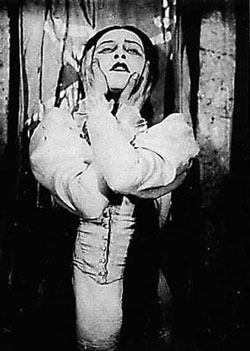
Photo from S. Ansky’s Yiddish play The Dybbuk
But that history just isn’t true. (And don’t get me started on what it means to Palestinians.) Yes, Jewish civilization continued, but the Yiddish culture that flourished in Europe was obliterated. It’s gone. It’s over. We went from roughly 12 million speakers in the 1930’s to fewer than 2 million in the 90’s, and most of those speakers are either elders or members of insular Orthodox communities. Our art, our literature, our film–it’s gone, gone, all gone, relegated to archives and museums. It’s true that Zionism and assimilation also played roles, but the Holocaust was a decisive factor. Did you know Yiddish is over a thousand years old? Did you know it used to be one of many Jewish languages? You’d never know it today.
I never knew the extent of the damage until I spent 6 weeks in the Baltic states: 5 weeks in Lithuania, taking an intermediate Yiddish class, and 1 week visiting Riga and Tallinn. One of my classmates told me his wife couldn’t take all the Holocaust museums and changed her plane ticket to go home early. I privately wrote her off as a wimp. But there are only so many mass grave sites you can visit before they start to eat away at you. There are only so many times you can stand in the exact place where all the children in a village were shot. There are only so many prayers you can say for the dead before, like the dybbuk of Jewish legend, they begin to graft themselves onto you. When I got to Riga’s Museum of the Occupation, I had to leave halfway through because I finally buckled. The history is so big, so ferocious, so stunningly bottomless. I think we spiritually-minded people sometimes fall victim to the idea that everything happens for a reason, but I can tell you this with absolute certainty: the Holocaust was as pointless as it was evil.
I know the term “Burning Times” is loaded and problematic and based more on an imagined history than a literal one, but it comes to me when I think about my Witchcraft and my Jewishness. Both are trailed by a long line of ancestors asking, Why? Why? Why me? Why my children? I don’t understand. How could they do this to us?
And what the hell am I supposed to tell them?
* * *

The remains of a mass grave in Lithuania.
You can read a thousand books, you can look at a million pictures, you can watch Schindler’s List or Roots or Hotel Rwanda until your eyes bleed, but sometimes you can’t really know a history until you visit the land where it happened. You can’t really know it until you listen to the ghosts that haunt that land. And even then, all you’ll get are the faintest echoes of the nightmares it contains.
Samhain is the time of year when I both reach out to my dybbuks and shield myself from them.
In Lithuania, I stood next to one of the mass grave sites in the forests outside of Vilnius and listened to our guide–an 89-year-old Yiddish speaker who’d fought with the partisan resistance–tell her war stories. I noticed something peculiar in the grass. I looked closer.
Strawberry plants. There were strawberry plants growing where the bodies had been exhumed. A butterfly was flitting among them.
We’re here, my ancestors said.
My heart broke and it is broken still.
Jewish Witch is published on alternate Tuesdays. Subscribe via RSS or e-mail!
For more reflections on ancestors and ancestor work, check out the Patheos Pagan Ancestor Remembrance Project.

Next Post

October 22, 2014 Alone In Her Presence: Halloween - Inviting the Secular
Browse Our Archives
Select a Category A Lakeside Hearth Adventures in Wortcunning Alone In Her Presence Arts, Crafts & Cooking Birthing Hereditary Witchcraft Book of Blackbirds Book Reviews Born-Again Witch Cauldron, Sword, Spear, & Stone Cermony and Liturgy Columns Community Dandelion Seeds Dear Jasmine Druid Thoughts Editor's Picks Everyday Pagan Family & Household Practice Family Traditions Full Frontal Magic Gateway Goddess Guest Articles Happily Heathen Health and Wellness Hearth of Hellenism Heathen Woman Hills of the Horizon History Holidays Horse Goddesses Interfaith Interviews Irish-American Witchcraft Jewish Witch Lamp & Labyrinth Letters from Midgard Literature, Media, Film, Music Loop of Brighid Love, Sex & Relationships Magic or Magick Making Light Naturalistic Traditions Nature News Outside The Circle Pantheisticon Politics Prayers, Poems, Blessings & Stories Queer Femme Mystic Queer of Swords Recipes Ritual and Practice Science and Research Seekers and Guides Seeking the Grail Socially Responsible Magic Spear of Athena Star Made Witch Syncretic Electric Technology The Blooming Staff The Busy Witch The Cartomancer The Crow's Nest The Dance of Pagan Recovery The Hearth of Hellenism The Lady's Quill The Other Side of the Hedge The Path of She The Rantin' Raven The Witches Next Door The Zen Pagan Theology, Ethics, Philosophy Tree City Witch Urban Earthwitch Wayfaring Woman Witch on Fire Wyrd Words
Select a Month January 2026 March 2025 December 2024 June 2024 April 2024 March 2024 January 2024 December 2023 November 2023 October 2023 August 2023 July 2023 May 2023 April 2023 March 2023 February 2023 January 2023 December 2022 November 2022 October 2022 September 2022 August 2022 July 2022 June 2022 May 2022 March 2022 February 2022 January 2022 December 2021 November 2021 October 2021 September 2021 August 2021 July 2021 June 2021 May 2021 April 2021 March 2021 February 2021 January 2021 December 2020 November 2020 October 2020 September 2020 August 2020 July 2020 June 2020 May 2020 April 2020 March 2020 February 2020 January 2020 December 2019 November 2019 October 2019 September 2019 August 2019 July 2019 June 2019 May 2019 April 2019 March 2019 February 2019 January 2019 December 2018 November 2018 October 2018 September 2018 August 2018 July 2018 June 2018 May 2018 April 2018 March 2018 February 2018 January 2018 December 2017 November 2017 October 2017 September 2017 August 2017 July 2017 June 2017 May 2017 April 2017 March 2017 February 2017 January 2017 December 2016 November 2016 October 2016 September 2016 August 2016 July 2016 June 2016 May 2016 April 2016 March 2016 February 2016 January 2016 December 2015 November 2015 October 2015 September 2015 August 2015 July 2015 June 2015 May 2015 April 2015 March 2015 February 2015 January 2015 December 2014 November 2014 October 2014 September 2014 August 2014 July 2014 June 2014 May 2014 April 2014 March 2014 February 2014 January 2014 December 2013 November 2013 October 2013 September 2013 August 2013 July 2013 June 2013 May 2013 April 2013 March 2013 February 2013 January 2013 December 2012 November 2012 October 2012 September 2012 August 2012 July 2012 June 2012 May 2012 April 2012 March 2012 February 2012 January 2012
Follow Us!
TAKE THE
Religious Wisdom Quiz
What is the main theme of the Parable of the Two Sons?
Select your answer to see how you score.
Obedience is proved by actions Firstborns are favored Repentance is easy Honesty is best
Related posts from Agora

Simple Witchery: To Keep Silent

Simple Witchery: Leaning On The Four Pillars


Simple Witchery: Resistance and Resilience in Hard Times
TRENDING AT PATHEOS Pagan

I was recently chatting with someone on Instagram. She asked me what...

While there are many people who share their results, the end of...

On July 23, I saw Christopher Nolan's The Odyssey which is Homer’s...

As I write this two big events have just finished up. One...

Restoring the Watershed of Divine Love
Perhaps cooperation is not something we manufacture through legislation, ideology, or moral...

Many UUs don’t pray because of bad experiences in a previous religion,...
view all Pagan blogs
Ad-Free & Subscriber Log-In Subscription Support
- About Us
- 2026 Calendar
- Videos
- Podcasts
- Library of World Religions
- Faith In Media Tracker
- Advertise With Us
- Write for Us
- Privacy Policy
- Terms of Service
- Do Not Sell My Data
- Contact Us
- Radiant Digital
- Manage Newsletter Subscriptions
- Unsubscribe From Notifications
- Sitemap
Copyright 2008-2026, Patheos. All rights reserved.
Subscription Support Ad-Free & Subscriber Log-In
Follow Patheos