
BuddhistCatholicContemplativeEvangelicalGeneral ChristianHinduJewishLatter-day SaintMuslimNew VisionsProgressive Christian
Beliefs
- Buddhist
- Catholic
- Contemplative
- Evangelical
- General Christian
- Hindu
- Jewish
- Latter-day Saint
- More Voices
- Muslim
- New Visions
- Pagan
- Progressive Christian
Topics
- Religion News
- Food and Religion
- Sports and Religion
- Religious Art
- Religious Music and Entertainment
- Religious Events
- History and Religion
- Style and Religion
- Politics and Religion
- Women in Religion
- Recreation Outdoors and Religion
- Business Finance and Religion
- Careers Workplace and Religion
- Education and Religion
- Family Parenting and Religion
- Health Fitness and Religion
- Home and Religion
- Relationships and Religion
- Technology and Religion
- Travel and Religion
Columnists
- Buddhist Columnists
- Business Finance and Religion Columnists
- Careers Workplace and Religion Columnists
- Catholic Columnists
- Contemplative Columnists
- Education and Religion Columnists
- Evangelists Columnists
- Family Parenting and Religion Columnists
- General Christian Columnists
- Health Fitness and Religion Columnists
- Hindu Columnists
- History and Religion Columnists
- Home and Religion Columnists
- Jewish Columnists
- More Voices Columnists
- Latter Day Columnists
- Muslim Columnists
- New Visions Columnists
- Nonreligious Columnists
- Pagan Columnists
- Politics and Religion Columnists
- Progressive Columnists
- Recreation Outdoors and Religion Columnists
- Relationships and Religion Columnists
- Religion News Columnists
- Religious Art Columnists
- Religious Events Columnists
- Religious Music and Entertainment Columnists
- Sports and Religion Columnists
- Style and Religion Columnists
- Technology and Religion Columnists
- Travel and Religion Columnists
- Women in Religion Columnists
Resource Library
- 2026 Calendar
- Library of World Religions
- The 100 Most Holy Places on Earth
- Patheos Answers
- Podcasts
- Videos
- Faith Leaders Database
- Anglican Episcopalian
- Bahai
- Baptist
- Buddhism
- Christianity
- Confucianism
- Eastern Orthodoxy
- Hinduism
- Holiness and Pentecostal
- ISKCON
- Islam
- Judaism
- Lutheran
- Methodist
- The Church of Jesus Christ of Latter-day Saints
- New Age
- Paganism
- Presbytarian and Reformed
- Protestantism
- Religion Behind the Scenes
- Roman Catholic
- Scientology
- Shia Islam
- Sikhism
- Sufism
- Sunni Islam
- Taoism
- Zen
- See all religions
Research Tools
 Ad-Free & Subscriber Log-In Subscription Support
Ad-Free & Subscriber Log-In Subscription Support
Follow Patheos 

- Trending:
- Forgiveness
- |
- Marriage
- |
- Consciousness
- |
- Death Penalty
- |
- Election
- |
- Halloween

- Home
- Pagan
- The Best of the Equinox – Vol 2: Dramatic Ritual (Review)
The Best of the Equinox – Vol 2: Dramatic Ritual (Review)
Last updated on: January 3, 2014 at 5:12 pm by Adam Blodgett
The Best of the Equinox – Vol 2: Dramatic Ritual (Review) 2014-01-03T17:12:36+00:00 Adam Blodgett
Patheos Explore the world's faith through different perspectives on religion and spirituality! Patheos has the views of the prevalent religions and spiritualities of the world.
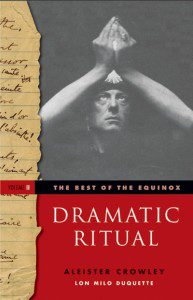 The Best of Equinox: Dramatic Ritual is a collection of Aleister Crowley’s seven short dramatic pieces titled “The Rites of Eleusis” accompanied by various related materials: essays, photos, music and a small handbook titled “A Treasure-House of Images.” As with the first volume in the series, the title of this volume is somewhat misleading. This is not a how-to book of dramatic ritual, but a collection of short dramatic pieces. Crowley himself frames these Eleusinian rites not strictly as performance pieces but as “methods of invocation,” though given the format, most readers will recognize the stage direction and dialogue as a short plays. That Crowley infuses these plays with the energy of sacred invocation makes explicit the implicit magic of good drama; he is turning (or perhaps returning) the magic of performance to a sacred end, calling upon a specific deity and sharing that energy with a larger group of people than traditional ritual might allow. In doing so, the audience is (hopefully) initiated into the mystery of the conjured divinity.
The Rites are intended to be initiatory experiences. Both Crowley and Lon Milo DuQuette (who selected all of the pieces and introduces each volume in the series) frame the Rites as such, but simply reading these plays in the book is a long way from a transcendental initiation into any mystery. Anyone who’s seen a play knows that reading the script is far less enthralling than seeing it performed. Shakespeare is the best example, and Crowley’s work is no different. The experience of reading these pieces must pale in comparison to experiencing the produced version that contain music, poetry and dance, none of which can be easily reproduced while reading. Further, the original performance of Crowley’s Rites also benefitted from of a “cup of libations,” which according to DuQuette contained “a potent mixture of herbs, alcohol, fruit juice and mescal buttons.” I considered reproducing this aspect for my review, and given the nature of Crowley’s writing it might well have helped.
The Rites themselves are poorly written drama; in fact, there is little drama whatsoever. Crowley’s writing is inescapably symbolic and drama seems a particularly unforgiving place for the symbolism that Crowley attempts to bring to life. His characters parade about the stage making highly cryptic remarks, as in the ‘Rite of Saturn’:
MAGISTER TEMPLI. I. Brother Aquarius, to what end are we assembled?
AQUARIUS. [Rises and whispers in his ear.] Shabbathai.
ALL [aloud]. Shabbathai.
MAGISTER TEMPLI. I. Are the brethren fed?
AQUARIUS. Upon the corpses of their children.
MAGISTER TEMPLI. I. Have they quenched their thirst?
AQUARIUS. Upon poppy-heads infused in blood.
MAGISTER TEMPLI. The raven has croaked.
AQUARIUS. The owl has hooted.
CAPRICORNUS. The bat has flapped its wings.
MAGISTER TEMPLI. Then… Lights!
While I understand that these are meant to be symbolic of something, I don’t understand what they’re meant to be symbolic of, and the author hasn’t prefaced these remarks with anything for me to decode them with. As is so often the case, Crowley has created a textual velvet rope, allowing only those already in the know to fully appreciate his work while those of us unfamiliar with his morbid code are left to puzzle things out for ourselves. While this confusion may be the hallmark of an initiatory experience, it must be considered a failure if the initiates aren’t eventually led to some understanding, and that never came to pass for me in reading this book.
Add to this the occasionally awful poetry (“And death’s insufferable perfume/ Beat the black air with golden fans / As Turkis rip a Nubian’s womb / With Damascened yataghans”) and the cryptic series of knocks that precede much of the dialogue (in groups of up to 49 knocks) with no explanation for their significance and the Rites leave much to be desired. Crowley is simply too blunt with his symbolism and leaves those outside the know with little to cling to, dismissing dramatic standards like plot and character development to the wings, assuming instead that the symbolism of his characters will shine through. As a whole, the Rites are neither one thing nor another; they are too symbolic to be good traditional drama, but too traditional to be considered wonderfully surreal.
The second half of the book fares somewhat better. The essays are at least comprehensible, and shed some light on the method behind Crowley’s madness, though his tone is unrelentingly condescending. It is only when he shifts into prophet mode that his vocabulary softens for the effusive adoration of the divine world. His essay “Earth” (under the pseudonym Francis Bendick) is romantic and thick with the sensual and poetic, and the booklet “A Treasure-House of Images” is a psalter of new age verse that echoes the purple prose of the first volume in this series, both in its archaic vocabulary and visual intensity.
On some level the sheer mass of writing that Crowley produces in the “Treasure-House” is admirable. The power and imagination the fills the 14 chapters of the booklet share volume one’s power and inspiration, but also its drawback: the intensity quickly becomes quite numbing and difficult to sustain for a long period as a reader. The quantity of imagery and praise becomes repetitive over the course of the booklet, and Crowley’s poetic methods wear thin and become more formulaic than inspired. Still, Crowley’s dedication to the divine in its myriad forms shines through, and effort to produce this amount of praise is significant in itself.
In its entirety, Volume Two of the Best of the Equinox reminds us that there is no doubt that as a magickian Crowley was world class, but as a writer Crowley hovers uncomfortably in the dilettante range. His language is archaic, his explanations are opaque, and his poetry at times pitiful. With a committed editor (which DuQuette is aspiring to admirably) and a dedication to killing his children (a writerly discipline that would have delighted Crowley), I have no doubt that Crowley would have become one of the premier writers of his day. But Crowley’s obscure style, inattention to detail and seeming dedication to obfuscatory symbolism make it clear that writing was at best his second love, and that his true interest lay in the experience itself, not the recording of it. Writing, his tone makes clear, only explains it for those who are too afraid or stupid to experience it for themselves. Still, Crowley knew that as the prophet of the new age that a record would be required of him, and as such he has left a trail of his scribblings for those of us who follow his circumlocutory ramblings and aspire to the enlightenment he himself was so passionate in attaining.
Previous Post

January 1, 2014
Druid Thoughts: Paganism - 10 Signs You’re Doing It Wrong!
Next Post
January 4, 2014 Yes, and Gods, part 1 (with Cicero)
Browse Our Archives
Select a Category A Lakeside Hearth Adventures in Wortcunning Alone In Her Presence Arts, Crafts & Cooking Birthing Hereditary Witchcraft Book of Blackbirds Book Reviews Born-Again Witch Cauldron, Sword, Spear, & Stone Cermony and Liturgy Columns Community Dandelion Seeds Dear Jasmine Druid Thoughts Editor's Picks Everyday Pagan Family & Household Practice Family Traditions Full Frontal Magic Gateway Goddess Guest Articles Happily Heathen Health and Wellness Hearth of Hellenism Heathen Woman Hills of the Horizon History Holidays Horse Goddesses Interfaith Interviews Irish-American Witchcraft Jewish Witch Lamp & Labyrinth Letters from Midgard Literature, Media, Film, Music Loop of Brighid Love, Sex & Relationships Magic or Magick Making Light Naturalistic Traditions Nature News Outside The Circle Pantheisticon Politics Prayers, Poems, Blessings & Stories Queer Femme Mystic Queer of Swords Recipes Ritual and Practice Science and Research Seekers and Guides Seeking the Grail Socially Responsible Magic Spear of Athena Star Made Witch Syncretic Electric Technology The Blooming Staff The Busy Witch The Cartomancer The Crow's Nest The Dance of Pagan Recovery The Hearth of Hellenism The Lady's Quill The Other Side of the Hedge The Path of She The Rantin' Raven The Witches Next Door The Zen Pagan Theology, Ethics, Philosophy Tree City Witch Urban Earthwitch Wayfaring Woman Witch on Fire Wyrd Words
Select a Month January 2026 March 2025 December 2024 June 2024 April 2024 March 2024 January 2024 December 2023 November 2023 October 2023 August 2023 July 2023 May 2023 April 2023 March 2023 February 2023 January 2023 December 2022 November 2022 October 2022 September 2022 August 2022 July 2022 June 2022 May 2022 March 2022 February 2022 January 2022 December 2021 November 2021 October 2021 September 2021 August 2021 July 2021 June 2021 May 2021 April 2021 March 2021 February 2021 January 2021 December 2020 November 2020 October 2020 September 2020 August 2020 July 2020 June 2020 May 2020 April 2020 March 2020 February 2020 January 2020 December 2019 November 2019 October 2019 September 2019 August 2019 July 2019 June 2019 May 2019 April 2019 March 2019 February 2019 January 2019 December 2018 November 2018 October 2018 September 2018 August 2018 July 2018 June 2018 May 2018 April 2018 March 2018 February 2018 January 2018 December 2017 November 2017 October 2017 September 2017 August 2017 July 2017 June 2017 May 2017 April 2017 March 2017 February 2017 January 2017 December 2016 November 2016 October 2016 September 2016 August 2016 July 2016 June 2016 May 2016 April 2016 March 2016 February 2016 January 2016 December 2015 November 2015 October 2015 September 2015 August 2015 July 2015 June 2015 May 2015 April 2015 March 2015 February 2015 January 2015 December 2014 November 2014 October 2014 September 2014 August 2014 July 2014 June 2014 May 2014 April 2014 March 2014 February 2014 January 2014 December 2013 November 2013 October 2013 September 2013 August 2013 July 2013 June 2013 May 2013 April 2013 March 2013 February 2013 January 2013 December 2012 November 2012 October 2012 September 2012 August 2012 July 2012 June 2012 May 2012 April 2012 March 2012 February 2012 January 2012
Follow Us!
TAKE THE
Religious Wisdom Quiz
What did Jesus use to heal blind man?
Select your answer to see how you score.
Water Oil Mud and saliva Cloth
Related posts from Agora

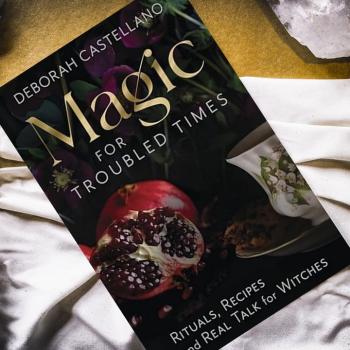
Pergamum Unfurled: Review - Magic for Troubled Times
TRENDING AT PATHEOS Pagan

I was recently chatting with someone on Instagram. She asked me what...

While there are many people who share their results, the end of...

On July 23, I saw Christopher Nolan's The Odyssey which is Homer’s...

As I write this two big events have just finished up. One...

Restoring the Watershed of Divine Love
Perhaps cooperation is not something we manufacture through legislation, ideology, or moral...

Many UUs don’t pray because of bad experiences in a previous religion,...
view all Pagan blogs
Ad-Free & Subscriber Log-In Subscription Support
- About Us
- 2026 Calendar
- Videos
- Podcasts
- Library of World Religions
- Faith In Media Tracker
- Advertise With Us
- Write for Us
- Privacy Policy
- Terms of Service
- Do Not Sell My Data
- Contact Us
- Radiant Digital
- Manage Newsletter Subscriptions
- Unsubscribe From Notifications
- Sitemap
Copyright 2008-2026, Patheos. All rights reserved.
Subscription Support Ad-Free & Subscriber Log-In
Follow Patheos