
BuddhistCatholicContemplativeEvangelicalGeneral ChristianHinduJewishLatter-day SaintMuslimNew VisionsProgressive Christian
Beliefs
- Buddhist
- Catholic
- Contemplative
- Evangelical
- General Christian
- Hindu
- Jewish
- Latter-day Saint
- More Voices
- Muslim
- New Visions
- Pagan
- Progressive Christian
Topics
- Religion News
- Food and Religion
- Sports and Religion
- Religious Art
- Religious Music and Entertainment
- Religious Events
- History and Religion
- Style and Religion
- Politics and Religion
- Women in Religion
- Recreation Outdoors and Religion
- Business Finance and Religion
- Careers Workplace and Religion
- Education and Religion
- Family Parenting and Religion
- Health Fitness and Religion
- Home and Religion
- Relationships and Religion
- Technology and Religion
- Travel and Religion
Columnists
- Buddhist Columnists
- Business Finance and Religion Columnists
- Careers Workplace and Religion Columnists
- Catholic Columnists
- Contemplative Columnists
- Education and Religion Columnists
- Evangelists Columnists
- Family Parenting and Religion Columnists
- General Christian Columnists
- Health Fitness and Religion Columnists
- Hindu Columnists
- History and Religion Columnists
- Home and Religion Columnists
- Jewish Columnists
- More Voices Columnists
- Latter Day Columnists
- Muslim Columnists
- New Visions Columnists
- Nonreligious Columnists
- Pagan Columnists
- Politics and Religion Columnists
- Progressive Columnists
- Recreation Outdoors and Religion Columnists
- Relationships and Religion Columnists
- Religion News Columnists
- Religious Art Columnists
- Religious Events Columnists
- Religious Music and Entertainment Columnists
- Sports and Religion Columnists
- Style and Religion Columnists
- Technology and Religion Columnists
- Travel and Religion Columnists
- Women in Religion Columnists
Resource Library
- 2026 Calendar
- Library of World Religions
- The 100 Most Holy Places on Earth
- Patheos Answers
- Podcasts
- Videos
- Faith Leaders Database
- Anglican Episcopalian
- Bahai
- Baptist
- Buddhism
- Christianity
- Confucianism
- Eastern Orthodoxy
- Hinduism
- Holiness and Pentecostal
- ISKCON
- Islam
- Judaism
- Lutheran
- Methodist
- The Church of Jesus Christ of Latter-day Saints
- New Age
- Paganism
- Presbytarian and Reformed
- Protestantism
- Religion Behind the Scenes
- Roman Catholic
- Scientology
- Shia Islam
- Sikhism
- Sufism
- Sunni Islam
- Taoism
- Zen
- See all religions
Research Tools
 Ad-Free & Subscriber Log-In Subscription Support
Ad-Free & Subscriber Log-In Subscription Support
Follow Patheos 

- Trending:
- Forgiveness
- |
- Marriage
- |
- Consciousness
- |
- Death Penalty
- |
- Election
- |
- Halloween

- Home
- Pagan
- Birthing Hereditary Witchcraft: Be Vocal, Be Creative When Teaching Tolerance
Birthing Hereditary Witchcraft: Be Vocal, Be Creative When Teaching Tolerance
Last updated on: January 19, 2014 at 8:35 pm by Lydia MN Crabtree
Birthing Hereditary Witchcraft: Be Vocal, Be Creative When Teaching Tolerance 2014-01-19T20:35:27+00:00 Lydia MN Crabtree
Patheos Explore the world's faith through different perspectives on religion and spirituality! Patheos has the views of the prevalent religions and spiritualities of the world.
In my last installment, I gave a short educational look at techniques pagan parents can utilize to bring awareness of racism, homophobia, gender bias, and religious intolerance. In this second installment, I will continue to look at the key points that help parents better guide their children toward an attitude of empathy toward minority populations.
I find it necessary that my readers understand my vocabulary. I use the term parent(s) in this blog and my forthcoming book Family Coven: Birthing Hereditary Witchcraft (Immanion Press). The choice of this word is my deliberate attempt to be inclusive of non-traditional family units, especially within paganism. The term parent(s) includes family units that are polyamorous.[i] In this blog and other works, I use the term co-parent with a dual meaning. It acknowledges the fact that same-sex couples are often referred to as co-parents in greater society. Additionally, I utilize co-parent as a term that infers we are all parents to all children. When my son is with my sister and he is disrespectful, I know she will co-parent my child, just as my husband-priest[ii] and I co-parent her children when they are in my care. Co-parenting can take some trust between adults and sometimes requires courageous adults who step in when they see inappropriate behavior.
A single mother came to my home with her young son for dinner at my home. During the course of the meal, we sat through the child being obnoxious, rude, and abusive to his mother. I watched my husband-priest’s tension slowly escalate throughout the meal. Finally, he addressed the child in a calm tone.
“Would you please come with me to the office?” The boy, who was stopped in the middle of calling his mother a bitch, looked stunned and then looked to his mother for guidance. His mother was in shock as well. The boy slowly rose from the table and went with my husband-priest into the other room.
“Don’t worry,” I addressed the mother. “Tony is just telling him that we do not speak to women–or men, for that matter–in the way your son was talking to you. He won’t lay a hand on the boy.”
The mother vaguely nodded, and shortly the man and child returned. The child went to his mother and apologized, and after a few minutes of silence, Tony drew the child into appropriate dinner conversation. This mother never returned to my home or spoke to my family coven again. I don’t regret what my husband did, though. I am sure that child will remember whatever was said in a controlled and calm conversation about his behavior, and hopefully both mother and child will be better for it.
In the last installment, I listed key points that co-parent(s) [iii] can utilize to help develop tolerant children. These points are:
→ Develop Child(ren) Who Interrogate Reality
→ Be Vocal
→ Words Have Power
→ Praise the Champion
→ Discuss Politics News and Current Events
→ Exploit the Media That Would Exploit Your Child(ren)
→ The Law and When to Break It
→ Empower Child(ren)’s Opinions
Interrogation of reality is a concept used to help children learn critical thinking skills, especially as they relate to the world they perceive and experience. It was fully explored in my last installment.
→ BE VOCAL: Racism, gender bias, religious intolerance, and homophobia continue to persist is silence. Good, loving, empathetic people say nothing when they hear, experience or deal with actions or talk tainted by hateful or ignorant views. Ignorance thrives in dark places where reason sheds no light.
My roommate Nate’s five-year-old baby brother had decided that bad men were always black. His decision was based on watching the nightly news with his mother. Despite the fact that his own half-brother Nate is bi-racial, exposure to media outlets and living in a county where only .003%[iv] of the population is black had given racism an easy foothold in this child’s mind.
I would point out that there was no maliciousness on the part of the child or his mother; however, the life he was leading, the life he was consistently being exposed to, was devoid of anything that could illuminate the unrealistic nature of the world he was perceiving.
This is how racism, homophobia, gender bias, and religious intolerance gain a foothold in children. Typically children are raised close to home, which can often provide a homogeneous view of society, gender, love, cultural customs, and expectations. Outside the bounds of the Family Coven, children often congregate with people who share a similarly homogeneous outlook. There is little to suggest that the wider world is any different than the one they live in. A child with plenty of food, clothing and shelter has a difficult time understanding that not everyone lives that way. A child raised by heterosexual parents may have problems coming to terms with the idea that some children have parents who are the same sex, or have more than two parents of any gender. For young children, simple exposure is often enough to broaden their hearts and minds.
The younger this expansion of a child’s horizon can begin, the better off they will be in the long run. Yet it is never too late to shed light on intolerance. It can happen one conversation at a time. Co-parent(s) must take any teaching moment encountered and wield tolerance and education with the same passion as those who wield narrow-mindedness and bigotry.
Utilizing Nate’s baby brother as an example, Nate could have introduced facts regarding the higher incarceration rates of minorities,[v] the social circumstances that contribute to those numbers,[vi] and the idea that southern white counties have a documented tendency to display more racism than other places within the United States.[vii] These factors contribute to black people being shown as “bad guys” on the news. Despite the brother’s young age, the conversation could still have been had. Imagine:
[Nate]“Bubba, do you think that black people break the law more than white people?”
“Yeah.”
[Nate] “Why do you think that?”
“’Cause when mama watches the news, you see bad people are always black people.”
[Nate] “So does that mean that white people don’t do bad things?”
“I don’t think so.”
[Nate] “Do you do bad things?”
“Sometimes.”
[Nate] “Are you black?”
“No.”
[Nate] “Okay, so you’re white and sometimes do bad things.”
“Yeah.”
[Nate] “So that probably means that white people do bad things sometimes too, right?”
“But I don’t go to jail.”
[Nate] “True enough. If we had two people who did the same bad thing and one was white and one was black, who would go to jail?”
“They both do.”
[Nate] “Well, actually the black person goes to jail more often than the white person. Let’s go buy some M&M’s and I’ll show you what I mean.
M&M Statistics
Tactile learning is a powerful tool. Utilizing statistics from the 2012 Census and the colors of M&Ms, a lesson around population norms and incarcerated populations can be made. For the purposes of this exercise, I have simplified the census data to whole numbers.[viii] You will need fifty M&M’s broken down as follows:
M&M Color Race Representation
Number of M&Ms
Census Correlation
Brown Black[ix]
6.5
13%
Red American Indian
.5
1%
Yellow Asian
1
2%
Orange Hispanic
8
16%
Blue Mixed Race/Other
4
4%
Green White
32
64%
50
100%
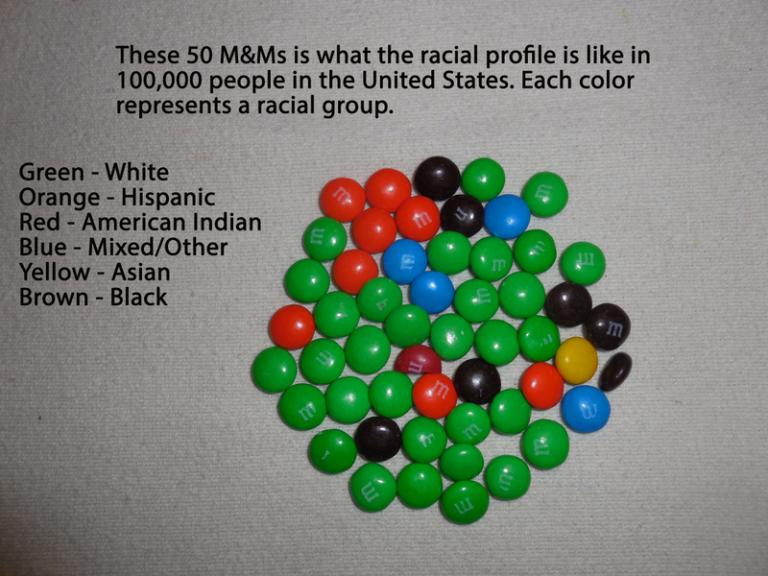
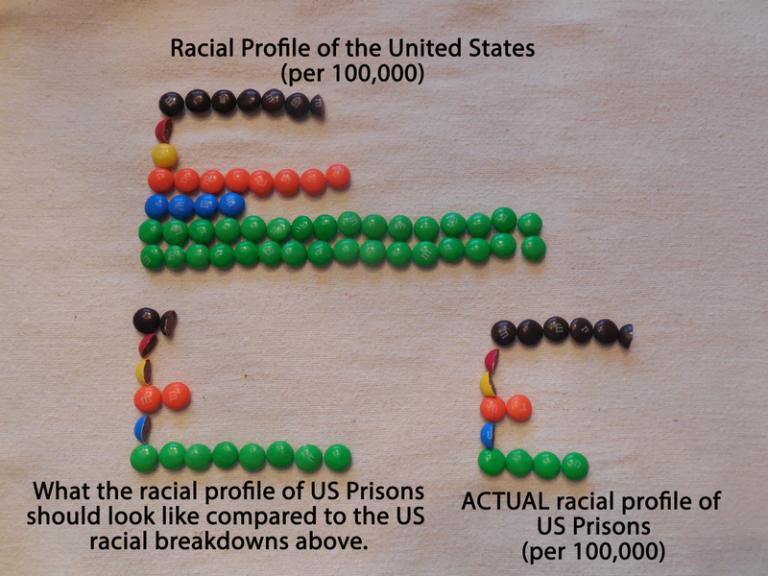
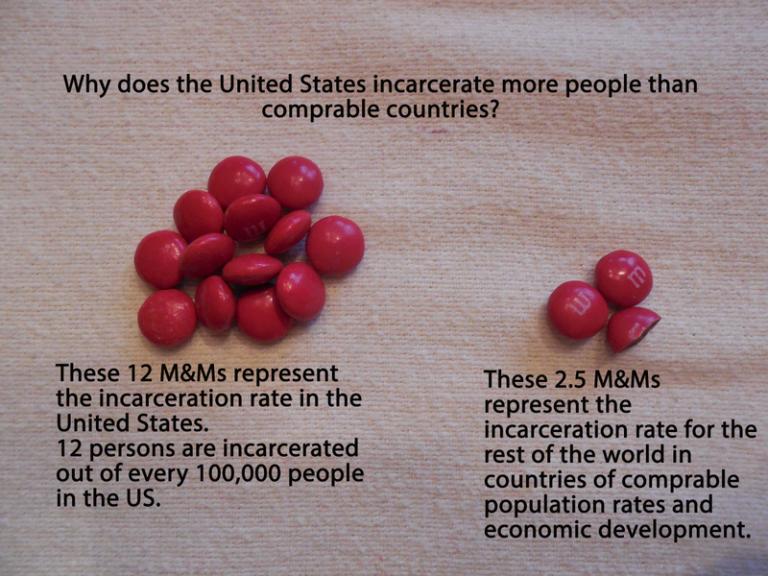
According to the Population Reference Bureau, the United States has 1.6 million person incarcerated. Per 100,000 persons, 500 people are incarcerated compared to 100 per 100,000 in comparable countries.[x] For our M&M exercise, I took 100,000 persons incarcerated in the US and converted it into a percentage (.5%), then multiplied this by the 50 M&Ms in our model. This gave us 25%, or 12.5 of our M&Ms, representing people who would be in prison. For the sake of not splitting M&Ms into .25 parts, I have rounded up the incarcerated rate to 13 M&Ms, which allows for a representation of all races. If the incarceration rate was reflective of the population, then our M&Ms would look like this:
M&M Color Race Representation
Number of M&Ms Jailed
Census Correlation
Brown Black
1.5
13%
Red American Indian
.5
1%
Yellow Asian
.5
2%
Orange Hispanic
2
16%
Blue Mixed Race/Other
.5
4%
Green White
8
64%
13
100%
(Just for fun, you could point out that the United States incarcerates more people than any other country. In this example, most other comparable countries on average incarcerate only 2.5 M&Ms to the United States’ 13.)
In reality, the incarceration rates actually look like this[xi]:
M&M Color Race Representation
Number of M&Ms Jailed
Census Correlation
Brown Black
5.5
44%
Red American Indian
.5
1%
Yellow Asian
.5
1%
Orange Hispanic
2
18%
Blue Mixed Race/Other
.5
1%
Green White
4
35%
13
100%
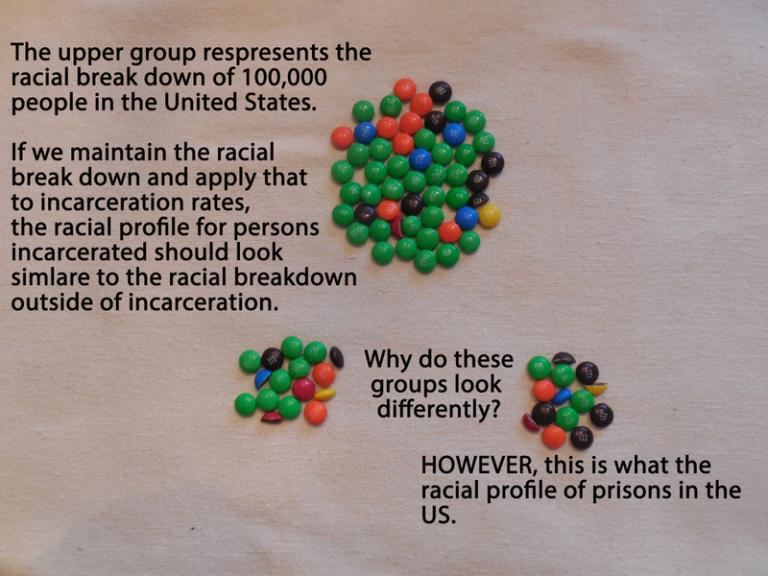
Discussion around why the population of prisoners looks so significantly different than the population of the United States will lead to talking about how 70% of all those incarcerated never graduated high school. The number of high school dropouts among black inmates is even higher than it is for white inmates. Additionally, incarceration rates in the South are 30% to 50% higher than other areas of the country. The adult can help the child consider why this is so. Differences between growing up in a white suburb compared to growing up where jobs are scarce, food is scarce, and violence is high could be discussed.
Interrogating reality and introducing fact-based discussions are the first two steps toward empowering children to overcome the subversive racism, homophobia, gender bias, and religious intolerance with which our media-filled world inundates them. In the next installment we will discuss the power of words, both the ones out of co-parent(s) mouths and the mouths of babes.
Continue this discussion on Facebook! Questions related to this article will be posted Monday, Wednesday, and Friday for the next two weeks. Let’s keep the conversation going!
[i] Polyamory should not be confused with polygamy. Polyamory is the act of taking multiple lovers. This can involve multiple partners in a long term commitment or a couple who is permitted to have short term, less serious relationships of a sexual nature while staying committed to the primary relationship. It should be noted that I am not polyamorous; however, I have long standing close friendships with persons who are. For my research in Family Coven: Birthing Hereditary Witchcraft I went out of my way to talk to and include family units who were polyamorous. Please follow some of the links below to read more about polyamory.
[ii] Husband-priest is the term for the person, regardless of gender, who most frequently brings the energy of male divinity into a Family Coven. Father-priest is the term for the person, regardless of gender, who frequently brings the energy of male divinity to any children within his/her care. Wife-priestess is the term for the person, regardless of gender, who most frequently brings the energy of female divinity into a Family Coven. Mother-Priestess is the term for the person, regardless of gender, who frequently brings the energy of female divinity to any children within his/her care.
[iii] From this point forward I will utilize the term co-parent(s) to honor gay and lesbian parents and the existence of polyamorous family units.
[iv] According to Consensus.gov’s 2010 demographics, there are 3, 684 total persons in Jasper County, Georgia and 115 black persons.
[v] Bonczar, T. Racial Disparity. The Sentencing Project News, n.d. Web. 30 Dec. 2013. <http://www.sentencingproject.org/template/page.cfm?id=122>.
[vi] “The situation arising from mass Black incarceration is fraught with savage, self-fulfilling policy ironies and sinister sociological synergies. Criminal justice policies are pushing hundreds of thousands of already disadvantaged and impoverished “underclass” Blacks further from minimally remunerative engagement with the labor market.” Street, Paul. “Race, Prison, and Poverty.” Race, Prison, and Poverty. Z Magazine, n.d. Web. 02 Jan. 2014. <http://www.historyisaweapon.com/defcon1/streeracpripov.html>.
[vii] “Drawing on a sample of more than 39,000 southern whites, we show that whites who currently live in counties that had high concentrations of slaves in 1860 are on average more conservative and express colder feelings towards African Americans than whites who live elsewhere in the South. That is, the larger the number of slaves in his or her county of residence in 1860, the greater the probability that a white Southerner today will identify as a Republican, express opposition to race-coded policies such as affirmative action, and express greater racial resentment towards African Americans. We show that these differences are robust to a variety of factors, including geography and mid-19th century economic conditions and political attitudes. We also show that our results strengthen when we instrument for the prevalence of slavery using local measures of the agricultural suitability to grow cotton. In fact, our findings indicate that in the counter factual world where the South had no slaves in 1860, the political views of white Southerners today would be indistinguishable from those of similarly situated white Northerners.” [author’s emphasis, not mine] Ian Millhisner**; Study Suggests that Slavery Turns White People Into Republicans 150 Years Later;** thinkprogress.org
[viii] United States of America. US Census Bureau. USA QuickFacts from the US Census Bureau. US Government, 17 Dec. 2013. Web. 31 Dec. 2013. <http://quickfacts.census.gov/qfd/states/00000.html>.
[ix] I would encourage you to permit your child(ren) to pick the race color representations. For the purposes of this example, I have stuck to social norms. When dealing with small children, abstract thinking can be difficult and might confuse the lesson.
[x] Tsai, Tyjen, and Paola Scommegna. U.S. Has World’s Highest Incarceration Rate. Rep. Population Reference Bureau, n.d. Web. 31 Dec. 2013. <http://www.prb.org/Publications/Articles/2012/us-incarceration.aspx>.
[xi] Based on US Inmates by Race (43.91% Black, rounded to 44%; 34.72% White, rounded to 35%; 18.26% Hispanic, rounded to 18% and 3.11% Mixed Race/Other, rounded to 4%) Spagnoli, Filip. PapBlog Human Rights Etc. Filip Spagnoli, 24 May 2013. Web. 02 Jan. 2014. <http://filipspagnoli.wordpress.com/stats-on-human-rights/statistics-on-freedom/statistics-on-prisoner-population-rates/>.
Birthing Hereditary Witchcraft
Previous Post

January 10, 2014
Heathen Woman: Embracing the Awakened Woman
Next Post

January 14, 2014 The Dance of Pagan Recovery: Welcome to the Dance
Browse Our Archives
Select a Category A Lakeside Hearth Adventures in Wortcunning Alone In Her Presence Arts, Crafts & Cooking Birthing Hereditary Witchcraft Book of Blackbirds Book Reviews Born-Again Witch Cauldron, Sword, Spear, & Stone Cermony and Liturgy Columns Community Dandelion Seeds Dear Jasmine Druid Thoughts Editor's Picks Everyday Pagan Family & Household Practice Family Traditions Full Frontal Magic Gateway Goddess Guest Articles Happily Heathen Health and Wellness Hearth of Hellenism Heathen Woman Hills of the Horizon History Holidays Horse Goddesses Interfaith Interviews Irish-American Witchcraft Jewish Witch Lamp & Labyrinth Letters from Midgard Literature, Media, Film, Music Loop of Brighid Love, Sex & Relationships Magic or Magick Making Light Naturalistic Traditions Nature News Outside The Circle Pantheisticon Politics Prayers, Poems, Blessings & Stories Queer Femme Mystic Queer of Swords Recipes Ritual and Practice Science and Research Seekers and Guides Seeking the Grail Socially Responsible Magic Spear of Athena Star Made Witch Syncretic Electric Technology The Blooming Staff The Busy Witch The Cartomancer The Crow's Nest The Dance of Pagan Recovery The Hearth of Hellenism The Lady's Quill The Other Side of the Hedge The Path of She The Rantin' Raven The Witches Next Door The Zen Pagan Theology, Ethics, Philosophy Tree City Witch Urban Earthwitch Wayfaring Woman Witch on Fire Wyrd Words
Select a Month January 2026 March 2025 December 2024 June 2024 April 2024 March 2024 January 2024 December 2023 November 2023 October 2023 August 2023 July 2023 May 2023 April 2023 March 2023 February 2023 January 2023 December 2022 November 2022 October 2022 September 2022 August 2022 July 2022 June 2022 May 2022 March 2022 February 2022 January 2022 December 2021 November 2021 October 2021 September 2021 August 2021 July 2021 June 2021 May 2021 April 2021 March 2021 February 2021 January 2021 December 2020 November 2020 October 2020 September 2020 August 2020 July 2020 June 2020 May 2020 April 2020 March 2020 February 2020 January 2020 December 2019 November 2019 October 2019 September 2019 August 2019 July 2019 June 2019 May 2019 April 2019 March 2019 February 2019 January 2019 December 2018 November 2018 October 2018 September 2018 August 2018 July 2018 June 2018 May 2018 April 2018 March 2018 February 2018 January 2018 December 2017 November 2017 October 2017 September 2017 August 2017 July 2017 June 2017 May 2017 April 2017 March 2017 February 2017 January 2017 December 2016 November 2016 October 2016 September 2016 August 2016 July 2016 June 2016 May 2016 April 2016 March 2016 February 2016 January 2016 December 2015 November 2015 October 2015 September 2015 August 2015 July 2015 June 2015 May 2015 April 2015 March 2015 February 2015 January 2015 December 2014 November 2014 October 2014 September 2014 August 2014 July 2014 June 2014 May 2014 April 2014 March 2014 February 2014 January 2014 December 2013 November 2013 October 2013 September 2013 August 2013 July 2013 June 2013 May 2013 April 2013 March 2013 February 2013 January 2013 December 2012 November 2012 October 2012 September 2012 August 2012 July 2012 June 2012 May 2012 April 2012 March 2012 February 2012 January 2012
Follow Us!
TAKE THE
Religious Wisdom Quiz
What Christian tradition refers to its pastors as "elders"?
Select your answer to see how you score.
Presbyterian Anglican Orthodox Catholic
Related posts from Agora

Simple Witchery: To Keep Silent

Simple Witchery: Leaning On The Four Pillars

Pergamum Unfurled: Magic with the Greek Gods (Book...

Pergamum Unfurled: Cunning Words (Review)
TRENDING AT PATHEOS Pagan

I was recently chatting with someone on Instagram. She asked me what...

While there are many people who share their results, the end of...

On July 23, I saw Christopher Nolan's The Odyssey which is Homer’s...

As I write this two big events have just finished up. One...

Restoring the Watershed of Divine Love
Perhaps cooperation is not something we manufacture through legislation, ideology, or moral...

Many UUs don’t pray because of bad experiences in a previous religion,...
view all Pagan blogs
Ad-Free & Subscriber Log-In Subscription Support
- About Us
- 2026 Calendar
- Videos
- Podcasts
- Library of World Religions
- Faith In Media Tracker
- Advertise With Us
- Write for Us
- Privacy Policy
- Terms of Service
- Do Not Sell My Data
- Contact Us
- Radiant Digital
- Manage Newsletter Subscriptions
- Unsubscribe From Notifications
- Sitemap
Copyright 2008-2026, Patheos. All rights reserved.
Subscription Support Ad-Free & Subscriber Log-In
Follow Patheos