
BuddhistCatholicContemplativeEvangelicalGeneral ChristianHinduJewishLatter-day SaintMuslimNew VisionsProgressive Christian
Beliefs
- Buddhist
- Catholic
- Contemplative
- Evangelical
- General Christian
- Hindu
- Jewish
- Latter-day Saint
- More Voices
- Muslim
- New Visions
- Pagan
- Progressive Christian
Topics
- Religion News
- Food and Religion
- Sports and Religion
- Religious Art
- Religious Music and Entertainment
- Religious Events
- History and Religion
- Style and Religion
- Politics and Religion
- Women in Religion
- Recreation Outdoors and Religion
- Business Finance and Religion
- Careers Workplace and Religion
- Education and Religion
- Family Parenting and Religion
- Health Fitness and Religion
- Home and Religion
- Relationships and Religion
- Technology and Religion
- Travel and Religion
Columnists
- Buddhist Columnists
- Business Finance and Religion Columnists
- Careers Workplace and Religion Columnists
- Catholic Columnists
- Contemplative Columnists
- Education and Religion Columnists
- Evangelists Columnists
- Family Parenting and Religion Columnists
- General Christian Columnists
- Health Fitness and Religion Columnists
- Hindu Columnists
- History and Religion Columnists
- Home and Religion Columnists
- Jewish Columnists
- More Voices Columnists
- Latter Day Columnists
- Muslim Columnists
- New Visions Columnists
- Nonreligious Columnists
- Pagan Columnists
- Politics and Religion Columnists
- Progressive Columnists
- Recreation Outdoors and Religion Columnists
- Relationships and Religion Columnists
- Religion News Columnists
- Religious Art Columnists
- Religious Events Columnists
- Religious Music and Entertainment Columnists
- Sports and Religion Columnists
- Style and Religion Columnists
- Technology and Religion Columnists
- Travel and Religion Columnists
- Women in Religion Columnists
Resource Library
- 2026 Calendar
- Library of World Religions
- The 100 Most Holy Places on Earth
- Patheos Answers
- Podcasts
- Videos
- Faith Leaders Database
- Anglican Episcopalian
- Bahai
- Baptist
- Buddhism
- Christianity
- Confucianism
- Eastern Orthodoxy
- Hinduism
- Holiness and Pentecostal
- ISKCON
- Islam
- Judaism
- Lutheran
- Methodist
- The Church of Jesus Christ of Latter-day Saints
- New Age
- Paganism
- Presbytarian and Reformed
- Protestantism
- Religion Behind the Scenes
- Roman Catholic
- Scientology
- Shia Islam
- Sikhism
- Sufism
- Sunni Islam
- Taoism
- Zen
- See all religions
Research Tools
 Ad-Free & Subscriber Log-In Subscription Support
Ad-Free & Subscriber Log-In Subscription Support
Follow Patheos 

- Trending:
- Forgiveness
- |
- Marriage
- |
- Consciousness
- |
- Death Penalty
- |
- Election
- |
- Halloween

- Home
- Pagan
- Hills of the Horizon: Reconstruction and Mysticism
Hills of the Horizon: Reconstruction and Mysticism
Last updated on: January 26, 2015 at 9:30 pm by Kiya Nicoll
Hills of the Horizon: Reconstruction and Mysticism 2015-01-26T21:30:22+00:00 Kiya Nicoll
Patheos Explore the world's faith through different perspectives on religion and spirituality! Patheos has the views of the prevalent religions and spiritualities of the world.
There is a tension between the process of reconstruction and the experience of mysticism.
The mystical experience is not one that can easily be written down (though many poets have tried, and some have had more success than others). In a religious context dominated by the stricter reconstructionist methodologies, that stuff that isn’t written down, most preferably in a book released by a reputable academic press, tends to be viewed with some suspicion. Subjective experiences are potentially treacherous; the question “How do you know they’re not making it up?” seems to float under the subtext of a great number of rejections of the mystical experience in others.
Some reconstructionist groups go so far as to reject work with mysteries entirely, dealing only in those things that can be found in the archaeological and textual records. Because private and esoteric practices left little decipherable material behind, those processes cannot be reconstructed exactly as they were; some have argued that it is inappropriate to even consider this kind of religious practice. (I have even seen it argued that since human neglect led to the disappearance of the gods-granted knowledge of holy mysteries, the mysteries are things that we don’t get to have anymore, as if they were toys to be taken away from unruly children.)
It is a simple fact, though, that the odds are that we’re not going to get, say, the Eleusinian Mysteries back. (I gave a talk on mysteries and reconstruction at this past year’s Paganicon, and part of that was a ramble about all the stuff we know about the Eleusinian Mysteries, which are extremely well-documented in some ways. In the end, nobody seemed to have much confidence they could pull that off.) Even if someone does manage to hit on the right ritual procedures to reproduce the effects of some of those known, named, and now-lost mysteries, we’ll never know if they got it right. It’ll be such-and-so coven’s Kore-and-Demeter torchlight ritual play and none of the rest of us will ever know.
This doesn’t mean that pursuing mystery work is a waste of time for reconstructionists; it does require a different process from attempting to decipher what procedures the (usually formal and/or upper-class, since those were more likely to be recorded) ancient practitioners of religions used to honor gods, spirits, ancestors, and whoever else, and then doing likewise. Instead of building a procedure to ancient blueprints, we are left with building a container, discovering what experiences can be held in that space, and elaborating, refining, and rearranging that container until the desired experiences arise naturally and reliably from the format.
(The actual lynchpin of my conversion to Egyptian reconstructionist practice actually went a bit like this. I decided to try a particular group’s suggested basic ritual, and came out of it saying, “Wow. That was the best damn ground and center I’ve ever encountered.” And since I had a history of, at best, feeling like a fool when doing rituals, having a completely positive reaction to a small ritual was a pretty amazing experience all by itself.)
The mysteries we discover with this kind of process will not be the same as ancient ones. However, they will be accessible to people of the time and place where they are found, they will be relevant to our modern practices, and they will be teachable within our lines of study. I do think that this can only reach its pinnacle of health within a context of a vibrant and consistent mainstream pagan culture of relevant, related practices, so that people can become familiar with the containers into which ecstatic experience can be poured.
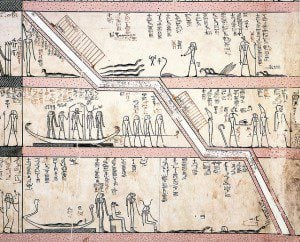
A meaningful pursuit of reconstructionist-oriented religion will return to the source texts and information that has been used to build the public rituals and assemble the festival calendars, and will then try to find ways which these can be iterated into deeper understandings: for example, not just tracing the progression of the sunboat through the twelve hours of the night as a sacred story, but exploring that passage as a mystical journey, and finding ways to construct cycles of practice that enable developing deeper personal understandings of that journey when repeated over time.
Hills of the Horizon is an occasional column by Egyptian reconstructionist pagan Kiya Nicoll. Subscribe via RSS or e-mail!
Previous Post

July 10, 2013
Druid Thoughts: Tennis for Pagans
Next Post

July 18, 2013 Loop of Brighid: Invocation of the Graces – A Brigidine Sacred Text, Part 3
Browse Our Archives
Select a Category A Lakeside Hearth Adventures in Wortcunning Alone In Her Presence Arts, Crafts & Cooking Birthing Hereditary Witchcraft Book of Blackbirds Book Reviews Born-Again Witch Cauldron, Sword, Spear, & Stone Cermony and Liturgy Columns Community Dandelion Seeds Dear Jasmine Druid Thoughts Editor's Picks Everyday Pagan Family & Household Practice Family Traditions Full Frontal Magic Gateway Goddess Guest Articles Happily Heathen Health and Wellness Hearth of Hellenism Heathen Woman Hills of the Horizon History Holidays Horse Goddesses Interfaith Interviews Irish-American Witchcraft Jewish Witch Lamp & Labyrinth Letters from Midgard Literature, Media, Film, Music Loop of Brighid Love, Sex & Relationships Magic or Magick Making Light Naturalistic Traditions Nature News Outside The Circle Pantheisticon Politics Prayers, Poems, Blessings & Stories Queer Femme Mystic Queer of Swords Recipes Ritual and Practice Science and Research Seekers and Guides Seeking the Grail Socially Responsible Magic Spear of Athena Star Made Witch Syncretic Electric Technology The Blooming Staff The Busy Witch The Cartomancer The Crow's Nest The Dance of Pagan Recovery The Hearth of Hellenism The Lady's Quill The Other Side of the Hedge The Path of She The Rantin' Raven The Witches Next Door The Zen Pagan Theology, Ethics, Philosophy Tree City Witch Urban Earthwitch Wayfaring Woman Witch on Fire Wyrd Words
Select a Month January 2026 March 2025 December 2024 June 2024 April 2024 March 2024 January 2024 December 2023 November 2023 October 2023 August 2023 July 2023 May 2023 April 2023 March 2023 February 2023 January 2023 December 2022 November 2022 October 2022 September 2022 August 2022 July 2022 June 2022 May 2022 March 2022 February 2022 January 2022 December 2021 November 2021 October 2021 September 2021 August 2021 July 2021 June 2021 May 2021 April 2021 March 2021 February 2021 January 2021 December 2020 November 2020 October 2020 September 2020 August 2020 July 2020 June 2020 May 2020 April 2020 March 2020 February 2020 January 2020 December 2019 November 2019 October 2019 September 2019 August 2019 July 2019 June 2019 May 2019 April 2019 March 2019 February 2019 January 2019 December 2018 November 2018 October 2018 September 2018 August 2018 July 2018 June 2018 May 2018 April 2018 March 2018 February 2018 January 2018 December 2017 November 2017 October 2017 September 2017 August 2017 July 2017 June 2017 May 2017 April 2017 March 2017 February 2017 January 2017 December 2016 November 2016 October 2016 September 2016 August 2016 July 2016 June 2016 May 2016 April 2016 March 2016 February 2016 January 2016 December 2015 November 2015 October 2015 September 2015 August 2015 July 2015 June 2015 May 2015 April 2015 March 2015 February 2015 January 2015 December 2014 November 2014 October 2014 September 2014 August 2014 July 2014 June 2014 May 2014 April 2014 March 2014 February 2014 January 2014 December 2013 November 2013 October 2013 September 2013 August 2013 July 2013 June 2013 May 2013 April 2013 March 2013 February 2013 January 2013 December 2012 November 2012 October 2012 September 2012 August 2012 July 2012 June 2012 May 2012 April 2012 March 2012 February 2012 January 2012
Follow Us!
TAKE THE
Religious Wisdom Quiz
How old was Abraham when he died?
Select your answer to see how you score.
150 years 200 years 125 years 175 years
Related posts from Agora

Simple Witchery: To Keep Silent

Simple Witchery: Leaning On The Four Pillars

Pergamum Unfurled: Magic with the Greek Gods (Book...

Pergamum Unfurled: Cunning Words (Review)
TRENDING AT PATHEOS Pagan

I was recently chatting with someone on Instagram. She asked me what...

While there are many people who share their results, the end of...

On July 23, I saw Christopher Nolan's The Odyssey which is Homer’s...

As I write this two big events have just finished up. One...

Restoring the Watershed of Divine Love
Perhaps cooperation is not something we manufacture through legislation, ideology, or moral...

Many UUs don’t pray because of bad experiences in a previous religion,...
view all Pagan blogs
Ad-Free & Subscriber Log-In Subscription Support
- About Us
- 2026 Calendar
- Videos
- Podcasts
- Library of World Religions
- Faith In Media Tracker
- Advertise With Us
- Write for Us
- Privacy Policy
- Terms of Service
- Do Not Sell My Data
- Contact Us
- Radiant Digital
- Manage Newsletter Subscriptions
- Unsubscribe From Notifications
- Sitemap
Copyright 2008-2026, Patheos. All rights reserved.
Subscription Support Ad-Free & Subscriber Log-In
Follow Patheos