
BuddhistCatholicContemplativeEvangelicalGeneral ChristianHinduJewishLatter-day SaintMuslimNew VisionsProgressive Christian
Beliefs
- Buddhist
- Catholic
- Contemplative
- Evangelical
- General Christian
- Hindu
- Jewish
- Latter-day Saint
- More Voices
- Muslim
- New Visions
- Pagan
- Progressive Christian
Topics
- Religion News
- Food and Religion
- Sports and Religion
- Religious Art
- Religious Music and Entertainment
- Religious Events
- History and Religion
- Style and Religion
- Politics and Religion
- Women in Religion
- Recreation Outdoors and Religion
- Business Finance and Religion
- Careers Workplace and Religion
- Education and Religion
- Family Parenting and Religion
- Health Fitness and Religion
- Home and Religion
- Relationships and Religion
- Technology and Religion
- Travel and Religion
Columnists
- Buddhist Columnists
- Business Finance and Religion Columnists
- Careers Workplace and Religion Columnists
- Catholic Columnists
- Contemplative Columnists
- Education and Religion Columnists
- Evangelists Columnists
- Family Parenting and Religion Columnists
- General Christian Columnists
- Health Fitness and Religion Columnists
- Hindu Columnists
- History and Religion Columnists
- Home and Religion Columnists
- Jewish Columnists
- More Voices Columnists
- Latter Day Columnists
- Muslim Columnists
- New Visions Columnists
- Nonreligious Columnists
- Pagan Columnists
- Politics and Religion Columnists
- Progressive Columnists
- Recreation Outdoors and Religion Columnists
- Relationships and Religion Columnists
- Religion News Columnists
- Religious Art Columnists
- Religious Events Columnists
- Religious Music and Entertainment Columnists
- Sports and Religion Columnists
- Style and Religion Columnists
- Technology and Religion Columnists
- Travel and Religion Columnists
- Women in Religion Columnists
Resource Library
- 2026 Calendar
- Library of World Religions
- The 100 Most Holy Places on Earth
- Patheos Answers
- Podcasts
- Videos
- Faith Leaders Database
- Anglican Episcopalian
- Bahai
- Baptist
- Buddhism
- Christianity
- Confucianism
- Eastern Orthodoxy
- Hinduism
- Holiness and Pentecostal
- ISKCON
- Islam
- Judaism
- Lutheran
- Methodist
- The Church of Jesus Christ of Latter-day Saints
- New Age
- Paganism
- Presbytarian and Reformed
- Protestantism
- Religion Behind the Scenes
- Roman Catholic
- Scientology
- Shia Islam
- Sikhism
- Sufism
- Sunni Islam
- Taoism
- Zen
- See all religions
Research Tools
 Ad-Free & Subscriber Log-In Subscription Support
Ad-Free & Subscriber Log-In Subscription Support
Follow Patheos 

- Trending:
- Forgiveness
- |
- Marriage
- |
- Consciousness
- |
- Death Penalty
- |
- Election
- |
- Halloween

- Home
- Pagan
- Druid Thoughts: The Influence of Story
Druid Thoughts: The Influence of Story
Last updated on: December 31, 2014 at 10:08 pm by Nimue Brown
Druid Thoughts: The Influence of Story 2014-12-31T22:08:56+00:00 Nimue Brown
Patheos Explore the world's faith through different perspectives on religion and spirituality! Patheos has the views of the prevalent religions and spiritualities of the world.
The vast majority of us will never read a book detailing the laws of the land we inhabit. Most of us will not study sociology or anthropology, either. Citizenship is on the syllabus for teenagers in the UK, but this is a relatively new thing. The norm and regulations that hold our cultures together are not formally taught, for the greater part. Social etiquette, expectation and the nuances of human interaction will never be part of those citizenship classes, either.
We learn a great deal by observing the behaviour of those around us. Our families and immediate neighbours supply us with information from the moment we are born. With the acquisition of language comes a vast array of tradition, assumption, belief, prejudice and ‘socialising’ alongside plenty of useful information about how the world works and how we should act. School introduces us to further social learning alongside the formal subjects. Sometimes what we pick up there doesn’t fit with what we already know, which can make life complicated. All new experiences have the potential to make us reconsider our views. Work spaces, neighbourhoods, and fashions oblige us to undertake lifelong learning just in order to fit in.

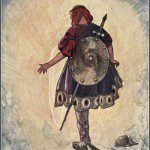
The Storyteller, by Eddi Van W.
For many people, the birth family also includes a technological member, beaming a whole array of tradition, assumption, belief, prejudice, social norms and useful things into our minds: many of us learn our core cultural ideas from our televisions and the internet. Before that, radio, books and newspapers filled a similar niche. Go back further and broadsheets, song sheets, the church and travelling theatre provided a similar, if reduced service. This pattern must go all the way back to the story tellers around the first camp fires, and I like to think it’s a lineage that includes the Druids of old. I’ll be back to dabble further in wild speculation later on. For now, let’s focus on what we know.No one sits a child down and explains to them the entirety of what is right and what is wrong by the standards of the society they live in. However, messages about how to behave are spoonfed to children from their earliest days.
Once upon a time, there was a beautiful princess, who was good and kind and liked soft, furry mammals. She had a lazy sister who was greedy and mean.
Fairy stories are full of these figures – characters who uphold virtues and are rewarded, alongside others who represent vices and are there to be punished. It is to a large extent through stories that we convey cultural values and absorb our earliest notions about how the world works.As we grow up, the stories and characters shared with us tend to get a bit more complex. However, every story (book, film, play, TV program, video game) that comes out of a culture is born to some extent from that culture’s values and assumptions. Consider the way in which the American film industry celebrates the hero with a gun in his hands. Think about the entirely unrealistic romance stories we keep generating. We give children the most surreal, brightly coloured, patronising and inane content to teach them… What? Not about the real world outside their doors, of that I feel certain. Then there are the soap operas and daytime reality and talk shows, full of angry and disrespectful language, verbal abuse, freak show treatments and a lot of shouting. The stories we tell to each other frequently scare me. So often, the solutions we’re offered revolve around violence, death, or having the loudest voice and the least willingness to listen or compromise. We offer abusive, destructive relationships as some kind of romantic ideal (Twilight, Fifty Shades), and we play games about killing things.
Stories are incredibly powerful things. They give us archetypes to draw on as we try, in our earliest years, to develop a sense of self. Stories take us outside immediate experience and show us a wider world, giving models for behaviour and ideas about how we may want to live our lives. Stories in any form have the potential to inform, inspire, uplift and enrich. This should be food for the soul. Turn on your television and watch the angry, the shouty, the attention-hungry, and the violent, or yet another advert-story that will sell you ideas of your own insufficiency to create demand for some needless product. Soul food stories are in short supply for many people.
Once upon a time there was a person who everyone had previously thought wasn’t clever or talented or important in any way. That person got onto a TV program. Everyone fell in love with them and voted for them, and so they became rich and famous and lived happily ever after.
This is the fairy story of our times in which no one mentions industry wolves, dragons of mental breakdown or the wicked step mother media. Once upon a time the fairy stories had grains of useful truth in them: Stay on the path. Don’t steal from witches. Be polite. Get off your arse and make an effort, because success will not beat a path to your door. Now we make marketing fairy tale about impossibly perfect families who live in impossibly perfect homes, and depression is a widespread ailment.
We have every reason to think that the Druids of old were keepers of knowledge – law, history and story were all part of that mix. Back before the advent of all this current technology, in a culture that refused to write things down, I imagine the importance of story may have been better understood. Here I dare to speculate a little. I imagine the bards, with their tales of heroism and tragedy, telling stories full of heart and truth. Stories to inspire and uplift. Tales of setback and struggle to guide the listeners through the trials of their own lives: Never give up. Be true to your beliefs. Don’t steal from witches. Show gratitude. Stories full of ideas to help people live alongside each other in peaceful and productive ways. Not so much of the angry, shouty violence, perhaps. In all fairness though, there were plenty of battles, and the Celts liked a good punch up as much as the next culture.
I come back, as I so often do, to the image of Cu Chulain and Feridad at the ford, fighting because honour demands it, duty demands it, but not killing each other for days because love and honour demand that too. Violence was part of the real lives of our Celtic ancestors. It wasn’t a fantasy game to them, but a harsh reality. I can’t imagine they would have a lot of time for our stories of shouty disrespect, hubris and blind stupidity.
Of course there are good modern stories out there too. Tales of heart and integrity are still being created, where a gun is not the only answer to conflict, and pain is not offered in pornographic terms. I rather suppose that our ancestors knew enough about suffering not to want or need to indulge in graphic representations of it. Our lives can be so far removed from the most essential things, it’s little wonder, perhaps, that so much modern story making now is intensely visceral in depicting sex and violence. Too many people are not grounded by close contact with the natural world. Our culture is not grounded, and so many stories offer us back only sickness and madness, in varying guises.
Telling stories has never been more important. It is from stories that we absorb so many of our assumptions and cultural norms. Stories can therefore be used to subvert and redirect the dominant thought forms in a culture. Consider the subversive work of Russian authors under communism. Remember Scheherazade, storytelling to survive a potentially lethal marriage. Storytellers have always included voices for counterculture, quiet rebellion and radical revision, not least because it’s tricky telling stories without intrinsic conflict in them. When there is conflict, there is always room to challenge the normal. All too often our modern storytellers do that by playing out established beliefs about how things work, rather than questioning them. The hero with the gun in his hand shoots the bad man, who also has a gun. The story of film so easily becomes the story of politics as well.
What are religions, if not a collection of stories gathered together for a specific purpose? Any religion, is a cluster of stories explaining how the world works, offering up archetypes and ideas for followers to emulate. Taking story out of a religious context does not make it any less a method for explaining things, but when we have religion wrapped around a story, it is easier to spot that there will be some kind of a point, some kind of message. I don’t think it’s possible to create stories that are free from assumption, moral framework, belief and intentions about how the world should be. It is all too possible to put stories into the world without considering that aspect of them, though. Or perhaps, in the quest to churn out an exciting best seller or blockbuster, the meaning comes a poor second. Just throw in a few more explosions and up the body count, that’ll keep them interested…
The morals of stories don’t tend to be pleasing when they’re too ‘in the face’. Subtler approaches can draw people in and smuggle ideas into heads without preaching or overwhelming. I’m particularly inspired by the work of Japanese film maker Hayao Miyazaki and his Studio Ghibli. Films like Spirited Away, Nausicaa of the Valley of the Wind, and My Neighbor Totoro are soulful fairy stories full of green consciousness and compassionate humanity. These films attract a wide audience, proving that more thoughtful stories can be shared to good, commercial effect. I love the way that in Miyazaki films, violence is the problem, not the answer. We could use a lot more stories with that basic shape.
We are all storytellers. We share tales of our own lives, jokes, anecdotes and news. Even if we aren’t consciously telling stories, our unconscious narratives all contribute to and are part of the same process. Each of these more personal stories is an expression of culture, belief, and assumptions. Jokes have long been a medium for conveying and upholding prejudice – racism and sexism all find their audiences through supposed ‘comedy’. (Why does a woman have legs? So she can get from the bed to the sink.) When that kind of idea can (or is supposed to) provoke a laugh, even the smallest joke can create the society we live in. Dignity and power can be stripped away by ‘comedy’. But jokes and personal storytelling can also be used to subvert and re-imagine, to poke fun at prejudice, laugh away fear, and steer us towards mutual understanding. Laughter can be serious, political stuff.
We all have the option of thinking about the sorts of stories we pass on, from jokes to novels. Every story conveys a message about how the world could be, or how we think it is. Even if we aren’t innovating, most of us engage in the transmission of ideas. In so doing, we lend our hands to shaping the culture we live in, which shapes the stories that shape the culture. There’s incredible power in that process, one with which we could achieve a lot more than we currently do.
Once upon a time, there was a Druid…
Druid Thoughts is published on occasional Wednesdays on Agora. Follow it via RSS or e-mail!
Literature, Media, Film, Music
Previous Post

January 29, 2013
Mourning Deena Butta, Priestess of the Fellowship of Isis
Next Post
January 31, 2013 Loop of Brighid: The Mysticism of Devotion, Part 2
Browse Our Archives
Select a Category A Lakeside Hearth Adventures in Wortcunning Alone In Her Presence Arts, Crafts & Cooking Birthing Hereditary Witchcraft Book of Blackbirds Book Reviews Born-Again Witch Cauldron, Sword, Spear, & Stone Cermony and Liturgy Columns Community Dandelion Seeds Dear Jasmine Druid Thoughts Editor's Picks Everyday Pagan Family & Household Practice Family Traditions Full Frontal Magic Gateway Goddess Guest Articles Happily Heathen Health and Wellness Hearth of Hellenism Heathen Woman Hills of the Horizon History Holidays Horse Goddesses Interfaith Interviews Irish-American Witchcraft Jewish Witch Lamp & Labyrinth Letters from Midgard Literature, Media, Film, Music Loop of Brighid Love, Sex & Relationships Magic or Magick Making Light Naturalistic Traditions Nature News Outside The Circle Pantheisticon Politics Prayers, Poems, Blessings & Stories Queer Femme Mystic Queer of Swords Recipes Ritual and Practice Science and Research Seekers and Guides Seeking the Grail Socially Responsible Magic Spear of Athena Star Made Witch Syncretic Electric Technology The Blooming Staff The Busy Witch The Cartomancer The Crow's Nest The Dance of Pagan Recovery The Hearth of Hellenism The Lady's Quill The Other Side of the Hedge The Path of She The Rantin' Raven The Witches Next Door The Zen Pagan Theology, Ethics, Philosophy Tree City Witch Urban Earthwitch Wayfaring Woman Witch on Fire Wyrd Words
Select a Month January 2026 March 2025 December 2024 June 2024 April 2024 March 2024 January 2024 December 2023 November 2023 October 2023 August 2023 July 2023 May 2023 April 2023 March 2023 February 2023 January 2023 December 2022 November 2022 October 2022 September 2022 August 2022 July 2022 June 2022 May 2022 March 2022 February 2022 January 2022 December 2021 November 2021 October 2021 September 2021 August 2021 July 2021 June 2021 May 2021 April 2021 March 2021 February 2021 January 2021 December 2020 November 2020 October 2020 September 2020 August 2020 July 2020 June 2020 May 2020 April 2020 March 2020 February 2020 January 2020 December 2019 November 2019 October 2019 September 2019 August 2019 July 2019 June 2019 May 2019 April 2019 March 2019 February 2019 January 2019 December 2018 November 2018 October 2018 September 2018 August 2018 July 2018 June 2018 May 2018 April 2018 March 2018 February 2018 January 2018 December 2017 November 2017 October 2017 September 2017 August 2017 July 2017 June 2017 May 2017 April 2017 March 2017 February 2017 January 2017 December 2016 November 2016 October 2016 September 2016 August 2016 July 2016 June 2016 May 2016 April 2016 March 2016 February 2016 January 2016 December 2015 November 2015 October 2015 September 2015 August 2015 July 2015 June 2015 May 2015 April 2015 March 2015 February 2015 January 2015 December 2014 November 2014 October 2014 September 2014 August 2014 July 2014 June 2014 May 2014 April 2014 March 2014 February 2014 January 2014 December 2013 November 2013 October 2013 September 2013 August 2013 July 2013 June 2013 May 2013 April 2013 March 2013 February 2013 January 2013 December 2012 November 2012 October 2012 September 2012 August 2012 July 2012 June 2012 May 2012 April 2012 March 2012 February 2012 January 2012
Follow Us!
TAKE THE
Religious Wisdom Quiz
Which relative of Saul cursed and threw stones at David during Absalom's rebellion?
Select your answer to see how you score.
Mephibosheth Shimei Ish-bosheth Jonathan
Related posts from Agora
Salt City Pagan: Facing the Full Truth
Salt City Pagan: Things I Haven’t Told You
Pergamum Unfurled: Review – Old Gods, New Druids
Salt City Pagan: What If Druidry Survived?
TRENDING AT PATHEOS Pagan

When we talk about Greek religion, we often begin with the dodekatheion—the...

I was recently chatting with someone on Instagram. She asked me what...

While there are many people who share their results, the end of...

On July 23, I saw Christopher Nolan's The Odyssey which is Homer’s...

As I write this two big events have just finished up. One...

Restoring the Watershed of Divine Love
Perhaps cooperation is not something we manufacture through legislation, ideology, or moral...
view all Pagan blogs
Ad-Free & Subscriber Log-In Subscription Support
- About Us
- 2026 Calendar
- Videos
- Podcasts
- Library of World Religions
- Faith In Media Tracker
- Advertise With Us
- Write for Us
- Privacy Policy
- Terms of Service
- Do Not Sell My Data
- Contact Us
- Radiant Digital
- Manage Newsletter Subscriptions
- Unsubscribe From Notifications
- Sitemap
Copyright 2008-2026, Patheos. All rights reserved.
Subscription Support Ad-Free & Subscriber Log-In
Follow Patheos