
BuddhistCatholicContemplativeEvangelicalGeneral ChristianHinduJewishLatter-day SaintMuslimNew VisionsProgressive Christian
Beliefs
- Buddhist
- Catholic
- Contemplative
- Evangelical
- General Christian
- Hindu
- Jewish
- Latter-day Saint
- More Voices
- Muslim
- New Visions
- Pagan
- Progressive Christian
Topics
- Religion News
- Food and Religion
- Sports and Religion
- Religious Art
- Religious Music and Entertainment
- Religious Events
- History and Religion
- Style and Religion
- Politics and Religion
- Women in Religion
- Recreation Outdoors and Religion
- Business Finance and Religion
- Careers Workplace and Religion
- Education and Religion
- Family Parenting and Religion
- Health Fitness and Religion
- Home and Religion
- Relationships and Religion
- Technology and Religion
- Travel and Religion
Columnists
- Buddhist Columnists
- Business Finance and Religion Columnists
- Careers Workplace and Religion Columnists
- Catholic Columnists
- Contemplative Columnists
- Education and Religion Columnists
- Evangelists Columnists
- Family Parenting and Religion Columnists
- General Christian Columnists
- Health Fitness and Religion Columnists
- Hindu Columnists
- History and Religion Columnists
- Home and Religion Columnists
- Jewish Columnists
- More Voices Columnists
- Latter Day Columnists
- Muslim Columnists
- New Visions Columnists
- Nonreligious Columnists
- Pagan Columnists
- Politics and Religion Columnists
- Progressive Columnists
- Recreation Outdoors and Religion Columnists
- Relationships and Religion Columnists
- Religion News Columnists
- Religious Art Columnists
- Religious Events Columnists
- Religious Music and Entertainment Columnists
- Sports and Religion Columnists
- Style and Religion Columnists
- Technology and Religion Columnists
- Travel and Religion Columnists
- Women in Religion Columnists
Resource Library
- 2026 Calendar
- Library of World Religions
- The 100 Most Holy Places on Earth
- Patheos Answers
- Podcasts
- Videos
- Faith Leaders Database
- Anglican Episcopalian
- Bahai
- Baptist
- Buddhism
- Christianity
- Confucianism
- Eastern Orthodoxy
- Hinduism
- Holiness and Pentecostal
- ISKCON
- Islam
- Judaism
- Lutheran
- Methodist
- The Church of Jesus Christ of Latter-day Saints
- New Age
- Paganism
- Presbytarian and Reformed
- Protestantism
- Religion Behind the Scenes
- Roman Catholic
- Scientology
- Shia Islam
- Sikhism
- Sufism
- Sunni Islam
- Taoism
- Zen
- See all religions
Research Tools
 Ad-Free & Subscriber Log-In Subscription Support
Follow Patheos 

- Trending:
- Advent
- |
- Forgiveness
- |
- Thanksgiving
- |
- Election
- |
- Seasonal Holidays
- |
- Marriage

- Home
- Pagan
- Pantheisticon: Sex, Gender, and the Green World
Pantheisticon: Sex, Gender, and the Green World
Last updated on: January 26, 2015 at 9:34 pm by Nicole Youngman
Pantheisticon: Sex, Gender, and the Green World 2015-01-26T21:34:51+00:00 Nicole Youngman
Patheos Explore the world's faith through different perspectives on religion and spirituality! Patheos has the views of the prevalent religions and spiritualities of the world.
I’ve just finished transcribing the Pagan Spirit Gathering press conference from last month regarding Dianic rituals and the inclusion of transgendered people, and it’s gotten my plant-loving-feminist-sociologist brain spinning. It was a fascinating discussion to listen to so closely, and it got me thinking about parallels between human sex/gender/sexuality and the sexual strategies of trees and other plants. In many ways, our friends in the green world are more like us than we think, and they can give us some important ideas for working our way through some of the current sex-and-gender-related controversies affecting the Pagan community.
One of the key points that Dianic priestess Ruth Barrett made during the press conference was a distinction between the “physicality” of being born female and experiencing one’s entire life through a female body, and the “different path” that transgendered women follow on their way to womanhood. Transgender activist Melissa Murry drew some important parallels between the work done by feminists of decades past and her own work today in re-claiming one’s body, life experiences, and sexuality as sacred. Both touched on a distinction between sex and gender, which is important in both feminist and queer theory, as well as in the social sciences: “sex” is biological, the physical reality that very nearly all of us are born with bodies that are clearly male or female, while “gender” is a social and cultural construct that has to do with how men and women are supposed to feel, look, and behave. Gender identity, as Ruth stated, is fluid–a person can feel that they are “really” male or female in ways that may or may not coincide with their physical body, or they may want to present themselves or behave in ways that may or may not coincide with what is expected of someone of their physical sex, and these feelings may change over time. Sex comes to us from evolution, as a useful reproductive strategy for complex life forms; gender is something that societies invent, and so can vary markedly across time, place, and cultures. One feminist theorist a couple of decades ago asserted that gender is a performance—it’s a show that we put on for society in our attempts to conform (or not!) to the gender roles that are considered acceptable for our biological sex. All of us demonstrate various levels of “masculinity” (i.e. traits that our culture associates with boys and men) and “femininity” (traits that our culture associates with girls and women) as we go about our lives. We all “do” gender performances, whether we’re aware of it or not; the question is to what extent those performances are authentic expressions of who we “really are” vs. the extent to which we’re just presenting ourselves in a particular way because that’s what society expects of us.
Sex and gender aren’t completely unrelated, though. If gender was indeed strictly a social construction, completely uninfluenced by biology, we could argue that trans-people wouldn’t exist at all; a person could decouple their sex from their gender and present themselves and behave however they wished without a desire to be seen as or to become the other biological sex. In reality, though, we have situations where one male-born identical twin can realize early in her childhood that she’s “really a girl” while her brother has a more typical male/masculine gender identity. Throw sexuality in, and you’ve complicated the mix even further. When I was working on my MA in women’s studies back in the early 90s, our gay-rights group was called the “Gay/Lesbian/Bisexual Alliance,” with the assumption that one was either gay/lesbian or straight or attracted to both sexes more or less equally. Today we generally speak of “GLBTQ” issues—and sometimes the acronym gets even longer when we try to be really inclusive—expressing a better recognition that sex, gender, and sexuality issues are tremendously tangled and complicated.
So what does all this mean for Pagans? For many of us, our practice and our theology (or thealogy, if you prefer) focus on the concepts of balance and reciprocity between opposites, especially male and female. This is particularly true in Wicca with its largely duotheistic God-and-Goddess focus—as a local Wiccan friend in his 50s with a very traditional form of practice told me recently, “If it doesn’t feed people or make babies, we’re not interested!” Many ancient Paganisms and Native/Indigenous belief systems have earth-and-sky motifs where one is perceived as male and the other as female, with the two joining to create life. Likewise, the sun is often perceived as male and the moon as female in ancient religious thought (although this isn’t always the case!), and the union of the two during solar eclipses is considered one of the great Mysteries.
But even so, we are nature-based religions, and we know that “natural” male and female social behavior in the animal kingdom is much more complicated than we used to think. Sometimes it isn’t directly related to finding food or making babies, and things often get more complicated the more social an animal species is. You’ve probably seen those great stories about “gay” penguins in zoos, and there are a host of other examples of “homosexual behavior” as forms of bonding or aggression in the animal kingdom. Animals that are mostly solitary, from bears to alligators, often have fiercely protective mothers and more or less “absentee” fathers. Male penguins, however—who live in extremely large groups—are fabulous dads, protecting their eggs and chicks from cold and predators by keeping them up on their feet and under their bellies. Female lions raise and protect their cubs collectively, and both male and female lions hunt and protect their offspring–although males may kill cubs fathered by rival males and females may go after the cubs of rival prides. In the primate world, our closest cousins (of both sexes) range from extremely aggressive to surprisingly peaceful to solving interpersonal problems through frequent and promiscuous sexual contact.
I think we can dig even deeper, though, and have a look at the plant kingdom as well for examples of diverse sexual behaviors and expressions in nature. Trees (and other plants) have three basic strategies for reproduction: they can be dioecious [dahy-ee’-shuhs], meaning individual trees are either male or female; monoecious [muh-nee’-shuhs], which means they have separate male and female flowers on the same tree; or cosexual/hermaphroditic, meaning that they have both male and female parts not only on the same tree, but also on the same flower. Flowers that contain both male and female parts are called “perfect” flowers, and flowers that contain all four reproductive organs (petals, sepels, stamens, and carpels/pistils) are called “complete” flowers. Also, plants can be wind-pollinated, insect-pollinated, or some combination of the two (you know that saying that taking a spoonful of local honey every day will help your allergies? Not if you’re allergic primarily to tree and grass pollen—those are spread by the wind, not bees).
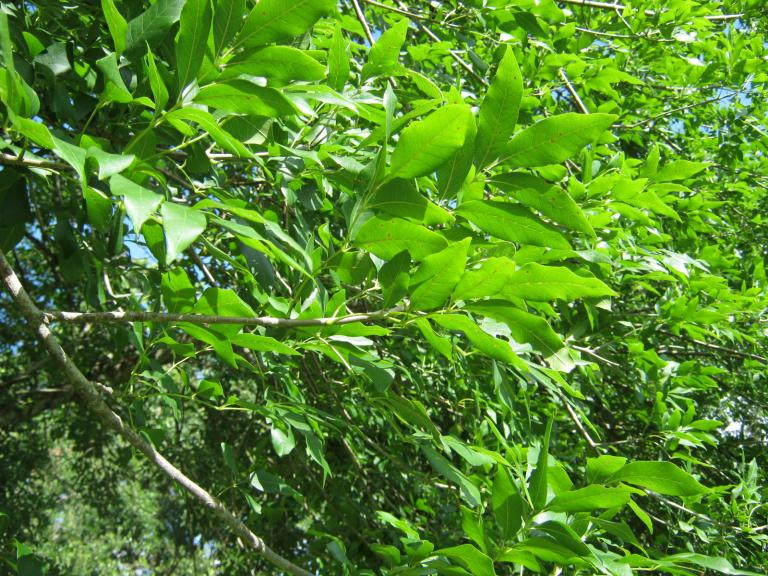
So here are some examples. Ash trees are dioecious—here’s a happy male and female pair in Audubon Park in New Orleans:

Close up it’s easy to see that one tree is female—it’s loaded with “keys” that contain ripening seeds:

Its male neighbor, however, doesn’t have these keys:
By contrast, here are a couple of young baldcypress trees, also in New Orleans, at the front of Audubon Zoo just a few days ago. These trees are monoecious, so they don’t come in separate male and female individuals. In the winter, these trees would have dropped their needles (which is why they’re called “bald”—these trees are conifers, but they’re not evergreen) and would be loaded with male “catkins.” Right now, though, they’re in the middle of making big fat seed pods (much to the delight of local squirrels, who are experts at eating seasonally!) and look like this:
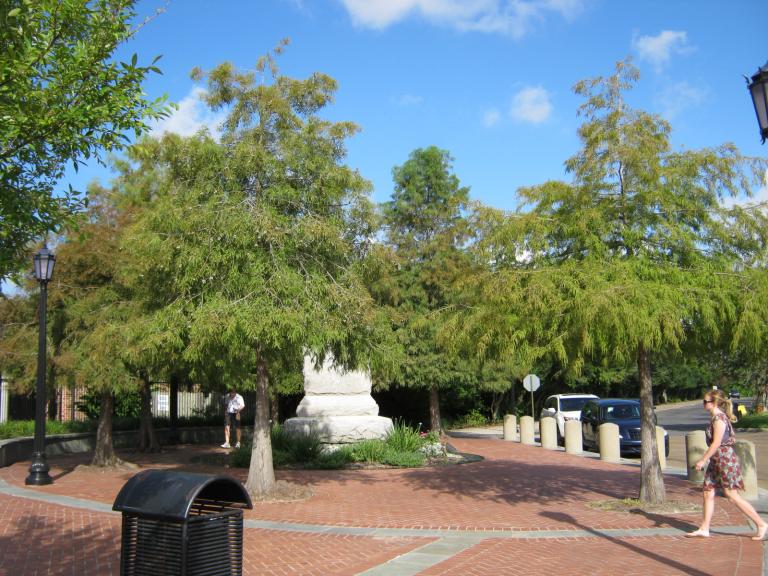
But have a look at how different the two individual trees are when you get closer. The tree on the left is absolutely loaded with seed pods:

While the tree on the right only has a few:
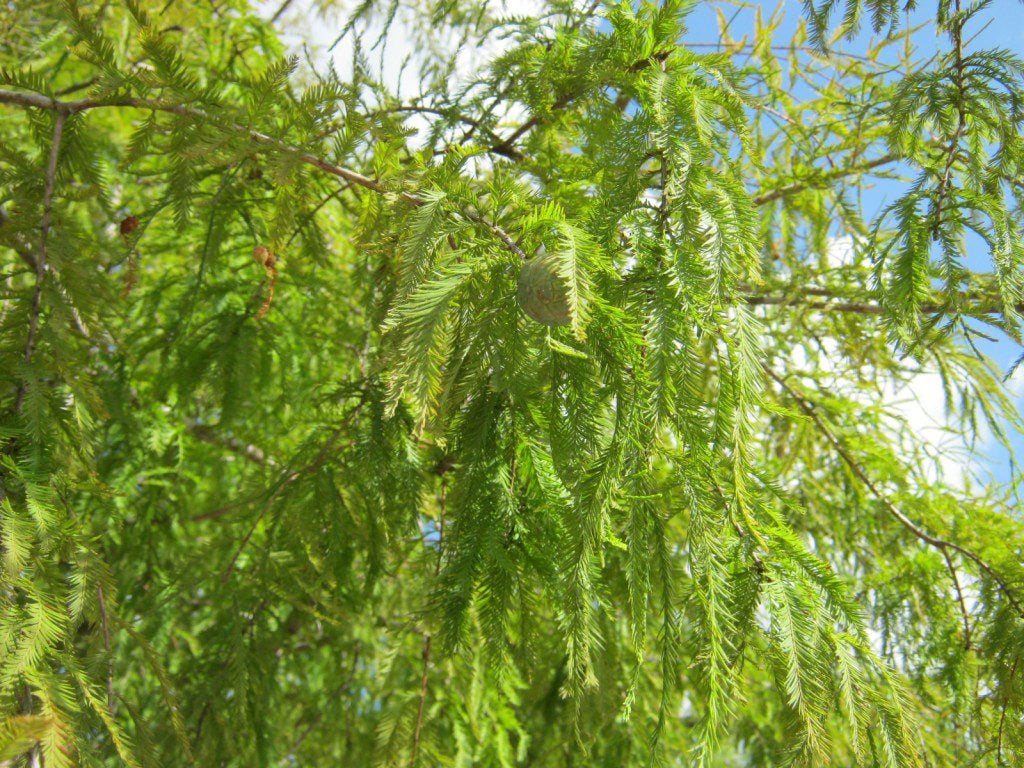
I’m not sure what accounts for this variation, but I’ve noticed it on a lot of baldcypress trees around here. Maybe it has something to do with age, or health, or genetics, or available light, but in any case, there’s certainly a lot of individual difference from tree to tree in this species, even though the trees themselves aren’t sexually differentiated.
Ok, now that we’ve figured out monoecious and dioecious, with some allowances for individual differences among trees of the same species, it’s time to get really complicated. As it turns out, there’s actually a lot of variation on this basic plant-sexuality theme, and around here swamp maples (aka red maples) are a good example. These trees are sort of dioecious, but, well, not always. The ratio of male-to-female flowers on any particular tree can vary considerably, with some individuals being mostly-male or mostly-female and others being very decidedly mixed up. This has led some researchers to declare swamp maples “polygamodioecious” or sometimes “polygamomonoecious.”

So it’s not just humans who have complicated sexualities (and, I would daresay, gender expressions). Other animals do too, and the plant kingdom has so much variation in reproductive strategies that it’ll make your head spin. The analogy isn’t perfect: humans are all one species, of course, and I’m making comparisons among a lot of different species of plants and animals here. And I want to be clear that I think we have to be VERY careful when we say that humans should live or believe a certain way because it’s “natural”—historically, those sorts of assertions have been used as a proxy for “the way God wants it,” and have been made to justify some pretty heinous social structures, like slavery, the “doctrine of discovery,” and keeping women barefoot and pregnant. And plants certainly don’t get socialized into expressing themselves in a certain sexed/gendered way, nor do they face harassment (or much worse) if they don’t—there’s no cultural component involved in how they grow and develop. I do think, though, that we can make a strong case that there is a wide variety of sexualities (and maybe even genders) in the rest of the natural world, just as there is in the human world. For nature-based religions, this is an important insight, and it can help us find our way around and through the difficulties of balancing the reality that life comes from the union of male and female with the reality that an awful lot of people have bodies, sexual orientations, and gender identities that don’t fit neatly into either/or categories.
Previous Post

July 23, 2012
Colorado Poets Slam Pat Robertson
Next Post

August 1, 2012 Naturalistic Traditions: All Things August
Browse Our Archives
Select a Category A Lakeside Hearth Adventures in Wortcunning Alone In Her Presence Arts, Crafts & Cooking Birthing Hereditary Witchcraft Book of Blackbirds Book Reviews Born-Again Witch Cauldron, Sword, Spear, & Stone Cermony and Liturgy Columns Community Dandelion Seeds Dear Jasmine Druid Thoughts Editor's Picks Everyday Pagan Family & Household Practice Family Traditions Full Frontal Magic Gateway Goddess Guest Articles Happily Heathen Health and Wellness Hearth of Hellenism Heathen Woman Hills of the Horizon History Holidays Horse Goddesses Interfaith Interviews Irish-American Witchcraft Jewish Witch Lamp & Labyrinth Letters from Midgard Literature, Media, Film, Music Loop of Brighid Love, Sex & Relationships Magic or Magick Making Light Naturalistic Traditions Nature News Outside The Circle Pantheisticon Politics Prayers, Poems, Blessings & Stories Queer Femme Mystic Queer of Swords Recipes Ritual and Practice Science and Research Seekers and Guides Seeking the Grail Socially Responsible Magic Spear of Athena Star Made Witch Syncretic Electric Technology The Blooming Staff The Busy Witch The Cartomancer The Crow's Nest The Dance of Pagan Recovery The Hearth of Hellenism The Lady's Quill The Other Side of the Hedge The Path of She The Rantin' Raven The Witches Next Door The Zen Pagan Theology, Ethics, Philosophy Tree City Witch Urban Earthwitch Wayfaring Woman Witch on Fire Wyrd Words
Select a Month January 2026 March 2025 December 2024 June 2024 April 2024 March 2024 January 2024 December 2023 November 2023 October 2023 August 2023 July 2023 May 2023 April 2023 March 2023 February 2023 January 2023 December 2022 November 2022 October 2022 September 2022 August 2022 July 2022 June 2022 May 2022 March 2022 February 2022 January 2022 December 2021 November 2021 October 2021 September 2021 August 2021 July 2021 June 2021 May 2021 April 2021 March 2021 February 2021 January 2021 December 2020 November 2020 October 2020 September 2020 August 2020 July 2020 June 2020 May 2020 April 2020 March 2020 February 2020 January 2020 December 2019 November 2019 October 2019 September 2019 August 2019 July 2019 June 2019 May 2019 April 2019 March 2019 February 2019 January 2019 December 2018 November 2018 October 2018 September 2018 August 2018 July 2018 June 2018 May 2018 April 2018 March 2018 February 2018 January 2018 December 2017 November 2017 October 2017 September 2017 August 2017 July 2017 June 2017 May 2017 April 2017 March 2017 February 2017 January 2017 December 2016 November 2016 October 2016 September 2016 August 2016 July 2016 June 2016 May 2016 April 2016 March 2016 February 2016 January 2016 December 2015 November 2015 October 2015 September 2015 August 2015 July 2015 June 2015 May 2015 April 2015 March 2015 February 2015 January 2015 December 2014 November 2014 October 2014 September 2014 August 2014 July 2014 June 2014 May 2014 April 2014 March 2014 February 2014 January 2014 December 2013 November 2013 October 2013 September 2013 August 2013 July 2013 June 2013 May 2013 April 2013 March 2013 February 2013 January 2013 December 2012 November 2012 October 2012 September 2012 August 2012 July 2012 June 2012 May 2012 April 2012 March 2012 February 2012 January 2012
Follow Us!
TAKE THE
Religious Wisdom Quiz
What metaphor is often used for the righteous in Psalms and Proverbs?
Select your answer to see how you score.
A mountain A river A tree A sun
Related posts from Agora

Simple Witchery: To Keep Silent

Simple Witchery: Leaning On The Four Pillars
Pergamum Unfurled: Magic with the Greek Gods (Book...

Pergamum Unfurled: Cunning Words (Review)
TRENDING AT PATHEOS Pagan

10 years of the Power Sigil & Moving...
Last week while reorganizing my studio space, I found the sketchbook that...
Here comes a rant (and TLDR: if you're a US citizen eligible...

Why are younger seekers drawn to Paganism and...
One of the things I've noticed the most is that I'm far...

When we talk about Greek religion, we often begin with the dodekatheion—the...

I was recently chatting with someone on Instagram. She asked me what...

On July 23, I saw Christopher Nolan's The Odyssey which is Homer’s...
view all Pagan blogs
Ad-Free & Subscriber Log-In Subscription Support
- About Us
- 2026 Calendar
- Videos
- Podcasts
- Library of World Religions
- Faith In Media Tracker
- Advertise With Us
- Write for Us
- Privacy Policy
- Terms of Service
- Do Not Sell My Data
- Contact Us
- Radiant Digital
- Manage Newsletter Subscriptions
- Unsubscribe From Notifications
- Sitemap
Copyright 2008-2026, Patheos. All rights reserved.
Subscription Support Ad-Free & Subscriber Log-In
Follow Patheos