
BuddhistCatholicContemplativeEvangelicalGeneral ChristianHinduJewishLatter-day SaintMuslimNew VisionsProgressive Christian
Beliefs
- Buddhist
- Catholic
- Contemplative
- Evangelical
- General Christian
- Hindu
- Jewish
- Latter-day Saint
- More Voices
- Muslim
- New Visions
- Pagan
- Progressive Christian
Topics
- Religion News
- Food and Religion
- Sports and Religion
- Religious Art
- Religious Music and Entertainment
- Religious Events
- History and Religion
- Style and Religion
- Politics and Religion
- Women in Religion
- Recreation Outdoors and Religion
- Business Finance and Religion
- Careers Workplace and Religion
- Education and Religion
- Family Parenting and Religion
- Health Fitness and Religion
- Home and Religion
- Relationships and Religion
- Technology and Religion
- Travel and Religion
Columnists
- Buddhist Columnists
- Business Finance and Religion Columnists
- Careers Workplace and Religion Columnists
- Catholic Columnists
- Contemplative Columnists
- Education and Religion Columnists
- Evangelists Columnists
- Family Parenting and Religion Columnists
- General Christian Columnists
- Health Fitness and Religion Columnists
- Hindu Columnists
- History and Religion Columnists
- Home and Religion Columnists
- Jewish Columnists
- More Voices Columnists
- Latter Day Columnists
- Muslim Columnists
- New Visions Columnists
- Nonreligious Columnists
- Pagan Columnists
- Politics and Religion Columnists
- Progressive Columnists
- Recreation Outdoors and Religion Columnists
- Relationships and Religion Columnists
- Religion News Columnists
- Religious Art Columnists
- Religious Events Columnists
- Religious Music and Entertainment Columnists
- Sports and Religion Columnists
- Style and Religion Columnists
- Technology and Religion Columnists
- Travel and Religion Columnists
- Women in Religion Columnists
Resource Library
- 2026 Calendar
- Library of World Religions
- The 100 Most Holy Places on Earth
- Patheos Answers
- Podcasts
- Videos
- Faith Leaders Database
- Anglican Episcopalian
- Bahai
- Baptist
- Buddhism
- Christianity
- Confucianism
- Eastern Orthodoxy
- Hinduism
- Holiness and Pentecostal
- ISKCON
- Islam
- Judaism
- Lutheran
- Methodist
- The Church of Jesus Christ of Latter-day Saints
- New Age
- Paganism
- Presbytarian and Reformed
- Protestantism
- Religion Behind the Scenes
- Roman Catholic
- Scientology
- Shia Islam
- Sikhism
- Sufism
- Sunni Islam
- Taoism
- Zen
- See all religions
Research Tools
 Ad-Free & Subscriber Log-In Subscription Support
Ad-Free & Subscriber Log-In Subscription Support
Follow Patheos 

- Trending:
- Forgiveness
- |
- Marriage
- |
- Consciousness
- |
- Death Penalty
- |
- Election
- |
- Halloween

- Home
- Pagan
- Pagan Easter Breakfast, and the origin of Easter things
Pagan Easter Breakfast, and the origin of Easter things
Last updated on: June 3, 2013 at 12:31 pm by Jason Mankey
Pagan Easter Breakfast, and the origin of Easter things 2013-06-03T12:31:18+00:00 Jason Mankey
Patheos Explore the world's faith through different perspectives on religion and spirituality! Patheos has the views of the prevalent religions and spiritualities of the world.
For the last ten years* or so my wife and I have hosted what we fondly call “Pagan Easter Breakfast.” Pagan Easter Breakfast (or PEB) is exactly what it sounds like, it’s breakfast on Easter by and for Pagans. I’ve had a few Pagans accuse me of having a “secret Christian agenda” for hosting such a thing, at the same time some Christians have accused me of belittling their beliefs by serving hash-brown casserole so close to the Jewish Passover. “Easter” stirs up a lot of emotions on both sides of the religious divide, and deservedly so, but I’ve never understood why I can’t have my Marshmallow Peeps and eat them too.
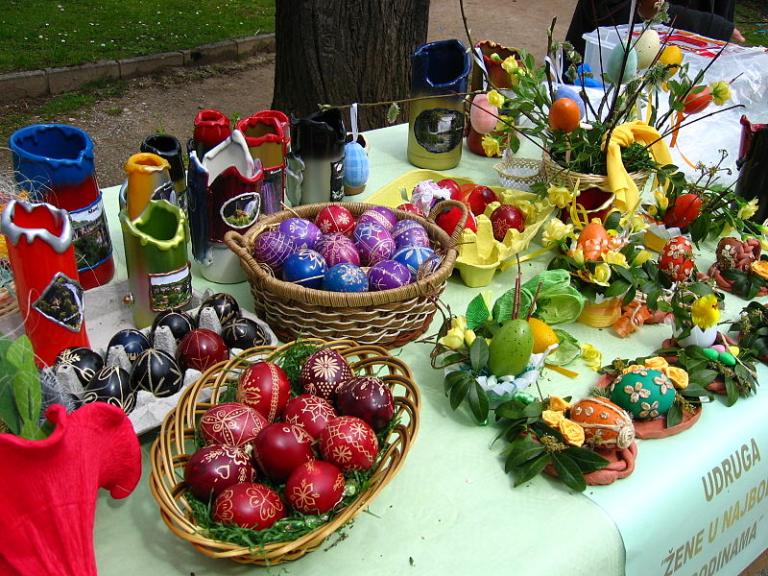
Christians would have you believe that Easter is about the resurrection of Jesus of Nazareth from the dead, and to a large extent, that’s certainly true, but Easter is about more than that. In many ways Easter is a traditional pagan holiday, celebrating Spring and the renewal of life. Since Beltane and the Spring Equinox are not generally celebrated by our society as a whole, Easter fills the void of “secular Spring holiday.” I think we all know that eggs, plastic grass, and chocolate bunnies have nothing to do with Jesus, and everything to do with the ideas of renewal and fertility (along with crass commercial marketing, but I digress).
The word “Easter” is problematic for many reasons. In non-English speaking countries the commemoration of Jesus’s return from the dead is called something else entirely, we simply translate it as “Easter” out of laziness. In Greece for example, “Easter” is called “Lambros” which translates as “shining” or “bright.” This is problematic because many Pagans like to make the argument that Easter is a specifically pagan holiday, because of the alleged origins of the word Easter. According to the British historian Bede (673-735 CE) the word “Easter” comes from the name of a Germanic fertility goddess named Eostre, whose name was given to an entire month “Eostur-month,” and then eventually to one specific holiday occurring in that month, the one we now call Easter.
The problem with all of this is that the only source for the goddess Eostre is Bede. There aren’t any tales of Eostre throwing eggs to all of the good little Germanic pagans**, or of her riding a giant rabbit, so it’s hard to say with certainty that she existed and is the source for the word “Easter.” The only thing really pointing towards her existence in Ancient History is that her name shares a linguistic origin with that of various Indo-European goddesses of the dawn (like the Greek Eos for example). The questions then becomes whether the dawn was named after the deities in question, or if the deities were named after the rising sun. The word Easter then could be linked directly to a pagan goddess, or simply mean beginnings (1). The fact that “Eos” is in there makes me a feel a lot better about the Pagan Goddess origin of the word theory, but I’m not going to accept that as the only interpretation.
So while the word “Easter” may or may not be pagan in origin, many of the trappings certainly are, and I’m not talking about eggs or that bunny either. The most pagan element of Easter is probably Jesus himself as the dying and resurrecting god. At Easter, Jesus has more in common with Dionysus, Tammuz, and Adonis than he does with Moses or the various apostles. The idea of a man or god overcoming death would have been alien to Second Temple Judaism, but not to the millions of pagans living in the Roman Empire. As my Easter Breakfast Invitations say “Why Easter Breakfast? Because dying and resurrecting gods belonged to us first.”
Jesus as a dying and resurrecting god is a two thousand year old tradition, there’s no question of its connection to ancient antiquity. The other trappings of Easter, the egg and the bunny, are far more problematic. I’ve been conditioned to always think of them as ancient pagan practices, but researching this article has brought up more questions than answers in that regard. I can say with certainty that eggs as a symbol of fertility and rebirth have a long pedigree (or is that eggigree?), but they were also very common items whose symbolism and role certainly could have changed and evolved over time.
In the Greek Orphic tradition the god Phanes was said to have hatched from a “world egg,” illustrating that the Ancient Greeks believed in the egg as a symbol of rebirth and new life. A direct link to Easter Eggs and Pagan Rome can be found in a legend surrounding the Roman Emperor Marcus Aurelius. The day when Marcus was born his mother’s red hen is said to have laid an egg spotted with red. That spekled egg was seen as a sign that young Marcus would become a great Emperor. When Marcus eventually assumed the throne colored eggs began to be passed around throughout the Empire as a symbol of congratulations(2). Later Christians adopted the custom. It’s hard to say with any certainty if that Marcus Aurelius legend is the origin of the Easter Egg, as it’s likely that eggs were being passed around before Marcus assumed the throne.
While colored eggs were shared in the Ancient World, there’s no continuous history linking the colored egg of pagandom to the Easter Egg. Eggs were relatively common in the Middle Ages, and an important source of nutrition in a society where meat was a rare treat. Monks were often given “gifts” (payment) on important Christian holidays, with Easter being one of those. Eggs were a common gift, and they were often given to priests in baskets. In Russia it was common for priests (and later members of the nobility) to give out eggs as gift, especially around Easter. Eventually the eggs that were passed out were elaborately decorated, and the custom spread throughout the country. Eggs were also generally banned during the period of Lent, so people sometimes would decorate them as they waited on their Easter feast and the return to eating eggs.
Eggs were also begged for by children in Great Britain during the Seventeenth Century. Before important holidays it was common for the poor to “trick or treat” for food, and at Easter children begged for eggs. (3) It doesn’t take a whole lot of imagination to picture poor children begging for eggs to put in a basket transforming into the modern Easter basket full of sacred goodies like waxy chocolate bunnies and stale jelly beans.
Rabbits have been associated with fertility from pagan times into the present. (I have friends who like to say “they go at it like rabbits” when discussing the sexual habits of others.) It seems likely that the Easter Bunny is an ancient pagan tradition (though the association of the bunny with the myth-less Eostra is most certainly a modern invention), but the first references to the Easter Bunny only date back to the 1500’s. That doesn’t mean the Easter Bunny didn’t exist before those first references to the Germanic Oschter Haws (or Osterhase), it just can’t be documented.
There’s a part of me that believes human beings have a natural tendency to venerate “Pagan things,” and tend to be drawn to things in the natural world that correlate to what is going on in their own environments. Venerating a rabbit in April during the Earth’s annual period of rebirth makes complete sense. That doesn’t mean it’s pagan in the sense that people worshipped a rabbit in the year 100, but it’s Pagan in the sense that it taps into the natural rhythms of the Earth. It’s also possible that now forgotten myths transformed into now lost folk tales and then into the egg laying rabbit we now call the Easter Bunny.
No matter how pagan certain beliefs are at Easter, it’s a very difficult holiday to ignore. Many businesses are closed and millions of Americans celebrate it as both a Christian and/or a secular holiday. (I remember lots of Easter Baskets as a kid piled with candy and a toy or two, and my family certainly didn’t associate it with Jesus.) Instead of being bitter about the whole situation I prefer to celebrate it with food and egg hunts. Since many Modern Pagan traditions lack an April holiday, and I tend to think of April as the most “Spring-like” month, it’s nice to get an extra Spring holiday to celebrate, no matter what its origins. Breakfast is at ten, the Easter Egg hunt is at eleven, and hockey will probably be on the TV all morning.
*We did take a year off from Easter Pagan Breakfast after we moved out to California last year, mostly because we were living in a townhouse which didn’t have enough room for visitors. We also celebrated “Pagan Orthodox Easter Breakfast” once when my wife was out of town on the other date.
**The use of the word “pagan” or “Pagan” can be extremely problematic. For more on how I use the words you can click here.
1. “The Stations of the Sun” by Ronald Hutton. Oxford University Press, 1996. Page 180
2. “An Egg at Easter” by Venetia Newall. Indiana University Press, 1971. Page 268
3. “The Stations of the Sun,” Hutton pg. 198
Previous Post
March 30, 2012
Druid Thoughts: Druidry and Poetry
Next Post

April 1, 2012 Naturalistic Traditions: All Things April
Browse Our Archives
Select a Category A Lakeside Hearth Adventures in Wortcunning Alone In Her Presence Arts, Crafts & Cooking Birthing Hereditary Witchcraft Book of Blackbirds Book Reviews Born-Again Witch Cauldron, Sword, Spear, & Stone Cermony and Liturgy Columns Community Dandelion Seeds Dear Jasmine Druid Thoughts Editor's Picks Everyday Pagan Family & Household Practice Family Traditions Full Frontal Magic Gateway Goddess Guest Articles Happily Heathen Health and Wellness Hearth of Hellenism Heathen Woman Hills of the Horizon History Holidays Horse Goddesses Interfaith Interviews Irish-American Witchcraft Jewish Witch Lamp & Labyrinth Letters from Midgard Literature, Media, Film, Music Loop of Brighid Love, Sex & Relationships Magic or Magick Making Light Naturalistic Traditions Nature News Outside The Circle Pantheisticon Politics Prayers, Poems, Blessings & Stories Queer Femme Mystic Queer of Swords Recipes Ritual and Practice Science and Research Seekers and Guides Seeking the Grail Socially Responsible Magic Spear of Athena Star Made Witch Syncretic Electric Technology The Blooming Staff The Busy Witch The Cartomancer The Crow's Nest The Dance of Pagan Recovery The Hearth of Hellenism The Lady's Quill The Other Side of the Hedge The Path of She The Rantin' Raven The Witches Next Door The Zen Pagan Theology, Ethics, Philosophy Tree City Witch Urban Earthwitch Wayfaring Woman Witch on Fire Wyrd Words
Select a Month January 2026 March 2025 December 2024 June 2024 April 2024 March 2024 January 2024 December 2023 November 2023 October 2023 August 2023 July 2023 May 2023 April 2023 March 2023 February 2023 January 2023 December 2022 November 2022 October 2022 September 2022 August 2022 July 2022 June 2022 May 2022 March 2022 February 2022 January 2022 December 2021 November 2021 October 2021 September 2021 August 2021 July 2021 June 2021 May 2021 April 2021 March 2021 February 2021 January 2021 December 2020 November 2020 October 2020 September 2020 August 2020 July 2020 June 2020 May 2020 April 2020 March 2020 February 2020 January 2020 December 2019 November 2019 October 2019 September 2019 August 2019 July 2019 June 2019 May 2019 April 2019 March 2019 February 2019 January 2019 December 2018 November 2018 October 2018 September 2018 August 2018 July 2018 June 2018 May 2018 April 2018 March 2018 February 2018 January 2018 December 2017 November 2017 October 2017 September 2017 August 2017 July 2017 June 2017 May 2017 April 2017 March 2017 February 2017 January 2017 December 2016 November 2016 October 2016 September 2016 August 2016 July 2016 June 2016 May 2016 April 2016 March 2016 February 2016 January 2016 December 2015 November 2015 October 2015 September 2015 August 2015 July 2015 June 2015 May 2015 April 2015 March 2015 February 2015 January 2015 December 2014 November 2014 October 2014 September 2014 August 2014 July 2014 June 2014 May 2014 April 2014 March 2014 February 2014 January 2014 December 2013 November 2013 October 2013 September 2013 August 2013 July 2013 June 2013 May 2013 April 2013 March 2013 February 2013 January 2013 December 2012 November 2012 October 2012 September 2012 August 2012 July 2012 June 2012 May 2012 April 2012 March 2012 February 2012 January 2012
Follow Us!
TAKE THE
Religious Wisdom Quiz
What did God use to lead the Israelites by day?
Select your answer to see how you score.
A pillar of fire An angel A pillar of cloud A trumpet
Related posts from Agora

Simple Witchery: To Keep Silent

Simple Witchery: Leaning On The Four Pillars


Pergamum Unfurled: Magic with the Greek Gods (Book...
TRENDING AT PATHEOS Pagan

I was recently chatting with someone on Instagram. She asked me what...

While there are many people who share their results, the end of...

On July 23, I saw Christopher Nolan's The Odyssey which is Homer’s...

As I write this two big events have just finished up. One...

Restoring the Watershed of Divine Love
Perhaps cooperation is not something we manufacture through legislation, ideology, or moral...

Many UUs don’t pray because of bad experiences in a previous religion,...
view all Pagan blogs
Ad-Free & Subscriber Log-In Subscription Support
- About Us
- 2026 Calendar
- Videos
- Podcasts
- Library of World Religions
- Faith In Media Tracker
- Advertise With Us
- Write for Us
- Privacy Policy
- Terms of Service
- Do Not Sell My Data
- Contact Us
- Radiant Digital
- Manage Newsletter Subscriptions
- Unsubscribe From Notifications
- Sitemap
Copyright 2008-2026, Patheos. All rights reserved.
Subscription Support Ad-Free & Subscriber Log-In
Follow Patheos