
BuddhistCatholicContemplativeEvangelicalGeneral ChristianHinduJewishLatter-day SaintMuslimNew VisionsProgressive Christian
Beliefs
- Buddhist
- Catholic
- Contemplative
- Evangelical
- General Christian
- Hindu
- Jewish
- Latter-day Saint
- More Voices
- Muslim
- New Visions
- Pagan
- Progressive Christian
Topics
- Religion News
- Food and Religion
- Sports and Religion
- Religious Art
- Religious Music and Entertainment
- Religious Events
- History and Religion
- Style and Religion
- Politics and Religion
- Women in Religion
- Recreation Outdoors and Religion
- Business Finance and Religion
- Careers Workplace and Religion
- Education and Religion
- Family Parenting and Religion
- Health Fitness and Religion
- Home and Religion
- Relationships and Religion
- Technology and Religion
- Travel and Religion
Columnists
- Buddhist Columnists
- Business Finance and Religion Columnists
- Careers Workplace and Religion Columnists
- Catholic Columnists
- Contemplative Columnists
- Education and Religion Columnists
- Evangelists Columnists
- Family Parenting and Religion Columnists
- General Christian Columnists
- Health Fitness and Religion Columnists
- Hindu Columnists
- History and Religion Columnists
- Home and Religion Columnists
- Jewish Columnists
- More Voices Columnists
- Latter Day Columnists
- Muslim Columnists
- New Visions Columnists
- Nonreligious Columnists
- Pagan Columnists
- Politics and Religion Columnists
- Progressive Columnists
- Recreation Outdoors and Religion Columnists
- Relationships and Religion Columnists
- Religion News Columnists
- Religious Art Columnists
- Religious Events Columnists
- Religious Music and Entertainment Columnists
- Sports and Religion Columnists
- Style and Religion Columnists
- Technology and Religion Columnists
- Travel and Religion Columnists
- Women in Religion Columnists
Resource Library
- 2026 Calendar
- Library of World Religions
- The 100 Most Holy Places on Earth
- Patheos Answers
- Podcasts
- Videos
- Faith Leaders Database
- Anglican Episcopalian
- Bahai
- Baptist
- Buddhism
- Christianity
- Confucianism
- Eastern Orthodoxy
- Hinduism
- Holiness and Pentecostal
- ISKCON
- Islam
- Judaism
- Lutheran
- Methodist
- The Church of Jesus Christ of Latter-day Saints
- New Age
- Paganism
- Presbytarian and Reformed
- Protestantism
- Religion Behind the Scenes
- Roman Catholic
- Scientology
- Shia Islam
- Sikhism
- Sufism
- Sunni Islam
- Taoism
- Zen
- See all religions
Research Tools
 Ad-Free & Subscriber Log-In Subscription Support
Ad-Free & Subscriber Log-In Subscription Support
Follow Patheos 

- Trending:
- Forgiveness
- |
- Marriage
- |
- Consciousness
- |
- Death Penalty
- |
- Election
- |
- Halloween

- Home
- Pagan
- Setting the Table: The Importance of Deity in Ritual
Setting the Table: The Importance of Deity in Ritual
Last updated on: December 26, 2014 at 10:08 pm by Jason Mankey
Setting the Table: The Importance of Deity in Ritual 2014-12-26T22:08:36+00:00 Jason Mankey
Patheos Explore the world's faith through different perspectives on religion and spirituality! Patheos has the views of the prevalent religions and spiritualities of the world.
A little over a week ago I led my first public ritual in California, and received at lot of positive feedback from people I like and respect in my community. Most of the comments that I got ended up being about the energy present at the ritual (strong and good), and the recitations of the Charge of the Goddess and Charge of the God by my wife and I. These are not separate things, because it’s always a lot easier to raise energy if the gods are attending your ritual.

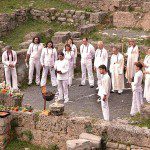
Image by Vassilis Tsantilas, CC license 3.0
In nearly twenty years of Paganism I’ve been to a lot of rituals, and one thing I’ve noticed over the years is how little time many ritual leaders devote to deity. I don’t think your God and Goddess calls have to take up thirty minutes of ritual time, but they should convey something. They should be more than just two quickly jotted down lines read with little to no emotion. I know that there’s often a focus on the rite during ritual, that tricky moment of leading your circle or coven in a magickal working or seasonal celebration, but your rite will go so much easier if you can feel the presence of the Lord and Lady while you are doing it.
When I finished my recent Imbolc ritual I wasn’t expecting any praise, from my point of view it was an average ritual, but I ended up getting it anyways, and my wife and I think it’s because we properly set the table. What do I mean by setting the table? To my wife and I it means successfully calling the Goddess and God into our circle, to the point where people feel the energy of the Lord and Lady around them. It’s speaking to deity with passion, and creating a moment in the circle where everyone is aware of who you are calling to.
I love my gods, I’m passionate about them, I’m also a suck-up, and I have a feeling that the gods like to be flattered. There’s nothing flattering about mumbling a few words to deity because it’s expected. Calling to the gods should be an experience people want to have. In the simplest of terms, it should feel good to say “Maiden, be with us in our circle tonight!” and if it doesn’t feel good, there’s a chance that ritual will be a little less than it could have been as a result. I don’t think every call to the Lord and Lady has to be full of flowery words and Shakespearean prose, just that communicating with them should be something people feel, and that feeling should be something others can pick up on.
One of the easiest ways to really draw in deity during ritual is by reciting a Charge. A charge is a first person revelation on the nature of deity. The most famous charge in all of Pagandom is Doreen Valiente’s Charge of the Goddess, and in my mind there’s no more powerful piece of liturgy in all of Paganism than that charge. You want to feel the Goddess in your ritual? Then read Doreen’s Charge, and don’t be surprised to feel a little tingle of energy while you do so. When I hear the words “and ye shall dance, sing, feast, make music and love, all in my praise.For mine is the ecstasy of the spirit and mine also is joy on earth; for my Law is Love unto all Beings” I know that She’s next to me.
Unfortunately, there is no “Charge of the God” equal to Valiente’s Charge of the Goddess. There are several God Charges available, all with various strengths and weaknesses. Some of them are re-workings of Valiente’s Charge, but from a male point of view, and they tend to use language and pacing similar to Valiente. Other versions are unique, and have found inspiration in other sources. It must have originally been during a bout of massive ego, but I wrote my own Charge of the God years ago and have used it in ritual ever since. You may not find the words “I am he that stands at the threshold of death, and life eternal. I welcome those who have departed your world and bid farewell to those who return to it. I guard the mysteries of the end and the wonder of beginnings. I am the Great God,” transformative, but it works for me.
In some ways using a charge is like using a short-cut (or as my wife calls it, “cheating.”) If it’s a charge familiar to a lot of people, it will automatically conjure up positive memories of rituals past. It’s a way to tap into something bigger than your ritual, it’s a connection to the thousands of rituals that have used those words. I think it’s always important to “create new” from time to time, but there is a comfort in the familiar, and a connection there that can instantly put someone in a space where they can commune with the Lord and Lady. That doesn’t always have to be a charge either, it could be a chant or a specific action, but in large, public, group ritual where not everyone has worked together in the past, Valiente’s Charge is the easy option.
What’s the point of all this reading and talking? It’s to call the Gods and have them present in ritual. You may not always be in a position to Draw Down the Moon, but there’s no reason why the presence of the Gods should be absent. Having deity present at ritual makes everything easier too, because once you have them there you are working from a position of strength. When people say to me “I felt energy at your ritual,” it’s because there was energy in the ritual long before we tried to raise any or do a working. Having deity present lays a foundation for all that comes afterwards, this is why my wife calls it “setting the table.”
Why was Beltane awesome? Because the Maiden was there, preparing for Womanhood, and that energy was something everyone in the circle felt and experienced. The energy that the gods bring to ritual is very real, and the truth of the matter is, it doesn’t always take a whole lot of work to receive it. You don’t have to dance, you don’t have to sing, and you don’t have to drum, you just have to be open to the call of deity, and have the desire to share that experience with others. Deity wants us to be successful when we have a ritual, deity wants to participate, it’s simply waiting for the invitation, and when deity shows up, ritual is all the better for it.
Previous Post

February 14, 2012
Dear Jasmine: Family Friendly Gatherings
Next Post
February 14, 2012 Making Light: Hellenic Reconstructionism (sensu Judaica)
Browse Our Archives
Select a Category A Lakeside Hearth Adventures in Wortcunning Alone In Her Presence Arts, Crafts & Cooking Birthing Hereditary Witchcraft Book of Blackbirds Book Reviews Born-Again Witch Cauldron, Sword, Spear, & Stone Cermony and Liturgy Columns Community Dandelion Seeds Dear Jasmine Druid Thoughts Editor's Picks Everyday Pagan Family & Household Practice Family Traditions Full Frontal Magic Gateway Goddess Guest Articles Happily Heathen Health and Wellness Hearth of Hellenism Heathen Woman Hills of the Horizon History Holidays Horse Goddesses Interfaith Interviews Irish-American Witchcraft Jewish Witch Lamp & Labyrinth Letters from Midgard Literature, Media, Film, Music Loop of Brighid Love, Sex & Relationships Magic or Magick Making Light Naturalistic Traditions Nature News Outside The Circle Pantheisticon Politics Prayers, Poems, Blessings & Stories Queer Femme Mystic Queer of Swords Recipes Ritual and Practice Science and Research Seekers and Guides Seeking the Grail Socially Responsible Magic Spear of Athena Star Made Witch Syncretic Electric Technology The Blooming Staff The Busy Witch The Cartomancer The Crow's Nest The Dance of Pagan Recovery The Hearth of Hellenism The Lady's Quill The Other Side of the Hedge The Path of She The Rantin' Raven The Witches Next Door The Zen Pagan Theology, Ethics, Philosophy Tree City Witch Urban Earthwitch Wayfaring Woman Witch on Fire Wyrd Words
Select a Month January 2026 March 2025 December 2024 June 2024 April 2024 March 2024 January 2024 December 2023 November 2023 October 2023 August 2023 July 2023 May 2023 April 2023 March 2023 February 2023 January 2023 December 2022 November 2022 October 2022 September 2022 August 2022 July 2022 June 2022 May 2022 March 2022 February 2022 January 2022 December 2021 November 2021 October 2021 September 2021 August 2021 July 2021 June 2021 May 2021 April 2021 March 2021 February 2021 January 2021 December 2020 November 2020 October 2020 September 2020 August 2020 July 2020 June 2020 May 2020 April 2020 March 2020 February 2020 January 2020 December 2019 November 2019 October 2019 September 2019 August 2019 July 2019 June 2019 May 2019 April 2019 March 2019 February 2019 January 2019 December 2018 November 2018 October 2018 September 2018 August 2018 July 2018 June 2018 May 2018 April 2018 March 2018 February 2018 January 2018 December 2017 November 2017 October 2017 September 2017 August 2017 July 2017 June 2017 May 2017 April 2017 March 2017 February 2017 January 2017 December 2016 November 2016 October 2016 September 2016 August 2016 July 2016 June 2016 May 2016 April 2016 March 2016 February 2016 January 2016 December 2015 November 2015 October 2015 September 2015 August 2015 July 2015 June 2015 May 2015 April 2015 March 2015 February 2015 January 2015 December 2014 November 2014 October 2014 September 2014 August 2014 July 2014 June 2014 May 2014 April 2014 March 2014 February 2014 January 2014 December 2013 November 2013 October 2013 September 2013 August 2013 July 2013 June 2013 May 2013 April 2013 March 2013 February 2013 January 2013 December 2012 November 2012 October 2012 September 2012 August 2012 July 2012 June 2012 May 2012 April 2012 March 2012 February 2012 January 2012
Follow Us!
TAKE THE
Religious Wisdom Quiz
What is the first line of the Bible?
Select your answer to see how you score.
The Lord is my shepherd. Hear, O Israel. Let there be light In the beginning God created the heavens and the earth.
Related posts from Agora

Simple Witchery: To Keep Silent

Simple Witchery: Leaning On The Four Pillars

Pergamum Unfurled: Magic with the Greek Gods (Book...

Pergamum Unfurled: Cunning Words (Review)
TRENDING AT PATHEOS Pagan

I was recently chatting with someone on Instagram. She asked me what...

While there are many people who share their results, the end of...

On July 23, I saw Christopher Nolan's The Odyssey which is Homer’s...

As I write this two big events have just finished up. One...

Restoring the Watershed of Divine Love
Perhaps cooperation is not something we manufacture through legislation, ideology, or moral...

Many UUs don’t pray because of bad experiences in a previous religion,...
view all Pagan blogs
Ad-Free & Subscriber Log-In Subscription Support
- About Us
- 2026 Calendar
- Videos
- Podcasts
- Library of World Religions
- Faith In Media Tracker
- Advertise With Us
- Write for Us
- Privacy Policy
- Terms of Service
- Do Not Sell My Data
- Contact Us
- Radiant Digital
- Manage Newsletter Subscriptions
- Unsubscribe From Notifications
- Sitemap
Copyright 2008-2026, Patheos. All rights reserved.
Subscription Support Ad-Free & Subscriber Log-In
Follow Patheos