
BuddhistCatholicContemplativeEvangelicalGeneral ChristianHinduJewishLatter-day SaintMuslimNew VisionsProgressive Christian
Beliefs
- Buddhist
- Catholic
- Contemplative
- Evangelical
- General Christian
- Hindu
- Jewish
- Latter-day Saint
- More Voices
- Muslim
- New Visions
- Pagan
- Progressive Christian
Topics
- Religion News
- Food and Religion
- Sports and Religion
- Religious Art
- Religious Music and Entertainment
- Religious Events
- History and Religion
- Style and Religion
- Politics and Religion
- Women in Religion
- Recreation Outdoors and Religion
- Business Finance and Religion
- Careers Workplace and Religion
- Education and Religion
- Family Parenting and Religion
- Health Fitness and Religion
- Home and Religion
- Relationships and Religion
- Technology and Religion
- Travel and Religion
Columnists
- Buddhist Columnists
- Business Finance and Religion Columnists
- Careers Workplace and Religion Columnists
- Catholic Columnists
- Contemplative Columnists
- Education and Religion Columnists
- Evangelists Columnists
- Family Parenting and Religion Columnists
- General Christian Columnists
- Health Fitness and Religion Columnists
- Hindu Columnists
- History and Religion Columnists
- Home and Religion Columnists
- Jewish Columnists
- More Voices Columnists
- Latter Day Columnists
- Muslim Columnists
- New Visions Columnists
- Nonreligious Columnists
- Pagan Columnists
- Politics and Religion Columnists
- Progressive Columnists
- Recreation Outdoors and Religion Columnists
- Relationships and Religion Columnists
- Religion News Columnists
- Religious Art Columnists
- Religious Events Columnists
- Religious Music and Entertainment Columnists
- Sports and Religion Columnists
- Style and Religion Columnists
- Technology and Religion Columnists
- Travel and Religion Columnists
- Women in Religion Columnists
Resource Library
- 2026 Calendar
- Library of World Religions
- The 100 Most Holy Places on Earth
- Patheos Answers
- Podcasts
- Videos
- Faith Leaders Database
- Anglican Episcopalian
- Bahai
- Baptist
- Buddhism
- Christianity
- Confucianism
- Eastern Orthodoxy
- Hinduism
- Holiness and Pentecostal
- ISKCON
- Islam
- Judaism
- Lutheran
- Methodist
- The Church of Jesus Christ of Latter-day Saints
- New Age
- Paganism
- Presbytarian and Reformed
- Protestantism
- Religion Behind the Scenes
- Roman Catholic
- Scientology
- Shia Islam
- Sikhism
- Sufism
- Sunni Islam
- Taoism
- Zen
- See all religions
Research Tools
 Ad-Free & Subscriber Log-In Subscription Support
Ad-Free & Subscriber Log-In Subscription Support
Follow Patheos 

- Trending:
- Forgiveness
- |
- Marriage
- |
- Consciousness
- |
- Death Penalty
- |
- Election
- |
- Halloween

- Home
- Pagan
- Making Light: Hellenic Reconstructionism (sensu Judaica)
Making Light: Hellenic Reconstructionism (sensu Judaica)
Last updated on: December 26, 2014 at 10:09 pm by Sunweaver
Making Light: Hellenic Reconstructionism (sensu Judaica) 2014-12-26T22:09:54+00:00 Sunweaver
Patheos Explore the world's faith through different perspectives on religion and spirituality! Patheos has the views of the prevalent religions and spiritualities of the world.
In a Pagan context, a Reconstructionist is one who wishes to re-create ancient practices as closely as possible to what they were prior to the rise of the Abrahamic religions. For most Hellenic polytheists, this means the practices of Classical Greece. Hellenics are very fortunate in that there is a mountain of source material from the writings that survived from that time period to secondary sources by classical scholars and beyond. We have a lot to work from and even though there are sometimes large gaps in what we know, we can still get a fairly good picture of what religious life was like in ancient Athens, Delphi, and even Sparta and Macedonia. I am beyond grateful for these sources and thank the gods that we have them, but though they contain a great deal of information on how the Theoi may have been worshipped at the time, they are not sacred texts in the same way many monotheists think of their holy books. We recognize that these were written by people and they were often very intelligent, inspired people, but they were people all the same and people are flawed.

Image by YSEE, CC license 2.0
I propose an approach to worship and practice that I will call “reconstructionist,” but in the sense that we can take the foundation of our religion and build something new that will serve us more effectively in the time and place in which we now live. I now sit 2500 years and 5600 miles/ 9000 km distant from the Athens that built the Parthenon. The Oracle at Delphi spoke her last prophesy almost 1700 years ago. Our ancient temples are not much more than ruins and difficult or impossible for most of us to access. That is an enormous distance to bridge and the world has changed in drastic ways since then.
This alternate concept of reconstructionist practice was derived from Jewish Reconstructionism. In the late 1920’s, a group of Conservative Jews diverged from their congregation with the goal of forming a more modern practice that was still Jewish at its foundation. Halakha became more a part of the honored past than law and modern ideas of equality and social justice took precedence. These congregations are democratic, inclusive, and egalitarian, supporting male and female Rabbis and very broad concepts of the divine. While maintaining Jewish observances and the study of the Torah, Jewish Reconstructionists also welcome new rituals and observances that reflect the needs of modern life.
In Judaism, there was a shift in leadership from the priests to the rabbis with the destruction of their Temple in Jerusalem as the turning point and since then, Judaism has grown and changed to integrate the changes that occurred in the world around them. Old rituals were edited or eliminated while new rituals were added. Interpretation of the Torah is ongoing and it is practically a commandment to challenge the old ideas.
If my fellow Hellenic Polytheists were to take a page from the Jewish playbook, we might find that there is, indeed, a foundation of Hellenic religion upon which we can build a modern practice rather than attempting to re-create what was done 2500 years ago. Our ancestral spiritual DNA can evolve into something more fit for modernity, but to do this, we must determine what the foundation upon which to build our new temples might be. Though some might see our polytheism as a disadvantage in finding unifying principles, I see polytheism itself as a unifying principle. A devotee of Aphrodite may take a different approach to his spiritual life than a priestess of Apollo, but the two can be mutually supportive in the ultimate goal of spiritual health for the whole person. Love of the Theoi alone is often enough to bring us together.
Additionally, it might be possible to unify as a people who wish to attain arete and to avoid hubris. Put very simply, the attainment of arete is a sort of quest for excellence. Though how one defines arete for oneself can be very personal, I often think of those Olympic gold medalists who speak of competing not against their opponents, but against themselves. They attain arete in their sport by working hard toward their personal best. To put it as one of my high school English teachers would say, “Don’t leave the house with your curlers in.” Take the time to take the curlers out and show everyone how fabulous your hair is. In other words, every day and in every endeavor, put forth your best work and shine as bright as you can. Hubris is often emphasized in the literature as what might be considered the deadliest “sin” of Hellenism. Though I believe in mistakes more than “sin” per se, hubris is a pretty big one. Its antithesis, humility*, might then be something favorable that we would collectively want to cultivate with the guidance of our gods. It is the difficulty and personal nature of the journey to balance excellence and humility in our endeavors that could be definitive of what it means to be a Hellenic. Home, family, ethics, service, and sacrifice are all important to Hellenic practice as well and as we seek to bring humble excellence into all aspects of our lives, we will find that our differences in these areas of life are not as great as we may think.
The rituals of Hellenism are as numerous and varied as Hellenics themselves – perhaps even more so. It is here where much contention remains as to what constitutes right practice and here where the idea of reconstructionism (sensu Judaica) can most benefit us. We can accept the old ways as part of our honored past and look to our practice with an eye toward modernity while still maintaining the core values that define Hellenism. The particulars of how to form new practices on this foundation are the topics of future posts and conversations, but I welcome thoughts on what has been stated here. Is this an approach that would work for you? Why or why not?
*My dear friends and colleagues of a more Norse bent find this both puzzling and hilarious. While I accept that boasting is nigh unto a sacred act for them, it is not to be recommended when in the service of the Theoi.
Previous Post
February 14, 2012
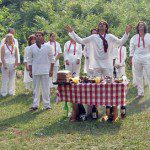
Setting the Table: The Importance of Deity in Ritual
Next Post
February 14, 2012 What Was Lost: The Story of Spring
Browse Our Archives
Select a Category A Lakeside Hearth Adventures in Wortcunning Alone In Her Presence Arts, Crafts & Cooking Birthing Hereditary Witchcraft Book of Blackbirds Book Reviews Born-Again Witch Cauldron, Sword, Spear, & Stone Cermony and Liturgy Columns Community Dandelion Seeds Dear Jasmine Druid Thoughts Editor's Picks Everyday Pagan Family & Household Practice Family Traditions Full Frontal Magic Gateway Goddess Guest Articles Happily Heathen Health and Wellness Hearth of Hellenism Heathen Woman Hills of the Horizon History Holidays Horse Goddesses Interfaith Interviews Irish-American Witchcraft Jewish Witch Lamp & Labyrinth Letters from Midgard Literature, Media, Film, Music Loop of Brighid Love, Sex & Relationships Magic or Magick Making Light Naturalistic Traditions Nature News Outside The Circle Pantheisticon Politics Prayers, Poems, Blessings & Stories Queer Femme Mystic Queer of Swords Recipes Ritual and Practice Science and Research Seekers and Guides Seeking the Grail Socially Responsible Magic Spear of Athena Star Made Witch Syncretic Electric Technology The Blooming Staff The Busy Witch The Cartomancer The Crow's Nest The Dance of Pagan Recovery The Hearth of Hellenism The Lady's Quill The Other Side of the Hedge The Path of She The Rantin' Raven The Witches Next Door The Zen Pagan Theology, Ethics, Philosophy Tree City Witch Urban Earthwitch Wayfaring Woman Witch on Fire Wyrd Words
Select a Month January 2026 March 2025 December 2024 June 2024 April 2024 March 2024 January 2024 December 2023 November 2023 October 2023 August 2023 July 2023 May 2023 April 2023 March 2023 February 2023 January 2023 December 2022 November 2022 October 2022 September 2022 August 2022 July 2022 June 2022 May 2022 March 2022 February 2022 January 2022 December 2021 November 2021 October 2021 September 2021 August 2021 July 2021 June 2021 May 2021 April 2021 March 2021 February 2021 January 2021 December 2020 November 2020 October 2020 September 2020 August 2020 July 2020 June 2020 May 2020 April 2020 March 2020 February 2020 January 2020 December 2019 November 2019 October 2019 September 2019 August 2019 July 2019 June 2019 May 2019 April 2019 March 2019 February 2019 January 2019 December 2018 November 2018 October 2018 September 2018 August 2018 July 2018 June 2018 May 2018 April 2018 March 2018 February 2018 January 2018 December 2017 November 2017 October 2017 September 2017 August 2017 July 2017 June 2017 May 2017 April 2017 March 2017 February 2017 January 2017 December 2016 November 2016 October 2016 September 2016 August 2016 July 2016 June 2016 May 2016 April 2016 March 2016 February 2016 January 2016 December 2015 November 2015 October 2015 September 2015 August 2015 July 2015 June 2015 May 2015 April 2015 March 2015 February 2015 January 2015 December 2014 November 2014 October 2014 September 2014 August 2014 July 2014 June 2014 May 2014 April 2014 March 2014 February 2014 January 2014 December 2013 November 2013 October 2013 September 2013 August 2013 July 2013 June 2013 May 2013 April 2013 March 2013 February 2013 January 2013 December 2012 November 2012 October 2012 September 2012 August 2012 July 2012 June 2012 May 2012 April 2012 March 2012 February 2012 January 2012
Follow Us!
TAKE THE
Religious Wisdom Quiz
In Hebrews, what was the veil in the temple?
Select your answer to see how you score.
The law of Moses The old covenant Christ's flesh The separation from God
Related posts from Agora

Simple Witchery: To Keep Silent

Simple Witchery: Leaning On The Four Pillars

Pergamum Unfurled: Magic with the Greek Gods (Book...

Pergamum Unfurled: Cunning Words (Review)
TRENDING AT PATHEOS Pagan

I was recently chatting with someone on Instagram. She asked me what...

While there are many people who share their results, the end of...

On July 23, I saw Christopher Nolan's The Odyssey which is Homer’s...

As I write this two big events have just finished up. One...

Restoring the Watershed of Divine Love
Perhaps cooperation is not something we manufacture through legislation, ideology, or moral...

Many UUs don’t pray because of bad experiences in a previous religion,...
view all Pagan blogs
Ad-Free & Subscriber Log-In Subscription Support
- About Us
- 2026 Calendar
- Videos
- Podcasts
- Library of World Religions
- Faith In Media Tracker
- Advertise With Us
- Write for Us
- Privacy Policy
- Terms of Service
- Do Not Sell My Data
- Contact Us
- Radiant Digital
- Manage Newsletter Subscriptions
- Unsubscribe From Notifications
- Sitemap
Copyright 2008-2026, Patheos. All rights reserved.
Subscription Support Ad-Free & Subscriber Log-In
Follow Patheos