
BuddhistCatholicContemplativeEvangelicalGeneral ChristianHinduJewishLatter-day SaintMuslimNew VisionsProgressive Christian
Beliefs
- Buddhist
- Catholic
- Contemplative
- Evangelical
- General Christian
- Hindu
- Jewish
- Latter-day Saint
- More Voices
- Muslim
- New Visions
- Pagan
- Progressive Christian
Topics
- Religion News
- Food and Religion
- Sports and Religion
- Religious Art
- Religious Music and Entertainment
- Religious Events
- History and Religion
- Style and Religion
- Politics and Religion
- Women in Religion
- Recreation Outdoors and Religion
- Business Finance and Religion
- Careers Workplace and Religion
- Education and Religion
- Family Parenting and Religion
- Health Fitness and Religion
- Home and Religion
- Relationships and Religion
- Technology and Religion
- Travel and Religion
Columnists
- Buddhist Columnists
- Business Finance and Religion Columnists
- Careers Workplace and Religion Columnists
- Catholic Columnists
- Contemplative Columnists
- Education and Religion Columnists
- Evangelists Columnists
- Family Parenting and Religion Columnists
- General Christian Columnists
- Health Fitness and Religion Columnists
- Hindu Columnists
- History and Religion Columnists
- Home and Religion Columnists
- Jewish Columnists
- More Voices Columnists
- Latter Day Columnists
- Muslim Columnists
- New Visions Columnists
- Nonreligious Columnists
- Pagan Columnists
- Politics and Religion Columnists
- Progressive Columnists
- Recreation Outdoors and Religion Columnists
- Relationships and Religion Columnists
- Religion News Columnists
- Religious Art Columnists
- Religious Events Columnists
- Religious Music and Entertainment Columnists
- Sports and Religion Columnists
- Style and Religion Columnists
- Technology and Religion Columnists
- Travel and Religion Columnists
- Women in Religion Columnists
Resource Library
- 2026 Calendar
- Library of World Religions
- The 100 Most Holy Places on Earth
- Patheos Answers
- Podcasts
- Videos
- Faith Leaders Database
- Anglican Episcopalian
- Bahai
- Baptist
- Buddhism
- Christianity
- Confucianism
- Eastern Orthodoxy
- Hinduism
- Holiness and Pentecostal
- ISKCON
- Islam
- Judaism
- Lutheran
- Methodist
- The Church of Jesus Christ of Latter-day Saints
- New Age
- Paganism
- Presbytarian and Reformed
- Protestantism
- Religion Behind the Scenes
- Roman Catholic
- Scientology
- Shia Islam
- Sikhism
- Sufism
- Sunni Islam
- Taoism
- Zen
- See all religions
Research Tools
 Ad-Free & Subscriber Log-In Subscription Support
Ad-Free & Subscriber Log-In Subscription Support
Follow Patheos 

- Trending:
- Forgiveness
- |
- Marriage
- |
- Consciousness
- |
- Death Penalty
- |
- Election
- |
- Halloween
 A Fox Among Ravens
- Home
- Pagan
- Older Isn’t Always Better
Older Isn’t Always Better
Last updated on: May 19, 2021 at 3:11 pm by Lea Svendsen
Older Isn’t Always Better 2021-05-19T15:11:45-04:00 Lea Svendsen
Patheos Explore the world's faith through different perspectives on religion and spirituality! Patheos has the views of the prevalent religions and spiritualities of the world.
In addition to mead, skaldic poetry, and gods, heathens tend to have a wild fascination with etymology. In studying the lore and archaeological record, parsing apart words and tracking the history of language is an invaluable tool in understanding the evolution of culture and society. Heathenry skews towards being a reconstructionist religion; linguists have a field day flexing their skills in their contributions to the conversation about how things were done in Ye Olde Dayes. Some of these conversations, however, tend to bring out the ranting, raving lunatic in me. I’m not an etymologist, but I have Opinions.
Arch Heathens
In a recent discussion about the academic study of runic alphabets, my personal etymologist/linguist I keep on retainer said many scholars disregard “modern” runic scripts because they’re “not old enough.” Of course, in academics, “modern” can mean, oh, the 1600s. Yes, Scandinavians and Germanic people were still writing in runes in the 17th Century! People don’t get as excited about that because it’s not a pre-Christian Bronze Age artifact. For some reason, heathens (and scholars) are more interested in just the really old stuff, and nuts to how it evolved and developed after Christian conversion, yeah?
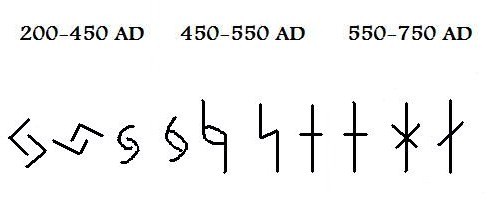
The evolution of a single rune, Jera. And this is a dramatic shift before Christianization! Image: Wikimedia Commons
No. This is where I bristle. Reconstruction is a great discipline that does invaluable work in reviving a lot of old practices and appreciation for the literature and philosophy of our ancient forebears, but it’s hardly the end-all be-all of how to study and live the faith. Over the years, I’ve seen a number of arguments in various forums and spaces about how we’re all doing heathenry wrong because we’ve strayed from what the “arch heathens,” or the “real” pagans who lived and worshipped before Christianity made its way north, did.
Get ready to send me hate mail: I don’t care what the arch heathens did.
Yes, I appreciate the history. Yes, I enjoy the sagas and skaldic poems and other bits of lore. Yes, I geek out over archaeology and artifacts. But it’s irrelevant to how I live my life in 21st Century America.
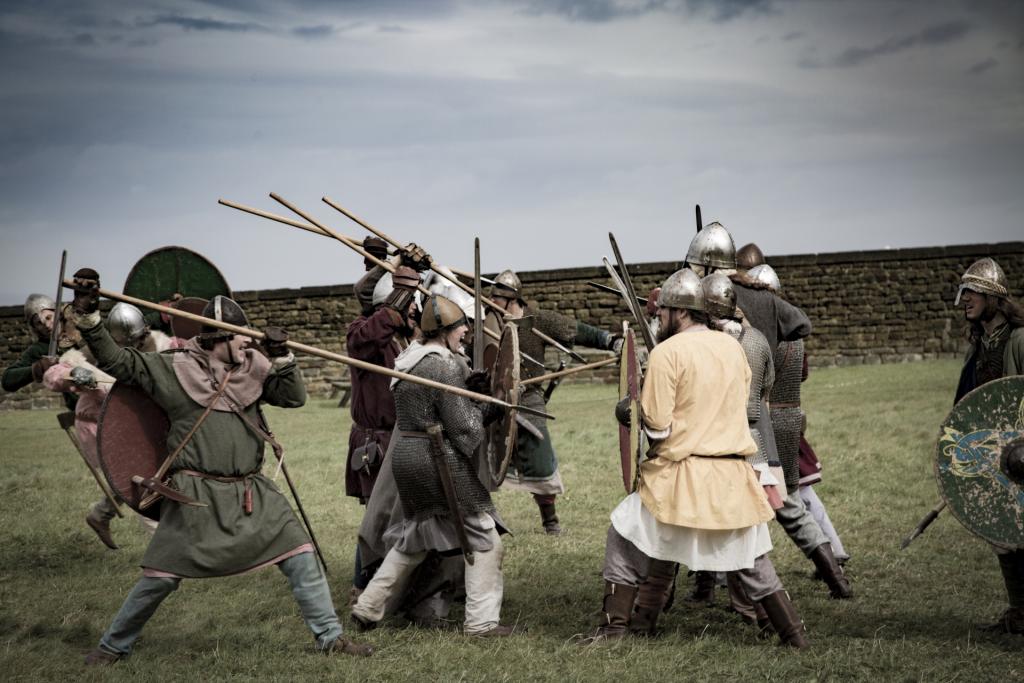
Do you even heathen, bro? Image: George Hodan/Public Domain
Here’s a little context for why I get so ranty about the topic.
My grandfather was heathen. He was a heathen import from Drammen, Norway. Came to America when he was 10 years old. He lived heathen, and he raised his son heathen, who raised me heathen.
Grandpa also forgot his native language not too long after settling in NYC. When he attended Columbia University, he had to hire a tutor to reteach him enough Norwegian that he could test out of the foreign language requirements (I blame him for my own failure with holding onto language. I used to be fluent in German since I grew up in W. Germany. Once I moved back to America – also at age 10 – I lost it, and barely scraped by with a B in German in undergrad. Genetics run strong in the Svendsen family, alas).
He certainly wasn’t holding onto old manuscripts in Old Norse and saying prayers to the gods he so loved in an ancient tongue. He wasn’t sacrificing goats or cattle – he was a Chablis man. My father was a Stoli’s vodka man. I’m probably more “traditional” than them with my offerings of mead with my kindred and community, but donuts and coffee tend to be a steady stream on my altars instead of alcohol.
My heathenry is different from my father’s, and his was different from his father’s. Heathenry today is, on the surface, dramatically different from the heathenry of, say, 9th Century Oslo. And let’s face it: the heathenry of someone in 9th Century Oslo was different from what someone in 9th Century Uppsala was doing, which was different from what someone did in 9th Century Frisian coastal regions.
The concept of the arch heathen is largely imaginary, some mythical “real actual pagan” archetype that, in reality, varied from place to place, century to century. I say today’s religion is different on the surface because the core concepts remain the same. Devotion to community and supporting one another, veneration of the Scandinavian and Germanic gods, ancestors, and vaettir, and a keen appreciation for a bawdy tale shared over mead and ale still define us.

Oh, your chieftain doesn’t store his food in something like this? What, does he use a fridge or something? Arch heathens are the only heathens worth emulating, so get to building a turf house. Image: A reconstruction of the Viking Longhouse Stöng in Iceland. Photo by Thomas Ormston/Creative Commons
21st Century Practices Are Valid
Heathenry has evolved with the rest of society. For one thing, we’re all literate with easy access to books of lore and essays that explore different concepts from different cultures. We’re living in houses and apartments with indoor plumbing and climate control. Live hundreds of miles from your kin? No biggie! We have planes, trains, and automobiles to visit friends and family. Zoom calls help us keep in touch with much needed face time. We’re bringing buffalo chicken dip and stuffed mushrooms and ice cream to potlucks instead of stews and lutefisk.
At sumbel, we’re speaking over the horn of mead in English (or modern Icelandic, or Ukrainian, or Spanish, or whatever the local dialect may be). We’re not often celebrating a good harvest to ensure our families don’t starve over the long, frigid winter – we’re more likely to celebrate a promotion that will make it easier to provide for our families.
I certainly understand and appreciate the drive to uncover the oldest possible record of a runic alphabet and the oldest original hof or temple. These finds further our knowledge and understanding of where we came from and why we do what we do. That said, we’re doing ourselves and our forebears a grave disservice by writing off more modern findings just because they’re dated to a post-Christian conversion period.
When studying runes and language, older isn’t better. The shifts in vowel sounds and runic staves tell us about adaptation and survival throughout the centuries. Streamlining both language and writing systems made communication easier and more efficient. Literacy and greater distribution of written materials had an impact. If oldest was best, there wouldn’t be newer material to study. If oldest was The One Correct Way, then we’d still be doing it, exactly as they did 1,000 years ago. There’s a reason why changes occur in society and language and practice. This evolution is as important to building our communities as discovering the oldest runestone on record.
Frankly, I agree with my personal etymologist. It’s amazingly cool that people were still writing in runic alphabets in the last few centuries! Have you ever seen how beautiful the runes are when written in fountain pen?! Heathenry is a reconstructionist religion, but there are so many fascinating threads that persist throughout living history that connect us to the pagans of millennia past. We have direct connections to the practices and beliefs and habits of Iron Age Scandinavians, they’re just overlooked because they’re “too new.”

Additions to the Norwegian rune poem in Edda Oblongata from 1680! Image used with Thorraborinn’s permission.
Reconstruction is cool and all, but as for me? I’ll share a horn of mead with my gods in pajama pants. I’ll do it from the comfort of my air conditioned house with a “hail all a’ y’all.” Grandpa Svendsen is just happy I’m thriving and remembering him with a smile when I hail the ancestors. Arch heathens had their ways, but modern heathens can do as we damn well please. Building frith with community and helping one another is far more important than wearing period-appropriate clothing and region-specific language. Toasting with mead you brewed in a horn you claimed from an ox you butchered? Or with a glass of Chablis from the bottle you got on sale at the grocery store? Doesn’t matter as long as you hail the gods and hail each other.
Besides, I’m pretty sure the arch heathens are jealous of the HVAC systems and grocery stores we enjoy. If they had such luxuries available, they’d be lounging on a couch as they scribbled their thoughts in their favorite alphabet. They’d be munching on salt and vinegar chips instead of lutefisk. Live and let live, because the past influences us, but it doesn’t control us.
Too long? Didn’t read? As long as you’re building frith and relationships with people in your communities (and this isn’t exclusive to heathen communities. It includes the communities in which we live and work) you’re not doing heathenry wrong. As long as you’re helping one another while hailing the gods you feel the greatest kinship with, then you’re not doing heathenry wrong. Don’t let anyone tell you your offerings are wrong or you’re not using the correct runic alphabet for whatever reason. Be a good person, represent the gods well, and FTN. That’s what my grandpa taught me, and that’s what I still believe it all comes down to.
Doesn’t matter what my grandfather’s ancestors were doing in Drammen in 813CE or whatever. They’re too busy marveling at the concept of Doordash to worry about the last of their line being unable to manage a farmstead.
Previous Post

April 26, 2021
Responsibilities of Being a Priestess of Sigyn
Browse Our Archives
Select a Category Uncategorized
Select a Month May 2021 April 2021 February 2021 January 2021 December 2020 November 2020 October 2020 September 2020 August 2020 July 2020
Follow Us!
TAKE THE
Religious Wisdom Quiz
Which feast was reinstituted with great joy, reading the Law daily for seven days?
Select your answer to see how you score.
Feast of Tabernacles Purim Passover Day of Atonement
Related posts from A Fox Among Ravens

Responsibilities of Being a Priestess of Sigyn
Why I'm Hesitant About Spellwork


Defending Our Symbols: Why It Matters
TRENDING AT PATHEOS Pagan

I was recently chatting with someone on Instagram. She asked me what...

While there are many people who share their results, the end of...

On July 23, I saw Christopher Nolan's The Odyssey which is Homer’s...

As I write this two big events have just finished up. One...

Restoring the Watershed of Divine Love
Perhaps cooperation is not something we manufacture through legislation, ideology, or moral...

Many UUs don’t pray because of bad experiences in a previous religion,...
view all Pagan blogs
Ad-Free & Subscriber Log-In Subscription Support
- About Us
- 2026 Calendar
- Videos
- Podcasts
- Library of World Religions
- Faith In Media Tracker
- Advertise With Us
- Write for Us
- Privacy Policy
- Terms of Service
- Do Not Sell My Data
- Contact Us
- Radiant Digital
- Manage Newsletter Subscriptions
- Unsubscribe From Notifications
- Sitemap
Copyright 2008-2026, Patheos. All rights reserved.
Subscription Support Ad-Free & Subscriber Log-In
Follow Patheos