
BuddhistCatholicContemplativeEvangelicalGeneral ChristianHinduJewishLatter-day SaintMuslimNew VisionsProgressive Christian
Beliefs
- Buddhist
- Catholic
- Contemplative
- Evangelical
- General Christian
- Hindu
- Jewish
- Latter-day Saint
- More Voices
- Muslim
- New Visions
- Pagan
- Progressive Christian
Topics
- Religion News
- Food and Religion
- Sports and Religion
- Religious Art
- Religious Music and Entertainment
- Religious Events
- History and Religion
- Style and Religion
- Politics and Religion
- Women in Religion
- Recreation Outdoors and Religion
- Business Finance and Religion
- Careers Workplace and Religion
- Education and Religion
- Family Parenting and Religion
- Health Fitness and Religion
- Home and Religion
- Relationships and Religion
- Technology and Religion
- Travel and Religion
Columnists
- Buddhist Columnists
- Business Finance and Religion Columnists
- Careers Workplace and Religion Columnists
- Catholic Columnists
- Contemplative Columnists
- Education and Religion Columnists
- Evangelists Columnists
- Family Parenting and Religion Columnists
- General Christian Columnists
- Health Fitness and Religion Columnists
- Hindu Columnists
- History and Religion Columnists
- Home and Religion Columnists
- Jewish Columnists
- More Voices Columnists
- Latter Day Columnists
- Muslim Columnists
- New Visions Columnists
- Nonreligious Columnists
- Pagan Columnists
- Politics and Religion Columnists
- Progressive Columnists
- Recreation Outdoors and Religion Columnists
- Relationships and Religion Columnists
- Religion News Columnists
- Religious Art Columnists
- Religious Events Columnists
- Religious Music and Entertainment Columnists
- Sports and Religion Columnists
- Style and Religion Columnists
- Technology and Religion Columnists
- Travel and Religion Columnists
- Women in Religion Columnists
Resource Library
- 2026 Calendar
- Library of World Religions
- The 100 Most Holy Places on Earth
- Patheos Answers
- Podcasts
- Videos
- Faith Leaders Database
- Anglican Episcopalian
- Bahai
- Baptist
- Buddhism
- Christianity
- Confucianism
- Eastern Orthodoxy
- Hinduism
- Holiness and Pentecostal
- ISKCON
- Islam
- Judaism
- Lutheran
- Methodist
- The Church of Jesus Christ of Latter-day Saints
- New Age
- Paganism
- Presbytarian and Reformed
- Protestantism
- Religion Behind the Scenes
- Roman Catholic
- Scientology
- Shia Islam
- Sikhism
- Sufism
- Sunni Islam
- Taoism
- Zen
- See all religions
Research Tools
 Ad-Free & Subscriber Log-In Subscription Support
Ad-Free & Subscriber Log-In Subscription Support
Follow Patheos 

- Trending:
- Forgiveness
- |
- Marriage
- |
- Consciousness
- |
- Death Penalty
- |
- Election
- |
- Halloween
 A Fox Among Ravens
- Home
- Pagan
- Responsibilities of Being a Priestess of Sigyn
Responsibilities of Being a Priestess of Sigyn
Last updated on: April 26, 2021 at 2:10 pm by Lea Svendsen
Responsibilities of Being a Priestess of Sigyn 2021-04-26T14:10:54-04:00 Lea Svendsen
Patheos Explore the world's faith through different perspectives on religion and spirituality! Patheos has the views of the prevalent religions and spiritualities of the world.
Norse heathenry doesn’t have priests or priestesses the way, say, Gardnerian Wicca does. While we do have accredited clergy through organizations such as The Troth, the responsibilities we hold differ. I’m not Official Clergy, but I serve as a priestess of Sigyn, and a recent camping expedition led to some serious reflection on what that really means.
Priest/ess vs Devotee
I never intended to be a priestess (despite an interest in The Troth’s clergy program for the credentials -they’d be useful for community outreach and interfaith work, as well as stepping in as a funeral celebrant; my work as a mortician has taught me that quite a lot of families don’t have someone to lead a non-Christian service, but I digress): I’m oathed to Loki, but the work I do with and for the tricky twerp is focused on personal spirituality and devotion. The whole “priestess of Sigyn” thing developed naturally because with Loki comes his bride, and I started to advocate for her and bring her back into the heathen community consciousness. The work I do for Sigyn is outward and community-focused, so it falls more into the realm of clergy work. This is a mantle I wear with humility and gratitude, because she’s a pretty neat lady who deserves to be recognized.
What does this really entail, though? Beyond reintroducing her into active veneration in the Northeast Heathen Community and leading blóts for her, I’m trying to set the record straight about her and offer more resources for heathens and pagans with larger projects, such as my upcoming book for Llewellyn, Loki and Sigyn: Lessons on Chaos, Laughter, and Loyalty from the Norse Gods.
Giving lectures and leading rituals for She of the Pouring is only a small part of the work required, as I learned recently. It’s one thing to teach the lessons she has to offer, but it’s far more important to live those lessons.
With a lifetime of loving the gods behind me, I’m accustomed to feeling their presence with occasionally overwhelming intensity. My experience as a generational heathen and having a fultrui relationship (meaning I’m oathed in a lifelong two-way partnership with a specific deity. It’s not a mutually exclusive relationship, and I still work with many others in the Norse pantheon) has taught me over the years how to “come down” from such encounters. This comes in handy when dealing with the aftercare of someone who’s been gobsmacked (or rather, godsmacked) by an unexpected visit from the gods.

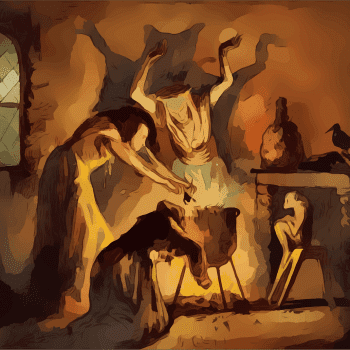
Loki and Sigyn, Karl Gebhardt. Image: Wikimedia Commons
Serving Others: The Importance of Being Present
On a gorgeous spring day, while hiking in a haunted forest, K (my Partner in Crime and Chaos) and I stopped to rest at a quiet little lake. Leaning against mossy boulders, we quietly basked in the still-cool air and watched hawks gliding on wind currents above the water. Suddenly, I was struck with a fierce sense of protectiveness over him and cradled his head on my shoulder as he slumped against me. “Are you okay?” I asked.
“Yeah. I’m okay,” he said. “I feel Sigyn in you.”
That caught me off guard. My mind had turned to her when the “must protect at all costs” sensation struck. One of the best lessons I’ve learned from her is that being kind and sweet is great, but I mustn’t be afraid to bite, and bite hard when necessary. For reasons beyond my own understanding, I’d felt ready to bite clean through the jugular of anyone who might hurt K despite the fact there was no one around to do so. So I thought of Sigyn, and the next thing I know he’s telling me he feels her presence. And she wasn’t alone. Others from our pantheon were present. I don’t know what they communicated to him because I didn’t ask; whatever happened was between K and the gods. I just needed to be there for him once the encounter concluded and help with recovery from the experience.
Some Advice
If you’re going to be a priest or priestess of a deity, you have to be ready to serve the community around you. It’s not just about you and that god/dess any more, it’s about facilitating the interactions of other people and that god/dess. It’s about teaching others about that deity and their lessons, and leading in your community by embodying those lessons and representing that deity through your deeds and your words. And while titles are neat and leading ritual is fun, being present for others is the crux of the responsibility of clergy.
If you’re going to take on the title, be ready to take on the work. Some advice from a funeral director who has worked with a lot of clergy from all different faiths on how to serve others while serving your deity:
- Be present. You don’t have to have answers or advice, but you have to be there for someone when they need you. Listen if they want to share the experience, but don’t pry and ask for details you may not be privy to.
- Be prepared. Experiencing deity can be physically taxing, especially when it’s an unexpected event. You don’t have to carry chocolate and peanut butter with you everywhere you go, but be ready to get some food and water to help someone recover from their physiological reaction to the spiritual intensity.
- Be calm. Spiritual experiences can be overwhelming, and tears may fall. Your responsibility as a priest or priestess is to help them through the emotional fallout and be a steady energy to balance the waves of “WTF was that?!” that are sure to radiate from the person you’re helping. Don’t react to their reaction, just be calm and steady during the comedown and aftercare.
- Be respectful. If the person you’re helping does talk about what transpired, the impressions or messages from the deity may not be what you expect based on your own personal experiences with that deity. Unless it’s egregiously bad or dangerous, don’t tell them they’re mistaken or wrong: you’re not the deity’s mouthpiece, you don’t get to speak for them.
- Keep confidentiality. Don’t gossip with others about the experience. I have K’s permission to share the experience as I myself witnessed it, but only the barest details were shared to illustrate how this advice works in practice. There’s more to that afternoon, but the nitty gritty of what happened when the gods spoke is irrelevant to anyone but him. Even if I knew what Sigyn and the others said to him, I wouldn’t share it with anyone else. If K wants people to know, he can tell them himself. It’s not my story to tell.
Taking a Cue from Sigyn
Sigyn is Loki’s wife, and she’s a quiet goddess in the Norse pantheon. She does what must be done to lessen the suffering of others. She doesn’t look for attention or accolades, she doesn’t do anything for glory or pride. She simply undertakes the work that must be done whether or not anyone notices or cares. That is what it means to be a priest or priestess.
Previous Post
February 8, 2021
Why I'm Hesitant About Spellwork
Next Post

May 19, 2021 Older Isn't Always Better
Browse Our Archives
Select a Category Uncategorized
Select a Month May 2021 April 2021 February 2021 January 2021 December 2020 November 2020 October 2020 September 2020 August 2020 July 2020
Follow Us!
TAKE THE
Religious Wisdom Quiz
What Christian group follows the "Westminster Confession of Faith"?
Select your answer to see how you score.
Presbyterians Baptists Catholics Lutherans
Related posts from A Fox Among Ravens

Why I'm Hesitant About Spellwork


Defending Our Symbols: Why It Matters
TRENDING AT PATHEOS Pagan

When we talk about Greek religion, we often begin with the dodekatheion—the...

I was recently chatting with someone on Instagram. She asked me what...

While there are many people who share their results, the end of...

On July 23, I saw Christopher Nolan's The Odyssey which is Homer’s...

As I write this two big events have just finished up. One...

Restoring the Watershed of Divine Love
Perhaps cooperation is not something we manufacture through legislation, ideology, or moral...
view all Pagan blogs
Ad-Free & Subscriber Log-In Subscription Support
- About Us
- 2026 Calendar
- Videos
- Podcasts
- Library of World Religions
- Faith In Media Tracker
- Advertise With Us
- Write for Us
- Privacy Policy
- Terms of Service
- Do Not Sell My Data
- Contact Us
- Radiant Digital
- Manage Newsletter Subscriptions
- Unsubscribe From Notifications
- Sitemap
Copyright 2008-2026, Patheos. All rights reserved.
Subscription Support Ad-Free & Subscriber Log-In
Follow Patheos