
BuddhistCatholicContemplativeEvangelicalGeneral ChristianHinduJewishLatter-day SaintMuslimNew VisionsProgressive Christian
Beliefs
- Buddhist
- Catholic
- Contemplative
- Evangelical
- General Christian
- Hindu
- Jewish
- Latter-day Saint
- More Voices
- Muslim
- New Visions
- Pagan
- Progressive Christian
Topics
- Religion News
- Food and Religion
- Sports and Religion
- Religious Art
- Religious Music and Entertainment
- Religious Events
- History and Religion
- Style and Religion
- Politics and Religion
- Women in Religion
- Recreation Outdoors and Religion
- Business Finance and Religion
- Careers Workplace and Religion
- Education and Religion
- Family Parenting and Religion
- Health Fitness and Religion
- Home and Religion
- Relationships and Religion
- Technology and Religion
- Travel and Religion
Columnists
- Buddhist Columnists
- Business Finance and Religion Columnists
- Careers Workplace and Religion Columnists
- Catholic Columnists
- Contemplative Columnists
- Education and Religion Columnists
- Evangelists Columnists
- Family Parenting and Religion Columnists
- General Christian Columnists
- Health Fitness and Religion Columnists
- Hindu Columnists
- History and Religion Columnists
- Home and Religion Columnists
- Jewish Columnists
- More Voices Columnists
- Latter Day Columnists
- Muslim Columnists
- New Visions Columnists
- Nonreligious Columnists
- Pagan Columnists
- Politics and Religion Columnists
- Progressive Columnists
- Recreation Outdoors and Religion Columnists
- Relationships and Religion Columnists
- Religion News Columnists
- Religious Art Columnists
- Religious Events Columnists
- Religious Music and Entertainment Columnists
- Sports and Religion Columnists
- Style and Religion Columnists
- Technology and Religion Columnists
- Travel and Religion Columnists
- Women in Religion Columnists
Resource Library
- 2026 Calendar
- Library of World Religions
- The 100 Most Holy Places on Earth
- Patheos Answers
- Podcasts
- Videos
- Faith Leaders Database
- Anglican Episcopalian
- Bahai
- Baptist
- Buddhism
- Christianity
- Confucianism
- Eastern Orthodoxy
- Hinduism
- Holiness and Pentecostal
- ISKCON
- Islam
- Judaism
- Lutheran
- Methodist
- The Church of Jesus Christ of Latter-day Saints
- New Age
- Paganism
- Presbytarian and Reformed
- Protestantism
- Religion Behind the Scenes
- Roman Catholic
- Scientology
- Shia Islam
- Sikhism
- Sufism
- Sunni Islam
- Taoism
- Zen
- See all religions
Research Tools
 Ad-Free & Subscriber Log-In Subscription Support
Ad-Free & Subscriber Log-In Subscription Support
Follow Patheos 

- Trending:
- Forgiveness
- |
- Marriage
- |
- Consciousness
- |
- Death Penalty
- |
- Election
- |
- Halloween
 A Fox Among Ravens
- Home
- Pagan
- A Tomte by Any Other Name
A Tomte by Any Other Name
Last updated on: August 17, 2020 at 8:26 am by Lea Svendsen
A Tomte by Any Other Name 2020-08-17T08:26:52-04:00 Lea Svendsen
Patheos Explore the world's faith through different perspectives on religion and spirituality! Patheos has the views of the prevalent religions and spiritualities of the world.
Hailing the gods is a big part of religious practice, but not all heathens are focused on the Big Guys. There’s a large number of people in the community who focus their attentions and veneration on the land spirits and ancestors. Even for those of us dedicated to a fulltrui or patron, landvættir and ancestors tend to be more of a daily devotion than blóts to the gods.
That said, in my own practice, I don’t particularly honor “traditional” landvættir. Despite being 2nd generation Norwegian-American raised on the folklore and faith of my grandfather, I don’t have a house nisse (or tomte, for you Swedes), and I don’t “feed” local land spirits porridge. I tend to honor the spirits and beings that are native to the region in which I live!
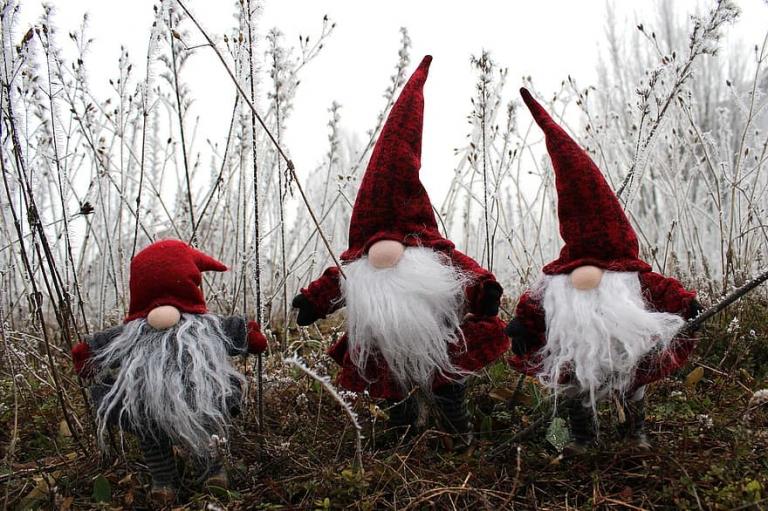
Gotta admit, the nisser/tomte are cute little buggers. Image: Pikist
Not Many Vikings in Eastern PA . . .
Up North, nature spirits and protectors of the home and hearth are landvættir (also known as wights). Being of Norwegian descent, I grew up calling them nisser/nisse. My most treasured family relic is my grandfather’s porridge bowl and cup he brought with him from Drammen; it’s painted with nisser dancing around the edge, and I’ve got a note in his handwriting offering both the literal and idiomatic translations of the inscription inside the cup. “Vi Nisser, Vi Nisser, Vi Gjöre Hvad Vi Kan,” or “We elves, we elves, we do our best.”
The folk tales on which I cut my teeth focused around nisser and their kin, yet I rarely felt too much of a connection with the spirits of the land. I noticed them frequently in Iceland, but often remark that in the United States, the energy (to me) is much weaker and much more confused and jumbled, which makes it incredibly difficult to pick up on things. And to be utterly honest, I’ve always felt silly leaving out a bowl of porridge with a slab of butter melting into it. I’ve obviously got no problems feeling dopey leaving out offerings of sweets and snackrifices, so being weirded out and embarrassed by a bowl of porridge says quite a lot about my relationship with the nisser.
That said, I do leave offerings of tobacco in the woods when I go hiking. The region in which I live and explore is, like most places in this country, heavy with the history of the Native Americans, and theirs is the influence I feel when I’m wandering the woods. Tobacco was a traditional offering for the people who were unfairly pushed away from this land, and it feels very right to give tobacco in honor of them and the spirits with whom they communed. It gives me a sense of connection, moreso than I ever get with porridge, and it sparks a little bit of ancestral acknowledgement as well as the Norse were known to make appropriate offerings to local deities and local temples throughout their, uh, travels. Eastern Pennsylvania is not a land of nisser or tomte, but it is a land of the Lenape and Delaware peoples, the Shawnee and the Susquehannock, and I prefer to honor and remember their spirits of the land.
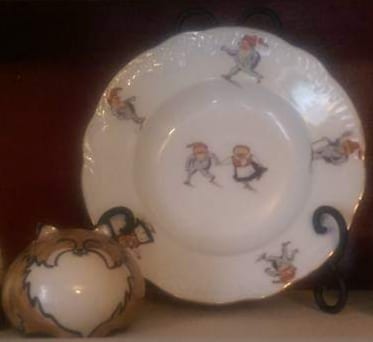
My grandfather’s old porridge bowl and a chonk-fox.
No Elves at Home, Either
As far as the spirit(s) in my home, the protectors and “helpers,” well, there’s no nisse here. But there is a ghost, or an imprint, of the original owner (and, to make myself sound even crazier, the ghost of her cat also roams the 2nd and 3rd floors of the rowhome). After noticing her presence shortly after moving in some 11 years ago, I did research on the property: my house was built in 1908, and from ’08 to ’99, it was owned by the same family.
Census records matched up with the age/dress of the lady I sometimes see from the corner of my eye, and her death certificate confirms she died here. She’s buried in the cemetery about a quarter mile from our home, on the same street, and I found her grave very much by accident. I like to visit her every now and then with an offering of flowers (in the spring, I bring tulips from our back courtyard space), and I thank her for letting me live in her beloved family home and for watching over it. Her presence brings a sense of deep love for the house and has a very protective quality about it. Though the house was bought and sold several times between 2000 and 2009, I’m the 2nd longest resident here. I like to think that Nancy approves of me for whatever reason, even if it’s just because I notice her and remember her and decorate her grave.
To be fair, I don’t like porridge, either
For years I thought I was a crappy heathen because I didn’t honor nisser the way I do my gods and ancestors. But spiritual practice and connecting with the world we can’t necessarily see has taught me that in some cases (in most cases, actually), it’s not about me. It’s about recognizing what and who is there, and it would be gravely disrespectful to refer to my local land spirits and protector ghost as nisser and try to feed them porridge. Where I live, what I experience, it’s not about me: it’s about who came before me, and remembering the entities that remain and honoring them in a context they understand.
I may not call them nisser or landvættir, but they’re still the local land spirits and house spirits watching over and protecting their turf. They don’t care for porridge, but they love tobacco and tulips, so what’s the difference between honoring them and honoring “land wights”? The intent is the same, the action is the same, and the outcome is the same, regardless of what I’m calling these energies I notice and honor.
That’s the thing about following an old European religion in a very diverse country with infinite cultural influences: I thought I didn’t notice the nisser ’round these parts, and had no idea how to cultivate a relationship with them. Turns out that what I’ve been honoring aren’t nisser or landvættir by name, but they’re the eastern North American equivalent. No cheerful little gnomes dancing around with pointy hats and bushy beards in my house, but rather the ghost of the first woman to make this house a home. No elves scurrying through the trees and undergrowth in the forests, but spirits of the trees and plants and water and rocks themselves, along with the memories of the people who first walked among them.
For me, leaving bowls of porridge for wights doesn’t work, because that’s not what they want in my neck of the woods. They don’t want to be called nisser or receive the gifts nisser traditionally enjoy, because they don’t have the connection or context for the language or the offering. They are their own entities, with their own identities and practices and preferences, and honoring them is a matter of paying attention and listening.
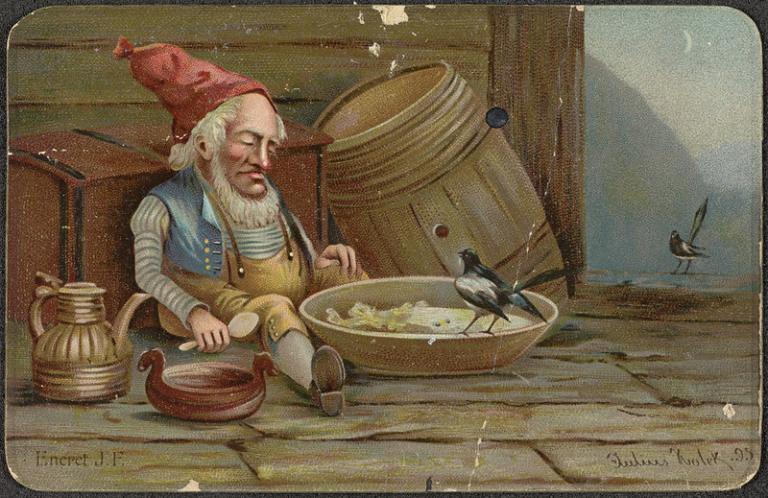
Artist: Julius Holck (1845-1911)/National Library of Norway
American Landvættir: The Elves Went Too Far Immigrated, Too
This is where experience varies: there are households in the United States that do have nisser/tomte that have followed their families, and swaths of land hosting immigrant landvættir. I know many people who make offerings of porridge and cream to their tomte, many who have created vés for landvættir on their properties. In my corner of my city, I don’t notice nisser. I’ve invited them, but they haven’t come because my place is already protected and looked after by a house spirit. The position has been filled, no vacancy. And it works for us as the Nordic land wight practices work for others. There’s no right or wrong so long as the land spirits are remembered and acknowledged in a way that honors them.
We’re an immigrant nation, and when our forbears brought the gods with them, they brought other beings as well. There could even be Nordic or Germanic landvættir in my own city, and I just haven’t met them yet because my hearth is already claimed by a protective watcher and her cat.
If you want to incorporate the land wights into your heathen practice, you can absolutely set up a cozy little corner of your home for them and leave out porridge (with a LARGE pat of butter on it – do NOT skimp on the butter, y’all, or you’ll face the consequences, according to Grandpa Frank). If that doesn’t jive, then be patient and pay attention to what’s around you, and you’ll know what to offer and in what context.
Whatever name or identity they take in whatever region you call home, it’s about recognizing the work they do to protect the land and the hearth. It’s thanking them for being present and sharing the space and the beauty around us. Whether it be a rosy-cheeked, bushy-bearded tomte or a Lenape tree spirit or an early 20th homemaker, we are surrounded by beings who care for the earth and those who live upon it, and they’re so very deserving of our gratitude.
Previous Post

August 11, 2020
When Your "God Phone" Isn't Ringing
Next Post

August 28, 2020 Community in Times of COVID-19
Browse Our Archives
Select a Category Uncategorized
Select a Month May 2021 April 2021 February 2021 January 2021 December 2020 November 2020 October 2020 September 2020 August 2020 July 2020
Follow Us!
TAKE THE
Religious Wisdom Quiz
What prominent city did Paul visit, known for its altar to "an unknown god"?
Select your answer to see how you score.
Athens Rome Corinth Ephesus
Related posts from A Fox Among Ravens

Stop Trying to Reclaim the Swastika
What's the Big Deal About Ancestors?


When Your "God Phone" Isn't Ringing
TRENDING AT PATHEOS Pagan

I was recently chatting with someone on Instagram. She asked me what...

While there are many people who share their results, the end of...

On July 23, I saw Christopher Nolan's The Odyssey which is Homer’s...

As I write this two big events have just finished up. One...

Restoring the Watershed of Divine Love
Perhaps cooperation is not something we manufacture through legislation, ideology, or moral...

Many UUs don’t pray because of bad experiences in a previous religion,...
view all Pagan blogs
Ad-Free & Subscriber Log-In Subscription Support
- About Us
- 2026 Calendar
- Videos
- Podcasts
- Library of World Religions
- Faith In Media Tracker
- Advertise With Us
- Write for Us
- Privacy Policy
- Terms of Service
- Do Not Sell My Data
- Contact Us
- Radiant Digital
- Manage Newsletter Subscriptions
- Unsubscribe From Notifications
- Sitemap
Copyright 2008-2026, Patheos. All rights reserved.
Subscription Support Ad-Free & Subscriber Log-In
Follow Patheos