
BuddhistCatholicContemplativeEvangelicalGeneral ChristianHinduJewishLatter-day SaintMuslimNew VisionsProgressive Christian
Beliefs
- Buddhist
- Catholic
- Contemplative
- Evangelical
- General Christian
- Hindu
- Jewish
- Latter-day Saint
- More Voices
- Muslim
- New Visions
- Pagan
- Progressive Christian
Topics
- Religion News
- Food and Religion
- Sports and Religion
- Religious Art
- Religious Music and Entertainment
- Religious Events
- History and Religion
- Style and Religion
- Politics and Religion
- Women in Religion
- Recreation Outdoors and Religion
- Business Finance and Religion
- Careers Workplace and Religion
- Education and Religion
- Family Parenting and Religion
- Health Fitness and Religion
- Home and Religion
- Relationships and Religion
- Technology and Religion
- Travel and Religion
Columnists
- Buddhist Columnists
- Business Finance and Religion Columnists
- Careers Workplace and Religion Columnists
- Catholic Columnists
- Contemplative Columnists
- Education and Religion Columnists
- Evangelists Columnists
- Family Parenting and Religion Columnists
- General Christian Columnists
- Health Fitness and Religion Columnists
- Hindu Columnists
- History and Religion Columnists
- Home and Religion Columnists
- Jewish Columnists
- More Voices Columnists
- Latter Day Columnists
- Muslim Columnists
- New Visions Columnists
- Nonreligious Columnists
- Pagan Columnists
- Politics and Religion Columnists
- Progressive Columnists
- Recreation Outdoors and Religion Columnists
- Relationships and Religion Columnists
- Religion News Columnists
- Religious Art Columnists
- Religious Events Columnists
- Religious Music and Entertainment Columnists
- Sports and Religion Columnists
- Style and Religion Columnists
- Technology and Religion Columnists
- Travel and Religion Columnists
- Women in Religion Columnists
Resource Library
- 2026 Calendar
- Library of World Religions
- The 100 Most Holy Places on Earth
- Patheos Answers
- Podcasts
- Videos
- Faith Leaders Database
- Anglican Episcopalian
- Bahai
- Baptist
- Buddhism
- Christianity
- Confucianism
- Eastern Orthodoxy
- Hinduism
- Holiness and Pentecostal
- ISKCON
- Islam
- Judaism
- Lutheran
- Methodist
- The Church of Jesus Christ of Latter-day Saints
- New Age
- Paganism
- Presbytarian and Reformed
- Protestantism
- Religion Behind the Scenes
- Roman Catholic
- Scientology
- Shia Islam
- Sikhism
- Sufism
- Sunni Islam
- Taoism
- Zen
- See all religions
Research Tools
 Ad-Free & Subscriber Log-In Subscription Support
Ad-Free & Subscriber Log-In Subscription Support
Follow Patheos 

- Trending:
- Forgiveness
- |
- Marriage
- |
- Consciousness
- |
- Death Penalty
- |
- Election
- |
- Halloween
 Aestheism
- Home
- Latter-day Saint
- Religion’s Placebo Effect(s)
Religion’s Placebo Effect(s)
Last updated on: May 20, 2016 at 1:07 pm by David Mason
Religion’s Placebo Effect(s) 2016-05-20T13:07:53-05:00 David Mason
Patheos Explore the world's faith through different perspectives on religion and spirituality! Patheos has the views of the prevalent religions and spiritualities of the world.
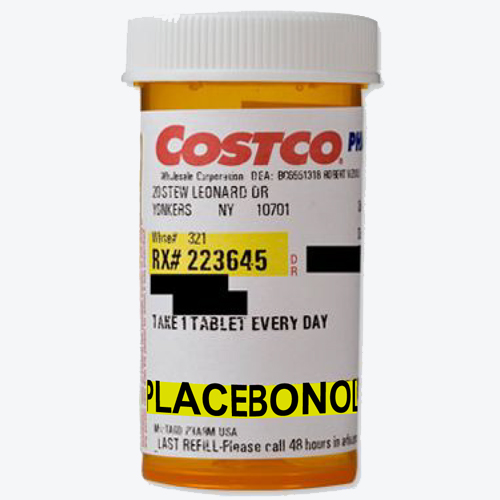
Placebonol®
If you have Irritable Bowel Syndrome—and reading blogposts can give it to you if you don’t—you’re in luck. The best treatment might be provided in little packets manufactured by C&H.
A few years ago, a team of real-life scientists produced an important study that showed that placebos work. This was not, itself, news. We came to understand long ago that a sugar pill, when pretending to be medication, can have positive material consequences on individuals’ health.
We even understand, now, some of the chemistry that placebos initiate. Placebos can motivate the brain to release endorphins. Placebos can motivate the brain to release dopamine. You tell folks that you’re giving them medication, and their own bodies go to work for their benefit.
Only, in the case of this study, the sugar pills were not pretending to be medication. The scientists, here, did not tell their research subjects that they were getting medication, nor even that they might get a placebo, but maybe not. On the contrary, this team of scientists told their research subjects they were taking sugar pills. Up front. From the beginning.
“We’re giving you sugar pills for your Irritable Bowel Syndrome,” the scientists said to half of their research subjects. Then they handed them a bottle of pills labeled: Placebo.
Apparently, the folks who took the Placebo-labeled placebos showed significant improvement over their counterparts, who weren’t treated at all.
Before I fall prey to the inclination to draw any medical conclusions, let me say that I don’t know froo-frah from medical bio-chemistry.
But the real-life scientists who do speak placebo-ese consistently reiterate that there is not a single “placebo effect”, but many such effects, in the plural, wrapped up together in these various placebo-laden phenomena. There’s a lot going on, apparently, when a person takes a sugar pill.
I’d like to recommend that play is one crucial element wrapped up in all of the chemistry. I don’t think I’m recommending any metaphysical interpretation of the circumstances. I don’t think a metaphysical or supernatural reading of placebo effects is warranted or necessary. I think playing, in perfectly natural ways, contributes to our physical health, as well as to our psychological and emotional well-being.
In short: we have to be able to do things that are ridiculous and that don’t make sense. We die if we don’t.
D. W. Winnicott argued decades ago that genuine living arises from experiencing the freedom that is the characteristic of play, and that that experience can only be had from doing.* That’s the employment of one’s body in action, people. One can think all day long about one’s health, but the taking of the placebo constitutes a creative force that does not come into being, otherwise, and that contributes substantively to an individual’s sense of himself or herself as a self. Until and unless one can play, reasoned Winnicott, one is not really living.
One plays by appropriating actual objects. In play, one demonstrates the autonomy that’s inherent in being able to claim an actual object for oneself, and by investing that claimed object with imaginative significance—one’s own imaginative significance—one projects oneself into the world of actual objects. The consequence is the experience of what would be a wholly impersonal universe as a place of personality. One creates, in play, a cosmic home.
It is creative apperception more than anything else that makes the individual feel that life is worth living. (87)
This is why so many people will slap down a couple hundred bucks for ForceFX lightsabers.
So, you take a placebo, knowing it’s a placebo, and affirm to yourself that you exist and that your life has value in a cosmos that doesn’t give a —t. It would be strange, I think, if placebos didn’t do something good.
Religion can be seen as a placebo, of course. But this correlation has much more to it than the suggestion that religion is just a bunch of namby-pamby pretending with nothing magical or supernatural or transcendent in it. Placebos aren’t, necessarily, about pretending. Religion, when it’s really working, is the freedom to play oneself into existence. This essential placebo quality of religion provides for seeing Christianity, Buddhism, Paganism, Pastafarianism, etc., as religions, together.
And religion doesn’t work when it denies play. It certainly happens that communities that call themselves religion operate to limit or to eliminate an individual’s capacity to play, demanding compliance, instead of the creative freedom by which true selves form. Where particular communities demand obedience—or, as Winnicott puts it, “when an adult puts too powerful a claim on the credulity of others, forcing them to acknowledge a sharing of illusion that is not their own” (4)—religion disappears, and genuine living with it.**
Compliance carries with it a sense of futility for the individual and is associated with the idea that nothing matters and that life is not worth living. (87)
So, no, there’s nothing magical about a doll, or a frisbee, or a Ford Mustang, or this AC/DC t-shirt I’m wearing, or a sugar pill. There’s nothing transcendent about the eucharist, or a temple, or a wedding ring (gay or straight), or a tree.
But the whole mundane nature of all this stuff is beside the point. We can play things—all sorts of sugar-pill things—into significance because we are imaginative, creative creatures, and that imagination and creativity must find an outlet. We don’t live unless it does. Religion can be an arena of play, and playing, when we can do it, makes us healthier humans.
————————
*D. W. Winnicott. Playing and Reality. NY: Routledge, 2005.
**Winnicott himself calls this demand for compliance “a hallmark of madness” (4).
***Image adapted from https://commons.wikimedia.org/wiki/File:Costco_Prescription_Bottle.jpg
Previous Post
May 9, 2016
Don't Stay in the Boat: the Sea of Mormon Stories
Next Post

June 6, 2016 Amurrica's Anti-Christian Prosperity Gospel
Browse Our Archives
Select a Category Activism Aesthetics Art Atheism Bible Book of Mormon Christianity Freedom Games Guest Posts Hinduism Identity LDS Church Marriage Prayer Ritual Science Theatre Theism Toxic Theology
Select a Month August 2017 July 2017 June 2017 May 2017 March 2017 February 2017 January 2017 December 2016 November 2016 October 2016 September 2016 August 2016 July 2016 June 2016 May 2016 April 2016 March 2016 February 2016 January 2016 December 2015 November 2015 October 2015 September 2015 August 2015 July 2015 June 2015 May 2015 April 2015 March 2015 February 2015 January 2015 December 2014 November 2014 October 2014 September 2014
Follow Us!
TAKE THE
Religious Wisdom Quiz
Proverbs 24:27 advises to "put your outdoor work in order" before what?
Select your answer to see how you score.
Building a house Getting married Going to war Seeking a teacher
Related posts from Aestheism




TRENDING AT PATHEOS Latter-day Saint

Did Prayer Cure His Cancer? Or Was It...
At 4 AM one morning, Joshua W. Brown’s wife awoke to a...

8 Ways a Near-Death Experience Rewires the Soul
Does Consciousness Survive Physical Death? After 50 Years of Research, Dr. Raymond...

Holy Longing: What Our Restlessness Is Telling Us
“One can find so many pains when the rain is falling.” -John...

What this is NOT about. This blog is definitely not about...

Who said the Israelites were God’s chosen? That’s right, they did. Who...

The Spirit World Is the Real World: God...
A Monk’s Wisdom on Body and Spirit I sit with Brother Martin...
view all Latter-day Saint blogs
Ad-Free & Subscriber Log-In Subscription Support
- About Us
- 2026 Calendar
- Videos
- Podcasts
- Library of World Religions
- Faith In Media Tracker
- Advertise With Us
- Write for Us
- Privacy Policy
- Terms of Service
- Do Not Sell My Data
- Contact Us
- Radiant Digital
- Manage Newsletter Subscriptions
- Unsubscribe From Notifications
- Sitemap
Copyright 2008-2026, Patheos. All rights reserved.
Subscription Support Ad-Free & Subscriber Log-In
Follow Patheos