
BuddhistCatholicContemplativeEvangelicalGeneral ChristianHinduJewishLatter-day SaintMuslimNew VisionsProgressive Christian
Beliefs
- Buddhist
- Catholic
- Contemplative
- Evangelical
- General Christian
- Hindu
- Jewish
- Latter-day Saint
- More Voices
- Muslim
- New Visions
- Pagan
- Progressive Christian
Topics
- Religion News
- Food and Religion
- Sports and Religion
- Religious Art
- Religious Music and Entertainment
- Religious Events
- History and Religion
- Style and Religion
- Politics and Religion
- Women in Religion
- Recreation Outdoors and Religion
- Business Finance and Religion
- Careers Workplace and Religion
- Education and Religion
- Family Parenting and Religion
- Health Fitness and Religion
- Home and Religion
- Relationships and Religion
- Technology and Religion
- Travel and Religion
Columnists
- Buddhist Columnists
- Business Finance and Religion Columnists
- Careers Workplace and Religion Columnists
- Catholic Columnists
- Contemplative Columnists
- Education and Religion Columnists
- Evangelists Columnists
- Family Parenting and Religion Columnists
- General Christian Columnists
- Health Fitness and Religion Columnists
- Hindu Columnists
- History and Religion Columnists
- Home and Religion Columnists
- Jewish Columnists
- More Voices Columnists
- Latter Day Columnists
- Muslim Columnists
- New Visions Columnists
- Nonreligious Columnists
- Pagan Columnists
- Politics and Religion Columnists
- Progressive Columnists
- Recreation Outdoors and Religion Columnists
- Relationships and Religion Columnists
- Religion News Columnists
- Religious Art Columnists
- Religious Events Columnists
- Religious Music and Entertainment Columnists
- Sports and Religion Columnists
- Style and Religion Columnists
- Technology and Religion Columnists
- Travel and Religion Columnists
- Women in Religion Columnists
Resource Library
- 2026 Calendar
- Library of World Religions
- The 100 Most Holy Places on Earth
- Patheos Answers
- Podcasts
- Videos
- Faith Leaders Database
- Anglican Episcopalian
- Bahai
- Baptist
- Buddhism
- Christianity
- Confucianism
- Eastern Orthodoxy
- Hinduism
- Holiness and Pentecostal
- ISKCON
- Islam
- Judaism
- Lutheran
- Methodist
- The Church of Jesus Christ of Latter-day Saints
- New Age
- Paganism
- Presbytarian and Reformed
- Protestantism
- Religion Behind the Scenes
- Roman Catholic
- Scientology
- Shia Islam
- Sikhism
- Sufism
- Sunni Islam
- Taoism
- Zen
- See all religions
Research Tools
 Ad-Free & Subscriber Log-In Subscription Support
Ad-Free & Subscriber Log-In Subscription Support
Follow Patheos 

- Trending:
- Forgiveness
- |
- Marriage
- |
- Consciousness
- |
- Death Penalty
- |
- Election
- |
- Halloween
 Aestheism
- Home
- Latter-day Saint
- Don’t Stay in the Boat: the Sea of Mormon Stories
Don’t Stay in the Boat: the Sea of Mormon Stories
Last updated on: November 7, 2017 at 3:57 pm by David Mason
Don’t Stay in the Boat: the Sea of Mormon Stories 2017-11-07T15:57:57-05:00 David Mason
Patheos Explore the world's faith through different perspectives on religion and spirituality! Patheos has the views of the prevalent religions and spiritualities of the world.
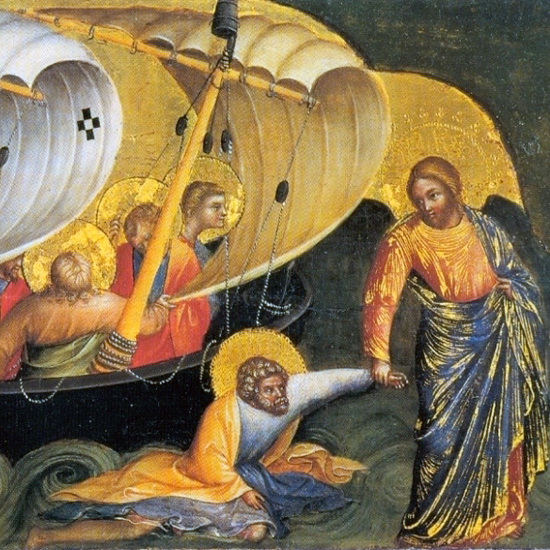
Peter Leaves the Boat
Jeffrey Holland is angry, nay, furious, at people who leave the LDS church.** It’s hard to ignore in the audio how bitter Holland sounds. It’s also impossible to ignore how deeply pained he is.
The anger Holland bellows at the guilty over the course of his impassioned, forty-five-minute sermon to a small crowd in Arizona a couple weeks ago feels rough and crumbling with deep, jagged hurt. Holland howls the howl of the marginalized and displaced, the cry of the person who cannot believe that no one listens. The folks at which he hurls his Irish ire know very well how stabbing-sharp it can be to realize that great crowds of people—family, friends, and loved ones—think you a fool.
The pain that clamps onto one’s heart when one sees that any of one’s lifelong community of faith would dismiss one as pointless, as a cypher, as not really mattering to the community’s shared identity, is fierce and sacred, and I feel compelled by what remains of my own humanity not to turn tighter, here, the screws that might make Holland’s pain yet more exquisite.
For the official record, then, I feel for Holland. I hear him. I hope he can find some peace. What follows is a rumination on how such fear and anger and vindictiveness arise in Mormondom, without, I hope, any judgment of Holland’s particular, pitiable condition.
Holland vents his rage in a story. A storm, Holland relates, comes up while Jesus and his buddies are out a-fishing. The buddies fear the boat is going to sink and Jesus steps in to send the storm away. Holland then hammers particular elements of the narrative into metaphors with which to build a particular conclusion.
The boat is the LDS church, for Holland. The storm is dissent inside the church and opposition to the church and its policies from without. The buddies are LDS folks who fear the positions the church has chosen to adopt, who fear that the crowd may be right, and who wonder if leaving the church now might not be the better path to the future. Stay in the boat, Holland cries. This storm will pass and you’ll find yourself safe.
But the story, the metaphor, that Holland chooses might say many very different things. Stories do not have meanings. Stories are only sequences of events (and, in some postmodern experiments, not even that) to which audiences impute meaning. The glorious thing about stories is that they open themselves up to a discovery of all sorts of meanings that can be complimentary, compatible, and even mutually exclusive. Stories reveal how complex, how full, life is, and how little power we have to determine it, for ourselves, much less for others.
So, Jesus and his buddies are in a boat. Certainly, other boats are on the same water and certainly the storm that arises suddenly threatens all of them. The calm that comes in the storm’s departure brings calm to each of the many boats on the freshwater sea, and to the many people gathered in them all.
One might just as well conclude that the moral of the story is: stay in any boat.
Anyway, the boat might not be so important to the story. It’s not that the boat brings an end to the storm. The boat is merely where they all happen to be when the storm comes up, and not the safest place to be in a storm, after all.
If safety is what the story values, the better conclusion would be: don’t ever get in a boat.
Besides, this boat story exists alongside several other boat stories. Given the language that Holland lets loose in his Arizona encyclical, we can easily imagine Jesus-buddies James and John, in another story, clinging to Peter’s sleeve and hissing, as the impetuous disciple climbs over the side, Stay in the boat! But over Peter goes, and off he walks on the tossing waves.
That is, taken together, Jesus stories certainly seem to tell us that sometimes getting out of the boat can be a really good thing, even when others’ fears plead otherwise.
For that matter, boats aren’t generally for hanging out. They’re vehicles that move us from one place to another, not the destinations themselves. Leave the boat when you arrive, or you never arrive at all. And lest the best metaphorical possibilities in boats and seas, together, be lost, note the kathâsaritsâgara, the title of a massive compendium of tales from medieval India: The Sea of Stories. The tales by which we know ourselves and each other is a vast ocean we sail over in our little vessels. Whatever the boat, wherever it’s going, it’s kept aloft and moving by tales, waving and washing, heaving all boats everywhere to their many several destinations.
Stories open up to a multiplicity of meanings, you see. They reveal worlds weird and wild in which we can imagine ourselves rehearsing for the hard, fast problems of real life, and we derive joy from the ways in which stories can guide us without commanding us.
The open worlds that stories offer have made stories the bedrock of religion. So dependent on stories are the multitude of religions that it’s no wonder that narrative tradition often features in definitions of what religion is. The peculiar capacity of stories to offer ends without capturing our agency, to show truth without labeling it, to help us find and to make ourselves, is so deliciously good that we ought to recognize it as the divine power that it is. The shapes that we discover in stories are our selves and what we can become, at the same time, and religion fails—we cause it to fail—when we work to determine what stories can say.
The pain that stabs at Holland’s soul, the same pain that needles so many LDS-Mormons and former LDS-Mormons, is the refusal of so many of us to acknowledge and to allow each others’ stories. The demand that has developed in Mormondom that so many stories can mean only what some special few say, and the insistence of so many that some stories cannot at all mean what some say, has nearly killed the divine potential of Mormonism’s rich and imaginative lore.
Worse, perhaps, is that we’ve turned stories into weapons. We know ourselves in the stories we own and that claim us. We are stories. Every demand we place on a story is a demand we place on another person, another wound we inflict on the very developing identities of our human fellows.
No wonder that so many on all sides are so furious. Holland, no less than everyone, cannot bear losing his stories. Surely some harm him with a fury to match his own, when they work to overturn his stories, for as his stories upend and sink, so sinks his own self, so neatly bound to them. Surely he harms some, with malice, when he tries to keep all stories for himself, for that jealous fear cuts the ropes by which some are tied to the only ship they know, the ship they’ve trusted to bear them to the far shore.
We’re all buoyed and held afloat by a sea of stories that laps and swirls around some little boats we think will save us, while, in fact, they separate us and keep us anxious strangers to each other. It may be that the storm on the face of the waters is not the thing to fear, but the safe, dry vessels that fool us that we aren’t all sustained by the same stuff.
Perhaps the best thing for humankind would be that we all throw ourselves over the gunwales and swim together in the great deep.
__________
* Image adapted from Lorenzo Veneziano’s “Christ Rescuing Peter”, https://commons.wikimedia.org/wiki/File:16_Lorenzo_Veneziano,_Christ_Rescuing_Peter_from_Drowning._1370_Staatliche_Museen,_Berlin..jpg
**I’m not an advocate for understanding people by way of sound bites, but one can get a quick sample of the relevant anger of this sermon, including Holland’s own deliberate use of the word furious to describe his feelings towards people who leave LDS-dom, at around 30′ in the audio/transcript.
Previous Post

April 25, 2016
"Letter to a CES Director" and Highlander Syndrome
Next Post
May 20, 2016 Religion's Placebo Effect(s)
Browse Our Archives
Select a Category Activism Aesthetics Art Atheism Bible Book of Mormon Christianity Freedom Games Guest Posts Hinduism Identity LDS Church Marriage Prayer Ritual Science Theatre Theism Toxic Theology
Select a Month August 2017 July 2017 June 2017 May 2017 March 2017 February 2017 January 2017 December 2016 November 2016 October 2016 September 2016 August 2016 July 2016 June 2016 May 2016 April 2016 March 2016 February 2016 January 2016 December 2015 November 2015 October 2015 September 2015 August 2015 July 2015 June 2015 May 2015 April 2015 March 2015 February 2015 January 2015 December 2014 November 2014 October 2014 September 2014
Follow Us!
TAKE THE
Religious Wisdom Quiz
Who saw a vision of four beasts coming out of the sea?
Select your answer to see how you score.
Ezekiel Amos Joel Daniel
Related posts from Aestheism


Toxic Theology: Learning Doesn't Matter


TRENDING AT PATHEOS Latter-day Saint

Did Prayer Cure His Cancer? Or Was It...
At 4 AM one morning, Joshua W. Brown’s wife awoke to a...

8 Ways a Near-Death Experience Rewires the Soul
Does Consciousness Survive Physical Death? After 50 Years of Research, Dr. Raymond...

Holy Longing: What Our Restlessness Is Telling Us
“One can find so many pains when the rain is falling.” -John...

What this is NOT about. This blog is definitely not about...

Who said the Israelites were God’s chosen? That’s right, they did. Who...

The Spirit World Is the Real World: God...
A Monk’s Wisdom on Body and Spirit I sit with Brother Martin...
view all Latter-day Saint blogs
Ad-Free & Subscriber Log-In Subscription Support
- About Us
- 2026 Calendar
- Videos
- Podcasts
- Library of World Religions
- Faith In Media Tracker
- Advertise With Us
- Write for Us
- Privacy Policy
- Terms of Service
- Do Not Sell My Data
- Contact Us
- Radiant Digital
- Manage Newsletter Subscriptions
- Unsubscribe From Notifications
- Sitemap
Copyright 2008-2026, Patheos. All rights reserved.
Subscription Support Ad-Free & Subscriber Log-In
Follow Patheos