
BuddhistCatholicContemplativeEvangelicalGeneral ChristianHinduJewishLatter-day SaintMuslimNew VisionsProgressive Christian
Beliefs
- Buddhist
- Catholic
- Contemplative
- Evangelical
- General Christian
- Hindu
- Jewish
- Latter-day Saint
- More Voices
- Muslim
- New Visions
- Pagan
- Progressive Christian
Topics
- Religion News
- Food and Religion
- Sports and Religion
- Religious Art
- Religious Music and Entertainment
- Religious Events
- History and Religion
- Style and Religion
- Politics and Religion
- Women in Religion
- Recreation Outdoors and Religion
- Business Finance and Religion
- Careers Workplace and Religion
- Education and Religion
- Family Parenting and Religion
- Health Fitness and Religion
- Home and Religion
- Relationships and Religion
- Technology and Religion
- Travel and Religion
Columnists
- Buddhist Columnists
- Business Finance and Religion Columnists
- Careers Workplace and Religion Columnists
- Catholic Columnists
- Contemplative Columnists
- Education and Religion Columnists
- Evangelists Columnists
- Family Parenting and Religion Columnists
- General Christian Columnists
- Health Fitness and Religion Columnists
- Hindu Columnists
- History and Religion Columnists
- Home and Religion Columnists
- Jewish Columnists
- More Voices Columnists
- Latter Day Columnists
- Muslim Columnists
- New Visions Columnists
- Nonreligious Columnists
- Pagan Columnists
- Politics and Religion Columnists
- Progressive Columnists
- Recreation Outdoors and Religion Columnists
- Relationships and Religion Columnists
- Religion News Columnists
- Religious Art Columnists
- Religious Events Columnists
- Religious Music and Entertainment Columnists
- Sports and Religion Columnists
- Style and Religion Columnists
- Technology and Religion Columnists
- Travel and Religion Columnists
- Women in Religion Columnists
Resource Library
- 2026 Calendar
- Library of World Religions
- The 100 Most Holy Places on Earth
- Patheos Answers
- Podcasts
- Videos
- Faith Leaders Database
- Anglican Episcopalian
- Bahai
- Baptist
- Buddhism
- Christianity
- Confucianism
- Eastern Orthodoxy
- Hinduism
- Holiness and Pentecostal
- ISKCON
- Islam
- Judaism
- Lutheran
- Methodist
- The Church of Jesus Christ of Latter-day Saints
- New Age
- Paganism
- Presbytarian and Reformed
- Protestantism
- Religion Behind the Scenes
- Roman Catholic
- Scientology
- Shia Islam
- Sikhism
- Sufism
- Sunni Islam
- Taoism
- Zen
- See all religions
Research Tools
 Ad-Free & Subscriber Log-In Subscription Support
Follow Patheos 

- Trending:
- Advent
- |
- Forgiveness
- |
- Thanksgiving
- |
- Election
- |
- Seasonal Holidays
- |
- Marriage
 Aestheism
- Home
- Latter-day Saint
- Eve and Adam and Reason in the Mormon Temple
Eve and Adam and Reason in the Mormon Temple
Last updated on: October 2, 2015 at 7:51 am by David Mason
Eve and Adam and Reason in the Mormon Temple 2015-10-02T07:51:35-05:00 David Mason
Patheos Explore the world's faith through different perspectives on religion and spirituality! Patheos has the views of the prevalent religions and spiritualities of the world.
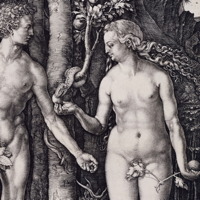
Dürer’s Eden
The fundamental myth of the Judeo-Christian tradition has a distinctly patriarchal tone to it, justifying all the chauvinism in the elaborate myth-making that follows from it. Eve and Adam, we are told by the tome, are placed in paradise, and then Eve ruins everything.
I’ve asserted before that Mormonism provides us with a promising revision of that story—an early nineteenth-century transmogrification that elevates Eve’s role in the affair. Never mind how the text that provides this revision came to be (not that this isn’t an interesting issue). Holy Mormon writ that dares to defy the Bible by adding to it tells us that The Fall is a good thing for everybody. For Mormonism, there’s no existence for the rest of us, without the choice that Eve makes. So, thank goodness she opted out of paradise.
It was a promising revision, back in the 1830’s. And it wasn’t without any effect. But LDS-Mormons have, perhaps, these days, mostly put behind them the most positive, the most progressive possibilities of the story.
In fact, LDS-Mormons get at least five versions—or partial versions—of the story of Eve and Adam, and have enshrined the most complete version in their holiest rites. The first two versions, of course, are everyone’s, as we get the Elohist and the Yahwist renditions in the first couple chapters of Genesis. The former seems a bit less masculinist than the latter, which insists—against the former—that Eve was made of a portion of Adam. It’s also the latter that pins the disaster on Eve.
LDS-Mormons also get versions from their Book of Moses and Book of Abraham. The latter doesn’t get as far as The Fall. The former lets Eve shout something like O Felix Culpa, and lets her explain that without her intervention, we’d all be in deep doo-doo.
The fifth LDS-Mormon version of the story is the most elaborate, and provides the spine for the sacred and exclusive rites of high LDS-Mormon culture. This version is rather a conundrum. The narrative leads to a participatory ceremony, in which, in the mode of Eve and Adam, LDS-Mormons commit to a life that will fix The Fall—ceremonial commitment that must live alongside the scriptural assertion that nothing was broken. Some LDS-Mormons have come to the conclusion that those commitments are so exploitative, so oppressive, and even so traumatic, that they can no longer go through the LDS-Mormon temple ceremonies. On this matter, see the ever-compelling series at feministmormonhousewives.
But the narrative itself—the story that leads to these commitments—does not anticipate the ferociously andro-centric character of the ceremony. Indeed, in some important ways, this version of the Judeo-Christian-Mormon foundation story stands at odds with what has become LDS-Mormonism’s dominant view of such notions as obedience to male authority.
Consider a scenario in which Eve makes a conscious decision to defy god by eating this presumptively forbidden fruit. Then, recognizing that she has put herself on the un-leavable path to mortality, she takes the fruit to Adam. He, of course, prophetic figure that he is, first says, No way. I’m obedient.
Rather than tricking him or manipulating him, imagine a scenario in which Eve articulates a perfectly logical rationale that Adam would be wise to eat and to follow her. I’m going that way, she says, and that’s how it’s got to be. You’re really going to mess things up if you sit here, by yourself, doing nothing at all, for obedience’s sake.
Imagine that Adam, the father of all, the patriarch of patriarchs, the prophet of his day, simply concedes to reason. No revelation, nor any evasive lamentation of the absence of it. No retreat into scripture. No citation of a handbook of instructions. Yep, he says to Eve, a woman with no authority, but with a perfectly good argument, you make a good point. Let’s do this thing.
This most elaborate of the LDS-Mormon Eve and Adam stories gives us a male authority who knows sound reasoning when he hears it, and who, because of sound reasoning, puts away his claim on permitting this or that action, so as to join the happy course of history that an otherwise-gendered person has set, brazenly and bravely, in motion.
That’s a remarkably encouraging revision of a story that has underwritten a lot of unnecessary misery in the world. It’s a story that indicates the promise that LDS-Mormonism may yet realize.
Previous Post

September 20, 2015
The Tao of Hula
Next Post
October 6, 2015 Who's at the Center? Who's in Crisis?
Browse Our Archives
Select a Category Activism Aesthetics Art Atheism Bible Book of Mormon Christianity Freedom Games Guest Posts Hinduism Identity LDS Church Marriage Prayer Ritual Science Theatre Theism Toxic Theology
Select a Month August 2017 July 2017 June 2017 May 2017 March 2017 February 2017 January 2017 December 2016 November 2016 October 2016 September 2016 August 2016 July 2016 June 2016 May 2016 April 2016 March 2016 February 2016 January 2016 December 2015 November 2015 October 2015 September 2015 August 2015 July 2015 June 2015 May 2015 April 2015 March 2015 February 2015 January 2015 December 2014 November 2014 October 2014 September 2014
Follow Us!
TAKE THE
Religious Wisdom Quiz
Why was it scandalous for the woman to anoint Jesus' feet with tears?
Select your answer to see how you score.
She was a child She was foreign She was wealthy She was a known sinner
Related posts from Aestheism
Utah: A Shining City on a Hill


TRENDING AT PATHEOS Latter-day Saint

Did Prayer Cure His Cancer? Or Was It...
At 4 AM one morning, Joshua W. Brown’s wife awoke to a...

8 Ways a Near-Death Experience Rewires the Soul
Does Consciousness Survive Physical Death? After 50 Years of Research, Dr. Raymond...

Holy Longing: What Our Restlessness Is Telling Us
“One can find so many pains when the rain is falling.” -John...

What this is NOT about. This blog is definitely not about...

Who said the Israelites were God’s chosen? That’s right, they did. Who...

The Spirit World Is the Real World: God...
A Monk’s Wisdom on Body and Spirit I sit with Brother Martin...
view all Latter-day Saint blogs
Ad-Free & Subscriber Log-In Subscription Support
- About Us
- 2026 Calendar
- Videos
- Podcasts
- Library of World Religions
- Faith In Media Tracker
- Advertise With Us
- Write for Us
- Privacy Policy
- Terms of Service
- Do Not Sell My Data
- Contact Us
- Radiant Digital
- Manage Newsletter Subscriptions
- Unsubscribe From Notifications
- Sitemap
Copyright 2008-2026, Patheos, part of the Radiant Digital network of media brands. All rights reserved.
Subscription Support Ad-Free & Subscriber Log-In
Follow Patheos