
BuddhistCatholicContemplativeEvangelicalGeneral ChristianHinduJewishLatter-day SaintMuslimNew VisionsProgressive Christian
Beliefs
- Buddhist
- Catholic
- Contemplative
- Evangelical
- General Christian
- Hindu
- Jewish
- Latter-day Saint
- More Voices
- Muslim
- New Visions
- Pagan
- Progressive Christian
Topics
- Religion News
- Food and Religion
- Sports and Religion
- Religious Art
- Religious Music and Entertainment
- Religious Events
- History and Religion
- Style and Religion
- Politics and Religion
- Women in Religion
- Recreation Outdoors and Religion
- Business Finance and Religion
- Careers Workplace and Religion
- Education and Religion
- Family Parenting and Religion
- Health Fitness and Religion
- Home and Religion
- Relationships and Religion
- Technology and Religion
- Travel and Religion
Columnists
- Buddhist Columnists
- Business Finance and Religion Columnists
- Careers Workplace and Religion Columnists
- Catholic Columnists
- Contemplative Columnists
- Education and Religion Columnists
- Evangelists Columnists
- Family Parenting and Religion Columnists
- General Christian Columnists
- Health Fitness and Religion Columnists
- Hindu Columnists
- History and Religion Columnists
- Home and Religion Columnists
- Jewish Columnists
- More Voices Columnists
- Latter Day Columnists
- Muslim Columnists
- New Visions Columnists
- Nonreligious Columnists
- Pagan Columnists
- Politics and Religion Columnists
- Progressive Columnists
- Recreation Outdoors and Religion Columnists
- Relationships and Religion Columnists
- Religion News Columnists
- Religious Art Columnists
- Religious Events Columnists
- Religious Music and Entertainment Columnists
- Sports and Religion Columnists
- Style and Religion Columnists
- Technology and Religion Columnists
- Travel and Religion Columnists
- Women in Religion Columnists
Resource Library
- 2026 Calendar
- Library of World Religions
- The 100 Most Holy Places on Earth
- Patheos Answers
- Podcasts
- Videos
- Faith Leaders Database
- Anglican Episcopalian
- Bahai
- Baptist
- Buddhism
- Christianity
- Confucianism
- Eastern Orthodoxy
- Hinduism
- Holiness and Pentecostal
- ISKCON
- Islam
- Judaism
- Lutheran
- Methodist
- The Church of Jesus Christ of Latter-day Saints
- New Age
- Paganism
- Presbytarian and Reformed
- Protestantism
- Religion Behind the Scenes
- Roman Catholic
- Scientology
- Shia Islam
- Sikhism
- Sufism
- Sunni Islam
- Taoism
- Zen
- See all religions
Research Tools
 Ad-Free & Subscriber Log-In Subscription Support
Ad-Free & Subscriber Log-In Subscription Support
Follow Patheos 

- Trending:
- Forgiveness
- |
- Marriage
- |
- Consciousness
- |
- Death Penalty
- |
- Election
- |
- Halloween
 Adventures in Eco-Mythology
- Home
- Pagan
- History and Religion
- Evidence of a cosmic egg dates back to Neanderthals and beyond
Evidence of a cosmic egg dates back to Neanderthals and beyond
Last updated on: February 22, 2023 at 11:31 pm by Ben H. Gagnon
Evidence of a cosmic egg dates back to Neanderthals and beyond 2023-02-22T23:31:08-05:00 Ben H. Gagnon
Patheos Explore the world's faith through different perspectives on religion and spirituality! Patheos has the views of the prevalent religions and spiritualities of the world.
It will come as no surprise that western scholarship has long overlooked symbols of female power, including the long cross-cultural history of the cosmic egg. But it takes willful blindness to ignore the abundant evidence of oval forms incorporated into sacred sites across cultures and eons of time.
Although no one knows what it was used for, the oldest structure in the historical record is an egg-shaped stone ring dating back 1.7 million years egg to the days of Homo erectus at Olduvai Gorge in Tanzania. Archaeologists found charred bones and Acheulean tools inside the ring.
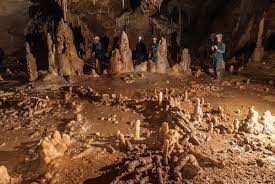
Bruniquel Cave. (Luc-Henri FageSSAC/Wikimedia Commons)
About 175,000 years ago, Neanderthals built an egg-shaped stone ring deep inside Bruniquel Cave in southern France, where they performed unknown rituals that included small fires on the ring, according to the May 2016 edition of Nature. An 18-member team concluded the site was only used for “symbolic” purposes, and was the oldest deep-cave example of human ritual activity.
And here’s the kicker – the egg-shaped rings at Olduvai Gorge (21 feet by 15 feet) and Bruniquel Cave (20 feet by 14 feet) are almost exactly the same size, certainly they feature the same 3/2 ratio of axes.
It’s not likely the measurements were handed down over almost two million years, but the ring-builders may have been imitating eggs they commonly observed in nature. The 3/2 ratio is a match for eggs laid by pheasants, hens, ducks, turkeys and other birds.
The Willendorf II Venus
The Gravettian culture of Moravia lived in oval homes about 31,000 years ago at Dolni Vestonice and again 4,000 years later at nearby Predmost, where a large elliptical burial pit contained the remains of 20 people. The most famous Gravettian artifact is the Willendorf II Venus, featuring enormous ovate hips and a huge egg-shaped belly.
Between 23,500-22,500 years ago, hunter-gatherers on the southern shores of the Sea of Galilee lived in six oval-shaped brush huts at what’s now the sprawling archaeological site, Ohalo II. Archaeologists are unsure of the purpose behind the many egg-shaped tortoise shells they found at Ohalo II, but the small shells were from Testudo graeca and Mauremys caspica, both sporting an egg-shaped carapace with a 3/2 ratio.
Megalithic eggs
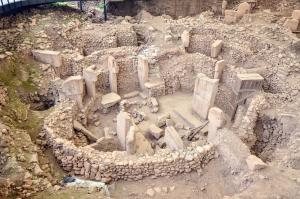
One of the egg-shaped enclosures at Göbekli Tepe. (Omeer/Shutterstock)
Scholars agree that ancient stone temples were typically designed to reflect the setting of creation. Despite the near-universal status of cosmic egg creation mythology, little attention has been paid to the many ovate forms found in numerous megaliths dating to the dawn of the Neolithic period.
The oldest megalithic temple in the world is Göbekli Tepe in eastern Turkey, dating back 11,500 years. Although a small portion has been excavated, it already looks like a giant nest filled with egg-shaped enclosures up to 100 feet across.
About 5,600 years ago on the Mediterranean island of Malta, the Mnajdra and Ġgantija temples featured more egg-shaped enclosures. Some scholars have suggested the two ovals in both temples were meant to appear from above as a Venus figurine with over-large breasts atop even larger hips.
On the northwest coast of France, the Scottish engineer Alexander Thom measured the 6,000-year-old Alignments at Menec, including 12 rows of standing stones leading up a hill to a large stone mound that he described simply as an “egg.” British archaeologist Aubrey Burl wrote that it’s inaccurate to use the phrase “stone ring” because “so many are not round but ovoid, egg-shaped.”
Built by hunter-gatherers across northwest Finland between 4,000 and 5,500 years ago, some Giant’s Churches were egg-shaped, including Kastelli Giant’s Church at 197 feet on the long axis and 115 feet across.
Incubating the soul
In ancient Egypt the sarcophagus was referred to as an “egg” where the soul rejuvenates, reflecting the belief that death was a temporary state not unlike incubation. It was the voice of the ibis-headed god Thoth that hatched the cosmic egg.
Around the world it’s common to find oval burial pits, often with the deceased in a fetal position. Egg-shaped ceramic vessels and/or decorated ostrich eggs were buried with the dead across ancient Mediterranean cultures.
Beginning about 2,700 years ago Egyptians began mummifying and burying nearly three million egg-shaped jars containing falcons and ibis in tombs up and down the Nile. The complex process gave birth to an entire industry that produced more than 1.75 million mummified falcons and ibis buried at Saqqara, just south of Cairo. Another million were entombed at Tuna El-Gebel in Middle Egypt.
Real ibis’ eggs were scattered among the egg-shaped jars containing the bird remains. A wooden statue of an ibis almost two feet from beak to tail contained a hidden section at the rear where X-rays revealed an oval cavity containing the remains of a mummified ibis.
Eggs, reincarnation & the winter solstice
Based on cross-cultural evidence, the sacred theater of the winter solstice once told a supernatural story of the reincarnation process, with eggs playing a starring role.
The metaphysical story began in late October, when people once gathered to bury the bones of the year’s dead and release their souls so migratory birds could fly them beyond the horizon to a sacred winter ground. The burial gatherings coincided with the fall departure of migratory birds.
Virtually all ancient megalithic structures aligned to the dawning sun on the winter solstice were built on the winter grounds of migratory birds, from Africa to Ireland and Cambodia. The stone temples featured a range of egg-shaped forms intended to receive the souls delivered by birds, where souls would heal and incubate until the winter solstice.
That’s when the first rays of the reborn sun quickened the incubating souls of the dead to reincarnation and new life. It was no coincidence that the winter solstice gatherings included an unusually high number of newborn infants and very pregnant women.
Nine months earlier around the spring equinox, early farming cultures from Mesopotamia to Egypt, Greece and Europe encouraged and condoned sexual intercourse as an act of sympathetic magic to evoke the universal power of fertility in planting season.
Spanning almost 5,000 years, the six sites explored below share the major elements of the mythic story: a location on the winter grounds of migratory birds, egg-shaped megaliths, a direct alignment to sunrise on the winter solstice – all constructed by cultures that believed in reincarnation.
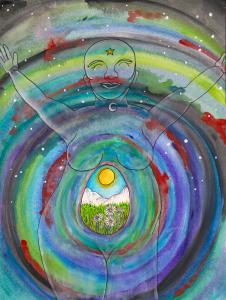
Rrepresentation of the cosmic egg. (Catherine Masters/wondrousmoonstudio.com)
Brú na Bóinne, Angkor Wat etc.
Whooper swans head southeast from Iceland every autumn to spend the winter in the Boyne Valley of County Meath, Ireland, where the 5,200-year-old ovate mound Brú na Bóinne welcomes the dawning solstice sun down a 60-foot passage and into a central chamber. Tens of thousands of smooth, egg-shaped, ‘river-rolled’ quartz stones were imported to the site as fill for the mound, like a nest of eggs.
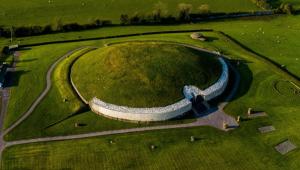
Brú na Bóinne in County Meath, Ireland. (ianmitchinson/Shutterstock)
Tonle Sap Lake in Cambodia is one of the largest wintering grounds for migratory birds in Southeast Asia. Just a few miles away at 900-year-old Angkor Wat, observers at a small temple can watch the winter solstice sun rise over the temple’s ovoid towers, which represent the metaphysical Mount Meru where Hindu souls reincarnate.
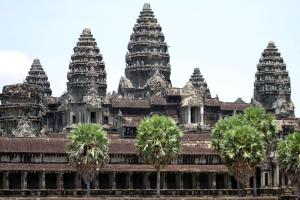
The ovoid towers of Angkor Wat represented the Mythical Mt/ Meru. (SAPhotog/Shutterstock)
The main feature of the 800-year-old Great Zimbabwe Ruins is the oval Great Enclosure, the largest prehistoric stone structure south of the Sahara, located near the convergence of three global bird flyways, a rare occurrence producing enormous avian populations. A 2002 study found that the three bright stars in Orion rise over three standing stone pillars on the morning of the winter solstice.
Ajanta Caves Buddha, The Great Serpent Mound etc.
In Maharashtra, India, the Ajanta Caves date back more than 2,000 years, located near the Jaikwadi Bird Sanctuary, a winter ground for about 30 species of migratory birds. On the winter solstice, the dawning sun shines into Cave 19 on a standing Buddha as he appears to emerge from an egg of polished white stone.
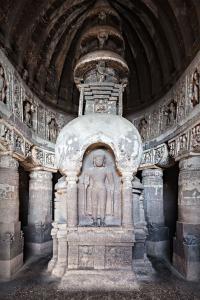
The dawning solstice sun shines into the Ajanta Caves and onto this Buddha, which appears to emerge from an egg. (Saiko3p/Shutterstock)
Dating back at least 1,000 years, the Great Serpent Mound in southeast Ohio is located where the Central and Atlantic Americas global bird migration flyways converge in a narrow corridor south of the Great Lakes. The serpent’s mouth stretches around an egg-shaped mound, perhaps the mythic bait in a metaphysical scheme to induce sacred birds to descend from the sky and engage with their nemesis the serpent, about to devour the egg. The serpent mound is aligned to the solstices and equinoxes.

Curves in The Great Serpent Moun in Ohio. (Superstar/Shutterstock)
Located where a route of the Pacific Americas Flyway makes landfall on the coast of northern Peru, the boundary line of the 2,400-year-old village of Chankillo was an oval stone ring. Above the village on a north-south running ridge are the Thirteen Towers of Chankillo, which align with both summer solstices. (Another half-dozen examples of the cosmic egg reincarnation theory and a lot more detail is contained in Church of Birds: An eco-history of myth and religion; see link to pre-order at the bottom of this column.)
Time to rebirth the cosmic egg
The conceptions of birth, death and the afterlife were all part of a story that unfolded with the sacred calendar, drawing upon the entire community in dramatic celebrations of the perpetual cycle of life, embodied in the cosmic egg.
While western scholarship was busy ignoring the evidence of cosmic eggs in megalithic architecture, the institutional church was rejecting and ridiculing the age-old concept of reincarnation. After all, female figures oversaw the whole operation.
From wailing women at funerals to the placing of eggs in tombs to a mother goddess conducting souls along the Milky Way, the reincarnation process was once managed entirely by nurturing female figures. The vultures and whooper swans that conducted souls to the afterlife were believed to be all female, conceiving by miraculous and mysterious means.
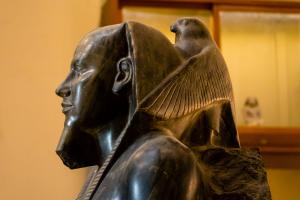
Pharaoh Khafre with Horus the falcon. (Andrej Privizer/Shutterstock)
There was profound power in overseeing the afterlife, which once involved a great deal of karmic negotiation and re-balancing overseen by various gods, often shown with wings. In ancient Egypt the falcon god Horus oversaw and ensured the continuity of the royal family, as did other bird species in other cultures.
Apart from being a truly ancient symbol, the cosmic egg was crucially important, amazingly widespread and stubbornly persistent over time. The evidence is not difficult to find, suggesting just how deep the biases of western scholarship have run against the symbols of female power.
Today a more accurate education about our shared ancient past is badly needed in the ongoing challenge to re-balance the genders.
(Ben H. Gagnon is an award-winning journalist and author of Church of Birds: An Eco-History of Myth and Religion, coming March 2023 from John Hunt Publishing, now available for pre-order. More information can be found at this website, which links to a YouTube video.)
New Visions
Religion News
Previous Post

February 19, 2023
The lost art of soul flight: A tour of ancient beliefs
Next Post
February 26, 2023 The agony and ecstasy of the urban storm god
Recent Comments
Browse Our Archives
Select a Category contemplative History New Visions Pagan Progressive Christian Uncategorized
Select a Month June 2023 May 2023 April 2023 March 2023 February 2023 January 2023 December 2022
Follow Us!
TAKE THE
Religious Wisdom Quiz
Who did God call to lead the Israelites out of Egypt?
Select your answer to see how you score.
Aaron Joseph David Moses
Related posts from Adventures in Eco-Mythology
In Greece, Petralona Cave may be oldest sacred...
In the Arctic, a 2,500-year-old Greek myth is...

The ancient religious meaning of volcanoes, from Persia...
Evidence shows ape-human hybrids evolved on bird migration...
TRENDING AT PATHEOS Pagan

I was recently chatting with someone on Instagram. She asked me what...

While there are many people who share their results, the end of...

On July 23, I saw Christopher Nolan's The Odyssey which is Homer’s...

As I write this two big events have just finished up. One...

Restoring the Watershed of Divine Love
Perhaps cooperation is not something we manufacture through legislation, ideology, or moral...

Many UUs don’t pray because of bad experiences in a previous religion,...
view all Pagan blogs
Ad-Free & Subscriber Log-In Subscription Support
- About Us
- 2026 Calendar
- Videos
- Podcasts
- Library of World Religions
- Faith In Media Tracker
- Advertise With Us
- Write for Us
- Privacy Policy
- Terms of Service
- Do Not Sell My Data
- Contact Us
- Radiant Digital
- Manage Newsletter Subscriptions
- Unsubscribe From Notifications
- Sitemap
Copyright 2008-2026, Patheos. All rights reserved.
Subscription Support Ad-Free & Subscriber Log-In
Follow Patheos