
BuddhistCatholicContemplativeEvangelicalGeneral ChristianHinduJewishLatter-day SaintMuslimNew VisionsProgressive Christian
Beliefs
- Buddhist
- Catholic
- Contemplative
- Evangelical
- General Christian
- Hindu
- Jewish
- Latter-day Saint
- More Voices
- Muslim
- New Visions
- Pagan
- Progressive Christian
Topics
- Religion News
- Food and Religion
- Sports and Religion
- Religious Art
- Religious Music and Entertainment
- Religious Events
- History and Religion
- Style and Religion
- Politics and Religion
- Women in Religion
- Recreation Outdoors and Religion
- Business Finance and Religion
- Careers Workplace and Religion
- Education and Religion
- Family Parenting and Religion
- Health Fitness and Religion
- Home and Religion
- Relationships and Religion
- Technology and Religion
- Travel and Religion
Columnists
- Buddhist Columnists
- Business Finance and Religion Columnists
- Careers Workplace and Religion Columnists
- Catholic Columnists
- Contemplative Columnists
- Education and Religion Columnists
- Evangelists Columnists
- Family Parenting and Religion Columnists
- General Christian Columnists
- Health Fitness and Religion Columnists
- Hindu Columnists
- History and Religion Columnists
- Home and Religion Columnists
- Jewish Columnists
- More Voices Columnists
- Latter Day Columnists
- Muslim Columnists
- New Visions Columnists
- Nonreligious Columnists
- Pagan Columnists
- Politics and Religion Columnists
- Progressive Columnists
- Recreation Outdoors and Religion Columnists
- Relationships and Religion Columnists
- Religion News Columnists
- Religious Art Columnists
- Religious Events Columnists
- Religious Music and Entertainment Columnists
- Sports and Religion Columnists
- Style and Religion Columnists
- Technology and Religion Columnists
- Travel and Religion Columnists
- Women in Religion Columnists
Resource Library
- 2026 Calendar
- Library of World Religions
- The 100 Most Holy Places on Earth
- Patheos Answers
- Podcasts
- Videos
- Faith Leaders Database
- Anglican Episcopalian
- Bahai
- Baptist
- Buddhism
- Christianity
- Confucianism
- Eastern Orthodoxy
- Hinduism
- Holiness and Pentecostal
- ISKCON
- Islam
- Judaism
- Lutheran
- Methodist
- The Church of Jesus Christ of Latter-day Saints
- New Age
- Paganism
- Presbytarian and Reformed
- Protestantism
- Religion Behind the Scenes
- Roman Catholic
- Scientology
- Shia Islam
- Sikhism
- Sufism
- Sunni Islam
- Taoism
- Zen
- See all religions
Research Tools
 Ad-Free & Subscriber Log-In Subscription Support
Follow Patheos 

- Trending:
- Advent
- |
- Forgiveness
- |
- Thanksgiving
- |
- Election
- |
- Seasonal Holidays
- |
- Marriage
 Adventures in Eco-Mythology
- Home
- Pagan
- History and Religion
- Welcome to the ‘Church of Birds’ in three episodes
Welcome to the ‘Church of Birds’ in three episodes
Last updated on: March 15, 2023 at 1:12 am by Ben H. Gagnon
Welcome to the ‘Church of Birds’ in three episodes 2023-03-15T01:12:21-04:00 Ben H. Gagnon
Patheos Explore the world's faith through different perspectives on religion and spirituality! Patheos has the views of the prevalent religions and spiritualities of the world.
Towards the end of my slim novel of historical fiction, People of the Flow (2019, Beacon Publishing Group), the characters discover that ancient temples in Ireland and India aligned to dawn on the winter solstice were built on the wintering ground of migratory birds.
After finishing the novel I continued to find more solstice-aligned temples located on the wintering grounds of migratory birds, enough to be sure the connection was no coincidence. The result is the nonfiction Church of Birds: an eco-history of myth and religion, coming out March 31 in the UK and April 1 in the U.S., from Moon Books, an imprint of John Hunt Publishing in London.
Moon Books produced a video on the major themes of the book from a script and images I submitted in Powerpoint format, and as a former documentary producer I’m happy to say they did an excellent job, helped along by incredible artwork from Catherine Masters, whose work is at wondrousmoonstudio.com. A link to the Church of Birds video is here.
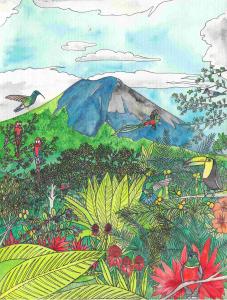
A mythical Garden of Eden. (Catherine Masters/wondrousmoonstudio)
Setting the scene
The foundation of the Church of Birds is the ancient landscape where fossils from every species of the genus Homo can be found – prime bird habitat. Overlaying bird migration maps from BirdLife International onto a map of the human fossil record shows our distant ancestors followed the busiest bird migration corridors and settled on their largest wintering grounds.
Following migratory bird routes was a Darwinian adaptation that improved the chances of survival on extended treks. First, bird migration routes don’t stray far from fresh water and fertile ecosystems with plentiful resources. Second, bird alarm calls warn of dangerous predators nearby. Third, the scattering behavior of birds is an indicator that dangerous weather is on the way, even without visible signs. Finally, birds and their eggs make for nutritious meals.
In the company of birds the human trekker was more likely to find fresh water and food while enjoying a 24/7 security system that warned of predators and cataclysmic storms. Those who didn’t follow busy bird routes were more likely to die of thirst, hunger, predators or sudden floods.
Discovering ancient landscapes
Using Google Earth to take a look at archaeological sites where the fossils and tools of the Homo genus were found, I kept coming across the same landscape – serpentine rivers draining from volcanic mountains into valleys below.
As I magnified Google Earth to focus on one site after another, it was uncanny how often the same snaky rivers appeared It also became clear that remains of human habitation were found in three places: 1) where two rivers met, 2) inside a sharp river bend or 3) at an elevated site with a view of the entire river system, often featuring a cave.
While writing Church of Birds I moved to a rural area next to a serpentine river and immediately noticed a wide variety of birds, including a bald eagle, lots of vultures, big crows, turkeys etc. It hit home how much food is concentrated in areas where rivers form tight bends, geometrically increasing the acre-feet of riverbank. It also would have been convenient for our distant ancestors to flush and trap deer in one of those U-shaped bends – you could clean up the carcasses in the river.

The Ubeidiya archaeolgical site.
Indeed, Homo erectus butchered hippos and wild cows inside a large bend of the Jordan River at the Ubeidiya archaeological site just south of the Sea of Galilee. Ubeidiya is located in the only active volcanic region of Israel, a country that ranks first in the world with 500 million migratory birds passing through each year. The extreme migratory bird population is due to Israel’s location at the junction of three continents and the convergence of two heavily travelled bird flyways.
The World Tree as a map
I’ve always been a fan of the world tree concept, with its roots reaching down to sacred springs and its high branches tickling the Milky Way. The iconic motif of the world tree features a bird or birds in its branches and around the base a great serpent, a common symbol for rivers across ancient and indigenous cultures.
Looking at these ancient human landscapes on Google Earth it became clear the world tree wasn’t just an abstraction, it was a map of our ancestral home – we lived along serpentine rivers in areas with high populations and a wide diversity of bird species.

A depiction of the world tree. (Catherin Masters/wondrousmoonstudio)
Every world tree was chosen for its nutritional and medicinal properties and was often associated with female goddesses providing milky drinks made from hazel or almond nuts, or from the sycamore or sacred fig. Sounds like the Garden of Eden, but one where snakes are a symbol of water and the bountiful life it supports.
Everything up to this point is covered in the first episode of the video – establishing the basic parameters of the Church of Birds. Walking in the leather shoes of a hunter-gatherer, I wondered what they must have thought every year when winter approached and 80 percent of the bird population took off to follow the sun. They knew the birds would return as they did every year, but must have wondered where they spent the other six months of the year.
Imagining paradise
The question of where birds went for the winter must have been a subject of conversation around the campfire as the first snow fell. Those birds are lucky, they can follow the sun and escape this cold. Wherever they went it must be warm!
Is it a coincidence that from the Irish Tír na nÓg to Buddha’s Nandana Grove, so many visions of paradise are of a sunny garden filled with vegetation and singing birds? The second episode in the video explores the widespread belief that birds were agents of the sun and one of their tasks was to carry human souls to a heavenly afterlife. Of all the categories of bird mythology – and there are many – birds playing the role of soul guide is the most widespread. It shouldn’t be a surprise after all, considering virtually every cultures identifies heaven with the afterlife and … how else is a soul supposed to get there?
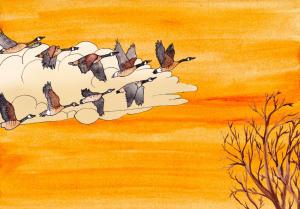
Migrating geese. (Catherine Masters/wondrousmoonstudio)
The video covers several examples of soul flight but the book has many more. I thought it was important to show the cross-racial and cross-cultural nature of these beliefs, and how long they persisted. The most fascinating examples are given their due space, followed by dozens of one- or two-sentence bullets that are there for the reading or to skip over if you’ve got the point already.
Sacred theater of the winter solstice
Against the backdrop of wintering waterfowl and enormous megalithic temples gleaming with quartz and hammered gold, the sacred theater of the winter solstice in the Neolithic era told a supernatural story of the afterlife, of what happens between death and rebirth.
The plot went something like this: In late October, migratory birds carry away the souls of the year’s dead, flying beyond the horizon to a sacred wintering ground. The birds deliver the souls to a temple that is egg-shaped itself or has egg-shaped design features, as a safe place for the souls to incubate and prepare for rebirth on hallowed grounds.
The climax of this ancient metaphysical plot occurred at the moment of dawn on the winter solstice, when the rays of the re-birthing sun quickened the incubating souls to their own reincarnation. An unusually high number of pregnant women at full term were in attendance, having conceived nine months earlier during festivals that encouraged sexual intercourse as part of spring ‘planting’ season. These were the ready vessels for reincarnated souls. Several examples of this metaphysical sacred theater are given in the video with more in the book.
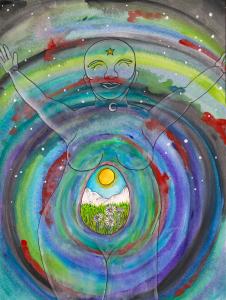
Rrepresentation of the cosmic egg. (Catherine Masters/wondrousmoonstudio.com)
A celestial mirror
The celebration of the winter solstice was not confined to the earthly realm, as the third and final episode of the video demonstrates.
It’s long been a consensus of scholars that virtually every ancient and indigenous culture sees a mirror world in the heavens, a concept first popularized in Heaven’s Mirror: Quest for the Lost Civilization (1998, Three Rivers Press), by Graham Hancock and Santha Faiia.
In the case of the winter solstice, the Finnish epic Kalevela contains the most literal description of the soul’s afterlife journey to the heavenly celestial pole, a journey shared across dozens of other cultures. The Kalevela describes sw Finnihans flying souls of the dead to a warm place beyond the horizon and then up the Milky Way, known as Linnunrata or Path of the Birds.
As the soul-bearing swans approach the northern celestial pole, a swirling wind caused by the turning bowl of the sky pulls them out through a small hole to a heavenly land of rest called Tuonela. Ultimately the swans complete their round-trip migration and return the healed and rejuvenated ‘new’ souls to pregnant mothers on Earth.
The video shows the concept of bird-enabled celestial soul flight appearing in a variety of forms across more than a dozen cultures around the world over at least 4,000 years. Again there are more examples in the book.
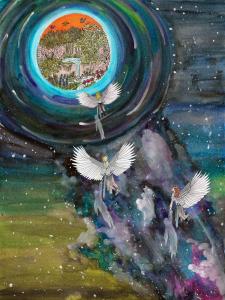
The Milky Way migration. (Catherine Masters/wondrousmoonstudio.com)
A sobering outlook
Although Church of Birds was a joy to research and write, it comes at a time when humanity is steadily decimating bird populations around the world. It’s my hope that greater knowledge about how important birds were in our own evolution will draw more attention to their current plight.
Our distant ancestors would stand in horrified judgment at humanity’s utter disrespect for birds, the very creatures who led us around the world to discover one Garden of Eden after another, and who were entrusted with the care of our immortal souls. Environmental activists say it’s not too late to reverse the trends, but the clock is ticking.
Hope is the thing with feathers – That perches in the soul – And sings the tune without the words – And never stops – at all … – Emily Dickinson
(Ben H. Gagnon is an award-winning journalist and author of Church of Birds: an eco-history of myth and religion, coming March 31, 2023 from John Hunt Publishing, now available for pre-order. More information can be found at this website, which links to a YouTube video.)
New Visions
Previous Post

March 11, 2023
Spiritual meaning of lightning strike at Marley's One Love Concert
Next Post

March 20, 2023 Seashells found in the mountains inspired myths of a world ocean
Recent Comments
Browse Our Archives
Select a Category contemplative History New Visions Pagan Progressive Christian Uncategorized
Select a Month June 2023 May 2023 April 2023 March 2023 February 2023 January 2023 December 2022
Follow Us!
TAKE THE
Religious Wisdom Quiz
What sound did God send to confuse Philistines when Israel was under attack?
Select your answer to see how you score.
Thunder Earthquake Singing Horses
Related posts from Adventures in Eco-Mythology
In Greece, Petralona Cave may be oldest sacred...
In the Arctic, a 2,500-year-old Greek myth is...

The ancient religious meaning of volcanoes, from Persia...
Evidence shows ape-human hybrids evolved on bird migration...
TRENDING AT PATHEOS Pagan

To help with the upcoming holiday season, I'm introducing the Holiday Helper...

10 years of the Power Sigil & Moving...
Last week while reorganizing my studio space, I found the sketchbook that...

Why are younger seekers drawn to Paganism and...
One of the things I've noticed the most is that I'm far...

When we talk about Greek religion, we often begin with the dodekatheion—the...

I was recently chatting with someone on Instagram. She asked me what...

On July 23, I saw Christopher Nolan's The Odyssey which is Homer’s...
view all Pagan blogs
Ad-Free & Subscriber Log-In Subscription Support
- About Us
- 2026 Calendar
- Videos
- Podcasts
- Library of World Religions
- Faith In Media Tracker
- Advertise With Us
- Write for Us
- Privacy Policy
- Terms of Service
- Do Not Sell My Data
- Contact Us
- Radiant Digital
- Manage Newsletter Subscriptions
- Unsubscribe From Notifications
- Sitemap
Copyright 2008-2026, Patheos, part of the Radiant Digital network of media brands. All rights reserved.
Subscription Support Ad-Free & Subscriber Log-In
Follow Patheos