
BuddhistCatholicContemplativeEvangelicalGeneral ChristianHinduJewishLatter-day SaintMuslimNew VisionsProgressive Christian
Beliefs
- Buddhist
- Catholic
- Contemplative
- Evangelical
- General Christian
- Hindu
- Jewish
- Latter-day Saint
- More Voices
- Muslim
- New Visions
- Pagan
- Progressive Christian
Topics
- Religion News
- Food and Religion
- Sports and Religion
- Religious Art
- Religious Music and Entertainment
- Religious Events
- History and Religion
- Style and Religion
- Politics and Religion
- Women in Religion
- Recreation Outdoors and Religion
- Business Finance and Religion
- Careers Workplace and Religion
- Education and Religion
- Family Parenting and Religion
- Health Fitness and Religion
- Home and Religion
- Relationships and Religion
- Technology and Religion
- Travel and Religion
Columnists
- Buddhist Columnists
- Business Finance and Religion Columnists
- Careers Workplace and Religion Columnists
- Catholic Columnists
- Contemplative Columnists
- Education and Religion Columnists
- Evangelists Columnists
- Family Parenting and Religion Columnists
- General Christian Columnists
- Health Fitness and Religion Columnists
- Hindu Columnists
- History and Religion Columnists
- Home and Religion Columnists
- Jewish Columnists
- More Voices Columnists
- Latter Day Columnists
- Muslim Columnists
- New Visions Columnists
- Nonreligious Columnists
- Pagan Columnists
- Politics and Religion Columnists
- Progressive Columnists
- Recreation Outdoors and Religion Columnists
- Relationships and Religion Columnists
- Religion News Columnists
- Religious Art Columnists
- Religious Events Columnists
- Religious Music and Entertainment Columnists
- Sports and Religion Columnists
- Style and Religion Columnists
- Technology and Religion Columnists
- Travel and Religion Columnists
- Women in Religion Columnists
Resource Library
- 2026 Calendar
- Library of World Religions
- The 100 Most Holy Places on Earth
- Patheos Answers
- Podcasts
- Videos
- Faith Leaders Database
- Anglican Episcopalian
- Bahai
- Baptist
- Buddhism
- Christianity
- Confucianism
- Eastern Orthodoxy
- Hinduism
- Holiness and Pentecostal
- ISKCON
- Islam
- Judaism
- Lutheran
- Methodist
- The Church of Jesus Christ of Latter-day Saints
- New Age
- Paganism
- Presbytarian and Reformed
- Protestantism
- Religion Behind the Scenes
- Roman Catholic
- Scientology
- Shia Islam
- Sikhism
- Sufism
- Sunni Islam
- Taoism
- Zen
- See all religions
Research Tools
 Ad-Free & Subscriber Log-In Subscription Support
Follow Patheos 

- Trending:
- Advent
- |
- Forgiveness
- |
- Thanksgiving
- |
- Election
- |
- Seasonal Holidays
- |
- Marriage
 Adventures in Eco-Mythology
- Home
- Pagan
- History and Religion
- The spiritual experience of clouds across religions
The spiritual experience of clouds across religions
Last updated on: March 10, 2023 at 2:22 pm by Ben H. Gagnon
The spiritual experience of clouds across religions 2023-03-10T14:22:48-05:00 Ben H. Gagnon
Patheos Explore the world's faith through different perspectives on religion and spirituality! Patheos has the views of the prevalent religions and spiritualities of the world.
Contemplative writers and artists across religious traditions have used cloud imagery to describe a personal connection to god. The formless cloud is a meditative model for Contemplative Christians, Daoists, Buddhists, Hindus, Sufis, Transcendentalists and others.
Written by an anonymous English monk in the 14th century, The Cloud of Unknowing used clouds as a metaphor for getting closer to God: “(We need) a cloud of forgetting between us and the whole created world.”
The book is intended to be a journey away from all things familiar; abandoning all thought and reason, embracing blankness and nothingness, entering the cloud of unknowing. One practice described in the book has been linked to the Zen meditation technique of the mantra.
The Cloud of Unknowing advises the reader to “Take a short word … being like the working of the spirit … fix this word fast to your heart so that it is always there come what may. … With this word you will hammer the darkness above you … you will suppress all thought. … if ever you are tempted to think what it is you are seeking, this one word will be sufficient answer.”
Cynthia Bourgeualt, founding director of The Contemplative Society and author of Centering Prayer and Inner Awakening, told me in a phone interview The Cloud of Unknowing was a very early attempt to conjure physiological changes in the brain through contemplative practice.
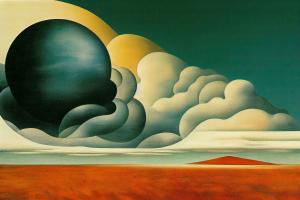
Clouds in the surrealist style. (Cassette Bleue/Shutterstock)
Altered states
“The word you repeat becomes a placeholder for attention, to keep the mind from the multiplicity and maze of thinking but ultimately it’s only a stepping stone towards abandoning all thought,” Bourgeault said. “Our normal every-day faculties cannot comprehend the infinite. Anything you rest your mind on becomes an object. To keep the mind completely from objects of attention unlocks the physiological non-dual consciousness.
“The symbol of the cloud as blankness and nothingness is a way of expressing a state of non-dual consciousness,” Bourgeault continued. “There is nothing for the mind to attach to. You are looking for a diffuse awareness, an object-less awareness, tuning down your faculties to move in more subtle fields of intelligence, to give our spiritual faculties a chance to perceive … ”
Across religions and cultural traditions over the centuries, clouds have been a symbol of the spiritual experience.

A cumulonimbus cloud (David Kratschmann/Wikimedia Commons)
A 2,200-year-old compendium of Taoist knowledge, The Essential Huainanzi, covers similar spiritual territory: “When (water vapor) ascends into the heavens … it dissolves into the realms of the Formless … When the mind is inalterably expansive, it achieves the perfection of tranquility.”
In Awakening: A Sufi Experience, author Pir Vilayat Inayat Khan wrote of the spiritual effects of a late-night thunderstorm: “ … I observed the dark clouds and heard the thunderclaps gradually receding into the distance, swept away by a raging wind. As if in sympathetic resonance, my consciousness began to melt away, scattering into an infinite, edge-less Universe.”
Finding god in a summer storm
The Hindu philosopher and statesman Sarvepalli Radhakrishnan wrote in his essay “The Religious Experience”: “It is a condition of consciousness in which feelings are fused, ideas melt into one another, boundaries broken and ordinary distinctions transcended. Past and present fade away in a sense of timeless being. … ”
A Buddhist prayer calls upon clouds for spiritual sustenance: “O holy perfect lama, in the sky of the truth body, gather your clouds of love and wisdom, and pour down upon the land of deserving disciples the great rains of the profound and magnificent Dharma!”
Over time, repeated spiritual experiences tend to instill in people the widespread religious belief that the material plane is a honey-trap, a place where it’s all too tempting to indulge emotional hunger by satisfying transitory desires.
“From the vantage point of altered states of consciousness … we suddenly see the experience of human life as so precious, rare and poignant that we feel ashamed for having let ourselves be consumed by petty grudges and fleeting temptations,” wrote Khan.
In New England, the Transcendentalists and Unitarians consumed every new translation of Eastern religious texts as they became available in the 19th century.
Minister and chief spokesman for New England Unitarianism William Ellery Channing (1780-1842) wrote of finding god in a summer storm.
“Take, for example, the delight which we find in the … immensity of the heavens and the ocean, and especially in the rush and roar of mighty winds, waves and torrents when, amidst our deep awe, a power within seems to respond to the omnipotence around it.”

Clouds at dawn. (Roman Mikhailiuk/Shutterstock)
Ethereal clouds in Romantic poetry
Published in 1789, The Book of Thel was written and illustrated by William Blake, including a philosophical Cloud character with oratorical powers who tries to cheer up a young girl (Thel) upset that her youth will one day fade. The Cloud explains that the universe is a beautiful symphony of interdependence that never ends.
“‘O maid I tell thee, when I pass away it is to tenfold life, to love, to peace, and raptures holy; unseen descending, weigh my light wings upon balmy flowers; and court the fair-eye dew …’”
Blake and the later Romantics saw the beauty of nature as the perpetual manifestation of a creative and energetic spirit that was present in all things. The following excerpt from “The Cloud,” by Percey Bysse Shelley, portrays clouds as every-changing, but never dying.
I am the daughter of Earth and Water,
and the nursling of the Sky;
I pass through the pores of the ocean and shores;
I change, but I cannot die.
Like a child from the womb,
like a ghost from the tomb,
I arise and unbuild it again.

Surrealist art inspired by Salvador Dali. (Cassette Bleue/Shutterstock)
Surrealist clouds
After the horrors of World War I, Romantic poetry went out of style but soon enough clouds were back in the art world, used by surrealist painters to conjure an altered state of consciousness.
Salvador Dali painted hallucinatory clouds as part of his goal to break down the outward forms of ordinary objects, creating a state of mind that can no longer assign a name to what it’s seeing. Conversely René Magritte painted normal-looking clouds in otherwise bizarre tableaus, mixing tranquility and chaos to provide a glimpse of what Magritte called “inner mystery.” He believed “all people are driven to a greater or lesser degree to escape from the prevailing order.” As the forms of familiar things begin to break down, Magritte once said, they “shriek aloud.”
Salvador Dali once attended an exhibition in a diving suit to reflect his interest in the subconscious. He was compelled by art that “… can neither be explained nor reduced by logical systems or rational approaches.”
Six hundred years after The Cloud of Unknowing, Dali and Magritte used cloud imagery to break down the overactive discriminating mind that identifies subjects and objects, causes and effects, to aim instead for an altered state of consciousness. Even for just a moment.
The divine spark
Immanence is a word not often used in daily conversation, but its meaning has roots in most religious traditions – there’s an energetic presence in all things, at all times.
In the extra-canonical Gospel of Thomas, Jesus said, “ …the Kingdom of God is inside of you, and it is outside of you. … Split a piece of wood, and I am there. Lift a stone, and you will find me there.”
Sufi doctrine states that a divine essence recreates the entire material world in every millisecond. Mormons believe all material creation has a divine spark within it. A similar concept is found in the West African Yoruba religion and the related Orisa religion in the Caribbean.
“Alive all around you and inside of you is the sacred energy of the Supreme Being … no being, place or thing, visible or invisible, living or inanimate, is without holiness,” wrote Tobe Melora Correal in Finding Soul on the Path of Orisa: A West African Spiritual Tradition.
Perhaps the religious experience is a glimpse of the divine spark, between the milliseconds. A spiritual experience is usually intense and relatively short. Many return from the spiritual plane with a vaguely blissful feeling and a funny little smile. Artists are driven to capture the experience in words, music, painting or sculpture, to get back, somehow, to that ephemeral state of being.
“Like the inevitable swing of the pendulum, consciousness cannot remain in sublime transcendence … the seeker does not return empty-handed, but emanating the exotic perfume of his or her spiritual realization,” wrote Khan.
(Ben H. Gagnon is an award-winning journalist and author of Church of Birds: an eco-history of myth and religion, coming March 2023 from John Hunt Publishing, now available for pre-order. More information can be found at this website, which links to a YouTube video.)
Contemplative
Recreation, Outdoors and Religion
Previous Post

March 4, 2023
Vessels of soul travel between lifetimes: A cross-cultural review
Next Post

March 11, 2023 Spiritual meaning of lightning strike at Marley's One Love Concert
Recent Comments
Browse Our Archives
Select a Category contemplative History New Visions Pagan Progressive Christian Uncategorized
Select a Month June 2023 May 2023 April 2023 March 2023 February 2023 January 2023 December 2022
Follow Us!
TAKE THE
Religious Wisdom Quiz
What was primary method of land transfer?
Select your answer to see how you score.
Written deed Witness testimony Verbal agreement Oath
Related posts from Adventures in Eco-Mythology
In Greece, Petralona Cave may be oldest sacred...

In the Arctic, a 2,500-year-old Greek myth is...

The ancient religious meaning of volcanoes, from Persia...

Evidence shows ape-human hybrids evolved on bird migration...
TRENDING AT PATHEOS Pagan

To help with the upcoming holiday season, I'm introducing the Holiday Helper...

10 years of the Power Sigil & Moving...
Last week while reorganizing my studio space, I found the sketchbook that...

Why are younger seekers drawn to Paganism and...
One of the things I've noticed the most is that I'm far...

When we talk about Greek religion, we often begin with the dodekatheion—the...

I was recently chatting with someone on Instagram. She asked me what...

On July 23, I saw Christopher Nolan's The Odyssey which is Homer’s...
view all Pagan blogs
Ad-Free & Subscriber Log-In Subscription Support
- About Us
- 2026 Calendar
- Videos
- Podcasts
- Library of World Religions
- Faith In Media Tracker
- Advertise With Us
- Write for Us
- Privacy Policy
- Terms of Service
- Do Not Sell My Data
- Contact Us
- Radiant Digital
- Manage Newsletter Subscriptions
- Unsubscribe From Notifications
- Sitemap
Copyright 2008-2026, Patheos, part of the Radiant Digital network of media brands. All rights reserved.
Subscription Support Ad-Free & Subscriber Log-In
Follow Patheos