
BuddhistCatholicContemplativeEvangelicalGeneral ChristianHinduJewishLatter-day SaintMuslimNew VisionsProgressive Christian
Beliefs
- Buddhist
- Catholic
- Contemplative
- Evangelical
- General Christian
- Hindu
- Jewish
- Latter-day Saint
- More Voices
- Muslim
- New Visions
- Pagan
- Progressive Christian
Topics
- Religion News
- Food and Religion
- Sports and Religion
- Religious Art
- Religious Music and Entertainment
- Religious Events
- History and Religion
- Style and Religion
- Politics and Religion
- Women in Religion
- Recreation Outdoors and Religion
- Business Finance and Religion
- Careers Workplace and Religion
- Education and Religion
- Family Parenting and Religion
- Health Fitness and Religion
- Home and Religion
- Relationships and Religion
- Technology and Religion
- Travel and Religion
Columnists
- Buddhist Columnists
- Business Finance and Religion Columnists
- Careers Workplace and Religion Columnists
- Catholic Columnists
- Contemplative Columnists
- Education and Religion Columnists
- Evangelists Columnists
- Family Parenting and Religion Columnists
- General Christian Columnists
- Health Fitness and Religion Columnists
- Hindu Columnists
- History and Religion Columnists
- Home and Religion Columnists
- Jewish Columnists
- More Voices Columnists
- Latter Day Columnists
- Muslim Columnists
- New Visions Columnists
- Nonreligious Columnists
- Pagan Columnists
- Politics and Religion Columnists
- Progressive Columnists
- Recreation Outdoors and Religion Columnists
- Relationships and Religion Columnists
- Religion News Columnists
- Religious Art Columnists
- Religious Events Columnists
- Religious Music and Entertainment Columnists
- Sports and Religion Columnists
- Style and Religion Columnists
- Technology and Religion Columnists
- Travel and Religion Columnists
- Women in Religion Columnists
Resource Library
- 2026 Calendar
- Library of World Religions
- The 100 Most Holy Places on Earth
- Patheos Answers
- Podcasts
- Videos
- Faith Leaders Database
- Anglican Episcopalian
- Bahai
- Baptist
- Buddhism
- Christianity
- Confucianism
- Eastern Orthodoxy
- Hinduism
- Holiness and Pentecostal
- ISKCON
- Islam
- Judaism
- Lutheran
- Methodist
- The Church of Jesus Christ of Latter-day Saints
- New Age
- Paganism
- Presbytarian and Reformed
- Protestantism
- Religion Behind the Scenes
- Roman Catholic
- Scientology
- Shia Islam
- Sikhism
- Sufism
- Sunni Islam
- Taoism
- Zen
- See all religions
Research Tools
 Ad-Free & Subscriber Log-In Subscription Support
Follow Patheos 

- Trending:
- Advent
- |
- Forgiveness
- |
- Thanksgiving
- |
- Election
- |
- Seasonal Holidays
- |
- Marriage
 Adventures in Eco-Mythology
- Home
- Pagan
- History and Religion
- The science of creation myths and how the oceans were filled
The science of creation myths and how the oceans were filled
Last updated on: January 25, 2023 at 2:28 am by Ben H. Gagnon
The science of creation myths and how the oceans were filled 2023-01-25T02:28:05-05:00 Ben H. Gagnon
Patheos Explore the world's faith through different perspectives on religion and spirituality! Patheos has the views of the prevalent religions and spiritualities of the world.
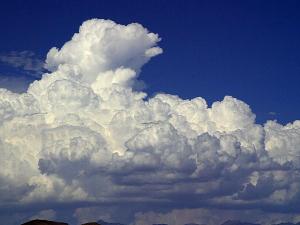
A cumulonimbus cloud gathers. (Jon Sullivan/Wikimedia Commons)
It’s hard to find a more important moment in Earth’s history than the very first thunderstorm.
For 700 million years after the planet formed, the volcanic landscape was too hot for water to exist in any form until finally the crust began to cool and high in the atmosphere the temperature dropped below 100 degrees Celsius for the first time.
At that moment – about 3.8 billion years ago – water vapor condensed into clouds for the first time and it didn’t stop raining for about 300 million years, maybe longer.
It wasn’t until Gottfried Wilhelm von Leibniz published Protogaea in 1680 that modern science recognized the earth was once a glowing mass of molten lava, and that the first extended thunderstorm created the oceans.
“[The Earth was] originally a burning luminous mass, which ever since its creation has been undergoing refrigeration,” wrote Liebniz. “When the outer crust had cooled down sufficiently to allow the vapors to be condensed, they fell, and formed a universal ocean …”
Science v. Religion
For centuries the Vatican tried to co-opt Liebniz’ theory as proof of Noah’s Flood and actively railed against geologists who found clear evidence of a world much older than the 6,000 years suggested in the Bible. Just 60 years ago, at least one scholar still found it necessary to push back on the church.
In 1969, Time-Life published The Sea, including the following observation on how the oceans were formed. “The accumulation [of the seas] did not take place through ‘the greatest deluge of all time’ that has so often been described. So far as anyone can tell, it may merely have rained as it rains today. Nature has plenty of time. It probably took a billion years to fill the oceans.”
Today the Duke University website delivers the straight story; “The water on Earth stayed in gaseous form until the planet’s surface cooled below 100 degrees Celsius. At this time, 3.8 billion years ago, water condensed into rain and poured onto the land. Water collected in low lying areas which gradually became the primitive oceans.”
The science of ancient myth

Sunset over the Atlantic Ocean. (Photo by Ben H. Gagnon)
Long before western science fought to make the case for a molten earth that cooled enough to form clouds, myths from indigenous cultures around the world identified cloud formation as the moment of creation.
It seems the condescending nature of most Christian scholars prevented them from entertaining the notion that indigenous people understood the workings of the planetary water cycle. Perhaps the haughtiest of all was Herbert Spencer, who wrote in The Principles of Sociology Volume I (1874) that “savages” had no idea from where clouds came.
“In the sky, clear a few moments ago, the savage sees a fragment of cloud which grows while he gazes. … Something he could not before see has become visible … The whence, and the where, and the why, he cannot tell; but there is the fact,” Spencer wrote.
In contrast, a quick tour through just four creation myths shows a keen understanding that heat plus water equals clouds. The Kuba of Central Africa say clouds formed after the creator vomited the sun onto the primordial ocean, the supreme being of the Tungus in Siberia set fire to the ocean and evaporated the world-covering waters, the Sulawesi of Indonesia say a hot rock emerged from the primordial sea to form clouds and the Pawnee of the Great Plains describe Morning Star throwing a fireball at a serpent representing the primordial ocean.
The first thunderstorms
Other creation stories describe the first clouds and storms filling the oceans, including the West African Yorubans of West Africa, whose creator god Oludumare gathered invisible vapors to form clouds and create the ocean.
Early Hindu texts say that from primordial nothingness came a desire, “Let me be,” and from this came fire and smoke, ultimately producing clouds and rain and filling the oceans. In a similar myth from the American southwest, the Zuni Pueblo say the first thought of the creator Awonawilona radiated outwards as mist, forming great thickening clouds and storms that filled the seas. The Chewa of Malawi in West Africa believe the creator Chiuta lived in the sky until one day clouds formed into a thunderstorm. The first people, animals and vegetation appeared out of the rain.
It’s worth noting that water, in one form or another, was already present at the beginning of all creation stories. No creator god is given credit for creating water. It is the ultimate divine substance. Even the Judeo-Christian god in the Book of Genesis does not create the waters, but merely “separates” them into ocean and clouds.
Creating the landscape
Unlike the catastrophic Sumerian and Judeo-Christian flood stories, many ancient and/or indigenous cultures perceived the original storm and flood as benevolent in nature, shaping the mountains and valleys and providing opportunities for life in all its forms to find food and shelter.
The Yorubans conceived of an original storm whipped up by angelic beings after creation, transforming what had been a completely level earth into a diverse landscape of mountains and valleys. The Bunun of Taiwan say a flood came after a fight between a snake and a crab, transforming a previously flat land into mountains and valleys.
For Aboriginal cave painters in Kimberley, Australia, the Wandjina were human-like creator spirits of clouds and rain that rose from the sea like mist and came down from the sky like rain and shaped the earth’s topography. The Nlakapamuk of British Columbia described a great flood receding to form the terraces of mountains while leaving fish behind in lakes and creeks.
The moment of creation
Across dozens of cultures the moment of creation was defined as when the planetary water cycle began, when heat was introduced to the dormant primordial waters, producing clouds and storms that rained down and flooded the landscape.
Some ancient and indigenous cultures took it a step further and conflated rain with the seeds of vegetation. The 20th century historian Mircea Eliade wrote that the Pima tribe of New Mexico believed mother earth was made pregnant by a drop of water from a cloud, and observed that the Sumerian word “a” meant both water and sperm.
A key to early conceptions of the water cycle is its immortality. Once a creator god started the cycle it couldn’t be stopped. For example the water cycle is an endless manifestation of Dao in The Annals of Lu Buwei (2000, Stanford University Press), a compendium of knowledge written about 2,300 years ago.
“Clouds and vapors move to the west in great abundance, stopping neither in winter nor in summer; rivers and streams flow to the east resting neither day nor night … these are examples of the circularity of the Dao.”

Clouds on parade in Wyoming. (Photo by Ben H. Gagnon)
Academic blindness?
The archaic belief in water as a divine substance is described by early western anthropologists and other scholars, including Edward Burnett Tylor, Andrew Lang, Herbert Spencer, George Frazer, Rudolf Otto and Gerardus Van Der Leeuw.
The most extensive exploration of the subject is found in Eliade’s numerous books, yet even he did not explore the indigenous perception of the planetary water cycle as a whole, and as a never ending series of morphing phases.
But the catalyzing of a perpetual water cycle is consistent with Eliade’s observation that indigenous creator gods often leave the scene soon after the fact, a concept he called Deus otiosus. It’s the mythical sons and daughters of the creator, in the form of wind, weather and storms, that were the pressing concern. Only in extreme emergencies was the creator called upon.
It’s no surprise that mastery of the waters was the calling card of the shaman(ess), who was believed capable of traveling to the heavens by shape-shifting along with the water cycle. A performative shamanic journey might include dramatic moments like the rescue of a wandering soul but after the spirit-adventure was over the audience would always be rewarded with predictions of coming weather.
Embedded truths
Myths of creation are often filled with fantastical characters, surrealistic plot-lines and supernatural magic. There are cosmic giants, primordial serpents and naked goddesses dancing on the waters, not to mention fireballs, mountains arguing over who was taller and creative thought-waves.
To modern ears these are bizarre and fantastical, but were inserted largely to meet the hyperbolic requirements of oral storytelling. Embedded in those characters and plot-lines was the knowledge that our planetary water cycle had a start date and was responsible for filling the oceans.
It’s hard to escape the conclusion that reaching the same scientific understanding in the western world was an uphill battle over several centuries against the Judeo-Christian tradition, which favored its appropriation of the cloud as an iconic symbol of the creator god rather than accept the truth and beauty of the cloud’s natural and scientific origins.
(Ben H. Gagnon is the author of Church of Birds: An Eco-History of Myth and Religion, to be released March 31, 2023, by John Hunt Publishing, London, now available for pre-order. More information on the book is at churchofbirds.godaddysites.com, which links to a YouTube video on some of the larger themes in the book. The material in this column does not appear in the book.)
Education and Religion
Previous Post

January 15, 2023
Introducing the mythical whooper swan, Virgin Queen of birds
Next Post

January 21, 2023 The blossoming of the silver flower: shamanic rituals of creation
Recent Comments
Browse Our Archives
Select a Category contemplative History New Visions Pagan Progressive Christian Uncategorized
Select a Month June 2023 May 2023 April 2023 March 2023 February 2023 January 2023 December 2022
Follow Us!
TAKE THE
Religious Wisdom Quiz
What's the main theme of the Book of Job?
Select your answer to see how you score.
Why good people suffer Building a wall Genealogies Exile and return
Related posts from Adventures in Eco-Mythology

In Greece, Petralona Cave may be oldest sacred...
In the Arctic, a 2,500-year-old Greek myth is...
The ancient religious meaning of volcanoes, from Persia...

Evidence shows ape-human hybrids evolved on bird migration...
TRENDING AT PATHEOS Pagan

To help with the upcoming holiday season, I'm introducing the Holiday Helper...

10 years of the Power Sigil & Moving...
Last week while reorganizing my studio space, I found the sketchbook that...

Why are younger seekers drawn to Paganism and...
One of the things I've noticed the most is that I'm far...

When we talk about Greek religion, we often begin with the dodekatheion—the...

I was recently chatting with someone on Instagram. She asked me what...

On July 23, I saw Christopher Nolan's The Odyssey which is Homer’s...
view all Pagan blogs
Ad-Free & Subscriber Log-In Subscription Support
- About Us
- 2026 Calendar
- Videos
- Podcasts
- Library of World Religions
- Faith In Media Tracker
- Advertise With Us
- Write for Us
- Privacy Policy
- Terms of Service
- Do Not Sell My Data
- Contact Us
- Radiant Digital
- Manage Newsletter Subscriptions
- Unsubscribe From Notifications
- Sitemap
Copyright 2008-2026, Patheos, part of the Radiant Digital network of media brands. All rights reserved.
Subscription Support Ad-Free & Subscriber Log-In
Follow Patheos