
BuddhistCatholicContemplativeEvangelicalGeneral ChristianHinduJewishLatter-day SaintMuslimNew VisionsProgressive Christian
Beliefs
- Buddhist
- Catholic
- Contemplative
- Evangelical
- General Christian
- Hindu
- Jewish
- Latter-day Saint
- More Voices
- Muslim
- New Visions
- Pagan
- Progressive Christian
Topics
- Religion News
- Food and Religion
- Sports and Religion
- Religious Art
- Religious Music and Entertainment
- Religious Events
- History and Religion
- Style and Religion
- Politics and Religion
- Women in Religion
- Recreation Outdoors and Religion
- Business Finance and Religion
- Careers Workplace and Religion
- Education and Religion
- Family Parenting and Religion
- Health Fitness and Religion
- Home and Religion
- Relationships and Religion
- Technology and Religion
- Travel and Religion
Columnists
- Buddhist Columnists
- Business Finance and Religion Columnists
- Careers Workplace and Religion Columnists
- Catholic Columnists
- Contemplative Columnists
- Education and Religion Columnists
- Evangelists Columnists
- Family Parenting and Religion Columnists
- General Christian Columnists
- Health Fitness and Religion Columnists
- Hindu Columnists
- History and Religion Columnists
- Home and Religion Columnists
- Jewish Columnists
- More Voices Columnists
- Latter Day Columnists
- Muslim Columnists
- New Visions Columnists
- Nonreligious Columnists
- Pagan Columnists
- Politics and Religion Columnists
- Progressive Columnists
- Recreation Outdoors and Religion Columnists
- Relationships and Religion Columnists
- Religion News Columnists
- Religious Art Columnists
- Religious Events Columnists
- Religious Music and Entertainment Columnists
- Sports and Religion Columnists
- Style and Religion Columnists
- Technology and Religion Columnists
- Travel and Religion Columnists
- Women in Religion Columnists
Resource Library
- 2026 Calendar
- Library of World Religions
- The 100 Most Holy Places on Earth
- Patheos Answers
- Podcasts
- Videos
- Faith Leaders Database
- Anglican Episcopalian
- Bahai
- Baptist
- Buddhism
- Christianity
- Confucianism
- Eastern Orthodoxy
- Hinduism
- Holiness and Pentecostal
- ISKCON
- Islam
- Judaism
- Lutheran
- Methodist
- The Church of Jesus Christ of Latter-day Saints
- New Age
- Paganism
- Presbytarian and Reformed
- Protestantism
- Religion Behind the Scenes
- Roman Catholic
- Scientology
- Shia Islam
- Sikhism
- Sufism
- Sunni Islam
- Taoism
- Zen
- See all religions
Research Tools
 Ad-Free & Subscriber Log-In Subscription Support
Ad-Free & Subscriber Log-In Subscription Support
Follow Patheos 

- Trending:
- Forgiveness
- |
- Marriage
- |
- Consciousness
- |
- Death Penalty
- |
- Election
- |
- Halloween

- Home
- Evangelical
- History and Religion
- The Gospel Bids me Fly and Gives me Wings: Historical Source
The Gospel Bids me Fly and Gives me Wings: Historical Source
Last updated on: December 23, 2025 at 4:09 pm by Adrian Warnock
The Gospel Bids me Fly and Gives me Wings: Historical Source 2025-12-23T16:09:57+00:00 Adrian Warnock
Patheos Explore the world's faith through different perspectives on religion and spirituality! Patheos has the views of the prevalent religions and spiritualities of the world.

Image: Adrian Warnock
GIVES US WINGS
One of the most famous advertising slogans today belongs to Red Bull, the drink manufacturer. They claim their strongly caffeinated drink “gives you wings”. I have often wondered how they can get away with that as an advertising claim.
Certainly, I would not have approved such a claim for any medicine in my days as a pharmaceutical medical director! My job back then was in part to act as a kind of conscience for the companies I worked for, ensuring they didn’t make claims they couldn’t support with data.
Perhaps if anyone ever challenged the drinks manufacturer, they could point to the Formula One racing team they sponsor, the cars literally do have wings, as of course do the planes in the Red Bull airshows!
But I mention this slogan because of an older use of the concept. Many Christians will have heard of the following little poem that perfectly summarizes what we are talking about in this chapter about how God enables us to live for him rather than simply commanding it. God gives us his life deep in our souls in order that we can truly change.
These words perfectly sum up the idea:
“Run, John, run, the law commands
But gives us neither feet nor hands,
Far better news the gospel brings:
It bids us fly and gives us wings.”
It is also often quoted in a slightly different form:
“To run and work the law commands,
Yet gives me neither feet nor hands;
But better news the gospel brings:
It bids me fly, and gives me wings.”
Most people today cite those lines as being authored by John Bunyan, but historically there doesn’t seem to be any evidence for that.[1]
John Newton does say something strikingly similar:
“If I wanted a man to fly, I must contrive to find him wings; and thus, if I would successfully enforce moral duties, I must advance evangelical motives.”[2]
This quote is offered with no context in the introduction to Newton’s works. The concept can also be found in one of Newton’s profound sermons on the verses used in Handel’s Messiah, these were first preached in 1784-1785. Talking about the demands the gospel places on us he says,
“How truly then may it be said, that “his yoke is easy, and his burden light!” such a burden as wings are to a bird, raising the soul above the low and groveling attachments to which it was once confined. They only can rightly judge of the value of this rest who are capable of contrasting it with the distractions and miseries, the remorse and forebodings, of those who live without God in the world.”[3]
In Olney Hymns, one of those marked as being by Cowper expresses a similar thought:
“I was a groveling creature once,
And basely cleaved to earth;
I wanted spirit to renounce
The clod that gave me birth.
But God has breathed upon a worm,
And sent me, from above,
Wings, such as clothe an angel’s form,
The wings of joy and love.”[4]
These quotes are enough to make you wonder if they were somehow the source of the quote or inspired by it. It turns out that the second of these options is very likely the case, as the concept was circulating years before Newton and Cowper used it, although not in the exact wording many of us are familiar with today.
John Wesley included a similar idea in a hymn written in 1722:
“World of vanity, farewell!
Thee without regret I leave;
While, redeemed from death and hell,
Mercy doth my soul forgive,
Lends me wings from earth to fly,
Tells me I shall never die.”[5]
But the most likely earliest source of what Wesley, Cowper and Newton all said can be found in Erskine’s Gospel Sonnets which was published in 1720, and was circulating widely before John Newton began to preach:
When law and gospel kindly meet,
To serve each other both unite;
Sweet promises, and stern commands,
Do work to one-another’s hands.
The divine law demands no less
Than human perfect righteousness:
The gospel gives it this and more,
Even divine righteousness in store . . .
The law commands me to believe;
The gospel saving faith doth give:
The law enjoins me to repent;The gospel gives my tears a vent . . .
The law most perfect still remains,
And every duty full contains:
The gospel its perfection speaks,
And therefore, gives whatever it seeks.
Next, what by law I’m bound unto,
The same the gospel makes me do . . .
All that by precepts Heaven expects,
Free grace by promises effects:
To what the law by fear may move,
To that the gospel leads by love.
To run to work, the law commands;
The gospel gives me feet and hands:
The one requires that I obey;
The other does the power convey.
What in the law has duty’s place,
The gospel changes to a grace . . .
A rigid master was the law,
Demanding brick, denying straw:
But when with gospel-tongue it sings,
It bids me fly, and gives me wings.”[6]
C.H. Spurgeon says that John Berridge wrote the following version of this wonderful expression of grace, most likely around the same time Newton was preaching about Handel’s Messiah:
Run, John, and work, the law commands,
Yet finds me neither feet nor hands;
But sweeter news the gospel brings,
It bids me fly, and lends me wings.”[7]
It is easy to see why the word “lends” has been changed for “gives” to avoid the misunderstanding that we only borrow the God-given wings.
This concept of the Gospel giving us the power to do what the Law requires of us did not originate in the 1700s. It is a perfect way of summarizing the message of Scougal’s earlier book the Life of God in the Soul of Man.
But centuries before that, the great ancient theologian, Augustine of Hippo said,
“All my hope is in your great mercy. Give what you command, and command what you will.” [8]
It could be argued that this idea of the gospel giving us wings really originates in the Bible itself, and could simply be a commentary on the following verse:
“But those who trust in the LORD will find new strength. They will soar high on wings like eagles. They will run and not grow weary. They will walk and not faint.” (Isaiah 40:31, NLT)
This idea is also supported by these words from the Apostle Paul which could easily have served as the motto of John Newton’s ministry:
**“**My dear children, for whom I am again in the pains of childbirth until Christ is formed in you” (Galatians 4:19, NLT).
Newton said that his main goal in ministry was,
“To break a hard heart, and to heal a broken heart.”
His greatest work was to promote the life of God in the soul of man. He would sacrifice everything else. He saw the spirit of the ancient Pharisees at work among many who claimed to love the doctrines of grace. Some believers then and now stress their own doctrinal distinctives but neglect the weightier matters of unity and love. This is not what God intends us to be like.
What are the signs of the work of God in us?
Newton answers as follows:
“If any one criterion could be given of a real work of grace begun in the heart of a sinner, it would be found in his contrite spirit. The religion of a sinner, stands on two pillars; namely, what Christ did for us in his flesh, and what he performs in us by his Spirit: most errors arise from an attempt to separate these two.”[9]
Christ being formed in us. Giving us the wings to soar above the troubles of this world. What could be more encouraging than this message of God’s very life at work in the souls of man?
Read More from Adrian Warnock
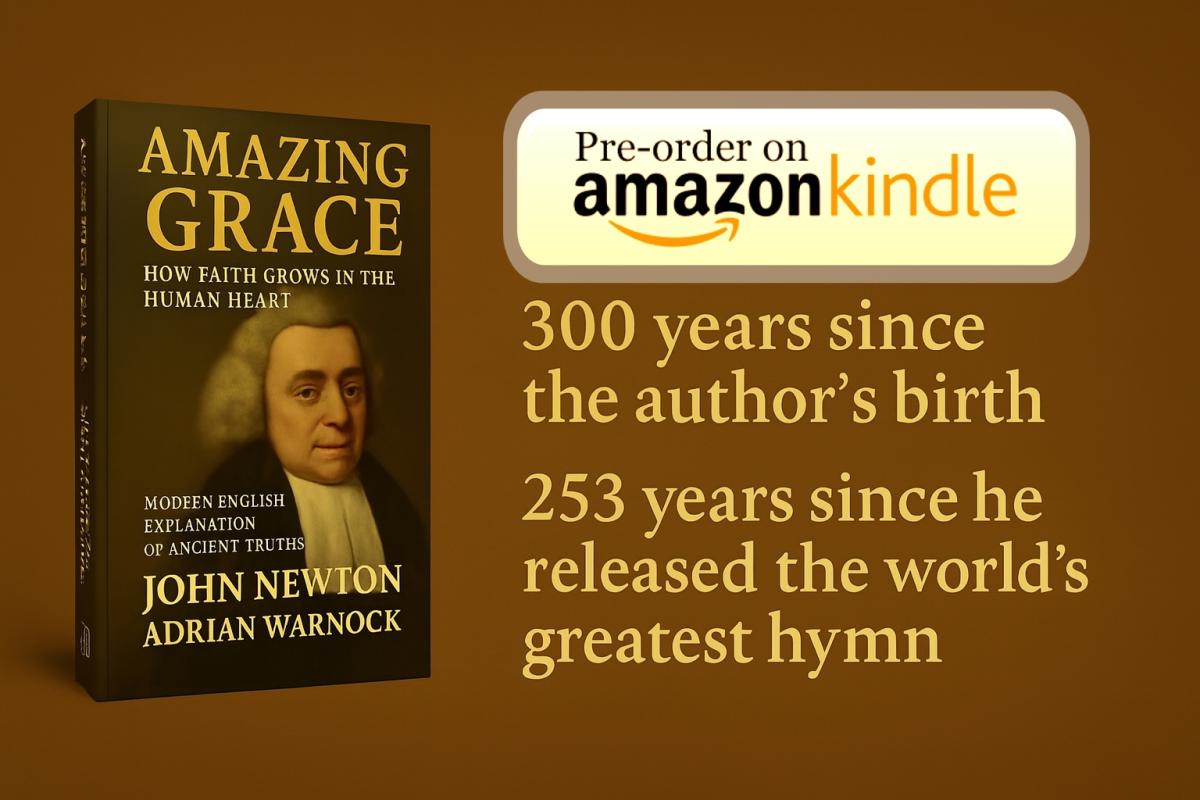
Amazing Grace: How Faith Grows in the Human Heart
Modern English Explanation of Ancient Truths.
By John Newton and Adrian Warnock
Pre-order here
Classic writings updated and a new biography.
300 years after the author’s birth
253 years after he released the world’s greatest hymn, Amazing Grace
This hymn has been recorded more often than any other song of any genre. In the same thirty-six hours which changed the world forever, his close friend William Cowper also wrote God Moves in a Mysterious Way, but then had a crushing mental breakdown from which he never fully recovered. Such powerful grace of God, but marked by terrible suffering. The echoes still reverberate today.
About Adrian Warnock
“Adrian is a first-rate communicator”—Albert Mohler Jr
About John Newton
”I look forward to meeting John Newton” — R. T. Kendall
”One of my heroes”—Tim Keller
“He says it all perfectly”— Martyn Lloyd-Jones
”The memory of his own gracious change of heart and life gave him tenderness in dealing with sinners, and it gave him hope for their restoration” — C. H. Spurgeon
”Why am I interested in this man? Because one of my great desires is to see Christians be as strong and durable as redwood trees, and as tender and fragrant as a field of clover. Oh, how rare are the Christians who speak with a tender heart and have a theological backbone of steel.” — John Piper
”If William Cowper could speak, he’d thank God for not only John Newton, but any friend who prays for and walks beside those with mental illness.” — Joni Eareckson Tada
Preview the content here:
→ I once was blind but now I see
→ Grace Within: The Inner Evidence of Faith
→ How Grace enters the Human Heart
→ Growing in Grace: When Shoots Take Root
→ A modern parable: The Traitors: Spellbound by Lies
More coming soon: subscribe by email or follow on social media
→ The 36 hours that changed the word
and much more…
Adrian Warnock presents a modern English edition of the 18th century classic writings of John Newton (1725-1807), author of Amazing Grace, the world’s greatest hymn and the most recorded song of any genre.
Think of this book as John Newton’s own explanation of his hymn Amazing Grace. His updated autobiography and devotional writings contained in this book form the perfect commentary on his lyrics, demonstrating what really is so amazing about grace.
Modern self-help is no help at all in an existential crisis. These pages contain the secret to genuine personal growth and spiritual transformation. They are simple and yet profoundly deep.
Amazing Grace appears 300 years after John Newton was born, and 253 years after he released his most famous hymn. The result is a seamless blend of Newton’s timeless wisdom with the clarity of thought and plain English that have marked Adrian Warnock’s Patheos blog for more than twenty years, and shapes his other books Raised with Christ, Hope Reborn, and The Traitor Within. Some chapters in this book are modern commentary written by Adrian.
John Newton, the former slave trader turned pastor, wrote letters that still speak to the deepest struggles of our spiritual journeys. In these pastoral devotions, Newton traces how divine grace takes root, grows, and matures in the human heart through three phases: conviction, conflict, and mature contemplation of God’s glory.
The letters in this book are chosen from the thousands preserved from Newton’s vast correspondence, a treasury mined for pastoral wisdom for more than two centuries. A skillful soul physician, Newton describes how grace changes every aspect of a Christian’s life over a lifetime of faith.
Amazing Grace also contains an updated autobiography of this great pastor, with a living interpretation of how significant his extraordinary life still is today. This material and his thoughts on entering Christian Ministry are not included in standard editions of his Works.
Newton becomes for us a vivid example of how God’s grace changes people gradually over time.We meet the rebellious and violent youth, the slave trader who oppressed thousands of innocents, was made a slave himself, and who was found by God’s grace during a storm that nearly sank his ship. This unruly man was pursued, rescued, and transformed by grace.
We learn how over time Newton became a pastor known for his compassion and kindness, most notably demonstrated by his deeply committed care towards the poet William Cowper during his mental illness. Read about how Newton was also a pastor of a whole nation, working for the abolition of the slave trade, and mentoring William Wilberforce for decades.
Newton bridged the gap between the warring denominational movements of his time, a friend of both George Whitefield and John Wesley. He turned his fervor not into the pamphlet flame wars or revival preaching, but into the tenderhearted soul care of the distressed and depressed as they struggled to find greater spiritual freedom and transformation. These pages invite readers not only to understand Newton’s insights, but to experience the living reality of grace in their own lives.
If this book makes you want to read more John Newton, and you do not mind the old English, buy the Logos Bible Software Edition of his Works or a paper version.


The Traitor Within
Understanding and Healing Our Deceitful Hearts
By Adrian Warnock with a chapter by John Newton
Pre-order here
“The human heart is the most deceitful of all things, and desperately wicked. Who really knows how bad it is?” (Jeremiah 17:9, NLT).
And yet our culture tells us to “follow your heart”. No wonder it too is now desperately sick and beyond cure. This book will explore the cultural phenomenon The Traitors as a modern parable as it unmasks the human heart.
Adrian blends his medical insights gained from his work as a doctor and psychiatrist with pastoral wisdom gathered from twenty-five years serving as part of a church leadership team. He witnessed a period of church growth from less than twenty members to thousands.
In recent years Adrian has also experienced chronic illness following his diagnosis with blood cancer, and this book reflects his passion to help others face all kinds of suffering with hope and compassion.
Preview the content here:
→ TV’s The Traitors: Spellbound by Lies
→ How Suffering Revealed What Was in My Heart
→ When Your Body Lies to You: False Messages and Appetites
→ Help when Life Hurts: dealing with specific challenges
More coming in 2026: subscribe or follow on social media
→ Healing Your Body: Practical Tools
→ Follow Your Heart? Not When Your Mind Is Lying to You
→ Healing Your Mind: Taking Every Thought Captive
→ How Lies Create Our Desperately Sick Society
→ Healing Our Broken Communites: Work, Friends, and Family
→ Our Deceitful Spirits: Without Hope and without God
→ Healing Your Spirit – Meaning and Religion
→ Forgiven in a Moment. Renewed Over a Lifetime. Glorified for Eternity.
Read Adrian’s Books
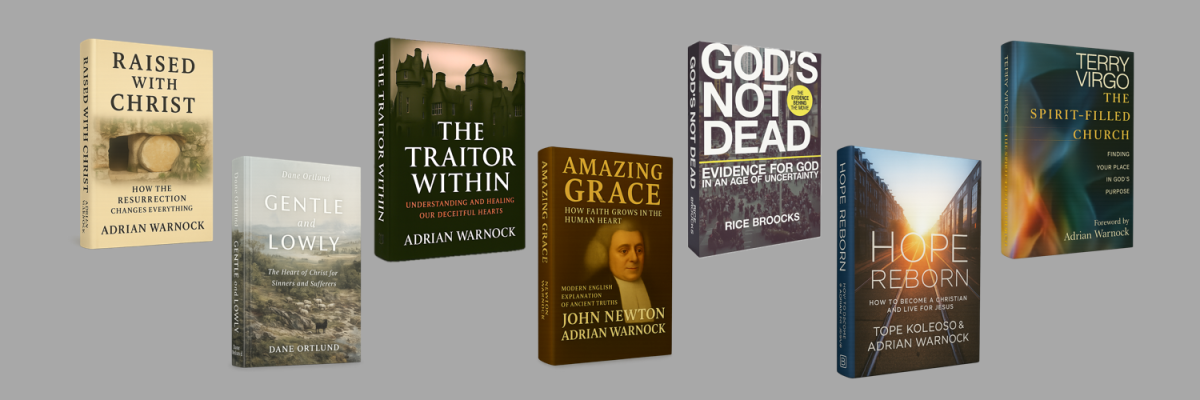
Transformed by Jesus: Spiritual Renewal
Buy a Book about Easter this Christmas

Help When Life Hurts: Dealing with Specific Pain
These articles are a growing collection, drawing from Adrian Warnock’s medical and psychological expertise, lived experience, and Christian faith.
Please also reach out to a close friend, family member, pastor, counsellor, or health professional such as your primary care doctor or GP. And if you do not feel safe right now and are in crisis then call a crisis line.
In the USA, in an emergency, call 911. If you are in crisis or suicidal and need someone to talk to call the national Suicide & Crisis Lifeline on 988..
In the UK, in an emergency, call 999. For urgent mental health support call 111, or complete the form at https://111.nhs.uk. For the Samaritans call 116 123.
Other countries have similar crisis helplines and a list is maintained at Wikipedia.
Click the type of pain you or a loved one are facing right now
General suffering Financial difficulties Feeling disqualified Chronic illness Divorce & family pain Depression & mental health Bereavement & end-of-life
See the full list of over 40 articles
References
[1] Thanks to Justin Taylor, 2011 for setting me on this trail: https://www.thegospelcoalition.org/blogs/justin-taylor/run-john-run/
[2] Newton, J., Richard Cecil (1824) The works of the John Newton. London: Hamilton, Adams & Co., p. 119.
[3] Newton, J. and Cecil, R. (1824) The Works of John Newton. London: Hamilton, Adams & Co., p. 182.
[4] Newton, J. and Cecil, R. (1824) The Works of John Newton. London: Hamilton, Adams & Co., pp. 623–624.
[5] Wesley, J. and Wesley, C. (1870) The Poetical Works of John and Charles Wesley. Edited by G. Osborn. London: Wesleyan-Methodist Conference Office, p. 366.
[6] The Sermons and Practical Works of Ralph Erksine, vol. 10 (Glasgow: W. Smith and J. Bryce, 1778), 283. Cited by Justin Taylor, https://www.thegospelcoalition.org/blogs/justin-taylor/run-john-run/
[7] Spurgeon, C.H. (2009) The Salt Cellars: Being a Collection of Proverbs, Together with Homily Notes Thereon. Bellingham, WA: Logos Bible Software, p. 200.
[8] Augustine of Hippo (1984) Augustine of Hippo: Selected Writings. Edited by J. Farina. Translated by M.T. Clark. Mahwah, NJ: Paulist Press (The Classics of Western Spirituality), p. 145.
[9] Newton, J., Richard Cecil (1824) The works of the John Newton. London: Hamilton, Adams & Co., p. 121.
General Christian
History and Religion
Education and Religion
Previous Post

December 12, 2025
The Renewed Christian: What does Maturity Look Like?
Next Post

December 19, 2025 Interview: PJ Smyth & See No Evil - God the Shed and my Dad
Recent Comments
"Atheism is no more a single worldview than theism is a single worldview. Both however ..."
Thank God Atheists Do Not Live ..."
"Athiests believe in love, most reject God because of the God depicted in the old ..."
Thank God Atheists Do Not Live ..."
"Have a read of some history, and you will find that your views are not ..."
Thank God Atheists Do Not Live ..."
"You act like Christians invented basic human decency. Here's a news flash: Humans thrived for ..."
Thank God Atheists Do Not Live ..."
Browse Our Archives
Select a Category 1 and 2 Corinthians 1 and 2 Thessalonians 1 and 2 Timothy 1 John 300 Leaders A Life of Joy Abortion Acts of the Apostles Adrian on radio Adrian on TV Adrian's Story Albert Mohler Amazing Grace Arminocalvinist Spectrum Assurance Atonement Atonement Series Attributes of God Barnabas Best of the Blog Bible Bible Software Bible Translation Biblical Inerrancy Billy Graham Bob Roberts Books C. J. Mahaney Calvinism Cessationism Charis Warnock Charismatic Spectrum Charles Simeon Charles Spurgeon Church Leadership Colossians Complementarian - Egalitarian Spectrum Complementarianism Conferences Culture Daniel Debates Deuteronomy DGM08 DGM13 Discernment Doctrine Don Carson Ed Stetzer Eddy Leo Ephesians ESV Bible Translators Interview Evangelism in a Post-Christian World evolution Exodus Expository Preaching Ezekial Faith and Feelings Family Florida Galatians General Genesis Get Wisdom - Proverbs sermons Gifts of The Holy Spirit Gifts of the Holy Spirit 2006 Global Faith Forum Godly Attitudes Gospel Gospels Grace Greg Haslam Grudem vs Piper: The Baptism Debate Healing Heaven Hell and Rob Bell Hebrews Henry Tyler Henry Warnock Holy Spirit Holy Spirit Baptism Hope Reborn Hugh Palmer Irresistable Grace Isaiah J. I. Packer Jack Hayford Joel Joel Warnock John John Lanferman John MacArthur John Newton John Owen John Piper John Smyth Jonathan Edwards Josh Harris Justification Justin Taylor Kenneth Ulmer Leadership Leadership Lessons from 1 & 2 Samuel Lex Loizides Liam Goligher Lig Duncan Limited Atonement Lou Fellingham Mark Dever Mark Driscoll Martyn Lloyd-Jones Matt Chandler Mental Health Missionary Methods: St Paul’s or Ours? My Story N. T. Wright Nehemiah NWA08 NWA09 NWA10 Opinion OT History Books Pentateuch Personal Personal Revival Philippians PJ Smyth Podcast Politics Preaching Prophecy Proverbs Psalms Raised With Christ Reformed Charismatic Regeneration Relationships Resurrection Resurrection & Salvation Revival Rice Broocks Rich Man and Lazarus Rick Warren Rob Rufus Roland Allen Romans Sam Storms Sanctification Series Sermons Sermons on Philippians Serving Jesus at Work Sexuality Sin St Paul Steve Chalke Strange Fire Suffering T4G T4G Statement TAB09 Tamasin Warnock Teamwork Terry Virgo The Atonement Debate - Chalke book The Soulwinner The Spirit-Filled Church The Traitor Within Theologcial Spectrums Theosis Tim Challies Tim Keller Titus TOAM06 TOAM07 TOAM08 TOAM09 TOAM10 TOAM11 Todd Bentley Tope Koleoso Total Depravity Video Water Baptism Wayne Grudem Worship
Select a Month October 2026 September 2026 August 2026 July 2026 June 2026 May 2026 April 2026 March 2026 February 2026 January 2026 December 2025 November 2025 October 2025 September 2025 May 2025 April 2025 January 2025 November 2024 October 2024 August 2024 July 2024 June 2024 May 2024 April 2024 March 2024 February 2024 January 2024 December 2023 August 2023 May 2023 April 2023 February 2023 October 2022 September 2022 August 2022 July 2022 June 2022 May 2022 April 2022 March 2022 February 2022 August 2021 May 2021 April 2021 February 2021 January 2021 December 2020 October 2020 September 2020 August 2020 July 2020 June 2020 May 2020 April 2020 March 2020 February 2020 January 2020 December 2019 November 2019 October 2019 September 2019 June 2019 May 2019 April 2019 March 2019 January 2019 December 2018 October 2018 September 2018 August 2018 July 2018 June 2018 May 2018 April 2018 March 2018 February 2018 January 2018 December 2017 November 2017 October 2017 September 2017 June 2017 April 2017 March 2017 February 2017 January 2017 December 2016 November 2016 October 2016 June 2016 March 2016 February 2016 January 2016 December 2015 November 2015 September 2015 August 2015 July 2015 June 2015 May 2015 April 2015 March 2015 February 2015 January 2015 December 2014 November 2014 October 2014 September 2014 August 2014 July 2014 June 2014 May 2014 April 2014 March 2014 February 2014 January 2014 December 2013 November 2013 October 2013 September 2013 August 2013 July 2013 June 2013 May 2013 April 2013 March 2013 February 2013 January 2013 December 2012 November 2012 October 2012 September 2012 August 2012 July 2012 June 2012 May 2012 April 2012 March 2012 February 2012 January 2012 December 2011 November 2011 October 2011 September 2011 August 2011 July 2011 June 2011 May 2011 April 2011 March 2011 February 2011 January 2011 December 2010 November 2010 October 2010 September 2010 August 2010 July 2010 June 2010 May 2010 April 2010 March 2010 February 2010 January 2010 December 2009 November 2009 October 2009 September 2009 August 2009 July 2009 June 2009 May 2009 April 2009 March 2009 February 2009 January 2009 December 2008 November 2008 October 2008 September 2008 August 2008 July 2008 June 2008 May 2008 April 2008 March 2008 February 2008 January 2008 December 2007 November 2007 October 2007 September 2007 August 2007 July 2007 June 2007 May 2007 April 2007 March 2007 February 2007 January 2007 December 2006 November 2006 October 2006 September 2006 August 2006 July 2006 June 2006 May 2006 April 2006 March 2006 February 2006 January 2006 December 2005 November 2005 October 2005 September 2005 August 2005 July 2005 June 2005 May 2005 April 2005 March 2005 February 2005 January 2005 December 2004 November 2004 October 2004 September 2004 August 2004 July 2004 June 2004 May 2004 April 2004 March 2004 February 2004 January 2004 December 2003 November 2003 October 2003 September 2003 August 2003 July 2003 June 2003 May 2003 April 2003
Follow Us!
TAKE THE
Religious Wisdom Quiz
What did Moses' staff turn into as a sign for Pharaoh?
Select your answer to see how you score.
A serpent A frog A branch A dove
Books by This Author Books by Adrian Warnock
Related posts from Adrian Warnock

How the author of the world's best hymn...

"Open" is not Biblical, "eagerly desire spiritual gifts"...

Thank God Atheists Do Not Live By Their...
Jesus was not Manipulated by Anyone. He Knew...
TRENDING AT PATHEOS Evangelical

How the author of the world's best hymn...
I've been working with John Newton for a while now. This makes...

Long before this Lectio Divina, Psalm 130 - the song - started...

What About the Trees? Another Living Parable
After I finished writing the last article about falling leaves as a...

Why Classical Education Is a Conversation, Not a...
Come and Read: Joy in Classical Education When I was a little...

Falling Leaves: A Living Parable on Letting Go
I’ve spent the vast majority of my life in the southeast corner...

Cornell University has received a great deal of negative publicity and intense...
view all Evangelical blogs
What Are Your Thoughts?leave a comment
Ad-Free & Subscriber Log-In Subscription Support
- About Us
- 2026 Calendar
- Videos
- Podcasts
- Library of World Religions
- Faith In Media Tracker
- Advertise With Us
- Write for Us
- Privacy Policy
- Terms of Service
- Do Not Sell My Data
- Contact Us
- Radiant Digital
- Manage Newsletter Subscriptions
- Unsubscribe From Notifications
- Sitemap
Copyright 2008-2026, Patheos. All rights reserved.
Subscription Support Ad-Free & Subscriber Log-In
Follow Patheos