
BuddhistCatholicContemplativeEvangelicalGeneral ChristianHinduJewishLatter-day SaintMuslimNew VisionsProgressive Christian
Beliefs
- Buddhist
- Catholic
- Contemplative
- Evangelical
- General Christian
- Hindu
- Jewish
- Latter-day Saint
- More Voices
- Muslim
- New Visions
- Pagan
- Progressive Christian
Topics
- Religion News
- Food and Religion
- Sports and Religion
- Religious Art
- Religious Music and Entertainment
- Religious Events
- History and Religion
- Style and Religion
- Politics and Religion
- Women in Religion
- Recreation Outdoors and Religion
- Business Finance and Religion
- Careers Workplace and Religion
- Education and Religion
- Family Parenting and Religion
- Health Fitness and Religion
- Home and Religion
- Relationships and Religion
- Technology and Religion
- Travel and Religion
Columnists
- Buddhist Columnists
- Business Finance and Religion Columnists
- Careers Workplace and Religion Columnists
- Catholic Columnists
- Contemplative Columnists
- Education and Religion Columnists
- Evangelists Columnists
- Family Parenting and Religion Columnists
- General Christian Columnists
- Health Fitness and Religion Columnists
- Hindu Columnists
- History and Religion Columnists
- Home and Religion Columnists
- Jewish Columnists
- More Voices Columnists
- Latter Day Columnists
- Muslim Columnists
- New Visions Columnists
- Nonreligious Columnists
- Pagan Columnists
- Politics and Religion Columnists
- Progressive Columnists
- Recreation Outdoors and Religion Columnists
- Relationships and Religion Columnists
- Religion News Columnists
- Religious Art Columnists
- Religious Events Columnists
- Religious Music and Entertainment Columnists
- Sports and Religion Columnists
- Style and Religion Columnists
- Technology and Religion Columnists
- Travel and Religion Columnists
- Women in Religion Columnists
Resource Library
- 2026 Calendar
- Library of World Religions
- The 100 Most Holy Places on Earth
- Patheos Answers
- Podcasts
- Videos
- Faith Leaders Database
- Anglican Episcopalian
- Bahai
- Baptist
- Buddhism
- Christianity
- Confucianism
- Eastern Orthodoxy
- Hinduism
- Holiness and Pentecostal
- ISKCON
- Islam
- Judaism
- Lutheran
- Methodist
- The Church of Jesus Christ of Latter-day Saints
- New Age
- Paganism
- Presbytarian and Reformed
- Protestantism
- Religion Behind the Scenes
- Roman Catholic
- Scientology
- Shia Islam
- Sikhism
- Sufism
- Sunni Islam
- Taoism
- Zen
- See all religions
Research Tools
 Ad-Free & Subscriber Log-In Subscription Support
Ad-Free & Subscriber Log-In Subscription Support
Follow Patheos 

- Trending:
- Forgiveness
- |
- Marriage
- |
- Consciousness
- |
- Death Penalty
- |
- Election
- |
- Halloween

- Home
- Evangelical
- Religious Events
- Cosmic Renewal: The Resurrection Of All Things
Cosmic Renewal: The Resurrection Of All Things
Last updated on: November 20, 2025 at 12:28 pm by Adrian Warnock
Cosmic Renewal: The Resurrection Of All Things 2025-11-20T12:28:41+00:00 Adrian Warnock
Patheos Explore the world's faith through different perspectives on religion and spirituality! Patheos has the views of the prevalent religions and spiritualities of the world.

A renewed cosmos will be the result of Jesus Resurrction. Pixabay
The resurrection of Jesus is not just about changing individual lives. The whole universe is going to experience a resurrection. Everything will be made new. There will be no more pain, no more sickness, no more death. We will live together in a glorious renewed creation with our Creator.
Then I saw a new heaven and a new earth, for the first heaven and the first earth had passed away, and the sea was no more. And I saw the holy city, new Jerusalem, coming down out of heaven from God, prepared as a bride adorned for her
husband. And I heard a loud voice from the throne saying,
“Behold, the dwelling place of God is with man. He will dwell with them, and they will be his people, and God himself will be with them as their God. He will wipe away every tear from their eyes, and death shall be no more, neither shall there be mourning, nor crying, nor pain anymore, for the
former things have passed away.” And he who was seated on the throne said, “Behold, I am making all things new.”REVELATION 21:1–5
Jesus’ resurrection does not only change us by saving our souls, making us holy, and filling us with power to live. The fact that it changes our bodies to be immortal is still not the most glorious aspect of the story of salvation. Often the gospel is spoken of as being a great arc leading from the creation to the Fall to the Incarnation to the death of Jesus and then his resurrection and ascension. But that arc is not yet complete. Jesus will return, and when he does, the resurrection really will change everything. The Bible tells us, “He must remain in heaven until the time comes for God to restore everything” (Acts 3:21, niv).
This article is based on a chapter from the second edition of my book Raised with Christ – How the Resurrection Changes Everything 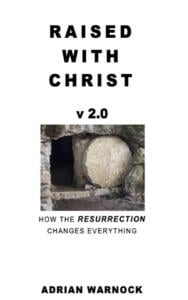
The second edition of my book, Raised With Christ has been released in Kindle, Paperback, and Hardback. You can order the book on your nearest Amazon online store wherever you are in the World. We have been able to release this new edition of the book at a very reasonable prices:
BUY THE BOOK
USA: Paperback Hardback Kindle
UK: Paperback Hardback Kindle
Looking for Christian Help for When Life Hurts?
Check out a growing collection of articles, drawing from Adrian Warnock’s medical and psychological expertise, lived experience, and Christian faith.
Click the type of pain you or a loved one are experiencing right now
General suffering & disappointment
Financial difficulties
Feeling disqualified
Chronic illness & disability
Divorce & family pain
Depression & mental health
Bereavement & end-of-life
See the full list of over 40 articles
Paul tells us that God has “a plan for the fullness of time, to unite all things in him, things in heaven and things on earth” (Ephesians 1:9–10). There will be no more rebellion. Only then will this tiny rebellious corner of the universe we call earth resound with the praise of Jesus’ glory.
He is before all things, and in him all things hold together. And he is the head of the body, the church. He is the beginning, the firstborn from the dead, that in everything he might be preeminent. For in him all the fullness of God was pleased to dwell, and through him to reconcile to himself all things, whether on earth or in heaven, making peace by the blood of his cross. (Colossians 1:17–20)
A CREATION WITHOUT DEATH
If this regeneration or resurrection of all things means anything, it means the reversal of the effects of death. Death entered the world through mankind: “Sin came into the world through one man, and death through sin, and so death spread to all men because all sinned” (Romans 5:12). As a result of one man’s sin, the whole of creation was delivered up to bondage and decay. But all is not lost. This process has begun to be reversed as a result of the actions of one man, Jesus:
For since by man came death, by man came also the resurrection of the dead. (1 Corinthians 15:21–22, kjv)
For the creation waits with eager longing for the revealing of the sons of God. For the creation was subjected to futility, not willingly, but because of him who subjected it, in hope that the creation itself will be set free from its bondage to corruption and obtain the freedom of the glory of the children of God. For we know that the whole creation has been groaning together in the pains of childbirth until now. And not only the creation, but we ourselves, who have the firstfruits of the Spirit, groan inwardly as we wait eagerly for adoption as sons, the redemption of our bodies. (Romans 8:19–23)
Astonishingly, in that second passage we see that it is the actual revealing of the resurrected children of God that will be associated with the end of death. It is the unveiling of the glory of God’s church that creation waits for. What an incredible privilege for us. This must be because we will reflect God’s glory. As in God’s original plan for Adam and Eve, we will rule over the new creation. And everything will change as a direct result. Even animals will cease from killing.
The wolf will live with the lamb, and the leopard shall lie down with the young goat, and the calf and the lion and the fattened calf together; and a little child shall lead them . . . They shall not hurt or destroy in all my holy mountain; for the earth shall be full of the knowledge of the Lord as the waters cover the sea. (Isaiah 11:6, 9; see Isaiah 65:25)
A UNIVERSE MADE NEW
The return of the Lord will lead to the renewal of all things. We are told repeatedly that the heavens and the earth will pass away. They will be renewed or re-created by fire, and we will live eternally in a new heaven and a new earth.
Lift up your eyes to the heavens, and look at the earth beneath; for the heavens vanish like smoke, the earth will wear out like a garment, and they who dwell in it will die in like manner; but my salvation will be forever, and my righteousness will never be dismayed. (Isaiah 51:6)
The heavens will pass away with a roar, and the heavenly bodies will be burned up and dissolved, and the earth and the works that are done on it will be exposed. Since all these things are thus to be dissolved, what sort of people ought you to be in lives of holiness and godliness, waiting for and hastening the coming of the day of God, because of which the heavens will be set on fire and dissolved, and the heavenly bodies will melt as they burn! But according to his promise we are waiting for new heavens and a new earth in which righteousness dwells. (2 Peter 3:10–13)
Then I saw a new heaven and a new earth, for the first heaven and the first earth had passed away, and the sea was no more. And I saw the holy city, new Jerusalem, coming down out of heaven from God, prepared as a bride adorned for her husband. And I heard a loud voice from the throne saying, “Behold, the dwelling place of God is with man. He will dwell with them, and they will be his people, and God himself will be with them as their God. He will wipe away every tear from their eyes, and death shall be no more, neither shall there be mourning, nor crying, nor pain anymore, for the former things have passed away.” And he who was seated on the throne said, “Behold, I am making all things new.” (Revelation 21:1–5)
If heaven is where God dwells, then in that sense in the new creation heaven will be a place on earth as the heavenly Jerusalem descends. We will live on earth with renewed bodies, but it seems likely that we will be free to explore both the rest of the universe and the whole of heaven at will. As the whole creation exists for God’s glory and reflects his majesty, if we are to know God fully, then that must include understanding the universe he created. The hunger within us to explore the stars, evidenced by the perennial appeal of science fiction and astronomy, may perhaps one day be fulfilled. But if we do explore the stars, they will induce wonder in us not merely in their own beauty but rather in the way in which their beauty causes us to worship the One who flung them into space and designed all their beautiful patterns.
THE JUDGMENT OF THE RISEN CHRIST
At the return of Christ, Jesus will judge the whole world and bring restitution. The terrible wrath and vengeance of the spurned Savior will be unleashed. Every wrong that has been committed that has not been placed on his Son will be put right. No evil will go unpunished:
“For we must all appear before the judgment seat of Christ, so that each one may receive what is due for what he has done in the body, whether good or evil” (2 Corinthians 5:10).
This is not something anyone can escape, since “it is appointed for man to die once, and after that comes judgment” (Hebrews 9:27). The Christian’s experience of the judgment of Christ will be very different since, as Daniel saw prophetically, “the court sat in judgment, and the books were opened” (Daniel 7:10). We will be confident in the knowledge that our names are written in the Lamb’s Book of Life.
Those before Christ’s judgment will have bodies: “There will be a resurrection of both the just and the unjust” (Acts 24:15). Jesus confirms this in John 5:28–29, “Do not marvel at this, for an hour is coming when all who are in the tombs will hear his voice and come out, those who have done good to the resurrection of life, and those who have done evil to the resurrection of judgment.”
Many passages in the Bible demonstrate that this day is coming. We do not like to think of it. It even makes many Christians feel uncomfortable. Some of us may worry that we will not make it into heaven, others that we may only make it in “by the skin of our teeth.” However, it is vital that we do think about judgment day. This is not only to motivate ourselves to live worthily, but also to remember that, for those around us who are not Christians, this is a day that will begin an eternity of terror for them. We must remember that it is only through Christ and his righteousness that we can stand guiltless before God. Paul warns us, “Examine yourselves, to see whether you are in the faith. Test yourselves” (2 Corinthians 13:5). God wants us to be so confident in the righteousness of Christ and his work for us that we can come with boldness, knowing that we are forgiven only because of what he has done.
If we are sure of our salvation, far from inducing fear and dread, judgment day should produce a joyful expectation. We will then be eager to press on and enter heaven as victors having lived our lives for the glory of God. Paul puts it this way: “Do you not know that in a race all the runners run, but only one receives the prize? So run that you may obtain it” (1 Corinthians 9:24). Elsewhere he says, “I press on toward the goal for the prize of the upward call of God in Christ Jesus” (Philippians 3:14).
We are called to persevere in our faith. This becomes especially true when difficulty arises. “And you will be hated by all for my name’s sake. But the one who endures to the end will be saved” (Mark 13:13). Hebrews 3:14 tells us that those with true faith will persist in following Christ, “for we have come to share in Christ.” This is in the past tense, indicating something that has already happened, but the verse continues to say that we will know for sure this has occurred only “if indeed we hold our original confidence firm to the end.” The true Christian does not place his confidence in his ability to persevere, but rather in “him who is able to keep you from stumbling and to present you blameless before the presence of his glory with great joy” (Jude 24). If we are confident that we have evidence of genuine faith in our lives, we can also be confident that the one in whom we have trusted will continue to prove faithful and keep us to that final day. No one can be snatched out of his hand. We cannot be unborn again. If we have been renewed, we cannot ever truly die! Before the judgment seat of Christ three possible verdicts could be declared.
“Away from Me, I Never Knew You”
The most terrifying words in the whole Bible come from the mouth of our Lord Jesus: “On that day many will say to me, ‘Lord, Lord, did we not prophesy in your name, and cast out demons in your name, and do many mighty works in your name?’ And then will I declare to them, ‘I never knew you; depart from me, you workers of lawlessness’” (Matthew 7:22–23).
There will be unbelievers who have been members of churches, even ministers. It is possible for the goats to deceive even sheep (Matthew 25:32–33). It is essential to our spiritual future that we appreciate the full horror of the wrath of God and flee to Jesus. Being cast out from the presence of God is the most horrific thing that could ever happen to us.
Spurgeon explains that the punishment experienced by those who are not Christians will be experienced in physical bodies.
There is a real fire in hell, as truly as you have now a real body—a fire exactly like that which we have on earth in everything except this—that it will not consume, though it will torture you . . .
I tell thee, sinner, that those eyes that now look on lust shall look on miseries that shall vex and torment thee. Those ears which now thou lendest to hear the song of blasphemy, shall hear moans, and groans, and horrid sounds, such as only the damned know. That very throat down which thou pourest drink shall be filled with fire. Those very lips and arms of thine will be tortured all at once. . . .
O my hearers! the wrath to come! the wrath to come! the wrath to come. Who among you can dwell with devouring fire? Who among you can dwell with everlasting burnings? Can you, sir? Can you? Can you abide the flame forever? “Oh, no,” sayest thou, “what can I do to be saved?” Hear thou what Christ hath to say: “Believe on the Lord Jesus Christ, and thou shalt be saved.”[1]
“Saved . . . as through Fire”
For no one can lay a foundation other than that which is laid, which is Jesus Christ. Now if anyone builds on the foundation with gold, silver, precious stones, wood, hay, straw—each one’s work will become manifest, for the Day will disclose it, because it will be revealed by fire, and the fire will test what sort of work each one has done. If the work that anyone has built on the foundation survives, he will receive a reward. If anyone’s work is burned up, he will suffer loss, though he himself will be saved, but only as through fire (1 Corinthians 3:11–15).
As these are people in whom the foundation of Christ has been laid, Paul is speaking about Christians. We are warned that we must be careful how we build and that there are consequences to carelessness. People whose works are burned up at Christ’s judgment seat will still experience the joy of heaven but also the shame of knowing they failed their Master. By the time we reach our eternal state, that disappointment will have passed as there will be no sorrow in eternity; somehow our sense of failure will be swallowed up. But as there will be degrees of punishment, there will also be degrees of reward. As Jonathan Edwards suggested, “The saints are like so many vessels of different sizes cast into a sea of happiness, where every vessel is full.”[2]
It is hard for us to identify exactly who the “as through fire” people are. Can someone be a Christian without any outward change at all? This would seem unlikely as Jesus said, “You will recognize them by their fruits” (Matthew 7:16), and Paul tells us that certain sins indicate that people will not inherit the kingdom of heaven (see Galatians 5:19–21). We might not always be able to tell which people will escape “as through fire” and which people were never Christians at all, but we can be certain that God will have no problem making that determination.
Whenever we meet people who no longer live as Christians but are adamant that they are safe and are not concerned about rewards, we should urge them to consider carefully if they have indeed been born again. No one must simply settle for being one of those who will, as it were, “scrape” into heaven. The Bible deliberately gives us no way of being certain that someone is a Christian at all if he is not living in a way that follows Jesus. There is a temptation toward pride here, or at other times to hopelessness. But no Christian ever earns their way into heaven, nor by one’s own effort does a person become worthy of a greater reward. Conversely, the believer saved “through fire” is no less saved than the one who receives a rich welcome as a faithful child of God.
“Well Done, Good and Faithful Servant”
The Scriptures clearly offer rewards to those who persevere and serve their God:
If the work that anyone has built on the foundation survives, he will receive a reward (1 Corinthians 3:14).
Well done, good and faithful servant. You have been faithful over a little; I will set you over much. Enter into the joy of your master (Matthew 25:21).
Whoever would draw near to God must believe that he exists and that he rewards those who seek him (Hebrews 11:6).
We often feel embarrassed about using the prospect of reward and recognition from God as motivation for us to behave as God wants us to. The Bible knows no such reticence. We are urged to understand that as a just judge, God will reward us for how we live. Why do we think that God would be so unjust as to not honor us for what we do?
There will be degrees of reward. We will be surprised at some who will be rewarded most by God. Perhaps the older lady who sits quietly in church in the back row but unknown to anyone intercedes daily with great passion will receive a greater reward than the preacher she listens to every week.
God has given us everything we require to be able to enter heaven with our heads held high. God doesn’t want us to be “skin of the teeth” Christians but rather to escape the corruption of the world and bring honor to our Savior’s name:
His divine power has granted to us all things that pertain to life and godliness, through the knowledge of him who called us to his own glory and excellence. . . . For this very reason, make every effort to supplement your faith with virtue, and virtue with knowledge, and knowledge with self-control, and self-control with steadfastness, and steadfastness with godliness, and godliness with brotherly affection, and brotherly affection with love. . . . For whoever lacks these qualities is so nearsighted that he is blind, having forgotten that he was cleansed from his former sins. Therefore, brothers, be all the more diligent to make your calling and election sure, for if you practice these qualities you will never fall. For in this way there will be richly provided for you an entrance into the eternal kingdom of our Lord and Savior Jesus Christ. (2 Peter 1:3–11)
A PUBLIC DISPLAY OF GOD’S GLORY
In God’s eternal kingdom, we will be prize exhibits, demonstrating something that cannot be seen without us:
But God . . . raised us up with him and seated us with him in the heavenly places in Christ Jesus, so that in the coming ages he might show the immeasurable riches of his grace in kindness toward us in Christ Jesus. (Ephesians 2:4–7)
. . . so that through the church the manifold wisdom of God might now be made known to the rulers and authorities in the heavenly places. (Ephesians 3:10)
Through the people of God the grace and wisdom of God is revealed. This revelation has already begun but will be consummated after Jesus returns. Without a world of foolishness how could anyone have truly appreciated God’s wisdom? Without sinful wretches who did not deserve his love, how could God have demonstrated his grace? It is not that grace did not exist before the Fall, since God’s love was always unconditional. But when the only creatures who existed were without sin, how would God have then demonstrated the true extent of his grace? When a parent looks at their young teenage child and says, “I will always love you, no matter what you do,” the full, gracious nature of that love will not be revealed unless that child later rebels and sins in such a way that they do not deserve their parent’s love. It is not that the parent’s love has therefore changed; it is just that the love is revealed as unconditional for all to see. The well-behaved child deserves the love that the parents give freely and without expecting anything in return and so that love may not be experienced as grace.
The memories of our lives before knowing Christ must survive to the extent of being able to appreciate the fullness of God’s mercy in redeeming us. In eternity we will once more become glorious, lovable creatures. Perhaps we will take turns to tell our testimonies of grace. We do know that God will have removed the sting of those memories because he promises that in those days there will be no more sorrow (see Revelation 21:4).
What a contrast there will be between Christians in their glorified state and the people in hell who will be demonstrating throughout all eternity to the universe the meaning of God’s holiness and justice. The knowledge of the stark alternatives before every human being should affect the way we see every person. As C. S. Lewis says:
Remember that the dullest and most uninteresting person you talk to may one day be a creature which, if you saw it now, you would strongly be tempted to worship, or else a horror and a corruption such as you now meet, if at all, only in a nightmare. All day long we are, in some degree, helping each other to one or other of these destinations. It is in the light of these overwhelming possibilities, it is with the awe and the circumspection proper to them, that we should conduct all our dealings with one another, all friendships, all loves, all play, all politics. There are no ordinary people. You have never talked to a mere mortal.[3]
When we fully appreciate what the people around us will one day become, we will treat everyone we meet with greater honor and importance and will be more aware of our influence. How can you and I help people on their journey to heaven rather than hell?
AN ETERNAL KINGDOM
This kingdom of God will be an eternal one, and there will be no rivals:
Then the seventh angel blew his trumpet, and there were loud voices in heaven, saying, “The kingdom of the world has become the kingdom of our Lord and of his Christ, and he shall reign forever and ever.” (Revelation 11:15)
For he must reign until he has put all his enemies under his feet. The last enemy to be destroyed is death. For “God has put all things in subjection under his feet.” But when it says, “all things are put in subjection,” it is plain that he is excepted who put all things in subjection under him. When all things are subjected to him, then the Son himself will also be subjected to him who put all things in subjection under him, that God may be all in all. (1 Corinthians 15:25–28)
God is not building a democracy but a kingdom. When we struggle against authority structures in the world today, we are actually struggling with a fundamental principle that goes to the heart of the Trinity. Jesus will always submit to the Father. So why do we struggle so much with submitting to those in authority over us in our homes, churches, workplaces, and nations?
THE KINGDOM NOW
We tend to think of the kingdom of Jesus as a future event. Jesus rarely spoke of the kingdom that was to come; instead he said far more often that it is already here. He repeatedly proclaimed, “The kingdom of God has come upon you” (Matthew 12:28).
The Christian already tastes the future kingdom. By virtue of our spiritual resurrection and our awareness of the Spirit’s work in our hearts, we have already entered the age to come and are now representatives of the King. The kingdom is in us, and we are experiencing it in ever-increasing measure:
Therefore, since we are receiving a kingdom that cannot be shaken, let us be thankful, and so worship God acceptably with reverence and awe, for our “God is a consuming fire.” (Hebrews 12:28–29, niv)
God himself is living inside us! We experience the power and presence of a Jesus who is living, active, and doing things today. In every circumstance of our life the resurrection can make the difference, bringing hope when things are hard and joyful deliverances when the power of the age to come breaks through. The kingdom really is now and not yet! We can be absolutely confident that all the blessings of the risen Jesus will be ours in the future.
Paul even says we have already been blessed “with every spiritual blessing in the heavenly places” (Ephesians 1:3). When, for example, we ask God to heal us, we are not twisting his arm to do something he has not promised to do. Rather, we are asking him to consider doing something for us now that we already know he has promised he will do for us in the future. When he sovereignly chooses to bring healing by whatever means in this world, this does not reverse the process of decline that will eventually lead to our death. When he does not heal, and a loved one is taken home to Christ, our grief is lessened by the knowledge that death for the Christian is actually the ultimate healing. We do not belong in this world. We are aliens and strangers here, just passing through. We grieve, but not in the same way as those who do not share the hope we have (see 1 Thessalonians 4:13).
We live as an army in occupied territory. We know our Master. We know he rules. We see that his enemy is still ruining this world. So we pray, “Your kingdom come, your will be done, on earth as it is in heaven” (Matthew 6:10). In our evangelism, we understand that we bring a kingdom message. We also know that an enemy is at work trying to discourage us and destroy our efforts:
When anyone hears the word of the kingdom and does not understand it, the evil one comes and snatches away what has been sown in his heart. This is what was sown along the path. (Matthew 13:19)
In a world full of pain and hatred and disappointment, we understand that “the good seed” is growing right next to the bad (Matthew 13:24–25, 38). We shouldn’t try to withdraw but rather recognize that the work of God looks like a tiny mustard seed but will eventually grow into a mighty tree (Matthew 13:31–32).
The kingdom of heaven may seem to us to be hidden at times, but the joy of the believer is in giving our lives to diligently seeking it and cooperating with God in nurturing its growth. Jesus taught a parable about treasure hidden in a field that could be applied to us but also to Jesus himself. Like him, we can know the joy of laying our life down for the sake of digging it up.
The kingdom of heaven is like treasure hidden in a field, which a man found and covered up. Then in his joy he goes and sells all that he has and buys that field. (Matthew 13:44)
Jesus said, “The kingdom of God is not coming with signs to be observed, nor will they say, ‘Look, here it is!’ or ‘There!’ for behold, the kingdom of God is in the midst of you” (Luke 17:20–21). Knowing that we already share in eternal life that will be ours in all its fullness in the future should thrill us and give us great hope.
But we have this treasure in jars of clay, to show that the surpassing power belongs to God and not to us. We are afflicted in every way, but not crushed; perplexed, but not driven to despair; persecuted, but not forsaken; struck down, but not destroyed; always carrying in the body the death of Jesus, so that the life of Jesus may also be manifested in our bodies. For we who live are always being given over to death for Jesus’ sake, so that the life of Jesus also may be manifested in our mortal flesh . . . knowing that he who raised the Lord Jesus will raise us also with Jesus and bring us with you into his presence. . . . Though our outer self is wasting away, our inner self is being renewed day by day. For this light momentary affliction is preparing for us an eternal weight of glory beyond all comparison, as we look not to the things that are seen but to the things that are unseen. For the things that are seen are transient, but the things that are unseen are eternal. (2 Corinthians 4:7–18)
We have already been raised with Christ, and yet we are waiting for the final day when our bodies will be resurrected with Christ. As Richard Gaffin said:
An unbreakable bond or unity exists between Christ and Christians in the experience of resurrection. That bond is such that the latter (the resurrection of Christians) has two components—one that has already taken place, at the inception of Christian life when the sinner is united to Christ by faith; and one that is still future, at Christ’s return.[4]
When Paul described his ministry, he said that he was “proclaiming the kingdom” (Acts 20:25), and he was clear that this declaration has dynamic effects: “for the kingdom of God does not consist in talk but in power” (1 Corinthians 4:20).
It is sobering that Paul warned us that in the last days there would be people “having the appearance of godliness, but denying its power” (2 Timothy 3:5). I trust that none of us deny the power of Jesus’ resurrection to work in our lives and change us. But I hope that as we have been studying this subject, we are now more desperate than ever to see his transforming power at work, changing everything in our lives and in those around us. You can sense something of that hunger to see more of God at work in the following words from Spurgeon:
I wish I could venture further to unveil this secret force, and still more fully reveal to you the power of our Lord’s resurrection. It is the power of the Holy Ghost; it is the energy upon which you must depend when teaching or preaching; it must all be “according to the working of his mighty power, which he wrought in Christ, when he raised him from the dead.” I want you to feel that power to-day. I would have you feel eternal life throbbing in your bosoms, filling you with glory and immortality.[5]
CONCLUSION
Christians have the same power that raised Christ Jesus from the dead living inside them. One day that power will complete the work of saving us, but in the meantime the normal Christian life can be one in which we are very aware of the change that the resurrection brings.
We are citizens of the age to come, living in a world that is dead to God. But we are not dead to him. We live to him. May God help us live in the light of that fact more each day. One day we will all see that, thanks to the death and resurrection of Jesus, everything really has been changed. The whole creation will have been renewed, and we will be like him.
I can think of no better way to end this book than with Paul’s prayer that speaks of the work of the Spirit, of the hope Jesus’ resurrection has given us, the power of his resurrection and of the coming kingdom in which he rules. May God answer this prayer in our lives and so help us to truly believe in the physical resurrection of Jesus Christ and live in light of the implications of that event.
The God of our Lord Jesus Christ, the Father of glory . . . give you a spirit of wisdom and of revelation in the knowledge of him, having the eyes of your hearts enlightened, that you may know what is the hope to which he has called you, what are the riches of his glorious inheritance in the saints, and what is the immeasurable greatness of his power toward us who believe, according to the working of his great might that he worked in Christ when he raised him from the dead and seated him at his right hand in the heavenly places, far above all rule and authority and power and dominion, and above every name that is named, not only in this age but also in the one to come. (Ephesians 1:17–21)
READ MORE
Looking for Christian Help for When Life Hurts?
Check out a growing collection of articles, drawing from Adrian Warnock’s medical and psychological expertise, lived experience, and Christian faith.
Click the type of pain you or a loved one are experiencing right now
General suffering & disappointment
Financial difficulties
Feeling disqualified
Chronic illness & disability
Divorce & family pain
Depression & mental health
Bereavement & end-of-life
See the full list of over 40 articles
References
[1] C. H. Spurgeon, Sermon No. 66, “The Resurrection of the Dead,” delivered on Sabbath Morning, February 17, 1856, at New Park Street Chapel, Southwark; http://www.spurgeon.org/sermons/0066.htm.
[2] Jonathan Edwards, Sermons and Discourses: 1723–1729, WJE Online, Vol. 14, 338; http://edwards.yale.edu/archive?path=aHR0cDovL2Vkd2FyZHMueWFsZS5lZHUvY2dpLWJpbi9uZXdwaGlsby9jb250ZXh0dWFsaXplLnBsP3AuMTMud2plby45MjAwMDYuOTIwMDEwLjkyMDAxMw==.
[3]C. S. Lewis, The Weight of Glory (New York: HarperOne, 2001), 14–15.
[4]Richard B. Gaffin, “Redemption and Resurrection: An Exercise in Biblical-Systematic Theology,”
Themelios, Vol. 27.2, Spring 2002, 16–31; http://www.beginningwithmoses.org/articles/redemption
resurrection.htm.
[5]C. H. Spurgeon, Sermon No. 2080, “The Power of His Resurrection,” delivered on April 21, 1889 at the Metropolitan Tabernacle, Newington; http://www.recoverthegospel.com/Old%20Recover%20the%20Gospel%20Site/Spurgeon/Spurgeon%202001-3000/2080.pdf.
General Christian
Religious Events

About Adrian Warnock
Adrian Warnock
Medical doctor · Published author · Patheos writer since 2003
I have always lived within sixty miles of London, UK where I studied, worked and worshipped for thirty years. I began writing for this Patheos blog in April 2003, making it one of the longest-running individual columns on the Christian Internet. My writing here, on Substack, and in my books is influenced by my medical training, eight years of working as a psychiatrist in the UK’s National Health Service (NHS), eighteen years working in medical research in the pharmaceutical industry, twenty-five years of serving as a pastoral leader in a growing multicultural church, and a difficult decade of lived experience with chronic illness, including blood cancer, and the unexpected losses, including early retirement, that resulted.
Together, these all shape a biopsychosocial-spiritual approach which I first wrote about on Patheos in 2013. This model offers us hope, compassion, and healing in all life’s challenges. This holistic approach is based on the idea that all truth is God’s truth.
At times, since my illness, my faith has been faint. I wondered if this was the end of my story. I was not strong enough to live for Jesus the way I wanted to. I could not change myself. And then hope reminded me: The resurrection of Jesus changes everything. Just not all at once. Healing takes time. Compassion and patience sustain us over a lifetime of change. I aim to approach suffering with hope and compassion, and address tough questions including:
-
What does Jesus’ resurrection mean for you?
Raised With Christ: How the Resurrection Changes Everything (Crossway, 2010; 2nd edition, Amazon, 2025)
-
Why is change so difficult? What causes the resistance?
The Traitor Within: Understanding and Healing Our Deceitful Hearts (Amazon, 2026)
-
Why is change so slow? How does grace lead us over a lifetime?
Amazing Grace: How Faith Grows in the Human Heart (Amazon, 2026)
-
How do you become a Christian? Can you know if you really are one?
Hope Reborn: How to Become a Christian and Live for Jesus Co-authored with Tope Koleoso (Christian Focus, 2014)
Qualifications
I qualified with an MB BS from the University of London (equivalent to an MD in the United States), hold postgraduate qualifications in psychiatry (MRCPsych) and pharmaceutical medicine (MFFM, DipPharmMed), and took theological training courses run by Newfrontiers.
Connect With me
- Substack: adrianwarnock.substack.com (the best way to ask questions)
- Twitter/X: @adrianwarnock
- Facebook: Adrian Warnock
- Email: [email protected] (I may not be able to respond to every message)
You can read more about the author here.
Previous Post

May 7, 2024
Afterlife: Disembodied Spirits or Resurrection Bodies?
Next Post

May 10, 2024 Adrian's Top Articles: Islam, Holy Spirit, Suicide, Hope
Recent Comments
"Atheism is no more a single worldview than theism is a single worldview. Both however ..."
Thank God Atheists Do Not Live ..."
"Athiests believe in love, most reject God because of the God depicted in the old ..."
Thank God Atheists Do Not Live ..."
"Have a read of some history, and you will find that your views are not ..."
Thank God Atheists Do Not Live ..."
"You act like Christians invented basic human decency. Here's a news flash: Humans thrived for ..."
Thank God Atheists Do Not Live ..."
Browse Our Archives
Select a Category 1 and 2 Corinthians 1 and 2 Thessalonians 1 and 2 Timothy 1 John 300 Leaders A Life of Joy Abortion Acts of the Apostles Adrian on radio Adrian on TV Adrian's Story Albert Mohler Amazing Grace Arminocalvinist Spectrum Assurance Atonement Atonement Series Attributes of God Barnabas Best of the Blog Bible Bible Software Bible Translation Biblical Inerrancy Billy Graham Bob Roberts Books C. J. Mahaney Calvinism Cessationism Charis Warnock Charismatic Spectrum Charles Simeon Charles Spurgeon Church Leadership Colossians Complementarian - Egalitarian Spectrum Complementarianism Conferences Culture Daniel Debates Deuteronomy DGM08 DGM13 Discernment Doctrine Don Carson Ed Stetzer Eddy Leo Ephesians ESV Bible Translators Interview Evangelism in a Post-Christian World evolution Exodus Expository Preaching Ezekial Faith and Feelings Family Florida Galatians General Genesis Get Wisdom - Proverbs sermons Gifts of The Holy Spirit Gifts of the Holy Spirit 2006 Global Faith Forum Godly Attitudes Gospel Gospels Grace Greg Haslam Grudem vs Piper: The Baptism Debate Healing Heaven Hell and Rob Bell Hebrews Henry Tyler Henry Warnock Holy Spirit Holy Spirit Baptism Hope Reborn Hugh Palmer Irresistable Grace Isaiah J. I. Packer Jack Hayford Joel Joel Warnock John John Lanferman John MacArthur John Newton John Owen John Piper John Smyth Jonathan Edwards Josh Harris Justification Justin Taylor Kenneth Ulmer Leadership Leadership Lessons from 1 & 2 Samuel Lex Loizides Liam Goligher Lig Duncan Limited Atonement Lou Fellingham Mark Dever Mark Driscoll Martyn Lloyd-Jones Matt Chandler Mental Health Missionary Methods: St Paul’s or Ours? My Story N. T. Wright Nehemiah NWA08 NWA09 NWA10 Opinion OT History Books Pentateuch Personal Personal Revival Philippians PJ Smyth Podcast Politics Preaching Prophecy Proverbs Psalms Raised With Christ Reformed Charismatic Regeneration Relationships Resurrection Resurrection & Salvation Revival Rice Broocks Rich Man and Lazarus Rick Warren Rob Rufus Roland Allen Romans Sam Storms Sanctification Series Sermons Sermons on Philippians Serving Jesus at Work Sexuality Sin St Paul Steve Chalke Strange Fire Suffering T4G T4G Statement TAB09 Tamasin Warnock Teamwork Terry Virgo The Atonement Debate - Chalke book The Soulwinner The Spirit-Filled Church The Traitor Within Theologcial Spectrums Theosis Tim Challies Tim Keller Titus TOAM06 TOAM07 TOAM08 TOAM09 TOAM10 TOAM11 Todd Bentley Tope Koleoso Total Depravity Video Water Baptism Wayne Grudem Worship
Select a Month October 2026 September 2026 August 2026 July 2026 June 2026 May 2026 April 2026 March 2026 February 2026 January 2026 December 2025 November 2025 October 2025 September 2025 May 2025 April 2025 January 2025 November 2024 October 2024 August 2024 July 2024 June 2024 May 2024 April 2024 March 2024 February 2024 January 2024 December 2023 August 2023 May 2023 April 2023 February 2023 October 2022 September 2022 August 2022 July 2022 June 2022 May 2022 April 2022 March 2022 February 2022 August 2021 May 2021 April 2021 February 2021 January 2021 December 2020 October 2020 September 2020 August 2020 July 2020 June 2020 May 2020 April 2020 March 2020 February 2020 January 2020 December 2019 November 2019 October 2019 September 2019 June 2019 May 2019 April 2019 March 2019 January 2019 December 2018 October 2018 September 2018 August 2018 July 2018 June 2018 May 2018 April 2018 March 2018 February 2018 January 2018 December 2017 November 2017 October 2017 September 2017 June 2017 April 2017 March 2017 February 2017 January 2017 December 2016 November 2016 October 2016 June 2016 March 2016 February 2016 January 2016 December 2015 November 2015 September 2015 August 2015 July 2015 June 2015 May 2015 April 2015 March 2015 February 2015 January 2015 December 2014 November 2014 October 2014 September 2014 August 2014 July 2014 June 2014 May 2014 April 2014 March 2014 February 2014 January 2014 December 2013 November 2013 October 2013 September 2013 August 2013 July 2013 June 2013 May 2013 April 2013 March 2013 February 2013 January 2013 December 2012 November 2012 October 2012 September 2012 August 2012 July 2012 June 2012 May 2012 April 2012 March 2012 February 2012 January 2012 December 2011 November 2011 October 2011 September 2011 August 2011 July 2011 June 2011 May 2011 April 2011 March 2011 February 2011 January 2011 December 2010 November 2010 October 2010 September 2010 August 2010 July 2010 June 2010 May 2010 April 2010 March 2010 February 2010 January 2010 December 2009 November 2009 October 2009 September 2009 August 2009 July 2009 June 2009 May 2009 April 2009 March 2009 February 2009 January 2009 December 2008 November 2008 October 2008 September 2008 August 2008 July 2008 June 2008 May 2008 April 2008 March 2008 February 2008 January 2008 December 2007 November 2007 October 2007 September 2007 August 2007 July 2007 June 2007 May 2007 April 2007 March 2007 February 2007 January 2007 December 2006 November 2006 October 2006 September 2006 August 2006 July 2006 June 2006 May 2006 April 2006 March 2006 February 2006 January 2006 December 2005 November 2005 October 2005 September 2005 August 2005 July 2005 June 2005 May 2005 April 2005 March 2005 February 2005 January 2005 December 2004 November 2004 October 2004 September 2004 August 2004 July 2004 June 2004 May 2004 April 2004 March 2004 February 2004 January 2004 December 2003 November 2003 October 2003 September 2003 August 2003 July 2003 June 2003 May 2003 April 2003
Follow Us!
TAKE THE
Religious Wisdom Quiz
What did Esther risk by approaching the king without being summoned?
Select your answer to see how you score.
Her fortune Her reputation Her citizenship Her life
Books by This Author Books by Adrian Warnock
Related posts from Adrian Warnock

How the author of the world's best hymn...
"Open" is not Biblical, "eagerly desire spiritual gifts"...

Thank God Atheists Do Not Live By Their...
Spirituality Does Belong in Healthcare: How to Truly...
TRENDING AT PATHEOS Evangelical

How the author of the world's best hymn...
I've been working with John Newton for a while now. This makes...

Long before this Lectio Divina, Psalm 130 - the song - started...

What About the Trees? Another Living Parable
After I finished writing the last article about falling leaves as a...

Why Classical Education Is a Conversation, Not a...
Come and Read: Joy in Classical Education When I was a little...

Falling Leaves: A Living Parable on Letting Go
I’ve spent the vast majority of my life in the southeast corner...

Cornell University has received a great deal of negative publicity and intense...
view all Evangelical blogs
What Are Your Thoughts?leave a comment
Ad-Free & Subscriber Log-In Subscription Support
- About Us
- 2026 Calendar
- Videos
- Podcasts
- Library of World Religions
- Faith In Media Tracker
- Advertise With Us
- Write for Us
- Privacy Policy
- Terms of Service
- Do Not Sell My Data
- Contact Us
- Radiant Digital
- Manage Newsletter Subscriptions
- Unsubscribe From Notifications
- Sitemap
Copyright 2008-2026, Patheos. All rights reserved.
Subscription Support Ad-Free & Subscriber Log-In
Follow Patheos