
BuddhistCatholicContemplativeEvangelicalGeneral ChristianHinduJewishLatter-day SaintMuslimNew VisionsProgressive Christian
Beliefs
- Buddhist
- Catholic
- Contemplative
- Evangelical
- General Christian
- Hindu
- Jewish
- Latter-day Saint
- More Voices
- Muslim
- New Visions
- Pagan
- Progressive Christian
Topics
- Religion News
- Food and Religion
- Sports and Religion
- Religious Art
- Religious Music and Entertainment
- Religious Events
- History and Religion
- Style and Religion
- Politics and Religion
- Women in Religion
- Recreation Outdoors and Religion
- Business Finance and Religion
- Careers Workplace and Religion
- Education and Religion
- Family Parenting and Religion
- Health Fitness and Religion
- Home and Religion
- Relationships and Religion
- Technology and Religion
- Travel and Religion
Columnists
- Buddhist Columnists
- Business Finance and Religion Columnists
- Careers Workplace and Religion Columnists
- Catholic Columnists
- Contemplative Columnists
- Education and Religion Columnists
- Evangelists Columnists
- Family Parenting and Religion Columnists
- General Christian Columnists
- Health Fitness and Religion Columnists
- Hindu Columnists
- History and Religion Columnists
- Home and Religion Columnists
- Jewish Columnists
- More Voices Columnists
- Latter Day Columnists
- Muslim Columnists
- New Visions Columnists
- Nonreligious Columnists
- Pagan Columnists
- Politics and Religion Columnists
- Progressive Columnists
- Recreation Outdoors and Religion Columnists
- Relationships and Religion Columnists
- Religion News Columnists
- Religious Art Columnists
- Religious Events Columnists
- Religious Music and Entertainment Columnists
- Sports and Religion Columnists
- Style and Religion Columnists
- Technology and Religion Columnists
- Travel and Religion Columnists
- Women in Religion Columnists
Resource Library
- 2026 Calendar
- Library of World Religions
- The 100 Most Holy Places on Earth
- Patheos Answers
- Podcasts
- Videos
- Faith Leaders Database
- Anglican Episcopalian
- Bahai
- Baptist
- Buddhism
- Christianity
- Confucianism
- Eastern Orthodoxy
- Hinduism
- Holiness and Pentecostal
- ISKCON
- Islam
- Judaism
- Lutheran
- Methodist
- The Church of Jesus Christ of Latter-day Saints
- New Age
- Paganism
- Presbytarian and Reformed
- Protestantism
- Religion Behind the Scenes
- Roman Catholic
- Scientology
- Shia Islam
- Sikhism
- Sufism
- Sunni Islam
- Taoism
- Zen
- See all religions
Research Tools
 Ad-Free & Subscriber Log-In Subscription Support
Ad-Free & Subscriber Log-In Subscription Support
Follow Patheos 

- Trending:
- Forgiveness
- |
- Marriage
- |
- Consciousness
- |
- Death Penalty
- |
- Election
- |
- Halloween

- Home
- Evangelical
- Blogging, Discernment, and a Book by Tim Challies
Blogging, Discernment, and a Book by Tim Challies
Last updated on: July 31, 2026 at 1:03 pm by Adrian Warnock
Blogging, Discernment, and a Book by Tim Challies 2026-07-31T13:03:54+01:00 Adrian Warnock
Patheos Explore the world's faith through different perspectives on religion and spirituality! Patheos has the views of the prevalent religions and spiritualities of the world.

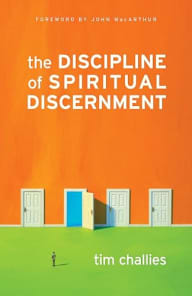
Those of you with an eagle-eye will have already noticed that I am publicizing Tim Challies’ forthcoming book, The Discipline of Spiritual Discernment. I doubt that many are surprised that I should want to encourage you to read his book, and I will show in this post why that is the case.
To begin with, however, I want to be very open and honest with you. When I first heard that Tim was writing a book I was actually a little concerned. This may surprise those regular readers who know how much I respect Tim and enjoy his blog. But I still had in my mind an old paradigm where those who are in some way “approved” as trained experts are the ones who should write books. Tim, like me, has no theological degrees. I also know that, just like me concerning this blog, he has been rather surprised by the way in which his readership has grown to an extent he never predicted (and, I should say, to a substantially larger figure than my own). So I was surprised that Tim put his neck on the line still further by taking on the challenge of writing a book.
Tim and I have both been riding a wave—the wave of blogging. In both the secular field and the Christian field, it seems that the most successful bloggers almost all seem to have something in common; they are not “officially trained” recognized global experts in their chosen fields. Perhaps this is because the real experts are too busy to write on a daily basis, or perhaps this is because of a new phenomena in our culture—one with which I’m not particularly thrilled, to be honest. In our 21st century culture there is a growing mistrust of any form of authority and of academics. It is actually rather sad to me that this now seems to be spilling over into the Church, and that it might seem, at first glance, to also include the Christian blogosphere.
One of the most influential early articles discussing the Christian blogging phenomenon was titled, “We Know More Than Our Pastors,” and it embodied this trend. It concerned me immensely. David Wayne summarized this piece and sounded some very valid concerns about it. For me, I wanted almost nothing to do with the concepts outlined therein.
Even as I have enjoyed the way that I have been able to be buffeted in this hurricane called blogging, I have also been somewhat concerned about some of the implications of this new marketplace of ideas. I suppose that, despite these reservations, I remain in the blogosphere because I am drawn to it as surely as a bee is to a flower in bloom, and as the Apostle Paul was to the debating spots of ancient Athens.
I am also here because somebody has to be. I am certainly not here because I imagine myself to be at the vanguard of some modern reformation that will sweep away the “old guard” in the way some bloggers (usually not Christian ones) speak about. I am here because, ironically enough, I see this new media as a way that we can proclaim the old, old message. I am here because, in some small way, I can act as a signpost to direct passing traffic to wiser heads than mine. The more readers I find visiting here, the more I feel the need to both quote and link to others. Whatever the size of your blog readership, that filtering process is the single best gift you can give both to your readers and to the writers of even the biggest blogs. I am pleased that the headlines from several bloggers who deserve to be read more than I do appear in the “Warnie Winners” box in my sidebar.
The blogging community can be thought of as a road system, a library, an ecosystem, or perhaps most aptly of all, a jungle. With no single classification system or map, what is needed are good wise guides. There are precious few of them online.
 One such wise guide is surely Tim Challies. I know that he shares many of my concerns about the world of blogs, and has a similar attitude in wanting to support those in positions of authority in the Church rather than tearing them down. I know that he is submissive to others. I like that he respects those, like me, who might differ with him on secondary issues, but firmly join hands on the Gospel. I have also met a godly man called Paul Martin who pastors him wisely. The more I came to know Tim, the more my concerns about the concept of a non-expert writing
a book began to evaporate. If the modern world needs non-experts to grapple with the words of the experts and make them more accessible to the rest of us, then those who have been given that gift should be encouraged to find an appropriate outlet, even if that looks a bit different from previous models.
Writing a book is very different from writing a blog, even though the number of words involved in a blog over the years may be just as numerous. With a blog, there is instant feedback, and a chance to easily go back and reword or retract an argument. With a book, not only is it more permanent, it is somehow expected to be more accurate, so the responsibility feels greater. James 3 is ever present in the mind of a preacher, and should be in the mind of a blogger as well. Speaking personally, I have applied it even more strongly to the concept of writing a book, which quite frankly has always terrified me rather than attracted me.
But for some people there comes a time when a book finds them and demands to be written. That is what has happened to the man I am glad to call my friend, Tim Challies. He is painfully aware of the cacophony of voices available online, and the need to discriminate between them. The average member of your congregation might well be either theologically illiterate or have imbibed a watered-down, overly simplistic doctrinal system which he has heard away from your church pulpit. Blogs, mp3s, books, magazines, TV programs, conferences, and radio all compete for the minds of modern Christians. The battle has never been stronger. How should we respond to this?
There are a number of different approaches that could be taken. We could just ignore what is going on around us, which would not be wise. We could, instead, become great experts in the different types of false teaching that are being purveyed. There are some bloggers who seem to have the goal of ferreting out everything that is less than perfect. These are often termed “watch blogs.” The temptation is to take some kind of perverse gratification out of proving others wrong. As the years have gone on, by God’s grace, that temptation has increasingly looked less appealing to me, although there was a time when I frequently delighted in giving in to it.
Sometimes even bloggers with good intentions can fall into the trap of being over zealous in their discernment. I am sure I have fallen into that trap myself at times.
But this past week, in reading a post by Phil Johnson, I thought I saw a classic example of someone who had over-reached himself in reacting to some things he had discerned. Now, don’t get me wrong. I share many of Phil’s concerns. I am indeed concerned about some aspects of Willow Creek’s ministry philosophy. Personally, I am not sure how to interpret their recent “repentance,” and certainly was VERY worried to see that they have invited Brian McLaren to speak at one of their conferences. BUT it bothers me that Phil seemed (at least to me) to be implying that Willow Creek has absolutely nothing to teach us. I am sure that if we fail to recognize something as being good and helpful and true, we fail in our discernment as much as if we blindly accepted everything in a naive way. I know it sounds cliched, but we really must be looking for the good in people, especially in those who have not denied important aspects of the Gospel. It is quite correct to say, “I like what this person says about the following subject, and have learned from them, although I disagree strongly with them on another subject.” If, instead, we lump people and whole movements together into an amorphous lump of theological rejects, surely we risk alienating them and, ironically, driving some further away from the truth of the Gospel that I know Phil and I both love.
But if Phil was harsh on Willow Creek, he went on in the same post to be even harder on the charismatics. I mention this because this kind of over-zealous discernment is sadly quite common. Again, quite rightly, he was pointing out the sin in a specific charismatic minister. Also, quite rightly, he was pointing out that due to an absence of discernment this kind of error is all too common in the charismatic movement, and sadly is often covered up. So far so good. And, despite his claim that his charismatic friends would be angry at these comments, I agree! What I struggle with, however, is that he then makes plain that he believes that charismatic doctrine itself is to blame for these sins and the lack of discernment that allows them to continue unchallenged. Phil applies the red card of his disapproval to the entire movement that, despite all its acknowledged weaknesses, I am thrilled to have been part of for decades. Should we use discernment with such a broad brush stroke?
 My dear friend, Jesse Phillips, took Phil to task admirably in the comments section and repeated this on his own blog. No one seemed able to answer his arguments that while it is true that some second-order implications which people draw from core charismatic doctrine do encourage gullibility and an absence of discernment, the core doctrines themselves do not need to do so. Phil, in reply, claimed that reformed charismatics were a new breed, and only caused by alien influences on the movement. This is not true. Men like Terry Virgo and C. J. Mahaney and the groups of churches they lead have been around for many decades now. Perhaps these groups are not as visible as they could be, but I know they are also not alone in being committed to a firm grasp on reality and the wisdom of the Bible.
To simply dismiss the entire charismatic movement in just one sentence does not seem a wise response to the fastest growing segment of Christianity. It is not, of course, wrong to disagree with charismatic theology (some of my best friends online are cessationists, like Tim himself, of course), but Phil does not seem to recognize any good that has come out of the movement. It would be like me refusing to acknowledge the fantastic work being produced by cessationists. Much as I disagree with some of the positions cessationists take, I am willing to go so far as to state I learn as much and perhaps even more helpful theology from their teachers as I do from fellow charismatic teachers. Doesn’t discernment require that we identify helpful material even when it comes from those we disagree with on relatively minor points?
There is surely another way to respond to the marketplace of ideas to which we are exposed in today’s church. The single best approach to discerning truth from error is to focus on understanding and proclaiming the truth more (while remaining aware of what is being taught around us). We need to learn to recognize the truth for ourselves by studying the Bible. But we must recognize that we ourselves are not immune to error. We need to ask God for humility wherein we submit ourselves to the views of others and are willing to be taught by them. Indeed, we should be willing to use our discernment as a sieve to strain out the good bits from a mixture of error in order to do so. None of us has a monop
oly on truth, or for that matter, error. Some may grasp certain aspects of the truth with remarkable ease, while others of us may struggle to understand it for years. There is, in my view, often much truth in the very ministries of those who we eagerly criticize. We can learn from more people than we like to think we can—provided we have discernment. I am frequently provoked when I read the writings or listen to the teachings of others who come from different parts of the Church than I. This must be done with caution, of course, and requires that I have studied the Bible for myself first. The more we understand the biblical truth for ourselves the better skilled we will become at testing everything and holding onto the good. I love the way Tim says it in his book:
“We can best know what is wrong by first knowing what is right. Experts on counterfeit currency know this as well. They train others first to know the traits of genuine currency because such knowledge will make apparent what is fraudulent. Christians need to dedicate themselves to learning and knowing truth so that what is evil and abnormal will appear obvious. For this reason the Apostle writes, “Finally, brothers, whatever is true, whatever is honorable, whatever is just, whatever is pure, whatever is lovely, whatever is commendable, if there is any excellence, if there is anything worthy of praise, think about these things” (Philippians 4:8). He encourages us to think first and foremost about what is right and true and pure and lovely. In Romans 16:19b he says this as well, exhorting the Roman church “to be wise as to what is good and innocent as to what is evil.” Never does the Bible tell us to dwell primarily or repeatedly upon what is false.
The relationship of truth to error is such that we can best know error by knowing truth. The opposite is not true. People who invest undue effort in concentrating upon what is false will not necessarily be able to identify what is true. By dwelling upon the beautiful truths of Scripture we will subsequently learn discernment. A discerning person will know that he must focus his heart upon what is true and pure and lovely, having confidence that in doing this God will bless Him with the ability to expose darkness.”
Tim Challies takes us from the turbulent marketplace of ideas that is the modern western church back into the world of the Scriptures. Sadly, today many people fall into the trap of being naively blown from one wind of teaching to another. Others become so expert at straining out the gnats of what they believe to be error that they are unable to learn from anybody. Instead they believe themselves to be the guardians of “true” doctrine. Tim shows us from the Bible itself how to avoid both errors. Tim’s reliance on the Bible is refreshing in an age when doctrinal pillars of our faith are being challenged by prominent preachers, and there is a constant search for novelty in parts of the Church. This book, like no other I have seen, aims to give ordinary Christians like you and me the tools we need to learn how to discern truth from error. I wholeheartedly urge you to get yourself a copy and read it, and then buy one for a friend.
I will close by quoting another passage from Tim’s book that expresses well his aim in writing the book:
This book is written for the general reader who wishes to understand discernment, to understand what the Bible teaches us about discernment, and who wishes to equip himself in this discipline. It is not written primarily for people with theological training, though I trust they, too, can benefit from it. Rather, it is written for you and for me—average Christians living in a culture and in a church where it so often seems that anything goes. It is written for those who look at much of what is said and done in the name of Jesus and ask themselves, “How can this be right?” It is written for all those who believe that it is the duty of every Christian to think biblically about all areas of life so that they might act biblically in all areas of life . . .
I do not intend to do the work of discernment for you. There are many books, web sites, and ministries that claim to teach discernment but do so by simply listing all the things you must do and the things you must not do. This book approaches the subject differently and is the result of my studies in Scripture to find the tools of discernment that God provides to us in his Word. And so I will not present a list of ministries you should avoid or endorse, authors whose books you should burn or buy, and music you should not listen to or that you should immediately download to your MP3 player. Rather, I hope to teach biblical wisdom on how you and I can become more discerning. I will present to you the wisdom of the Bible as it teaches us how we can become men and women of discernment. I will present principles you can use as you walk this life distinguishing between what is truth and what is error, what is right and what is wrong.
UPDATE—November 3, 2007
Phil has now written part two of his reply, and I have responded with a post entitled, “Of Tone, Discernment, and the Charismatic Question.”
UPDATE—October 29, 2007
Phil Johnson over at Pyromaniacs and I have been debating the issues raised by my criticism of him in the comments section of his original post. Just search for “Adrian” using the “find in page” function if you want to follow our specific debate. Phil has also written a new post, “If you can’t say something nice,” and we are debating in the comments on that post.
I will leave this post at the top of my blog for a couple more days as I want to give you all a chance to read it. If you are interested in some of my related thoughts on this subject, you could read the following posts:
- My Visit to the Billy Graham Center
- I Don’t Want Balance, I Want It All!
- My Comments Policy
- Blogging Principles for Christians
General Christian
Previous Post

October 25, 2007
Twelve Literary Features of the Bible
Next Post
October 30, 2007 Applying Discernment - Far From Simple
Browse Our Archives
Select a Category 1 and 2 Corinthians 1 and 2 Thessalonians 1 and 2 Timothy 1 John 300 Leaders A Life of Joy Abortion Acts of the Apostles Adrian on radio Adrian on TV Adrian's Story Albert Mohler Amazing Grace Arminocalvinist Spectrum Assurance Atonement Atonement Series Attributes of God Barnabas Best of the Blog Bible Bible Software Bible Translation Biblical Inerrancy Billy Graham Bob Roberts Books C. J. Mahaney Calvinism Cessationism Charis Warnock Charismatic Spectrum Charles Simeon Charles Spurgeon Church Leadership Colossians Complementarian - Egalitarian Spectrum Complementarianism Conferences Culture Daniel Debates Deuteronomy DGM08 DGM13 Discernment Doctrine Don Carson Ed Stetzer Eddy Leo Ephesians ESV Bible Translators Interview Evangelism in a Post-Christian World evolution Exodus Expository Preaching Ezekial Faith and Feelings Family Florida Galatians General Genesis Get Wisdom - Proverbs sermons Gifts of The Holy Spirit Gifts of the Holy Spirit 2006 Global Faith Forum Godly Attitudes Gospel Gospels Grace Greg Haslam Grudem vs Piper: The Baptism Debate Healing Heaven Hell and Rob Bell Hebrews Henry Tyler Henry Warnock Holy Spirit Holy Spirit Baptism Hope Reborn Hugh Palmer Irresistable Grace Isaiah J. I. Packer Jack Hayford Joel Joel Warnock John John Lanferman John MacArthur John Newton John Owen John Piper John Smyth Jonathan Edwards Josh Harris Justification Justin Taylor Kenneth Ulmer Leadership Leadership Lessons from 1 & 2 Samuel Lex Loizides Liam Goligher Lig Duncan Limited Atonement Lou Fellingham Mark Dever Mark Driscoll Martyn Lloyd-Jones Matt Chandler Mental Health Missionary Methods: St Paul’s or Ours? My Story N. T. Wright Nehemiah NWA08 NWA09 NWA10 Opinion OT History Books Pentateuch Personal Personal Revival Philippians PJ Smyth Podcast Politics Preaching Prophecy Proverbs Psalms Raised With Christ Reformed Charismatic Regeneration Relationships Resurrection Resurrection & Salvation Revival Rice Broocks Rich Man and Lazarus Rick Warren Rob Rufus Roland Allen Romans Sam Storms Sanctification Series Sermons Sermons on Philippians Serving Jesus at Work Sexuality Sin St Paul Steve Chalke Strange Fire Suffering T4G T4G Statement TAB09 Tamasin Warnock Teamwork Terry Virgo The Atonement Debate - Chalke book The Soulwinner The Spirit-Filled Church The Traitor Within Theologcial Spectrums Theosis Tim Challies Tim Keller Titus TOAM06 TOAM07 TOAM08 TOAM09 TOAM10 TOAM11 Todd Bentley Tope Koleoso Total Depravity Video Water Baptism Wayne Grudem Worship
Select a Month October 2026 September 2026 August 2026 July 2026 June 2026 May 2026 April 2026 March 2026 February 2026 January 2026 December 2025 November 2025 October 2025 September 2025 May 2025 April 2025 January 2025 November 2024 October 2024 August 2024 July 2024 June 2024 May 2024 April 2024 March 2024 February 2024 January 2024 December 2023 August 2023 May 2023 April 2023 February 2023 October 2022 September 2022 August 2022 July 2022 June 2022 May 2022 April 2022 March 2022 February 2022 August 2021 May 2021 April 2021 February 2021 January 2021 December 2020 October 2020 September 2020 August 2020 July 2020 June 2020 May 2020 April 2020 March 2020 February 2020 January 2020 December 2019 November 2019 October 2019 September 2019 June 2019 May 2019 April 2019 March 2019 January 2019 December 2018 October 2018 September 2018 August 2018 July 2018 June 2018 May 2018 April 2018 March 2018 February 2018 January 2018 December 2017 November 2017 October 2017 September 2017 June 2017 April 2017 March 2017 February 2017 January 2017 December 2016 November 2016 October 2016 June 2016 March 2016 February 2016 January 2016 December 2015 November 2015 September 2015 August 2015 July 2015 June 2015 May 2015 April 2015 March 2015 February 2015 January 2015 December 2014 November 2014 October 2014 September 2014 August 2014 July 2014 June 2014 May 2014 April 2014 March 2014 February 2014 January 2014 December 2013 November 2013 October 2013 September 2013 August 2013 July 2013 June 2013 May 2013 April 2013 March 2013 February 2013 January 2013 December 2012 November 2012 October 2012 September 2012 August 2012 July 2012 June 2012 May 2012 April 2012 March 2012 February 2012 January 2012 December 2011 November 2011 October 2011 September 2011 August 2011 July 2011 June 2011 May 2011 April 2011 March 2011 February 2011 January 2011 December 2010 November 2010 October 2010 September 2010 August 2010 July 2010 June 2010 May 2010 April 2010 March 2010 February 2010 January 2010 December 2009 November 2009 October 2009 September 2009 August 2009 July 2009 June 2009 May 2009 April 2009 March 2009 February 2009 January 2009 December 2008 November 2008 October 2008 September 2008 August 2008 July 2008 June 2008 May 2008 April 2008 March 2008 February 2008 January 2008 December 2007 November 2007 October 2007 September 2007 August 2007 July 2007 June 2007 May 2007 April 2007 March 2007 February 2007 January 2007 December 2006 November 2006 October 2006 September 2006 August 2006 July 2006 June 2006 May 2006 April 2006 March 2006 February 2006 January 2006 December 2005 November 2005 October 2005 September 2005 August 2005 July 2005 June 2005 May 2005 April 2005 March 2005 February 2005 January 2005 December 2004 November 2004 October 2004 September 2004 August 2004 July 2004 June 2004 May 2004 April 2004 March 2004 February 2004 January 2004 December 2003 November 2003 October 2003 September 2003 August 2003 July 2003 June 2003 May 2003 April 2003
Follow Us!
TAKE THE
Religious Wisdom Quiz
What does "Apocalypse" mean in Greek?
Select your answer to see how you score.
End of world Revelation or unveiling Redemption Wrath
Books by This Author Books by Adrian Warnock
Related posts from Adrian Warnock

"Open" is not Biblical, "eagerly desire spiritual gifts"...

Tim Challies Interview: "We trust God with that...

Franklin Graham Denies Trump Image Has Spiritual References

The Cross Alone Cannot Save You
TRENDING AT PATHEOS Evangelical

The REST of Your Life: A Creative Wrestles...
This week I had a conversation with a good friend from church....

How the author of the world's best hymn...
I've been working with John Newton for a while now. This makes...

Long before this Lectio Divina, Psalm 130 - the song - started...

What About the Trees? Another Living Parable
After I finished writing the last article about falling leaves as a...

Why Classical Education Is a Conversation, Not a...
Come and Read: Joy in Classical Education When I was a little...

Cornell University has received a great deal of negative publicity and intense...
view all Evangelical blogs
Ad-Free & Subscriber Log-In Subscription Support
- About Us
- 2026 Calendar
- Videos
- Podcasts
- Library of World Religions
- Faith In Media Tracker
- Advertise With Us
- Write for Us
- Privacy Policy
- Terms of Service
- Do Not Sell My Data
- Contact Us
- Radiant Digital
- Manage Newsletter Subscriptions
- Unsubscribe From Notifications
- Sitemap
Copyright 2008-2026, Patheos. All rights reserved.
Subscription Support Ad-Free & Subscriber Log-In
Follow Patheos