
BuddhistCatholicContemplativeEvangelicalGeneral ChristianHinduJewishLatter-day SaintMuslimNew VisionsProgressive Christian
Beliefs
- Buddhist
- Catholic
- Contemplative
- Evangelical
- General Christian
- Hindu
- Jewish
- Latter-day Saint
- More Voices
- Muslim
- New Visions
- Pagan
- Progressive Christian
Topics
- Religion News
- Food and Religion
- Sports and Religion
- Religious Art
- Religious Music and Entertainment
- Religious Events
- History and Religion
- Style and Religion
- Politics and Religion
- Women in Religion
- Recreation Outdoors and Religion
- Business Finance and Religion
- Careers Workplace and Religion
- Education and Religion
- Family Parenting and Religion
- Health Fitness and Religion
- Home and Religion
- Relationships and Religion
- Technology and Religion
- Travel and Religion
Columnists
- Buddhist Columnists
- Business Finance and Religion Columnists
- Careers Workplace and Religion Columnists
- Catholic Columnists
- Contemplative Columnists
- Education and Religion Columnists
- Evangelists Columnists
- Family Parenting and Religion Columnists
- General Christian Columnists
- Health Fitness and Religion Columnists
- Hindu Columnists
- History and Religion Columnists
- Home and Religion Columnists
- Jewish Columnists
- More Voices Columnists
- Latter Day Columnists
- Muslim Columnists
- New Visions Columnists
- Nonreligious Columnists
- Pagan Columnists
- Politics and Religion Columnists
- Progressive Columnists
- Recreation Outdoors and Religion Columnists
- Relationships and Religion Columnists
- Religion News Columnists
- Religious Art Columnists
- Religious Events Columnists
- Religious Music and Entertainment Columnists
- Sports and Religion Columnists
- Style and Religion Columnists
- Technology and Religion Columnists
- Travel and Religion Columnists
- Women in Religion Columnists
Resource Library
- 2026 Calendar
- Library of World Religions
- The 100 Most Holy Places on Earth
- Patheos Answers
- Podcasts
- Videos
- Faith Leaders Database
- Anglican Episcopalian
- Bahai
- Baptist
- Buddhism
- Christianity
- Confucianism
- Eastern Orthodoxy
- Hinduism
- Holiness and Pentecostal
- ISKCON
- Islam
- Judaism
- Lutheran
- Methodist
- The Church of Jesus Christ of Latter-day Saints
- New Age
- Paganism
- Presbytarian and Reformed
- Protestantism
- Religion Behind the Scenes
- Roman Catholic
- Scientology
- Shia Islam
- Sikhism
- Sufism
- Sunni Islam
- Taoism
- Zen
- See all religions
Research Tools
 Ad-Free & Subscriber Log-In Subscription Support
Ad-Free & Subscriber Log-In Subscription Support
Follow Patheos 

- Trending:
- Forgiveness
- |
- Marriage
- |
- Consciousness
- |
- Death Penalty
- |
- Election
- |
- Halloween
 Adamantine Muse
- Home
- Pagan
- The Horn of the Unicorn – Part 3
The Horn of the Unicorn – Part 3
Last updated on: November 17, 2020 at 1:23 pm by Sorita d'Este
The Horn of the Unicorn – Part 3 2020-11-17T13:23:52+01:00 Sorita d'Este
Patheos Explore the world's faith through different perspectives on religion and spirituality! Patheos has the views of the prevalent religions and spiritualities of the world.
Originally published as Alchemy, Innocence and Transformation – The Horn of the Unicorn by Sorita d’Este in SILKMILK, Jan 2010.
Read Part 1 HERE, Part 2 HERE.
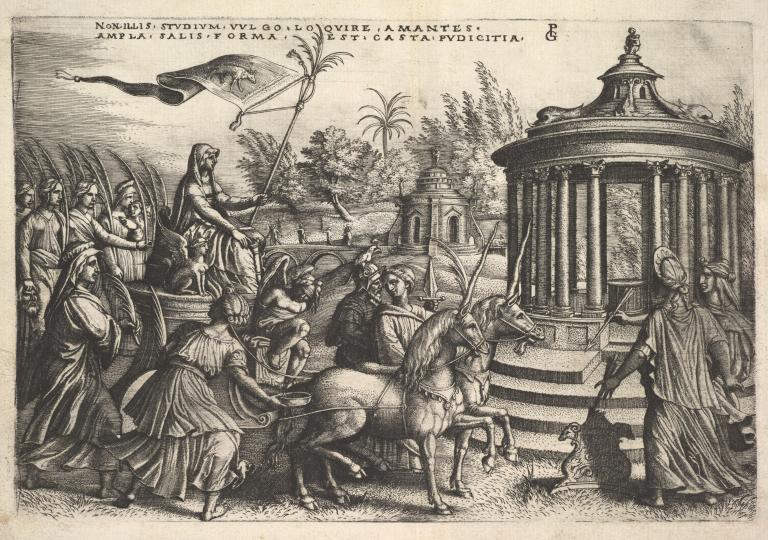
Triumph of Chastity: unicorns draw a carriage bearing a female figure seated next to a sphinx and holding a standard, Vestal virgins walk behind the carriage, round temple of Vesta at right, from the series ‘The Triumphs of Petrarch’
ca. 1539, Georg Pencz ; German
If we look to the Orient, the unicorn was perceived as being one of the four sacred animals there, associated with the element of Earth. It is more brightly hued than its occidental counterpart, with its colours being red, yellow, blue, white and black, or in other words the primary colours and the twin poles of light and dark. The oriental unicorn is a gentle beast, representing the noble qualities with its bell-like voice and its pacifistic non-violent approach to all life. These unicorns are only seen when the ruler is wise and benevolent, reflecting the association between a good ruler and the land they rule.
Back to the horn of the unicorn, this was famous for its credited magical powers, making it highly prized. The alleged powers of unicorn horn to neutralise any poison, cure diseases, epilepsy, plague and rabies ensured a profitable trade in such substitutes as narwhale horn, walrus tusk and rhinoceros horn. In the seventeenth century, Sir Nathaniel Bacon of Stiffkey went as far as directing which daughter would have custody of the unicorn horn in his will, though directing that all his family should have access to it for its healing powers.
The Greek physician Ctesias wrote in Book 25 of his work Indica in 398 BCE that,
“You cannot catch them alive. The flesh of this animal is so bitter that it is inedible; it is hunted for its horn and ankle bone.”
Ctesias may be the source for the trade-in healing unicorn horn, as he also wrote in the same work on the virtues of the horn and its protective abilities against poisons and sickness. Writing around a century later the Greek official Megasthenes commented on the spiral rings on the horn of the unicorn in his work India, setting the pattern for narwhale horn with its left-hand spiral to be the surrogate for unicorn horn. Between these two ancient authors came the reign of Alexander the Great, whose short, but highly influential life spanned the period 356-323 BCE. Alexander’s auspicious birth was on the same day that the Temple of Artemis of Ephesus was burned down, and it
was later said that this happened because the lunar Artemis was away overseeing his birth in her role as a kourotrophos (birth goddess). Alexander’s influence was to bring together the different civilizations of the world, from India to Egypt, Greece to Persia. The result of
this was the cross-fertilization of concepts regarding ideas including those such as alchemy and unicorns.
In her classic work Physica, the Christian mystic Abbess Hildegard of Bingen (1098-1179) wrote of a little piece of metal or glass found at the base of the unicorn horn. This subsequently became lapis monoceros (unicorn stone), which was described as a red stone found at the base of a unicorn’s horn. Lapis Monoceros was credited not only with all the powers attributed to unicorn horn but also with the power of projection (i.e. transmutation of base metals to gold) associated with the philosopher’s stone, bringing us back to the lunar unicorn of alchemy.
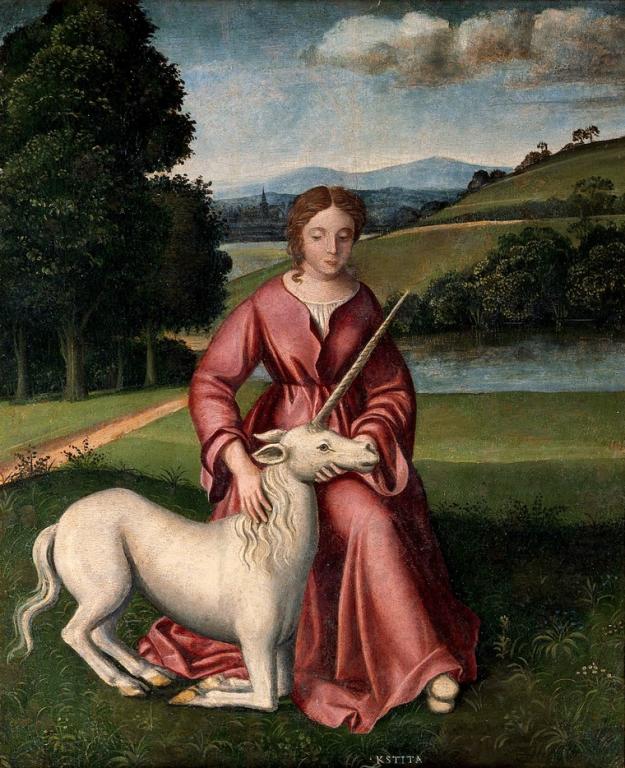
A virgin and a unicorn; representing chastity. Oil painting.. Credit: Wellcome Collection. Attribution 4.0 International (CC BY 4.0)
Read Part 1 HERE, Part 2 HERE.
Previous Post

November 17, 2020
The Horn of the Unicorn - Part 2
Next Post

November 25, 2020 Payam Nabarz - Children of Earth Interviews
Browse Our Archives
Select a Category Adamantine Musings Book Celtic Children of Earth - Interviews Christianity Druidry Elemental Magic Events Glastonbury Goddesses greek god Hekate Hellenic Hermes Ireland Italy magic(k) Mermaids Nature Pilgrimage Psychic & Mediumship Qabalah Roman Scotland Uncategorized Unicorns Vodou Wicca & Witchcraft
Select a Month November 2020 October 2020 August 2020 April 2020 October 2019 September 2019 August 2019 July 2019 June 2019 May 2019 November 2018 October 2018 July 2018 April 2018 March 2018 January 2018 December 2017 November 2017 July 2017 June 2017 February 2017 January 2017 December 2016 August 2016 July 2016 June 2016
Follow Us!
TAKE THE
Religious Wisdom Quiz
How many years between the exodus of the Children of Israel and construction of the temple?
Select your answer to see how you score.
400 years 500 years 450 years 480 years
Related posts from Adamantine Muse
The Horn of the Unicorn - Part 2
The Horn of the Unicorn - Part 1
TRENDING AT PATHEOS Pagan

When we talk about Greek religion, we often begin with the dodekatheion—the...

I was recently chatting with someone on Instagram. She asked me what...

While there are many people who share their results, the end of...

On July 23, I saw Christopher Nolan's The Odyssey which is Homer’s...

As I write this two big events have just finished up. One...

Restoring the Watershed of Divine Love
Perhaps cooperation is not something we manufacture through legislation, ideology, or moral...
view all Pagan blogs
Ad-Free & Subscriber Log-In Subscription Support
- About Us
- 2026 Calendar
- Videos
- Podcasts
- Library of World Religions
- Faith In Media Tracker
- Advertise With Us
- Write for Us
- Privacy Policy
- Terms of Service
- Do Not Sell My Data
- Contact Us
- Radiant Digital
- Manage Newsletter Subscriptions
- Unsubscribe From Notifications
- Sitemap
Copyright 2008-2026, Patheos. All rights reserved.
Subscription Support Ad-Free & Subscriber Log-In
Follow Patheos