
BuddhistCatholicContemplativeEvangelicalGeneral ChristianHinduJewishLatter-day SaintMuslimNew VisionsProgressive Christian
Beliefs
- Buddhist
- Catholic
- Contemplative
- Evangelical
- General Christian
- Hindu
- Jewish
- Latter-day Saint
- More Voices
- Muslim
- New Visions
- Pagan
- Progressive Christian
Topics
- Religion News
- Food and Religion
- Sports and Religion
- Religious Art
- Religious Music and Entertainment
- Religious Events
- History and Religion
- Style and Religion
- Politics and Religion
- Women in Religion
- Recreation Outdoors and Religion
- Business Finance and Religion
- Careers Workplace and Religion
- Education and Religion
- Family Parenting and Religion
- Health Fitness and Religion
- Home and Religion
- Relationships and Religion
- Technology and Religion
- Travel and Religion
Columnists
- Buddhist Columnists
- Business Finance and Religion Columnists
- Careers Workplace and Religion Columnists
- Catholic Columnists
- Contemplative Columnists
- Education and Religion Columnists
- Evangelists Columnists
- Family Parenting and Religion Columnists
- General Christian Columnists
- Health Fitness and Religion Columnists
- Hindu Columnists
- History and Religion Columnists
- Home and Religion Columnists
- Jewish Columnists
- More Voices Columnists
- Latter Day Columnists
- Muslim Columnists
- New Visions Columnists
- Nonreligious Columnists
- Pagan Columnists
- Politics and Religion Columnists
- Progressive Columnists
- Recreation Outdoors and Religion Columnists
- Relationships and Religion Columnists
- Religion News Columnists
- Religious Art Columnists
- Religious Events Columnists
- Religious Music and Entertainment Columnists
- Sports and Religion Columnists
- Style and Religion Columnists
- Technology and Religion Columnists
- Travel and Religion Columnists
- Women in Religion Columnists
Resource Library
- 2026 Calendar
- Library of World Religions
- The 100 Most Holy Places on Earth
- Patheos Answers
- Podcasts
- Videos
- Faith Leaders Database
- Anglican Episcopalian
- Bahai
- Baptist
- Buddhism
- Christianity
- Confucianism
- Eastern Orthodoxy
- Hinduism
- Holiness and Pentecostal
- ISKCON
- Islam
- Judaism
- Lutheran
- Methodist
- The Church of Jesus Christ of Latter-day Saints
- New Age
- Paganism
- Presbytarian and Reformed
- Protestantism
- Religion Behind the Scenes
- Roman Catholic
- Scientology
- Shia Islam
- Sikhism
- Sufism
- Sunni Islam
- Taoism
- Zen
- See all religions
Research Tools
 Ad-Free & Subscriber Log-In Subscription Support
Ad-Free & Subscriber Log-In Subscription Support
Follow Patheos 

- Trending:
- Forgiveness
- |
- Marriage
- |
- Consciousness
- |
- Death Penalty
- |
- Election
- |
- Halloween
 Adamantine Muse
- Home
- Pagan
- The Horn of the Unicorn – Part 2
The Horn of the Unicorn – Part 2
Last updated on: November 17, 2020 at 1:24 pm by Sorita d'Este
The Horn of the Unicorn – Part 2 2020-11-17T13:24:17+01:00 Sorita d'Este
Patheos Explore the world's faith through different perspectives on religion and spirituality! Patheos has the views of the prevalent religions and spiritualities of the world.
Originally published as Alchemy, Innocence and Transformation – The Horn of the Unicorn by Sorita d’Este in SILKMILK, Jan 2010.
Read Part 1 HERE, Part 3 HERE.
Of course, it is significant that the Emerald Tablet was said to be the work of the greatest of alchemists, Hermes Trismegistus. Hermes was also credited with instructions on the creation of the Philosopher’s Stone and its properties in the work entitled Aureus: The Golden Tractate of Hermes Trismegistus. Concerning the Physical Secret of the Philosophers Stone:
“This, O Son, is the concealed stone of many colours, which is born
and brought forth in one colour; know this and conceal it. By this, the Almighty
favouring, the greatest diseases are escaped, and every sorrow, distress, and
evil and hurtful thing is made to depart; for it leads from darkness into light,
from this desert wilderness to a secure habitation, and from poverty and
straits to a free and ample fortune.”
The unicorn’s horn was also associated with the white stone, which represented the purified feminine forces. The feminine white stone and the masculine red stone may be seen as the two dissociated forces, which are united back together in the Philosopher’s Stone. These two colours represent the polarity of opposites in many systems – they are the sun and moon, the twin pillars of the temple, the unicorn and the lion, the list goes on. In alchemy, the white stone is the result of the process which corresponds to inner change. The alchemist worked on the reification of the feminine within, which would correspond to the feminine Neshamah or higher soul in Qabalah. The white stone symbolised spiritual purity, and this was reflected in the whiteness of the unicorn. It is not the white of calcination when the stone was turned to ash earlier in its evolution, nor yet the whiteness that follows the blackness of putrefaction. This is the whiteness of the robe of Diana, the pure lunar force which nurtures plants and engenders life. To the alchemist, this feminine purity was the only force which could tame the wildness of the unicorn.
The Philosopher’s Stone was also known as the Philosopher’s Elixir or Medicine, because its power-operated on several levels, not simply the physical power of projection (transmutation of metals), but also the purification of the self, making the body completely healthy and bringing longevity, if not immortality. The purification and unification of the soul was another aim of the Great Work, of creating the Philosopher’s Stone.
Like the Philosopher’s Stone, the unicorn is also particularly associated with purity. His horn had purifying qualities, and he could only be approached by a pure (virgin) maiden. It is easy to see why the unicorn and his horn should become such powerful symbols in
alchemy and the magic of the Renaissance, also turning up in works like the Rosicrucian Chemical Wedding of Christian Rosenkreutz.
The lunar imagery of the unicorn can also be observed in its polarity with solar animals, as can be seen in the common image of the solar lion (red stone) and the lunar unicorn (white stone), or the solar stag and the unicorn, as seen in the sixteenth century
Book of Lambspring, which declared that “The unicorn will be the spirit at all times.”
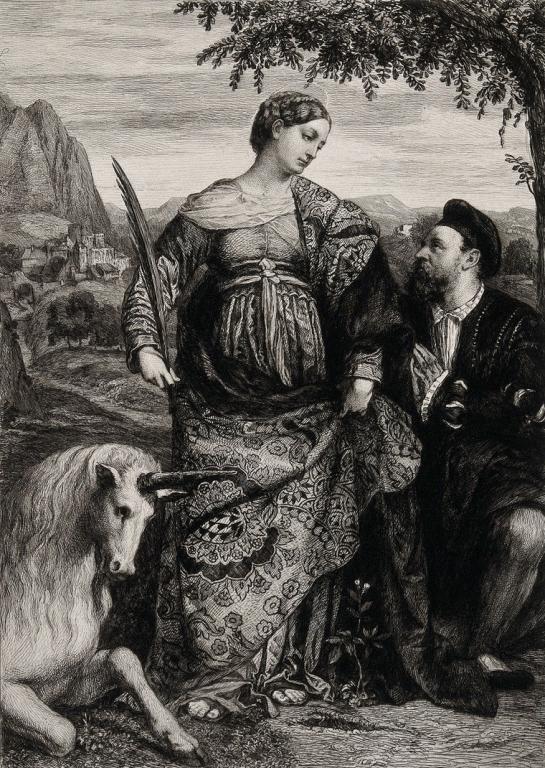
Saint Justina, with a unicorn and a man praying to her. Etching by W. Unger after Moretto of Brescia.. Credit: Wellcome Collection. Attribution 4.0 International (CC BY 4.0)
In Renaissance Italy this connection between the unicorn and the virgin goddesses was emphasised in art and literature, to emphasise chastity and purity. In 1470, Duke Borso d’Este had a series of planetary god murals painted in which he had two unicorns pulling the
chariot of the virgin goddess of wisdom, Pallas Athene. Subsequently, in 1499 the goddess Diana was depicted in a chariot pulled by six unicorns in a woodcut in the book The Dream of Polophilo.
That sourcebook of interesting material, the Bible, is full of references to unicorns (although more modern versions are phasing the unicorn out, probably a bit too pagan and magical, even though they were seen as symbolising Jesus in the Middle Ages), from Deuteronomy to Numbers, Isaiah to Job. Thus Psalms 92:10 observes,
“But my horn shalt
thou exalt like the horn of an unicorn.”
Neo-Assyrian cylinder seal impression from the eighth century BCE identified by several sources as a possible depiction of the slaying of Tiamat from the Enûma Eliš
By Ben Pirard at nl.wikipedia, CC BY-SA 3.0, https://commons.wikimedia.org/w/index.php?curid=3217534
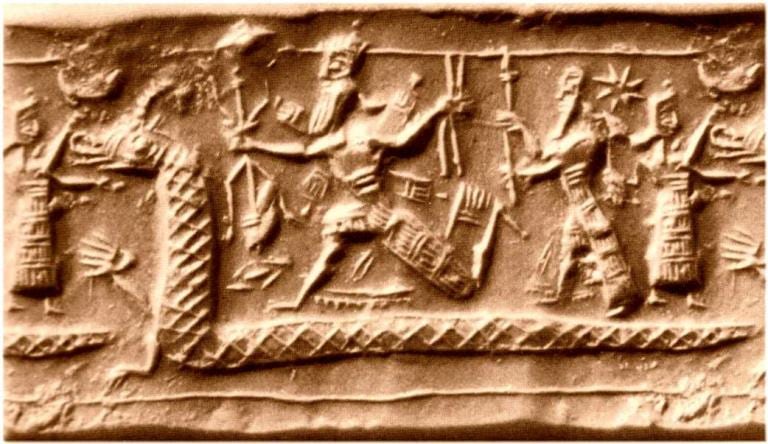
Unicorns were one of the eleven types of ‘monster’ created by the primal goddess Tiamat to fight the hero-god Marduk in the first epic celestial battle. Unfortunately for her, she lost and had her body chopped up to make the universe. The children of Tiamat were
described as deities, so the original unicorns have a high pedigree, which continued into the Zoroastrian image of the unicorn. There he was described as being as big as a mountain, and wiping out evil creatures and bringing purity wherever it went. The Zoroastrian unicorn
also has a golden horn, which is probably the root of this colouring. There however he was portrayed as impregnating the waters and causing mass births of young in animals wherever he went, so virginity was definitely not his domain.
Read Part 1 HERE, Part 3 HERE.
Previous Post
November 17, 2020
The Horn of the Unicorn - Part 1
Next Post

November 17, 2020 The Horn of the Unicorn - Part 3
Browse Our Archives
Select a Category Adamantine Musings Book Celtic Children of Earth - Interviews Christianity Druidry Elemental Magic Events Glastonbury Goddesses greek god Hekate Hellenic Hermes Ireland Italy magic(k) Mermaids Nature Pilgrimage Psychic & Mediumship Qabalah Roman Scotland Uncategorized Unicorns Vodou Wicca & Witchcraft
Select a Month November 2020 October 2020 August 2020 April 2020 October 2019 September 2019 August 2019 July 2019 June 2019 May 2019 November 2018 October 2018 July 2018 April 2018 March 2018 January 2018 December 2017 November 2017 July 2017 June 2017 February 2017 January 2017 December 2016 August 2016 July 2016 June 2016
Follow Us!
TAKE THE
Religious Wisdom Quiz
True or False: In Revelation, there are ten elders seated around God's throne.
Select your answer to see how you score.
TRUE FALSE
Related posts from Adamantine Muse
The Horn of the Unicorn - Part 3
The Horn of the Unicorn - Part 1
TRENDING AT PATHEOS Pagan

I was recently chatting with someone on Instagram. She asked me what...

While there are many people who share their results, the end of...

On July 23, I saw Christopher Nolan's The Odyssey which is Homer’s...

As I write this two big events have just finished up. One...

Restoring the Watershed of Divine Love
Perhaps cooperation is not something we manufacture through legislation, ideology, or moral...

Many UUs don’t pray because of bad experiences in a previous religion,...
view all Pagan blogs
Ad-Free & Subscriber Log-In Subscription Support
- About Us
- 2026 Calendar
- Videos
- Podcasts
- Library of World Religions
- Faith In Media Tracker
- Advertise With Us
- Write for Us
- Privacy Policy
- Terms of Service
- Do Not Sell My Data
- Contact Us
- Radiant Digital
- Manage Newsletter Subscriptions
- Unsubscribe From Notifications
- Sitemap
Copyright 2008-2026, Patheos. All rights reserved.
Subscription Support Ad-Free & Subscriber Log-In
Follow Patheos