
BuddhistCatholicContemplativeEvangelicalGeneral ChristianHinduJewishLatter-day SaintMuslimNew VisionsProgressive Christian
Beliefs
- Buddhist
- Catholic
- Contemplative
- Evangelical
- General Christian
- Hindu
- Jewish
- Latter-day Saint
- More Voices
- Muslim
- New Visions
- Pagan
- Progressive Christian
Topics
- Religion News
- Food and Religion
- Sports and Religion
- Religious Art
- Religious Music and Entertainment
- Religious Events
- History and Religion
- Style and Religion
- Politics and Religion
- Women in Religion
- Recreation Outdoors and Religion
- Business Finance and Religion
- Careers Workplace and Religion
- Education and Religion
- Family Parenting and Religion
- Health Fitness and Religion
- Home and Religion
- Relationships and Religion
- Technology and Religion
- Travel and Religion
Columnists
- Buddhist Columnists
- Business Finance and Religion Columnists
- Careers Workplace and Religion Columnists
- Catholic Columnists
- Contemplative Columnists
- Education and Religion Columnists
- Evangelists Columnists
- Family Parenting and Religion Columnists
- General Christian Columnists
- Health Fitness and Religion Columnists
- Hindu Columnists
- History and Religion Columnists
- Home and Religion Columnists
- Jewish Columnists
- More Voices Columnists
- Latter Day Columnists
- Muslim Columnists
- New Visions Columnists
- Nonreligious Columnists
- Pagan Columnists
- Politics and Religion Columnists
- Progressive Columnists
- Recreation Outdoors and Religion Columnists
- Relationships and Religion Columnists
- Religion News Columnists
- Religious Art Columnists
- Religious Events Columnists
- Religious Music and Entertainment Columnists
- Sports and Religion Columnists
- Style and Religion Columnists
- Technology and Religion Columnists
- Travel and Religion Columnists
- Women in Religion Columnists
Resource Library
- 2026 Calendar
- Library of World Religions
- The 100 Most Holy Places on Earth
- Patheos Answers
- Podcasts
- Videos
- Faith Leaders Database
- Anglican Episcopalian
- Bahai
- Baptist
- Buddhism
- Christianity
- Confucianism
- Eastern Orthodoxy
- Hinduism
- Holiness and Pentecostal
- ISKCON
- Islam
- Judaism
- Lutheran
- Methodist
- The Church of Jesus Christ of Latter-day Saints
- New Age
- Paganism
- Presbytarian and Reformed
- Protestantism
- Religion Behind the Scenes
- Roman Catholic
- Scientology
- Shia Islam
- Sikhism
- Sufism
- Sunni Islam
- Taoism
- Zen
- See all religions
Research Tools
 Ad-Free & Subscriber Log-In Subscription Support
Ad-Free & Subscriber Log-In Subscription Support
Follow Patheos 

- Trending:
- Forgiveness
- |
- Marriage
- |
- Consciousness
- |
- Death Penalty
- |
- Election
- |
- Halloween
 Adamantine Muse
- Home
- Pagan
- Samhain, Faerie Birds & Cú Chulainn’s birth
Samhain, Faerie Birds & Cú Chulainn’s birth
Last updated on: October 23, 2020 at 12:46 pm by Sorita d'Este
Samhain, Faerie Birds & Cú Chulainn’s birth 2020-10-21T12:59:31+01:00 Sorita d'Este
Patheos Explore the world's faith through different perspectives on religion and spirituality! Patheos has the views of the prevalent religions and spiritualities of the world.
Occasionally I like looking back at old projects, and Samhain always feels like a good time to be doing that. To look not just at our ancestral bloodline, but also our spiritual ancestors and the history of our own lives. For the last few days I have been sharing extracts from the book The Guises of the Morrigan which I co-authored with David Rankine. It was the first book I published when I started my business Avalonia, and although I am more often thought of today for my work with the Goddess Hekate, the Morrigan was an important deity in my work 20 or so years ago around the time I took on the mantle of High Priestess.
The story of the hero Cu Chulainn is intricately linked to that of the Morrigan. As such this story about the Faerie Birds whose song captivated the Ulstermen and who prophesies the birth of the hero at Samhain is an interesting one to add to those you tell around the fire or in Circle at Samhain.
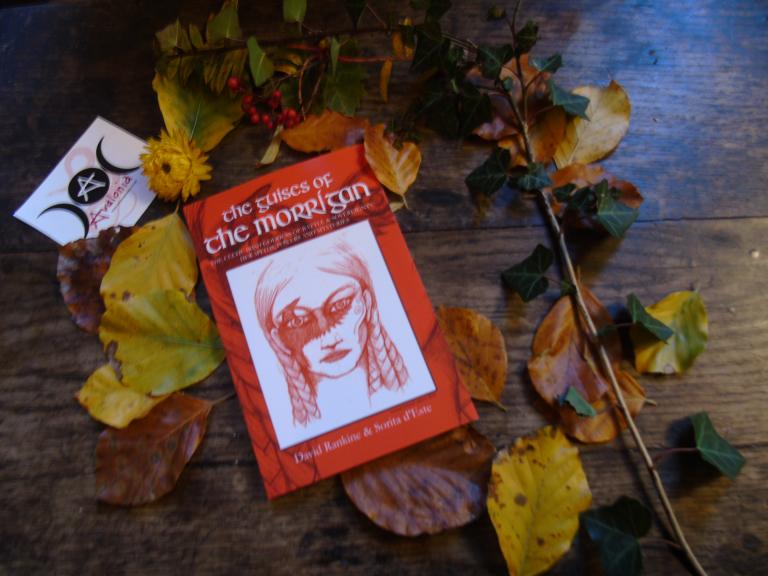
Guises of the Morrigan by David Rankine & Sorita d’Este. Cover art by Brian Andrews.
Faerie Birds
In The Conception of Cú Chulainn (Compert Con Culainn) a flight of faerie birds lays waste to the plain before Emain Macha and are pursued by the druid Conchobar and his daughter (or in some versions wife) Deichtine.
“The flight of the birds, and their song, captivated the Ulstermen with their beauty. There were nine score birds in all, with a silver chain between each pair of birds, and each score flew its own way. And two birds flew out in front, a silver yoke between them.”[1]
The birds eventually lead the party to a house where they feast, and the god Lugh appears to Deichtine in her dreams and tells her she will bear his child (Cú Chulainn). In an alternative version of the story Deichtine and fifty maidens transformed into the faerie birds. After three years of searching the men of Ulster find the maidens at a faerie house, and Cú Chulainn is born there.
The theme of faerie birds also occurs in The Wasting Sickness of Cú Chulainn (Serglige Con Culainn). The men of Ulster and their wives have gathered at the Plain of Murthemne to celebrate the winter festival of Samhain when a flock of beautiful birds land on a lake nearby.
All the women want a pair of these birds, but they argue over who is worthy of owning them. Cú Chulainn succeeds in catching all the birds and then distributes them.
As he gives the last ones away, he realises there are none left for his own wife. In this version of the story, his wife is called Ethne rather than Emer, which is more commonly used for her. Naturally, Ethne is angry and upset about being left out. To placate her, Cú Chulainn promises her that the next pair of birds to arrive will be hers. A pair of birds joined together by a chain arrives.[2] Recognising their otherworldly nature, symbolised by the connecting chain, both his wife and charioteer urge him not to use his sling on them. However, Cú Chulainn ignores them and on his third strike hits one of the birds on the wing.
Cú Chulainn then falls asleep sitting against a stone pillar and has a dream where two beautiful women laugh at him and beat him ferociously with a whip. When he wakes up, he is unable to speak and spends a year sick in bed. This is his punishment for attacking the faerie women in their bird forms, especially doing so ignoring the omen of missing them twice when he threw the stones. He never missed a throw in his life before and should have realised that the misses were for a magical reason.
The otherworldly nature of the women is subsequently revealed when Cú Chulainn is invited to the faerie realms to fight for one of the women in battle, with the promise of gainer her favour. He does so, but the subsequent tryst is prevented by his wife. She intervenes and holds his favour by the strength of her words and personality.
[1] Compert Con Culainn (The Conception of Cú Chulainn), from The Book of Druimm Snechta
[2] This motif of the two birds connected together with a chain occurs in a number of stories as a sign of the otherworld. See The Dream of Oengus (Aislinge Oengusso) and The Conception of Cú Chulainn (Compert Con Culainn).
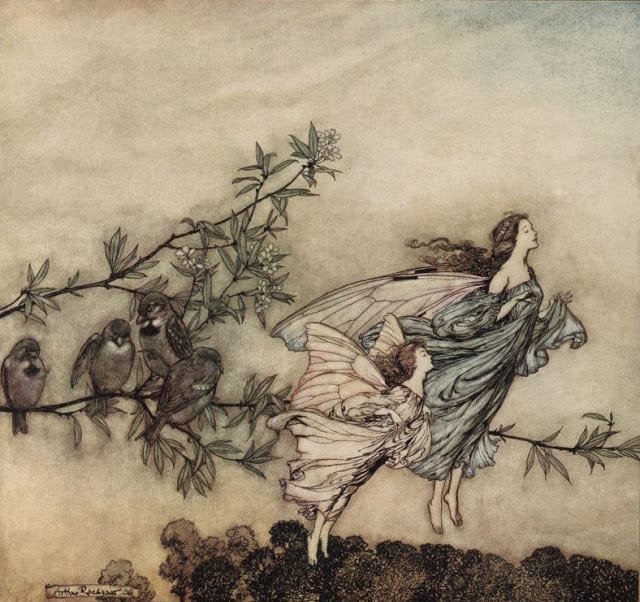
From Peter Pan in Kensington Gardens, illustrated by Arthur Rackham. The image has nothing whatsoever to do with the story above, but I love the art of Arthur Rackham (who doesn’t?) and thought this was a good excuse to include an old favourite in a blog 🙂

About Sorita d'Este
Sorita d’Este has been experimenting with ways of walking on the liminal since she was a child, exploring along the way many pathways of experiencing magic, mysticism and religion. Her own personal practise integrates aspects of Hellenic (Greek), Egyptian and Hermetic practices with a lived Orphic inspired philosophy, and experience gained in Initiatory Craft, traditions preserved in Italian, French and British grimoires and other contemporary esoteric teachings of the East and West. You can read more about the author here.
Previous Post
October 22, 2020
The Morrigan - Faerie Queen
Next Post
November 17, 2020 The Horn of the Unicorn - Part 1
Browse Our Archives
Select a Category Adamantine Musings Book Celtic Children of Earth - Interviews Christianity Druidry Elemental Magic Events Glastonbury Goddesses greek god Hekate Hellenic Hermes Ireland Italy magic(k) Mermaids Nature Pilgrimage Psychic & Mediumship Qabalah Roman Scotland Uncategorized Unicorns Vodou Wicca & Witchcraft
Select a Month November 2020 October 2020 August 2020 April 2020 October 2019 September 2019 August 2019 July 2019 June 2019 May 2019 November 2018 October 2018 July 2018 April 2018 March 2018 January 2018 December 2017 November 2017 July 2017 June 2017 February 2017 January 2017 December 2016 August 2016 July 2016 June 2016
Follow Us!
TAKE THE
Religious Wisdom Quiz
Who was the first woman created?
Select your answer to see how you score.
Leah Esther Sarah Eve
Related posts from Adamantine Muse
Janet Farrar & Gavin Bone - Children of...
TRENDING AT PATHEOS Pagan

When we talk about Greek religion, we often begin with the dodekatheion—the...

I was recently chatting with someone on Instagram. She asked me what...

While there are many people who share their results, the end of...

On July 23, I saw Christopher Nolan's The Odyssey which is Homer’s...

As I write this two big events have just finished up. One...

Restoring the Watershed of Divine Love
Perhaps cooperation is not something we manufacture through legislation, ideology, or moral...
view all Pagan blogs
Ad-Free & Subscriber Log-In Subscription Support
- About Us
- 2026 Calendar
- Videos
- Podcasts
- Library of World Religions
- Faith In Media Tracker
- Advertise With Us
- Write for Us
- Privacy Policy
- Terms of Service
- Do Not Sell My Data
- Contact Us
- Radiant Digital
- Manage Newsletter Subscriptions
- Unsubscribe From Notifications
- Sitemap
Copyright 2008-2026, Patheos. All rights reserved.
Subscription Support Ad-Free & Subscriber Log-In
Follow Patheos