
BuddhistCatholicContemplativeEvangelicalGeneral ChristianHinduJewishLatter-day SaintMuslimNew VisionsProgressive Christian
Beliefs
- Buddhist
- Catholic
- Contemplative
- Evangelical
- General Christian
- Hindu
- Jewish
- Latter-day Saint
- More Voices
- Muslim
- New Visions
- Pagan
- Progressive Christian
Topics
- Religion News
- Food and Religion
- Sports and Religion
- Religious Art
- Religious Music and Entertainment
- Religious Events
- History and Religion
- Style and Religion
- Politics and Religion
- Women in Religion
- Recreation Outdoors and Religion
- Business Finance and Religion
- Careers Workplace and Religion
- Education and Religion
- Family Parenting and Religion
- Health Fitness and Religion
- Home and Religion
- Relationships and Religion
- Technology and Religion
- Travel and Religion
Columnists
- Buddhist Columnists
- Business Finance and Religion Columnists
- Careers Workplace and Religion Columnists
- Catholic Columnists
- Contemplative Columnists
- Education and Religion Columnists
- Evangelists Columnists
- Family Parenting and Religion Columnists
- General Christian Columnists
- Health Fitness and Religion Columnists
- Hindu Columnists
- History and Religion Columnists
- Home and Religion Columnists
- Jewish Columnists
- More Voices Columnists
- Latter Day Columnists
- Muslim Columnists
- New Visions Columnists
- Nonreligious Columnists
- Pagan Columnists
- Politics and Religion Columnists
- Progressive Columnists
- Recreation Outdoors and Religion Columnists
- Relationships and Religion Columnists
- Religion News Columnists
- Religious Art Columnists
- Religious Events Columnists
- Religious Music and Entertainment Columnists
- Sports and Religion Columnists
- Style and Religion Columnists
- Technology and Religion Columnists
- Travel and Religion Columnists
- Women in Religion Columnists
Resource Library
- 2026 Calendar
- Library of World Religions
- The 100 Most Holy Places on Earth
- Patheos Answers
- Podcasts
- Videos
- Faith Leaders Database
- Anglican Episcopalian
- Bahai
- Baptist
- Buddhism
- Christianity
- Confucianism
- Eastern Orthodoxy
- Hinduism
- Holiness and Pentecostal
- ISKCON
- Islam
- Judaism
- Lutheran
- Methodist
- The Church of Jesus Christ of Latter-day Saints
- New Age
- Paganism
- Presbytarian and Reformed
- Protestantism
- Religion Behind the Scenes
- Roman Catholic
- Scientology
- Shia Islam
- Sikhism
- Sufism
- Sunni Islam
- Taoism
- Zen
- See all religions
Research Tools
 Ad-Free & Subscriber Log-In Subscription Support
Follow Patheos 

- Trending:
- Advent
- |
- Forgiveness
- |
- Thanksgiving
- |
- Election
- |
- Seasonal Holidays
- |
- Marriage
 Adamantine Muse
- Home
- Pagan
- Hekate’s Wheel & the Iynx Wheel
Hekate’s Wheel & the Iynx Wheel
Last updated on: August 28, 2020 at 10:10 am by Sorita d'Este
Hekate’s Wheel & the Iynx Wheel 2020-08-28T10:10:52+01:00 Sorita d'Este
Patheos Explore the world's faith through different perspectives on religion and spirituality! Patheos has the views of the prevalent religions and spiritualities of the world.
“Cyrene is also the location where Jason used the iynx wheel to cause Medea to fall in love with him.
According to Pindar Jason did this to ensure that Medea would follow him back to Athens.” ~ Circle for Hekate, V.1, d’Este
The Wheel of Hekate is a symbol that has become synonymous with the Goddess of the Crossroads in the last few decades, and it is confusingly sometimes named as an Iynx or Strophalos – which are ritual tools. A slight variant of the symbol appears in the Dua Lipa (featuring Madonna) “Levitating” video, in which there is a lot of significant Hekate related symbolism with a heavy emphasis on the Moon which is one of the likely sources for a surge in interest in the symbol.
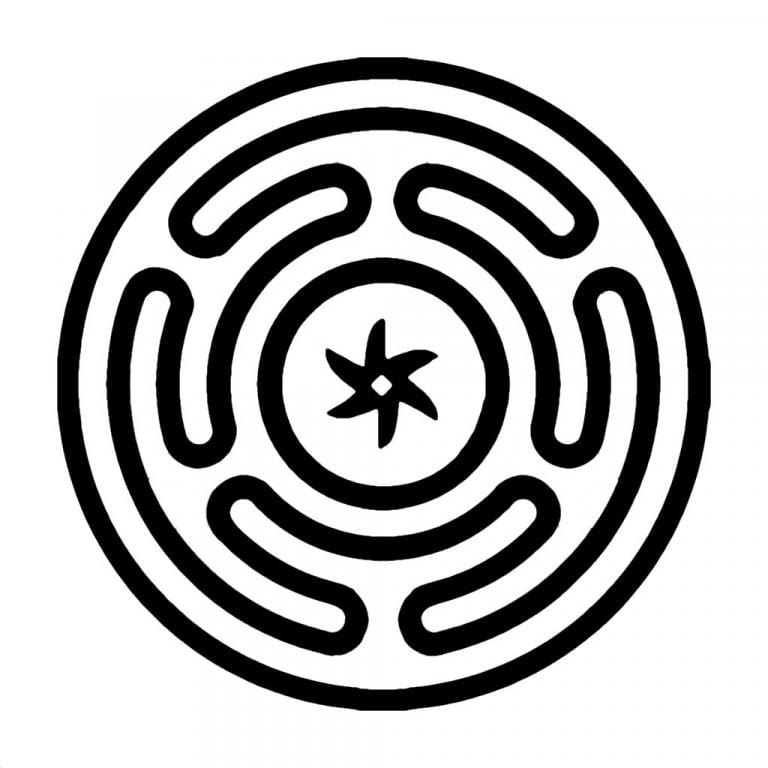
Hekate’s Wheel, from Circle for Hekate, Sorita d’Este
But what is this symbol and why is it linked to Hekate?

Screen Cap of Dua Lipa – Levitating showing a variant of the symbol on a record.
This is one of several occurrences of the symbol in the video.
I have not been able to track the symbol to a particular teacher or book, but have been told that it became used for Hekate in contemporary Pagan circles in the 1980’s. If anyone reading this can verify this, or provide further information – please do! Historically it does not appear to be a symbol linked specifically to Hekate, although the symbol and variant thereof, can be found on many small metal disks likely used as decoration dating to the Mycenean and Minoan civilisations. As an aside, I have often pondered, but not found evidence, that perhaps there is a link to the island of Aegina, where the Ancient Greek Geographer Pausanius tells us there was an important celebration of the Mysteries of Hekate. The Minoan treasures found on Aegina and currently in the British Museum collection is phenomenal, and includes depictions of Potnia Theron (Lady of the Animals, an iconic female figure closely associated with both Hekate and the Goddess Artemis). For convenience, here is a search showing the images on the British Museum Images database.
Wheel symbols are frequently associated with Hekate, but with the more usual sunwheel design. Dozens of these symbols are carved on the steps of the ruins of the Temple of Hekate in Lagina (Caria, modern Turkey).

Both the four spoked, and eight spoked wheels are found not only in Lagina, but also on many depictions, inscriptions and amulets showing the Goddess Hekate. There is a discussion about these in my book Circle for Hekate, Volume 1 (“Stars of Wheels, p.207 to 212).

Eight spoked Wheel at the Temple of Hekate Lagina.
Unfortunately, as with many things, there has been a bit of a misunderstanding about what Hekate’s Wheel is, which has resulted in it also being named as Hekate’s Iynx or Hekate’s Strophalos. Rankine and I named these tools in our 2009 book Hekate: Liminal Rites, and in Circle for Hekate in 2017 I dedicated a chapter to the topic, but because the conflated use of the terminology is so widespread, there is still a lot of confusion about it, which I hope this article will help untangle – at least a little!
What is the Iynx?
“The word iynx comes from the Greek name for the wryneck bird, a member of the woodpecker family who enjoys feasting on ants. The theory is that the original form in which the iynx wheel was used for magical purposes involved tying a wryneck to a wooden wheel which was then spun. A well-balanced iynx wheel makes a repetitive whirring sound, which somewhat resembles the pulsing call of the iynx bird in the wild.” – Circle for Hekate, V.1
The tool is named after the bird and was most often associated with the Goddess of Love, Aphrodite, and her son Eros who uses it as a tool to draw lovers together or to draw out passion. If you explore depictions of Eros, you will often see a little wheel or ring dangling from a string he is holding – this is the iynx!
“Draw my lover here, iynx (magic wheel)” – Idylls 2, Theocritus, 270 BCE, trans. Z. Yardley (Hekate: Liminal Rites, 2009)
In Theocritus’ Idylls, a desperate woman approaches a practitioner of magic to help her drawback an unfaithful lover. The spell calls on the goddess as Hekate and repeatedly the iynx (being used in the spell) is implored to draw the lover back or home. Although Hekate may not be the first goddess we think of when it comes to love magics, there are many examples of where she was the deity invoked in matters of the heart.
Illes-Johnston in her book Hekate Soteira also discusses the Iynx wheel, saying that:
“The sympathetic importance of the sound made by the whirling iynx-wheel fits in with the general importance of sounds in magical or theurgical acts. … magicians believed that the correct pronunciation of each of the seven Greek vowels affected one of the seven astral spheres and therefore aided in invoking and controlling the sphere’s divinities…” – Johnston (Hekate Soteira, 1990)
The iynx is one of several ritual tools used in the ancient world which was spun in one way or another to produce the desired effect and outcome. In addition to being associated with love magic, it can also be found depicted in death and funerary scenes. It was associated with Hekate, alongside the strophalos, rhombus and bull-roarer. All of these are tools that are spun and whirred, the bull-roarer today is known among practitioners of magic as a tool frequently used for weather-related magic, but in the ancient world, it was associated with the Mysteries of Dionysos and Kybele. Both in turn, and also Aphrodite, have strong connections to the Mysteries of Hekate. For more about the Iynx and Magic Wheels as linked to Hekate see Circle for Hekate, Volume I, p. 240-245.
What does an Iynx Wheel Look like?
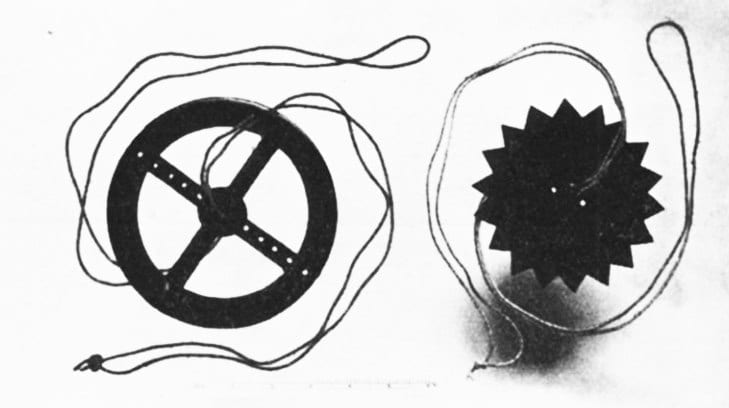
REPRODUCTIONS OF IYNX WHEELS PUBLISHED BY GOW IN THE JOURNAL FOR HELLENIC STUDIES 1934.
As a child growing up in the 70’s and 80’s in Africa we made a lot of our own toys, and sometimes we would take buttons, string some embroidery thread through it and make little whirring wheels. These child’s toys, which can still be found for sale in some toy shops (sold as spinners or whirlygigs), including some 21st-century plastic ones with LED lights, entertained us for hours, and they were essentially iynx wheels! Different designs can be seen depicted on archaeological finds, but essentially they are all circular disks, with two (or more) central holes through which string is threaded. You use the tool by holding the two ends of the string in opposite hands and then spinning the wheel until the string has been wound in one direction, then you pull the string and release in a rhythmic manner, allowing the wheel in the center to spin. Depending on the design, the wheel will emit a whirring sound.
The tool is incredible for meditation, contemplation as well as for ritual work.
Have you used it? Have you made your own? If not, go and try it out now! If you don’t have the tools to make it from wood or metal, it is possible to use a firm piece of cardboard to try it out, so no excuses!
ps. If you have enjoyed this introduction and you find this an interesting tool, how about helping me differentiate between Hekate’s Wheel (the symbol) and the Iynx (the ritual object or tool)?
References / Further reading:
Dua Lipa, featuring Madonna, Levitating: https://youtu.be/E3tCHMagPOY
Gow, The Journal for Hellenic Studies, 1934
Circle for Hekate, Volume 1, d’Este, 2017
Hekate: Liminal Rites, d’Este & Rankine, 2009

About Sorita d'Este
Sorita d’Este has been experimenting with ways of walking on the liminal since she was a child, exploring along the way many pathways of experiencing magic, mysticism and religion. Her own personal practice integrates aspects of Hellenic (Greek), Egyptian and Hermetic practices with a lived Orphic inspired philosophy, and experience gained in Initiatory Craft, traditions preserved in Italian, French and British grimoires and other contemporary esoteric teachings of the East and West. You can read more about the author here.
Previous Post

April 19, 2020
Oak & Ash - The Season Turns
Next Post
August 28, 2020 Hekate & Pop Culture : Liminal Fantasies, or Modern Temples?
Browse Our Archives
Select a Category Adamantine Musings Book Celtic Children of Earth - Interviews Christianity Druidry Elemental Magic Events Glastonbury Goddesses greek god Hekate Hellenic Hermes Ireland Italy magic(k) Mermaids Nature Pilgrimage Psychic & Mediumship Qabalah Roman Scotland Uncategorized Unicorns Vodou Wicca & Witchcraft
Select a Month November 2020 October 2020 August 2020 April 2020 October 2019 September 2019 August 2019 July 2019 June 2019 May 2019 November 2018 October 2018 July 2018 April 2018 March 2018 January 2018 December 2017 November 2017 July 2017 June 2017 February 2017 January 2017 December 2016 August 2016 July 2016 June 2016
Follow Us!
TAKE THE
Religious Wisdom Quiz
How many people did Jesus raise from the dead?
Select your answer to see how you score.
2 4 5 3
Related posts from Adamantine Muse
Hekate & Pop Culture : Liminal Fantasies, or...
Autumn Equinox: Light and Dark equal? I think...
TRENDING AT PATHEOS Pagan

To help with the upcoming holiday season, I'm introducing the Holiday Helper...

10 years of the Power Sigil & Moving...
Last week while reorganizing my studio space, I found the sketchbook that...

Why are younger seekers drawn to Paganism and...
One of the things I've noticed the most is that I'm far...

When we talk about Greek religion, we often begin with the dodekatheion—the...

I was recently chatting with someone on Instagram. She asked me what...

On July 23, I saw Christopher Nolan's The Odyssey which is Homer’s...
view all Pagan blogs
Ad-Free & Subscriber Log-In Subscription Support
- About Us
- 2026 Calendar
- Videos
- Podcasts
- Library of World Religions
- Faith In Media Tracker
- Advertise With Us
- Write for Us
- Privacy Policy
- Terms of Service
- Do Not Sell My Data
- Contact Us
- Radiant Digital
- Manage Newsletter Subscriptions
- Unsubscribe From Notifications
- Sitemap
Copyright 2008-2026, Patheos, part of the Radiant Digital network of media brands. All rights reserved.
Subscription Support Ad-Free & Subscriber Log-In
Follow Patheos