
BuddhistCatholicContemplativeEvangelicalGeneral ChristianHinduJewishLatter-day SaintMuslimNew VisionsProgressive Christian
Beliefs
- Buddhist
- Catholic
- Contemplative
- Evangelical
- General Christian
- Hindu
- Jewish
- Latter-day Saint
- More Voices
- Muslim
- New Visions
- Pagan
- Progressive Christian
Topics
- Religion News
- Food and Religion
- Sports and Religion
- Religious Art
- Religious Music and Entertainment
- Religious Events
- History and Religion
- Style and Religion
- Politics and Religion
- Women in Religion
- Recreation Outdoors and Religion
- Business Finance and Religion
- Careers Workplace and Religion
- Education and Religion
- Family Parenting and Religion
- Health Fitness and Religion
- Home and Religion
- Relationships and Religion
- Technology and Religion
- Travel and Religion
Columnists
- Buddhist Columnists
- Business Finance and Religion Columnists
- Careers Workplace and Religion Columnists
- Catholic Columnists
- Contemplative Columnists
- Education and Religion Columnists
- Evangelists Columnists
- Family Parenting and Religion Columnists
- General Christian Columnists
- Health Fitness and Religion Columnists
- Hindu Columnists
- History and Religion Columnists
- Home and Religion Columnists
- Jewish Columnists
- More Voices Columnists
- Latter Day Columnists
- Muslim Columnists
- New Visions Columnists
- Nonreligious Columnists
- Pagan Columnists
- Politics and Religion Columnists
- Progressive Columnists
- Recreation Outdoors and Religion Columnists
- Relationships and Religion Columnists
- Religion News Columnists
- Religious Art Columnists
- Religious Events Columnists
- Religious Music and Entertainment Columnists
- Sports and Religion Columnists
- Style and Religion Columnists
- Technology and Religion Columnists
- Travel and Religion Columnists
- Women in Religion Columnists
Resource Library
- 2026 Calendar
- Library of World Religions
- The 100 Most Holy Places on Earth
- Patheos Answers
- Podcasts
- Videos
- Faith Leaders Database
- Anglican Episcopalian
- Bahai
- Baptist
- Buddhism
- Christianity
- Confucianism
- Eastern Orthodoxy
- Hinduism
- Holiness and Pentecostal
- ISKCON
- Islam
- Judaism
- Lutheran
- Methodist
- The Church of Jesus Christ of Latter-day Saints
- New Age
- Paganism
- Presbytarian and Reformed
- Protestantism
- Religion Behind the Scenes
- Roman Catholic
- Scientology
- Shia Islam
- Sikhism
- Sufism
- Sunni Islam
- Taoism
- Zen
- See all religions
Research Tools
 Ad-Free & Subscriber Log-In Subscription Support
Ad-Free & Subscriber Log-In Subscription Support
Follow Patheos 

- Trending:
- Forgiveness
- |
- Marriage
- |
- Consciousness
- |
- Death Penalty
- |
- Election
- |
- Halloween
 Adamantine Muse
- Home
- Pagan
- Three Serpents & Two Famous Magical Staffs
Three Serpents & Two Famous Magical Staffs
Last updated on: September 16, 2019 at 11:50 pm by Sorita d'Este
Three Serpents & Two Famous Magical Staffs 2019-09-16T23:50:15+01:00 Sorita d'Este
Patheos Explore the world's faith through different perspectives on religion and spirituality! Patheos has the views of the prevalent religions and spiritualities of the world.
Do the Gods, their stories and symbols evolve?
Let’s talk about two magical staffs: The Caduceus and the Rod of Asclepius. The Caduceus is a famous symbol of two snakes coiling around a staff; where as the Rod of Asclepius is a staff with one serpent coiled around it.

The Caduceus – Symbol of the God Hermes (or Mercury).

Rod of Asclepius – the wand of Asclepius, the God of Medicine & Healing
Today the Caduceus is very well known as a symbol representing products and services associated with healing – such as doctors, medicine and ambulances. But it started as a mistake, or a misunderstanding, of sorts. The Caduceus became popular in the late 19th or early 20th century in the USA as a symbol for medicine, used by the US Army Medical Corps and other major medicine-related organisations. However, looking at history it should have been the Rod of Asclepius (the God of Medicine & Healing), rather than the Caduceus of Hermes (Messenger of the Gods, God of Communication, Trickster & Shepherd God). Very easy mistake, both staffs are entwined with serpents. However, today there is absolutely no denying it – the Caduceus is now ALSO a symbol of healing and it has been a predominant symbol for the healing professions for more than a century now.
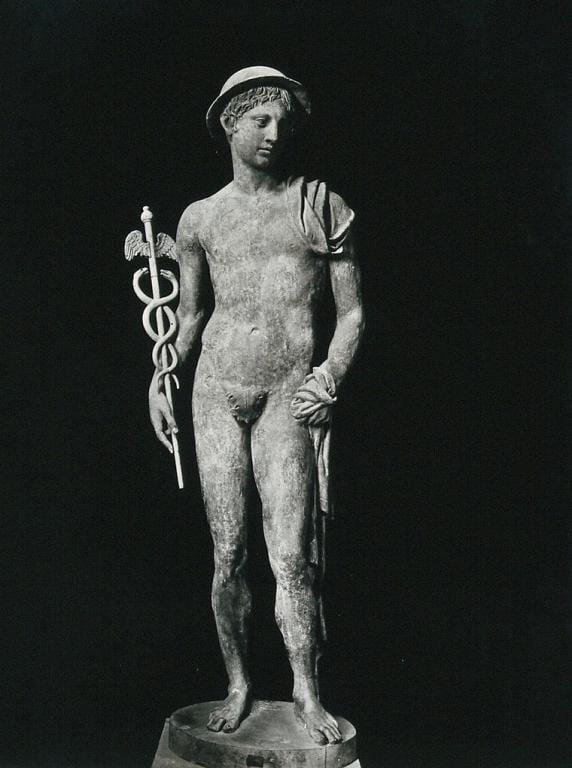
Mercury (Hermes). Photograph by Alinari. Credit: Wellcome Collection. CC BY
But if you, like me, believe that the Gods are alive and that they continue evolving and changing – as they did in antiquity, then perhaps there is another explanation?
Perhaps it was Hermes, as the Trickster God (and also the God of Thieves) who maneuvered himself and his staff to represent aspects of the healing profession in the 20th and now into the 21st centuries? There is no denying that the world has evolved and that communication (a function of Hermes) is central to the work of the modern medical profession. So perhaps it is not only appropriate, but inevitable that Hermes’ staff became so strongly associated with medicine. Also, Hermes (and his Roman counterpart Mercury) are both associated with alchemy, which is often thought of as a forerunner of science. Today scientific research and thought are central to medicine and through this association there is another reason for the staff of Hermes to be so closely associated with medicine and healing today.
And besides, Gods have always assumed new symbols, adapted to new circumstances, merged with the cults of other Gods and adapted historically – why should that have stopped in recent years?
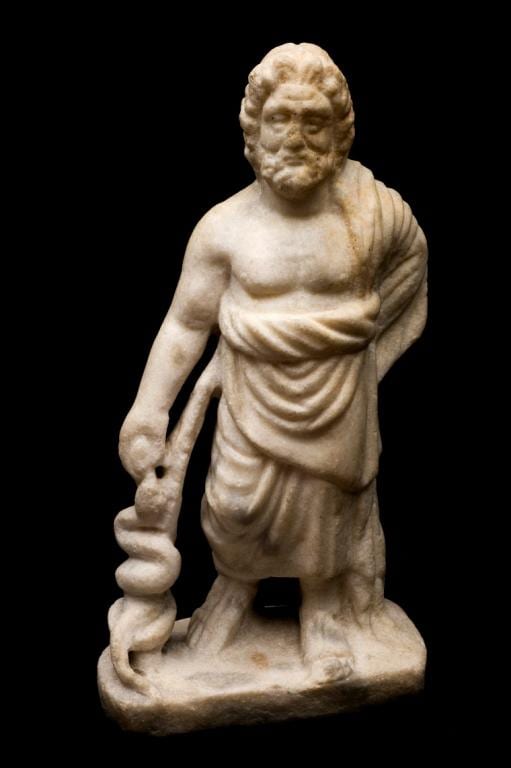
Marble statue of Asklepios, Greek, 400-200 BCE. Credit: Science Museum, London. CC BY
Does this make Asclepius any less important? Of course not, his Rod (with the single serpent) continues to be used by institutions and brands who were better informed and not so easily tricked by Hermes!
———————–
Share your thoughts on this topic by commenting here on Patheos, or by tagging me on social media so that I can see your comments!
Instagram: www.instagram.com/sorita.deste @sorita.deste
#soritadeste
Facebook:
www.facebook.com/soritadeste
Twitter:
@theurgia

About Sorita d'Este
Sorita d’Este has been experimenting with ways of walking on the liminal since she was a child, exploring along the way many pathways of experiencing magic, mysticism and religion. Her own personal practice integrates aspects of Hellenic (Greek), Egyptian and Hermetic practices with a lived Orphic inspired philosophy, and experience gained in Initiatory Craft, traditions preserved in Italian, French and British grimoires and other contemporary esoteric teachings of the East and West. You can read more about the author here.
Previous Post

September 15, 2019
Recommended Reading: The Goddess Hekate
Next Post

September 17, 2019 Did Mabon steal the Autumn Equinox?
Browse Our Archives
Select a Category Adamantine Musings Book Celtic Children of Earth - Interviews Christianity Druidry Elemental Magic Events Glastonbury Goddesses greek god Hekate Hellenic Hermes Ireland Italy magic(k) Mermaids Nature Pilgrimage Psychic & Mediumship Qabalah Roman Scotland Uncategorized Unicorns Vodou Wicca & Witchcraft
Select a Month November 2020 October 2020 August 2020 April 2020 October 2019 September 2019 August 2019 July 2019 June 2019 May 2019 November 2018 October 2018 July 2018 April 2018 March 2018 January 2018 December 2017 November 2017 July 2017 June 2017 February 2017 January 2017 December 2016 August 2016 July 2016 June 2016
Follow Us!
TAKE THE
Religious Wisdom Quiz
What city's walls fell after the Israelites marched around them?
Select your answer to see how you score.
Ai Jericho Jerusalem Bethel
Related posts from Adamantine Muse
Hekate & Pop Culture : Liminal Fantasies, or...
Hekate's Wheel & the Iynx Wheel
Autumn Equinox: Light and Dark equal? I think...
TRENDING AT PATHEOS Pagan

I was recently chatting with someone on Instagram. She asked me what...

While there are many people who share their results, the end of...

On July 23, I saw Christopher Nolan's The Odyssey which is Homer’s...

As I write this two big events have just finished up. One...

Restoring the Watershed of Divine Love
Perhaps cooperation is not something we manufacture through legislation, ideology, or moral...

Many UUs don’t pray because of bad experiences in a previous religion,...
view all Pagan blogs
Ad-Free & Subscriber Log-In Subscription Support
- About Us
- 2026 Calendar
- Videos
- Podcasts
- Library of World Religions
- Faith In Media Tracker
- Advertise With Us
- Write for Us
- Privacy Policy
- Terms of Service
- Do Not Sell My Data
- Contact Us
- Radiant Digital
- Manage Newsletter Subscriptions
- Unsubscribe From Notifications
- Sitemap
Copyright 2008-2026, Patheos. All rights reserved.
Subscription Support Ad-Free & Subscriber Log-In
Follow Patheos