
BuddhistCatholicContemplativeEvangelicalGeneral ChristianHinduJewishLatter-day SaintMuslimNew VisionsProgressive Christian
Beliefs
- Buddhist
- Catholic
- Contemplative
- Evangelical
- General Christian
- Hindu
- Jewish
- Latter-day Saint
- More Voices
- Muslim
- New Visions
- Pagan
- Progressive Christian
Topics
- Religion News
- Food and Religion
- Sports and Religion
- Religious Art
- Religious Music and Entertainment
- Religious Events
- History and Religion
- Style and Religion
- Politics and Religion
- Women in Religion
- Recreation Outdoors and Religion
- Business Finance and Religion
- Careers Workplace and Religion
- Education and Religion
- Family Parenting and Religion
- Health Fitness and Religion
- Home and Religion
- Relationships and Religion
- Technology and Religion
- Travel and Religion
Columnists
- Buddhist Columnists
- Business Finance and Religion Columnists
- Careers Workplace and Religion Columnists
- Catholic Columnists
- Contemplative Columnists
- Education and Religion Columnists
- Evangelists Columnists
- Family Parenting and Religion Columnists
- General Christian Columnists
- Health Fitness and Religion Columnists
- Hindu Columnists
- History and Religion Columnists
- Home and Religion Columnists
- Jewish Columnists
- More Voices Columnists
- Latter Day Columnists
- Muslim Columnists
- New Visions Columnists
- Nonreligious Columnists
- Pagan Columnists
- Politics and Religion Columnists
- Progressive Columnists
- Recreation Outdoors and Religion Columnists
- Relationships and Religion Columnists
- Religion News Columnists
- Religious Art Columnists
- Religious Events Columnists
- Religious Music and Entertainment Columnists
- Sports and Religion Columnists
- Style and Religion Columnists
- Technology and Religion Columnists
- Travel and Religion Columnists
- Women in Religion Columnists
Resource Library
- 2026 Calendar
- Library of World Religions
- The 100 Most Holy Places on Earth
- Patheos Answers
- Podcasts
- Videos
- Faith Leaders Database
- Anglican Episcopalian
- Bahai
- Baptist
- Buddhism
- Christianity
- Confucianism
- Eastern Orthodoxy
- Hinduism
- Holiness and Pentecostal
- ISKCON
- Islam
- Judaism
- Lutheran
- Methodist
- The Church of Jesus Christ of Latter-day Saints
- New Age
- Paganism
- Presbytarian and Reformed
- Protestantism
- Religion Behind the Scenes
- Roman Catholic
- Scientology
- Shia Islam
- Sikhism
- Sufism
- Sunni Islam
- Taoism
- Zen
- See all religions
Research Tools
 Ad-Free & Subscriber Log-In Subscription Support
Ad-Free & Subscriber Log-In Subscription Support
Follow Patheos 

- Trending:
- Forgiveness
- |
- Marriage
- |
- Consciousness
- |
- Death Penalty
- |
- Election
- |
- Halloween
 Adamantine Muse
- Home
- Pagan
- The Dead & The Goddess Hekate
The Dead & The Goddess Hekate
Last updated on: October 29, 2018 at 6:27 pm by Sorita d'Este
The Dead & The Goddess Hekate 2018-10-29T18:27:20+01:00 Sorita d'Este
Patheos Explore the world's faith through different perspectives on religion and spirituality! Patheos has the views of the prevalent religions and spiritualities of the world.
In modern Pagan literature Hekate’s association with the restless dead is often emphasized, and with the season of Samhain (All Hallow’s; Halloween) upon us, I was inspired to share this extract from my 2017 book Circle for Hekate, Volume I (History & Mythology) with readers here – I hope that it will inspire you to explore this fascinating subject in more depth.
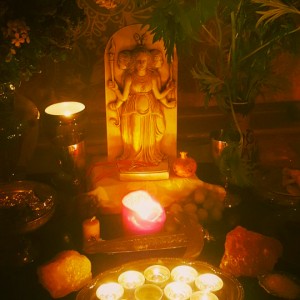
Community Shrine, Glastonbury
The Dead
“But either thou art frightened of a spectre beheld in sleep and hast joined the revel-rout of nether Hekate.”[1]
Tibetan Buddhism teaches that “Death is certain; and the time of death is uncertain”, and proposes that the only thing that can help us as individuals at the time of our death is our spiritual and mental development. While this is not at all directly linked to the goddess Hekate, it is a wise approach which initiates of the Mysteries would have understood. All of us will face death sooner or later, and as such it is not surprising that customs and practices associated with the dead and dying can be found in all the regions and cultures in which Hekate’s cult had a foothold.
“No figure is more closely associated with the returning souls of the dead than Hecate. Her role as their leader was well enough established by the fifth century for the tragedians to allude to it without further explanation.” [2]
Considering her long history of association with the dead, Hekate’s role with the dead is naturally multifaceted. She is called upon in necromantic rites in which efforts are made to interact with the dead, as she was believed to control the domain(s) in which those who had not fully passed into the Underworld dwelled. She was also said to rule over those who died untimely deaths, which included those who died through murder, suicide or another violent act. Described as “raging among the souls of the dead” in a fourth-century Hippocratic treatise on sacred diseases.[3] The spirits of these people were thought to do Hekate’s bidding with evidence showing that some feared nightly attacks by Hekate’s band of ghosts. They were also believed to cause various mental diseases, which were possibly sent to torment those who misbehaved in some way or another, until such time they rectified their action.
The understanding held about death by the priesthoods, devotees and initiates of Hekate’s mysteries in the past provides thought-provoking insights on beliefs and customs associated with death. An inscription found on a gravestone from the town of Mesembria, Thrace dated to around the second-century CE tells the story of a devotee of the goddess who died:
“I, the goddess Hecate, lie here, as you see. Earlier I was mortal, now, as a goddess, I am immortal and young forever. I, Julia, daughter of the generous Nikias. My native city was Mesembria – the name comes from Melsa and “bria.” The stone commemorates the years I lived: in all, three times five, twice over twenty, and, in addition, ten and five.” [4]
It is one of the numerous examples of funeral inscriptions expressing a belief in apotheosis, a process through which the deceased becomes one with the deity. In this case Julia, who was presumably an initiate of the Mysteries of Hekate, becomes the goddess Hekate upon her death. Similar cases exist mentioning the goddess Gaia, the Titan Earth goddess, suggesting that upon death the body does not die, but instead transforms and becomes assimilated into the living body of Gaia[5]. It also brings to mind the transformation of Iphigeneia, Aphaia and Queen Hekabe.
With such an understanding there is no death, and there is nothing to fear, as death is understood as a transformation rather than an ending. This may account for the different awareness of death held by initiates of the Mysteries. To them the process of initiation provided a self-transformation from which initiates emerged with a different understanding of death, armed with knowledge on how to transcend death. Additionally, based on inscriptions on some of the Orphic Gold Tablets, initiates may additionally have believed that the knowledge they gained through initiation would provide them with specific privileges after death.
Hekate’s association with childbirth brought her into the lives of women at the very liminal time of labour. Not only is childbirth painful, but it is also a dangerous time for both mother and child. Taking into consideration Hekate’s role towards the dead, Hekate’s role as child-nurse can then be seen to take on additional layers of meaning, where she is seen responsible for helping during birth, and taking into her care those who did not make it through the process.
[1] Fragment 249, Aeschylus, 5th century BCE, trans. W Smyth.
[2] Restless Dead, Johnston, 1999.
[3] Restless Dead, Johnston, 1999.
[4] Inscription, trans. Portefaix, Images of Eternal Beauty by Wypustek, 2013.
[5] Eternal Beauty, Wypustek, 2013.
The above extract is from Circle for Hekate, Volume I – History & Mythology, by Sorita d’Este, 2017.
Further recommended reading:
The Restless Dead by Sarah Illes Johnston
Memento Mori (anthology, various contributors), edited by Kim Huggens
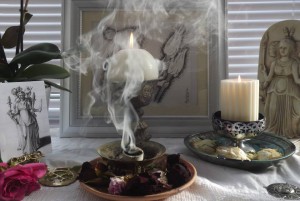
Incense offering to Hekate.
Previous Post

October 23, 2018
Skylla: Daughter of Hekate?
Next Post

November 4, 2018 The Cyberbully in Paganism
Browse Our Archives
Select a Category Adamantine Musings Book Celtic Children of Earth - Interviews Christianity Druidry Elemental Magic Events Glastonbury Goddesses greek god Hekate Hellenic Hermes Ireland Italy magic(k) Mermaids Nature Pilgrimage Psychic & Mediumship Qabalah Roman Scotland Uncategorized Unicorns Vodou Wicca & Witchcraft
Select a Month November 2020 October 2020 August 2020 April 2020 October 2019 September 2019 August 2019 July 2019 June 2019 May 2019 November 2018 October 2018 July 2018 April 2018 March 2018 January 2018 December 2017 November 2017 July 2017 June 2017 February 2017 January 2017 December 2016 August 2016 July 2016 June 2016
Follow Us!
TAKE THE
Religious Wisdom Quiz
I came to Jesus at night to ask about being born again. Who was this Pharisee and member of the Jewish ruling council?
Select your answer to see how you score.
Joseph of Arimathea Gamaliel Caiaphas Nicodemus
Related posts from Adamantine Muse
Hekate & Pop Culture : Liminal Fantasies, or...
Hekate's Wheel & the Iynx Wheel
TRENDING AT PATHEOS Pagan

I was recently chatting with someone on Instagram. She asked me what...

While there are many people who share their results, the end of...

On July 23, I saw Christopher Nolan's The Odyssey which is Homer’s...

As I write this two big events have just finished up. One...

Restoring the Watershed of Divine Love
Perhaps cooperation is not something we manufacture through legislation, ideology, or moral...

Many UUs don’t pray because of bad experiences in a previous religion,...
view all Pagan blogs
Ad-Free & Subscriber Log-In Subscription Support
- About Us
- 2026 Calendar
- Videos
- Podcasts
- Library of World Religions
- Faith In Media Tracker
- Advertise With Us
- Write for Us
- Privacy Policy
- Terms of Service
- Do Not Sell My Data
- Contact Us
- Radiant Digital
- Manage Newsletter Subscriptions
- Unsubscribe From Notifications
- Sitemap
Copyright 2008-2026, Patheos. All rights reserved.
Subscription Support Ad-Free & Subscriber Log-In
Follow Patheos