
BuddhistCatholicContemplativeEvangelicalGeneral ChristianHinduJewishLatter-day SaintMuslimNew VisionsProgressive Christian
Beliefs
- Buddhist
- Catholic
- Contemplative
- Evangelical
- General Christian
- Hindu
- Jewish
- Latter-day Saint
- More Voices
- Muslim
- New Visions
- Pagan
- Progressive Christian
Topics
- Religion News
- Food and Religion
- Sports and Religion
- Religious Art
- Religious Music and Entertainment
- Religious Events
- History and Religion
- Style and Religion
- Politics and Religion
- Women in Religion
- Recreation Outdoors and Religion
- Business Finance and Religion
- Careers Workplace and Religion
- Education and Religion
- Family Parenting and Religion
- Health Fitness and Religion
- Home and Religion
- Relationships and Religion
- Technology and Religion
- Travel and Religion
Columnists
- Buddhist Columnists
- Business Finance and Religion Columnists
- Careers Workplace and Religion Columnists
- Catholic Columnists
- Contemplative Columnists
- Education and Religion Columnists
- Evangelists Columnists
- Family Parenting and Religion Columnists
- General Christian Columnists
- Health Fitness and Religion Columnists
- Hindu Columnists
- History and Religion Columnists
- Home and Religion Columnists
- Jewish Columnists
- More Voices Columnists
- Latter Day Columnists
- Muslim Columnists
- New Visions Columnists
- Nonreligious Columnists
- Pagan Columnists
- Politics and Religion Columnists
- Progressive Columnists
- Recreation Outdoors and Religion Columnists
- Relationships and Religion Columnists
- Religion News Columnists
- Religious Art Columnists
- Religious Events Columnists
- Religious Music and Entertainment Columnists
- Sports and Religion Columnists
- Style and Religion Columnists
- Technology and Religion Columnists
- Travel and Religion Columnists
- Women in Religion Columnists
Resource Library
- 2026 Calendar
- Library of World Religions
- The 100 Most Holy Places on Earth
- Patheos Answers
- Podcasts
- Videos
- Faith Leaders Database
- Anglican Episcopalian
- Bahai
- Baptist
- Buddhism
- Christianity
- Confucianism
- Eastern Orthodoxy
- Hinduism
- Holiness and Pentecostal
- ISKCON
- Islam
- Judaism
- Lutheran
- Methodist
- The Church of Jesus Christ of Latter-day Saints
- New Age
- Paganism
- Presbytarian and Reformed
- Protestantism
- Religion Behind the Scenes
- Roman Catholic
- Scientology
- Shia Islam
- Sikhism
- Sufism
- Sunni Islam
- Taoism
- Zen
- See all religions
Research Tools
 Ad-Free & Subscriber Log-In Subscription Support
Ad-Free & Subscriber Log-In Subscription Support
Follow Patheos 

- Trending:
- Forgiveness
- |
- Marriage
- |
- Consciousness
- |
- Death Penalty
- |
- Election
- |
- Halloween
 Adamantine Muse
- Home
- Pagan
- Skylla: Daughter of Hekate?
Skylla: Daughter of Hekate?
Last updated on: October 23, 2018 at 9:13 pm by Sorita d'Este
Skylla: Daughter of Hekate? 2018-10-23T21:13:32+01:00 Sorita d'Este
Patheos Explore the world's faith through different perspectives on religion and spirituality! Patheos has the views of the prevalent religions and spiritualities of the world.
A friend and I spent a couple of hours discussing the oceanic aspects of the Goddess Hekate recently. One of those things you do on a cold night with a fire, good tea and company, and one of the topics we touched on was Skylla – the mythical seamonster(ess) who was believed to live in the Messina Straits, the strip of ocean between mainland Italy and the island of Sicily. Skylla was also, on occasion, named as the daughter of the Goddess Hekate – though evidence is scant the connection is an interesting enough one to explore, especially when connecting with the oceanic aspects of Hekate.
What follows is an extract from my 2017 book, Circle for Hekate I, in which I present some of the evidence for Skylla’s connection with the Goddess of the Crossroads.
Skylla: Daughter of Hekate?
“Nor let them go too near the hateful den of Ausonian Skylla, that wicked monster borne to Phorkys by night-wandering Hekate, whom men call Kratais.”[1]
Speaking these words in the Argonautica, the sorceress Kirke equates Hekate with Kratais (Kharybdis). The latter is also named as Skylakagetis, meaning leader of dogs, Lamia (from Shark) and Trienos (the Thrice). Trienos is a reference to three high and low tides, which were ascribed to Skylla’s ability to suck the water in and spit it out again three times a day. The number three is also an important symbol associated with Hekate.
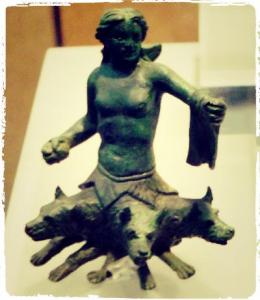
4 – Skylla, Daughter of Hekate. In the Archeological Museum, Athens.
Skylla is depicted as having the torso and head of a female and a body with multiple legs, sometimes part canine and part fish. She is closely associated with both the island of Sicily and with the Strait of Messina, a narrow and treacherous strip of ocean between Sicily and mainland Italy, where she is said to live.
“Half-way up the cliff is a murky cave, facing Erebos, and doubtless it is past this, Odysseus, that you and your men will steer your vessel… Inside lives Skylla, yelping hideously; her voice is no deeper than a young puppy’s but she herself is a fearsome monster; no one could see her and still be happy, not even a god if he went that way. She has twelve feet all dangling down, six long necks with a grisly head on each of them, and in each head a triple row of crowded and close-set teeth, fraught with black death…”[2]
Kirke’s advice to Odysseus is that he should invoke Kratais for her help against the perils of Skylla:
“Will you not bow to the deathless gods themselves? Skylla is not of mortal kind; she is a deathless monster, grim and baleful, savage, not to be wrestled with. Against her there is no defence, and the best path is the path of flight. If you pause to arm beside that rock, I fear that she may dart out again, seize again with as many heads and snatch as many men as before. No, row hard and invoke Krataiis; she is Skylla’s mother; it is she who bore her to plague mankind; Krataiis will hold her from darting twice.” [3]
There are some parallels between Skylla and the Nereids, female creatures who lived in the Aegean Sea, which included Thetis, a goddess of the waters. Thetis is sometimes equated to Metis, who is described as the first of the wives of Zeus.
“Now Zeus, king of the gods, made Metis his wife first, and she was wisest among gods and mortal men. But when she was about to bring forth the goddess bright-eyed Athene, Zeus craftily deceived her with cunning words and put her in his own belly, as Earth and starry Heaven advised.” [4]
She was associated with the art of magic, as well as with wisdom. She was also described as the goddess of wisdom, wise counsel and prudence, qualities which were highly valued in the Mycenaean era.
“The general resemblance between the myths of Metis and Thetis is unmistakable. Metis, like Thetis, was a sea-power. Metis like Thetis was a shape-shifter. Metis, like Thetis, was loved by Zeus. Metis, like Thetis, was destined to bear a son that should oust his father – a danger averted in either case by an oracular utterance and consequent guile.”[5]
While Zeus desired Thetis, he avoided intercourse with her due to an oracle and according to Ovid instead sent Peleus to be with her. He went looking for her in a cave, and to escape his embraces Thetis variously shapeshifted into a bird, a tree, a tiger and hundreds of other forms[6]. However, with the help of the gods of the sea, Peleus was able to have his way with the shape-shifting virgin Nereid in the end.
“…you will have the bride you desire, if you bind her, unawares, with nooses and tight cords, while she is lulled asleep in the rocky cave. Though she deceives you with a hundred counterfeit shapes, hold her to you, whatever she becomes, until she is again what she was before.”[7]
Thetis is depicted as a young naked woman riding a dolphin, or astride a hippocampus, a mythical sea monster. The hippocampus has the body of a horse, but the tail of a fish, and is sometimes simply named as a sea-horse.
[1] Argonautica, Apollonius Rhodius, 3rd century BCE, trans. Seaton, 1912.
[2] The Odyssey, Homer, circa 8th or 7th century BCE, trans. Shewring, 1980.
[3] The Odyssey, Homer, circa 8th or 7th century BCE, trans. Shewring, 1980.
[4] The Theogony, circa 8th or 7th century BCE, Hesiod, trans. Evelyn-White, 1914.
[5] Zeus. A Study In Ancient Religion. Volume 2, Part 1, Cook, 1925.
[6] Metamorphosis, Ovid, 43 BCE – 18 CE, trans Kline, 1903.
[7] Metamorphosis, Ovid, 43 BCE – 18 CE, trans Kline, 1903.
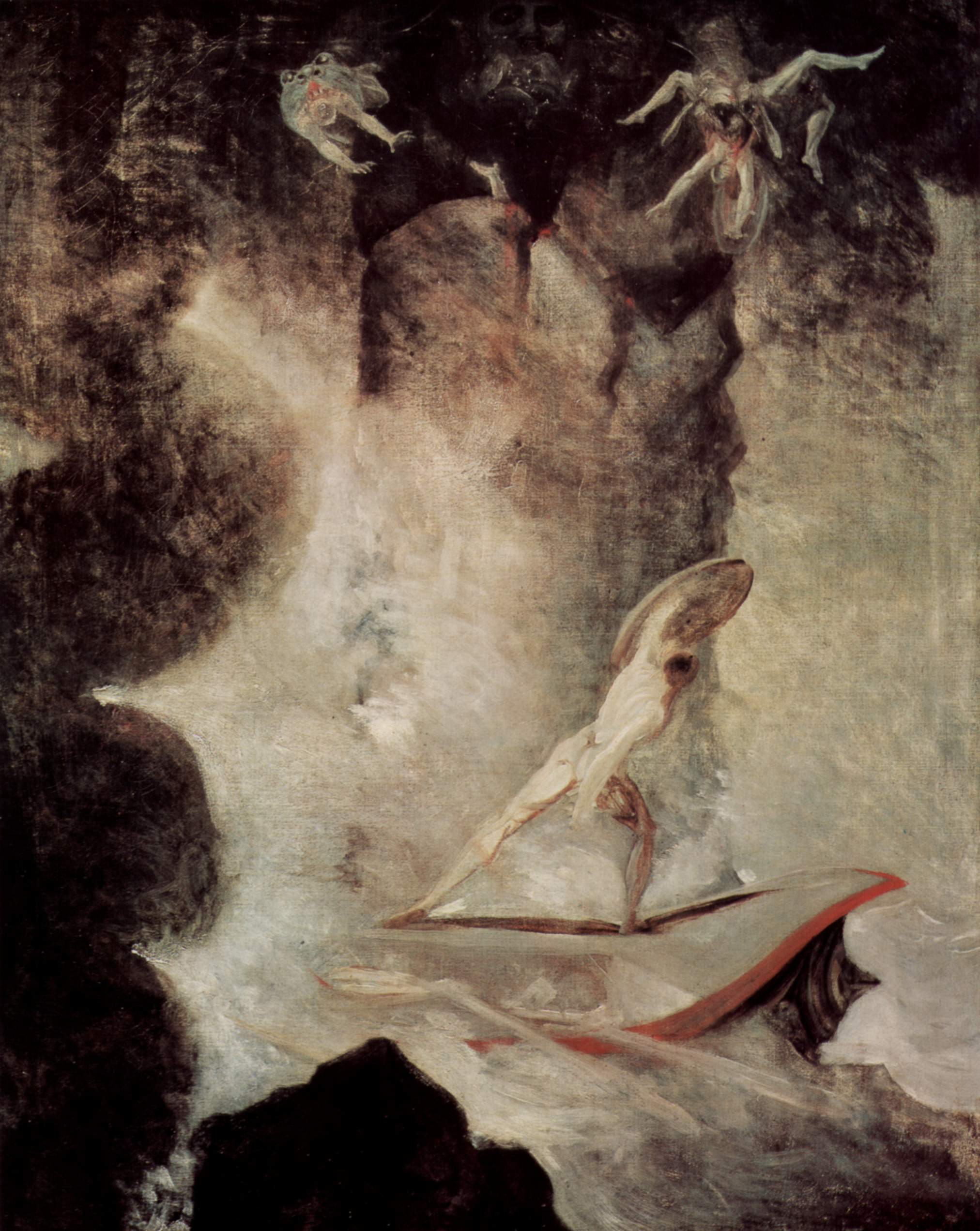
Scylla and Charybdis, 1794-6, by Fuseli

About Sorita d'Este
Sorita d’Este has been experimenting with ways of walking on the liminal since she was a child, exploring along the way many pathways of experiencing magic, mysticism and religion. Her own personal practice integrates aspects of Hellenic (Greek), Egyptian and Hermetic practices with a lived Orphic inspired philosophy, and experience gained in Initiatory Craft, traditions preserved in Italian, French and British grimoires and other contemporary esoteric teachings of the East and West. You can read more about the author here.
Previous Post

July 29, 2018
Buddhafield Festival 2018
Next Post

October 29, 2018 The Dead & The Goddess Hekate
Browse Our Archives
Select a Category Adamantine Musings Book Celtic Children of Earth - Interviews Christianity Druidry Elemental Magic Events Glastonbury Goddesses greek god Hekate Hellenic Hermes Ireland Italy magic(k) Mermaids Nature Pilgrimage Psychic & Mediumship Qabalah Roman Scotland Uncategorized Unicorns Vodou Wicca & Witchcraft
Select a Month November 2020 October 2020 August 2020 April 2020 October 2019 September 2019 August 2019 July 2019 June 2019 May 2019 November 2018 October 2018 July 2018 April 2018 March 2018 January 2018 December 2017 November 2017 July 2017 June 2017 February 2017 January 2017 December 2016 August 2016 July 2016 June 2016
Follow Us!
TAKE THE
Religious Wisdom Quiz
Who said, "Faith without works is dead"?
Select your answer to see how you score.
James John Peter Paul
Related posts from Adamantine Muse
The Horn of the Unicorn - Part 3
The Horn of the Unicorn - Part 2

Hekate & Pop Culture : Liminal Fantasies, or...
TRENDING AT PATHEOS Pagan

I was recently chatting with someone on Instagram. She asked me what...

While there are many people who share their results, the end of...

On July 23, I saw Christopher Nolan's The Odyssey which is Homer’s...

As I write this two big events have just finished up. One...

Restoring the Watershed of Divine Love
Perhaps cooperation is not something we manufacture through legislation, ideology, or moral...

Many UUs don’t pray because of bad experiences in a previous religion,...
view all Pagan blogs
Ad-Free & Subscriber Log-In Subscription Support
- About Us
- 2026 Calendar
- Videos
- Podcasts
- Library of World Religions
- Faith In Media Tracker
- Advertise With Us
- Write for Us
- Privacy Policy
- Terms of Service
- Do Not Sell My Data
- Contact Us
- Radiant Digital
- Manage Newsletter Subscriptions
- Unsubscribe From Notifications
- Sitemap
Copyright 2008-2026, Patheos. All rights reserved.
Subscription Support Ad-Free & Subscriber Log-In
Follow Patheos