
BuddhistCatholicContemplativeEvangelicalGeneral ChristianHinduJewishLatter-day SaintMuslimNew VisionsProgressive Christian
Beliefs
- Buddhist
- Catholic
- Contemplative
- Evangelical
- General Christian
- Hindu
- Jewish
- Latter-day Saint
- More Voices
- Muslim
- New Visions
- Pagan
- Progressive Christian
Topics
- Religion News
- Food and Religion
- Sports and Religion
- Religious Art
- Religious Music and Entertainment
- Religious Events
- History and Religion
- Style and Religion
- Politics and Religion
- Women in Religion
- Recreation Outdoors and Religion
- Business Finance and Religion
- Careers Workplace and Religion
- Education and Religion
- Family Parenting and Religion
- Health Fitness and Religion
- Home and Religion
- Relationships and Religion
- Technology and Religion
- Travel and Religion
Columnists
- Buddhist Columnists
- Business Finance and Religion Columnists
- Careers Workplace and Religion Columnists
- Catholic Columnists
- Contemplative Columnists
- Education and Religion Columnists
- Evangelists Columnists
- Family Parenting and Religion Columnists
- General Christian Columnists
- Health Fitness and Religion Columnists
- Hindu Columnists
- History and Religion Columnists
- Home and Religion Columnists
- Jewish Columnists
- More Voices Columnists
- Latter Day Columnists
- Muslim Columnists
- New Visions Columnists
- Nonreligious Columnists
- Pagan Columnists
- Politics and Religion Columnists
- Progressive Columnists
- Recreation Outdoors and Religion Columnists
- Relationships and Religion Columnists
- Religion News Columnists
- Religious Art Columnists
- Religious Events Columnists
- Religious Music and Entertainment Columnists
- Sports and Religion Columnists
- Style and Religion Columnists
- Technology and Religion Columnists
- Travel and Religion Columnists
- Women in Religion Columnists
Resource Library
- 2026 Calendar
- Library of World Religions
- The 100 Most Holy Places on Earth
- Patheos Answers
- Podcasts
- Videos
- Faith Leaders Database
- Anglican Episcopalian
- Bahai
- Baptist
- Buddhism
- Christianity
- Confucianism
- Eastern Orthodoxy
- Hinduism
- Holiness and Pentecostal
- ISKCON
- Islam
- Judaism
- Lutheran
- Methodist
- The Church of Jesus Christ of Latter-day Saints
- New Age
- Paganism
- Presbytarian and Reformed
- Protestantism
- Religion Behind the Scenes
- Roman Catholic
- Scientology
- Shia Islam
- Sikhism
- Sufism
- Sunni Islam
- Taoism
- Zen
- See all religions
Research Tools
 Ad-Free & Subscriber Log-In Subscription Support
Follow Patheos 

- Trending:
- Advent
- |
- Forgiveness
- |
- Thanksgiving
- |
- Election
- |
- Seasonal Holidays
- |
- Marriage
 Adamantine Muse
- Home
- Pagan
- Crone of Winter : The Cailleach
Crone of Winter : The Cailleach
Last updated on: December 8, 2017 at 8:57 am by Sorita d'Este
Crone of Winter : The Cailleach 2017-12-08T08:57:23+01:00 Sorita d'Este
Patheos Explore the world's faith through different perspectives on religion and spirituality! Patheos has the views of the prevalent religions and spiritualities of the world.
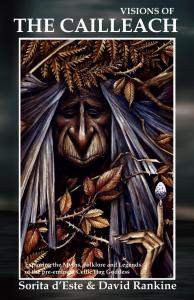
Book cover of Visions of the Cailleach by Sorita d’Este & David Rankine. Artwork by Marc Potts.
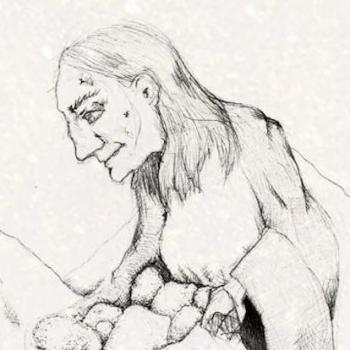
“Determined now her tomb to build,
Her ample skirt with stones she filled,
And dropped a heap on Carron-more;
Then stepped one thousand yards to Loar,
And dropped another goodly heap;
And then with one prodigious leap,
Gained carrion-beg; and on its height
Displayed the wonders of her might.”
(J.Swift, 17th century)
It is a clear starry night tonight here in Glastonbury, with the Moon riding high and bright towards a Full Moon in a couple of days from now. Last night the Crone of Winter had her way in my garden, freezing all that remained of the tender plants and leaving it to wilt in the little warmth the Sun was able to provide today. Soon the remaining green will turn brown too, and the land will remain frozen for a few weeks, with the promise of awakening again next
Spring.
The Cailleach is the primordial British Crone of Winter, and many of the stories associated with her highlights her strong association with the weather, especially the colder months. I absolutely love Her and the stories recorded about her over the centuries, and feel that she should be better known!
What follow is an extract from the book Visions of the Cailleach which I co-authored with David Rankine, and which was published back in 2009.
Visions of the Cailleach (2009). Cover art by Marc Potts.
“O life that ebbs like the seal
I am weary and old, I am weary and old –
Oh! How can I happy be
All alone in the dark and cold.
I’m the old Beira again,
My mantle no longer is green,
I think of my beauty with pain
And the days when another was queen.
My arms are withered and thin,
My hair once golden is grey;
‘Tis winter – my reign doth begin –
Youth’s summer has faded away.
Youth’s summer and autumn have fled –
I am weary and old, I am weary and old.
Every flower must fade and fall dead
When the winds blow cold,
when the winds blow cold.”[1]
In the winter months, it used to be believed that you might catch a glimpse of the Cailleach, shrouded in white and riding through the sky on the back of a wolf. If you did, you would keep very still for it was widely known that she could bring snow and blizzards, swirling the air with her magic wand and keeping her mantle of snow over the land. At Samhain[2] she would become dominant and ride through the land on her wolf, striking down signs of growth with her magic wand, spreading snow and winter across the land. She then ruled until the coming of summer at Beltane.[3]
There are regional variations on this story, some of which instead has the Cailleach ruling winter from the Autumn Equinox[4] to the Spring Equinox,[5] i.e. the days when there is more dark than light, and when water and cold tend to dominate the climate. The 25th March, just after the Spring Equinox, was referred to as Latha na Caillich (Cailleach Day), and is now sometimes known as Lady Day. Interestingly autumn and winter correspond to the elements of Water and Earth respectively, and these are the two elements that she was most associated with, which are also traditionally the two elements perceived as being feminine in nature.
The wintery associations in the story of Beira tie into references in the seasonal cycle. Hence the explanation for the short burst of good weather than often seems to introduce February, and likewise the connection to the wolf, with the old Gaelic name for the month of January being Faoilleach or wolf month.
Although the Cailleach as a winter goddess is not found in folklore beyond Britain, on the Continent, we find the Germanic winter goddess, Frau Holda or Holle. There is a significant number of shared motifs, such as Holda being described as a crone who can also appear as a beautiful maiden, and having connections with witches and with water through pools and fountains and other water sources.
Like the local Scottish descriptions of the Cailleach’s behaviour for the Corryvreckan whirlpool, Holda’s behaviour was said to determine the weather. Thus when it snowed Holda was shaking out her feather pillows, fog was smoke from her fire and thunder was Holda reeling flax. Curiously, like the Cailleach, there was ambivalence towards Holda from the Christian Church which became more negative with time. Thus it seems that certain characteristics were clearly associated with European winter goddesses, as there is no evidence to indicate that Holda and the Cailleach came from the same root source.
As winter marks the end of the year, leading towards its death, it is easy to see why a supernatural figure looking like an old woman should have come to personify the power of winter. The seasonal tides of the year have come to be associated with the ages of human life, and so the spring maiden matures into the old crone of winter, in a cyclical manner reflecting the seasons upon the Earth.
The beauty of the Cailleach reflected the beauty of winter. The lines on her face all told stories, she did not have the wrinkle-free smoothness of a young girl, but rather the wisdom won through age and experience. Her eyes spoke of death, wonder and determination, all of which were found in the harsh snows which blanketed the land and reminded people of their own mortality.
[1] Song of the Cailleach Beira, Wonder Tales from Scottish Myth and Legend; Mackenzie, 1917
[2] Halloween, 1st November.
[3] Mayday, 1st May.
[4] September 21st/22nd.
[5] March 21st/22nd.
Previous Post
November 22, 2017
Circle for Hekate
Next Post

December 3, 2017 Unification Rite (Elemental Magic)
Browse Our Archives
Select a Category Adamantine Musings Book Celtic Children of Earth - Interviews Christianity Druidry Elemental Magic Events Glastonbury Goddesses greek god Hekate Hellenic Hermes Ireland Italy magic(k) Mermaids Nature Pilgrimage Psychic & Mediumship Qabalah Roman Scotland Uncategorized Unicorns Vodou Wicca & Witchcraft
Select a Month November 2020 October 2020 August 2020 April 2020 October 2019 September 2019 August 2019 July 2019 June 2019 May 2019 November 2018 October 2018 July 2018 April 2018 March 2018 January 2018 December 2017 November 2017 July 2017 June 2017 February 2017 January 2017 December 2016 August 2016 July 2016 June 2016
Follow Us!
TAKE THE
Religious Wisdom Quiz
What does "Satan" mean in Hebrew?
Select your answer to see how you score.
Destroyer Murderer Deceiver Adversary
Related posts from Adamantine Muse
Samhain, Faerie Birds & Cú Chulainn's birth
Hekate & Pop Culture : Liminal Fantasies, or...
TRENDING AT PATHEOS Pagan

To help with the upcoming holiday season, I'm introducing the Holiday Helper...

10 years of the Power Sigil & Moving...
Last week while reorganizing my studio space, I found the sketchbook that...

Why are younger seekers drawn to Paganism and...
One of the things I've noticed the most is that I'm far...

When we talk about Greek religion, we often begin with the dodekatheion—the...

I was recently chatting with someone on Instagram. She asked me what...

On July 23, I saw Christopher Nolan's The Odyssey which is Homer’s...
view all Pagan blogs
Ad-Free & Subscriber Log-In Subscription Support
- About Us
- 2026 Calendar
- Videos
- Podcasts
- Library of World Religions
- Faith In Media Tracker
- Advertise With Us
- Write for Us
- Privacy Policy
- Terms of Service
- Do Not Sell My Data
- Contact Us
- Radiant Digital
- Manage Newsletter Subscriptions
- Unsubscribe From Notifications
- Sitemap
Copyright 2008-2026, Patheos, part of the Radiant Digital network of media brands. All rights reserved.
Subscription Support Ad-Free & Subscriber Log-In
Follow Patheos