
BuddhistCatholicContemplativeEvangelicalGeneral ChristianHinduJewishLatter-day SaintMuslimNew VisionsProgressive Christian
Beliefs
- Buddhist
- Catholic
- Contemplative
- Evangelical
- General Christian
- Hindu
- Jewish
- Latter-day Saint
- More Voices
- Muslim
- New Visions
- Pagan
- Progressive Christian
Topics
- Religion News
- Food and Religion
- Sports and Religion
- Religious Art
- Religious Music and Entertainment
- Religious Events
- History and Religion
- Style and Religion
- Politics and Religion
- Women in Religion
- Recreation Outdoors and Religion
- Business Finance and Religion
- Careers Workplace and Religion
- Education and Religion
- Family Parenting and Religion
- Health Fitness and Religion
- Home and Religion
- Relationships and Religion
- Technology and Religion
- Travel and Religion
Columnists
- Buddhist Columnists
- Business Finance and Religion Columnists
- Careers Workplace and Religion Columnists
- Catholic Columnists
- Contemplative Columnists
- Education and Religion Columnists
- Evangelists Columnists
- Family Parenting and Religion Columnists
- General Christian Columnists
- Health Fitness and Religion Columnists
- Hindu Columnists
- History and Religion Columnists
- Home and Religion Columnists
- Jewish Columnists
- More Voices Columnists
- Latter Day Columnists
- Muslim Columnists
- New Visions Columnists
- Nonreligious Columnists
- Pagan Columnists
- Politics and Religion Columnists
- Progressive Columnists
- Recreation Outdoors and Religion Columnists
- Relationships and Religion Columnists
- Religion News Columnists
- Religious Art Columnists
- Religious Events Columnists
- Religious Music and Entertainment Columnists
- Sports and Religion Columnists
- Style and Religion Columnists
- Technology and Religion Columnists
- Travel and Religion Columnists
- Women in Religion Columnists
Resource Library
- 2026 Calendar
- Library of World Religions
- The 100 Most Holy Places on Earth
- Patheos Answers
- Podcasts
- Videos
- Faith Leaders Database
- Anglican Episcopalian
- Bahai
- Baptist
- Buddhism
- Christianity
- Confucianism
- Eastern Orthodoxy
- Hinduism
- Holiness and Pentecostal
- ISKCON
- Islam
- Judaism
- Lutheran
- Methodist
- The Church of Jesus Christ of Latter-day Saints
- New Age
- Paganism
- Presbytarian and Reformed
- Protestantism
- Religion Behind the Scenes
- Roman Catholic
- Scientology
- Shia Islam
- Sikhism
- Sufism
- Sunni Islam
- Taoism
- Zen
- See all religions
Research Tools
 Ad-Free & Subscriber Log-In Subscription Support
Ad-Free & Subscriber Log-In Subscription Support
Follow Patheos 

- Trending:
- Forgiveness
- |
- Marriage
- |
- Consciousness
- |
- Death Penalty
- |
- Election
- |
- Halloween
 Adamantine Muse
- Home
- Pagan
- Wicca, the Tree of Life and the Goddess
Wicca, the Tree of Life and the Goddess
Last updated on: August 16, 2016 at 12:56 pm by Sorita d'Este
Wicca, the Tree of Life and the Goddess 2016-08-16T12:56:04+01:00 Sorita d'Este
Patheos Explore the world's faith through different perspectives on religion and spirituality! Patheos has the views of the prevalent religions and spiritualities of the world.
The Tree of Life – The Names of the Spheres (Illustration from: Practical Qabalah Magick, d’Este & Rankine)
“She is called the Spirit of Life and through Her do all men understand Wisdom.”
Zohar, 13th century
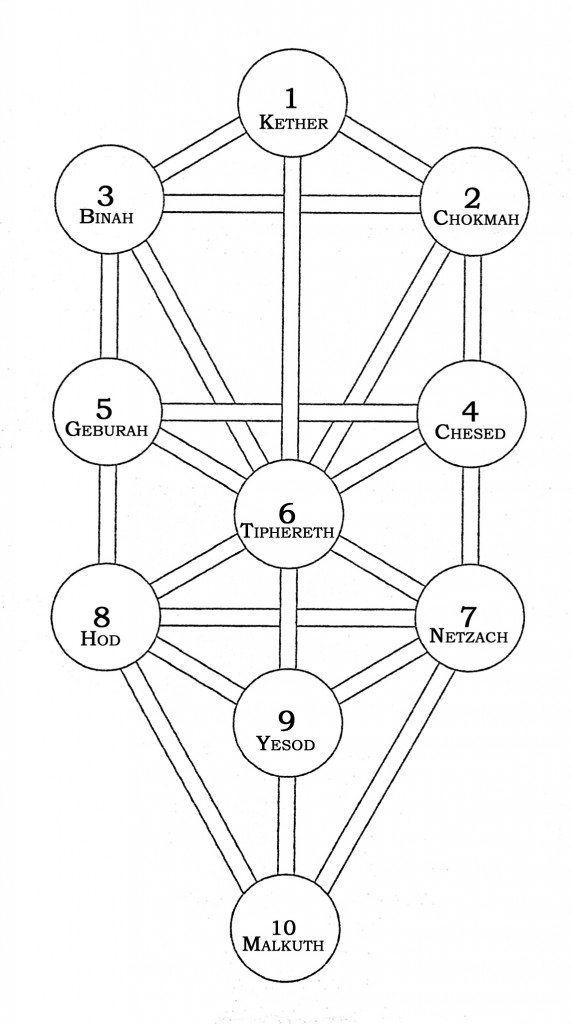
The Divine Feminine occupies a central role in a number of esoteric traditions – and whilst the presence of Goddess is obviously visible in traditions such as Wicca, it is often less obvious to outsiders that the Divine Feminine also has a pivotal role in the Qabalah. To Qabalists, the Goddess is the Shekinah, a Hebrew word which comes from the root shakhan, meaning “to dwell”. This meaning fits in with the Qabalistic idea that a fragment of the Shekinah is present within every living person, literally the divine spark of the Goddess dwelling within all of us.
The best-known image in the Qabalah is the glyph of the Tree of Life, representing both the universe and man, whilst also embodying the old magickal axiom of ’As above, so below.’ The Shekinah is sometimes described as the Tree of Life itself, as in Proverbs 3:17-18, which declares:
“Her ways are of pleasantness, and her paths are peace.
She is a tree of life to them that lay hold upon her; and happy is every one that retaineth her.”
Left & Right
On the Tree of Life the Shekinah is also particularly associated with the sephira of Binah (“Understanding”) at the top of the feminine Pillar of Severity. Significantly this Pillar is also known as the Black Pillar and is on the left as you look at an image of the Tree of Life. Balancing this is the masculine Pillar of Mercy or White Pillar. In Wicca these pillars are represented on the altar by the black and white candles of the goddess and god, which are positioned in the same manner, clearly illustrating the influence that Qabalah had on the development of Wicca. This symbolism of the pillars is also referred to in the Great Rite (used as part of the elevation to Third Degree in initiatory Wicca).
Indeed, The Tree of Life can be seen as a symbol map on which different magickal traditions can be mapped, and this is particularly true of initiatory Wiccan traditions such as Gardnerian Wicca, and traditions such as Alexandrian Wicca which was in part derived from the teachings of Gardner. Amongst the many divisions and layers of the Tree of Life we find clues which provides deeper understanding of the practices and beliefs of Wicca:
Salt & Water
Looking at the act of blessing the salt and water to consecrate the magic circle in the Wiccan tradition, we see it is full of Qabalistic significance. The water and salt are blessed, corresponding to the lower spheres of Malkuth (the salt) and Yesod (the water). Yesod is the sphere of the Moon, representing the astral and subtle realms, so by uniting the salt and water you are symbolically uniting the astral and the physical realms. The resulting salt water is also symbolic of the sphere of Binah, the Great Mother, which corresponds to the sea. So from a symbolic perspective the blessing of the salt and water and lustration represents the blessing of the circle with the energy of the mother goddess (Binah), and the journey between the worlds (union of Moon and Earth, Yesod and Malkuth).
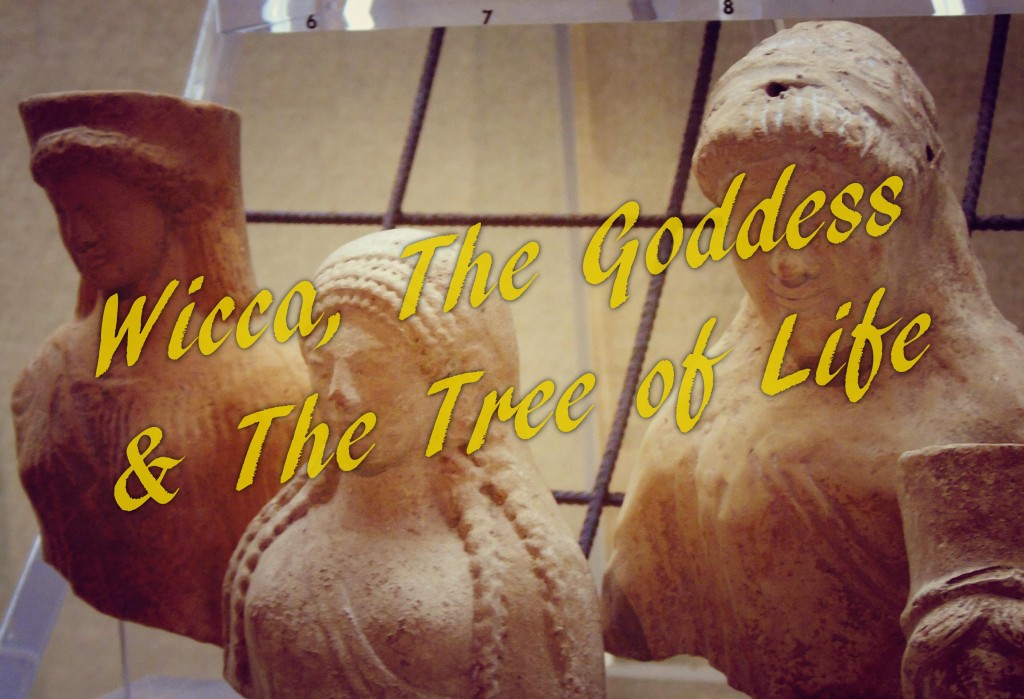
Wicca, the Goddess and the Tree of Life
(Photo: Sorita d’Este, 2015, Sicily)
The Mother of them All
The magic circle itself is another symbol shared by Wicca and Qabalah. One of the Qabalistic creation myths (from ninth century CE Germany) tells of how the Shekinah is the circle of fire who surrounds God, and that through their union the universe, human souls and angels come into being. In fact the Shekinah is seen in two forms in Qabalah, as the Greater Shekinah and the Lesser Shekinah. As the Greater Shekinah she is the great goddess who unites with god to create the universe, considered to be unmanifest and omnipresent, and is also known as the Superior Mother, who can be seen as the Great Mother Goddess of Wicca. A description of the Shekinah translated by MacGregor Mathers in The Kabbalah Unveiled shows the similarity in perception of the goddess with Wicca:
“From Her do they receive their nourishment, and from Her do they receive blessing; and She is called the Mother of them all.”
The relationship of the goddess and god, so central to Wicca, is also seen repeatedly on the Tree of Life. As well as the feminine and masculine pillars, it is also seen in the balanced pair of Sephiroth at the top of the pillars, Chokmah (‘Wisdom’) and Binah (’Understanding’), and in the relationship of the central solar Sephira of Tiphereth (’Beauty’) with the bottom Sephira of Malkuth (‘Kingdom’).
Divine Union
Malkuth has many titles, and it is also equated to the Lesser Shekinah. This is because Malkuth is the sphere of the elements, and corresponds to the physical world we live in, and nature. Hence we see titles for Malkuth such as the Bride, the Queen and the Mother of all things. As the Bride, Malkuth is said to be married to the Husband sphere of Tiphereth, symbolising the union of the sun god and the earth goddess as also seen in Wicca. Tiphereth as the child of Chokmah and Binah also corresponds to the Child of Promise, reborn at Yule.
The Elements
These Sephiroth of Chokmah, Binah, Tiphereth and Malkuth can also correspond to the great unpronounceable name of Qabalah, the Tetragrammaton, usually pronounced as Jehovah or Jahweh. This name is comprised of four letters, IHVH, and these letters have many attributions. Amongst these attributions are Father – Mother – Son – Daughter, Fire – Water –Air – Earth, Past – Future – Space – Present. A cursory glance immediately shows have familiar concepts from Wicca are also seen with these attributions, such as Fire and Air as the masculine elements and Water and Earth as the feminine ones. Likewise the relationship between the mother and daughter is emphasised by them both being attributed to the same letter, Heh, which is repeated in the unpronounceable name.
The 8-Spokes of the Wheel
Returning to Tiphereth, the Solar Sephira, it has a unique and interesting position on the Tree of Life, at the centre of the glyph. It is connected by paths to all of the other Sephiroth apart from Malkuth. This means there are eight Sephiroth around the sun, mirroring the symbolism Wheel of the Year, where the sun passes through the year and the eight Sabbats.
This is only a brief introduction to the topic of Wicca & the Tree of Life, but I hope it will spark some discussion and interest in the topic. For practitioners of the art magical to understand and further improve their practices – which surely is an ongoing process – having a firm understanding of symbolism is after all essential.
This is a re-edit of an article I first wrote in 2010 for a magazine. It draws on the work I did with David Rankine, and readers interested in further exploring the topic might find the following works we co-produced helpful:
Wicca Magickal Beginnings (2008)
Practical Qabalah Magick (2009)
The Cosmic Shekinah (2010)
Follow Sorita d’Este on Facebook:
Sorita D'Este | Promote your Page too

Previous Post
August 11, 2016
Is She the Crone? Hekate's Profanation?
Next Post

December 8, 2016 Avalon of the Heart: Dion Fortune & Glastonbury
Browse Our Archives
Select a Category Adamantine Musings Book Celtic Children of Earth - Interviews Christianity Druidry Elemental Magic Events Glastonbury Goddesses greek god Hekate Hellenic Hermes Ireland Italy magic(k) Mermaids Nature Pilgrimage Psychic & Mediumship Qabalah Roman Scotland Uncategorized Unicorns Vodou Wicca & Witchcraft
Select a Month November 2020 October 2020 August 2020 April 2020 October 2019 September 2019 August 2019 July 2019 June 2019 May 2019 November 2018 October 2018 July 2018 April 2018 March 2018 January 2018 December 2017 November 2017 July 2017 June 2017 February 2017 January 2017 December 2016 August 2016 July 2016 June 2016
Follow Us!
TAKE THE
Religious Wisdom Quiz
Who anointed Jesus with expensive perfume?
Select your answer to see how you score.
Peter Mary Martha Salome
Related posts from Adamantine Muse
The Horn of the Unicorn - Part 2
The Horn of the Unicorn - Part 1
Hekate & Pop Culture : Liminal Fantasies, or...
TRENDING AT PATHEOS Pagan

I was recently chatting with someone on Instagram. She asked me what...

While there are many people who share their results, the end of...

On July 23, I saw Christopher Nolan's The Odyssey which is Homer’s...

As I write this two big events have just finished up. One...

Restoring the Watershed of Divine Love
Perhaps cooperation is not something we manufacture through legislation, ideology, or moral...

Many UUs don’t pray because of bad experiences in a previous religion,...
view all Pagan blogs
Ad-Free & Subscriber Log-In Subscription Support
- About Us
- 2026 Calendar
- Videos
- Podcasts
- Library of World Religions
- Faith In Media Tracker
- Advertise With Us
- Write for Us
- Privacy Policy
- Terms of Service
- Do Not Sell My Data
- Contact Us
- Radiant Digital
- Manage Newsletter Subscriptions
- Unsubscribe From Notifications
- Sitemap
Copyright 2008-2026, Patheos. All rights reserved.
Subscription Support Ad-Free & Subscriber Log-In
Follow Patheos