
BuddhistCatholicContemplativeEvangelicalGeneral ChristianHinduJewishLatter-day SaintMuslimNew VisionsProgressive Christian
Beliefs
- Buddhist
- Catholic
- Contemplative
- Evangelical
- General Christian
- Hindu
- Jewish
- Latter-day Saint
- More Voices
- Muslim
- New Visions
- Pagan
- Progressive Christian
Topics
- Religion News
- Food and Religion
- Sports and Religion
- Religious Art
- Religious Music and Entertainment
- Religious Events
- History and Religion
- Style and Religion
- Politics and Religion
- Women in Religion
- Recreation Outdoors and Religion
- Business Finance and Religion
- Careers Workplace and Religion
- Education and Religion
- Family Parenting and Religion
- Health Fitness and Religion
- Home and Religion
- Relationships and Religion
- Technology and Religion
- Travel and Religion
Columnists
- Buddhist Columnists
- Business Finance and Religion Columnists
- Careers Workplace and Religion Columnists
- Catholic Columnists
- Contemplative Columnists
- Education and Religion Columnists
- Evangelists Columnists
- Family Parenting and Religion Columnists
- General Christian Columnists
- Health Fitness and Religion Columnists
- Hindu Columnists
- History and Religion Columnists
- Home and Religion Columnists
- Jewish Columnists
- More Voices Columnists
- Latter Day Columnists
- Muslim Columnists
- New Visions Columnists
- Nonreligious Columnists
- Pagan Columnists
- Politics and Religion Columnists
- Progressive Columnists
- Recreation Outdoors and Religion Columnists
- Relationships and Religion Columnists
- Religion News Columnists
- Religious Art Columnists
- Religious Events Columnists
- Religious Music and Entertainment Columnists
- Sports and Religion Columnists
- Style and Religion Columnists
- Technology and Religion Columnists
- Travel and Religion Columnists
- Women in Religion Columnists
Resource Library
- 2026 Calendar
- Library of World Religions
- The 100 Most Holy Places on Earth
- Patheos Answers
- Podcasts
- Videos
- Faith Leaders Database
- Anglican Episcopalian
- Bahai
- Baptist
- Buddhism
- Christianity
- Confucianism
- Eastern Orthodoxy
- Hinduism
- Holiness and Pentecostal
- ISKCON
- Islam
- Judaism
- Lutheran
- Methodist
- The Church of Jesus Christ of Latter-day Saints
- New Age
- Paganism
- Presbytarian and Reformed
- Protestantism
- Religion Behind the Scenes
- Roman Catholic
- Scientology
- Shia Islam
- Sikhism
- Sufism
- Sunni Islam
- Taoism
- Zen
- See all religions
Research Tools
 Ad-Free & Subscriber Log-In Subscription Support
Ad-Free & Subscriber Log-In Subscription Support
Follow Patheos 

- Trending:
- Forgiveness
- |
- Marriage
- |
- Consciousness
- |
- Death Penalty
- |
- Election
- |
- Halloween
 Adamantine Muse
- Home
- Pagan
- Magic or Magick?
Magic or Magick?
Last updated on: June 28, 2016 at 11:51 pm by Sorita d'Este
Magic or Magick? 2016-06-28T23:51:21+01:00 Sorita d'Este
Patheos Explore the world's faith through different perspectives on religion and spirituality! Patheos has the views of the prevalent religions and spiritualities of the world.

The Conjurer, 1475-1480, by Hieronymus Bosch
Aleister Crowley is often credited with inventing the use of the term magick (with a k) as opposed to magic. The addition of the k increases the magical potency of the word as k is the eleventh letter of the alphabet and eleven is a number considered to contain a lot of inherent magical power within the western magical system (being the one beyond ten). Crowley himself also emphasised that he used the spelling of magick in order to differentiate the term from the variety of magic practiced by stage performers.
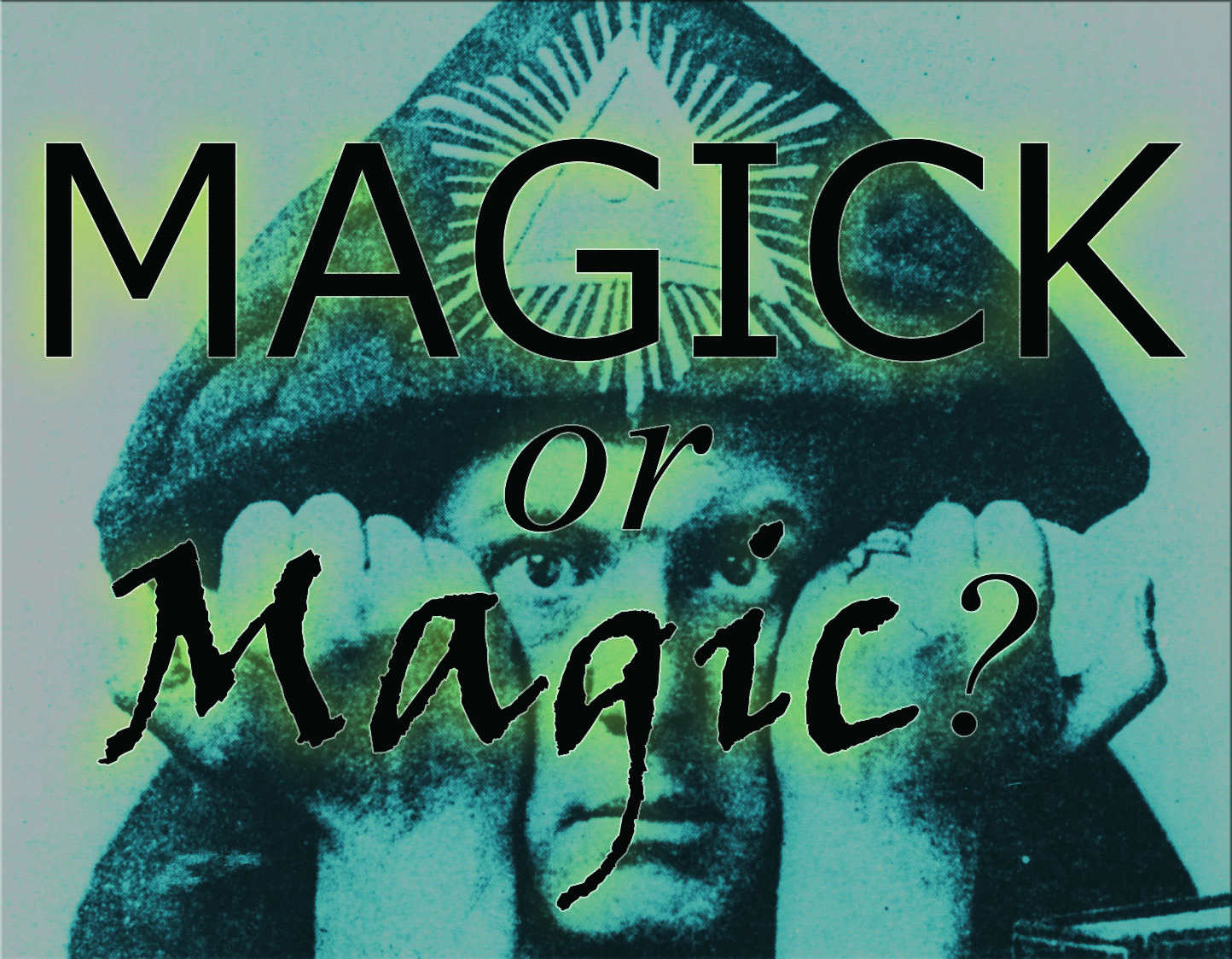
It is however also interesting to note that the use of both ‘magick’ and ‘magic’ occurs in medieval and renaissance grimoires, as well as other documents of the time, as there was no standardisation of spelling. For example, in the book History of Magick published in 1657 we find*:*
“From these four different wayes, we infer four kinds of Magick: Divine, relating to the first, Theurgick, to the second, Goetick, to the third, and Naturall, to the last…”
Richard Boulton’s two volume work of 1715-16, A Compleat History of Magick, Sorcery and Witchcraft continued this use with a ‘k’. Likewise in a completely non-esoteric context, we find it used in a scientific document published in 1811:
“To describe the construction of the Magick Lantern”[i]
Throughout the nineteenth century both spellings continued to be used frequently, and as Crowley was a well read man he would certainly have been familiar with the alternative spelling. So one could say that Crowley did popularise the Magick spelling, but also that he revived the use of this manner of spelling for the word (which was still after all widely in use a few decades earlier), whichever way – he certainly did not invent it.
So is MAGICK or MAGIC the better spelling to use within modern esoteric practices? Personally, I have alternated over the years in my preference of one over the other. I have not been consistent as an author, sometimes having changed forced upon me because of the preferences of a publication I have written for, or the context in which I have written. Sometimes I have simply been in the mood for Magick rather than Magic, or indeed Magic rather than Magick.
For me it really doesn’t matter. I am not going to get emotional about the spelling, because when it is translated into other languages, the word changes anyway – a concept to consider if you do feel an emotional attachment to one spelling over the other! Ultimately, the emphasis should be on ensuring that the reader of whatever is written understands the word for the meaning intended, within the context in which it is used. Other than that, surely it is the practice and study the word represents which we should be focussing on?
[i] Institutes of Natural Philosophy, William Enfield, Alexander Ewing, Samuel Webber, 1811
This article is adapted from a chapter published in WICCA: Magickal Beginnings, which I co-authored with David Rankine (Avalonia, 2008).
Previous Post

June 27, 2016
The Theban Script: (Not so) Secret Alphabet of the Witches
Next Post
July 5, 2016 Hekate, Isis and the Dog Star Sirius: Welcome to the Dog Days!
Browse Our Archives
Select a Category Adamantine Musings Book Celtic Children of Earth - Interviews Christianity Druidry Elemental Magic Events Glastonbury Goddesses greek god Hekate Hellenic Hermes Ireland Italy magic(k) Mermaids Nature Pilgrimage Psychic & Mediumship Qabalah Roman Scotland Uncategorized Unicorns Vodou Wicca & Witchcraft
Select a Month November 2020 October 2020 August 2020 April 2020 October 2019 September 2019 August 2019 July 2019 June 2019 May 2019 November 2018 October 2018 July 2018 April 2018 March 2018 January 2018 December 2017 November 2017 July 2017 June 2017 February 2017 January 2017 December 2016 August 2016 July 2016 June 2016
Follow Us!
TAKE THE
Religious Wisdom Quiz
Which branch of Christianity uses the term "Mass" for its main worship?
Select your answer to see how you score.
Baptist Methodist Pentecostal Catholic
Related posts from Adamantine Muse
The Horn of the Unicorn - Part 3

The Horn of the Unicorn - Part 2
The Horn of the Unicorn - Part 1
Did Mabon steal the Autumn Equinox?
TRENDING AT PATHEOS Pagan

I was recently chatting with someone on Instagram. She asked me what...

While there are many people who share their results, the end of...

On July 23, I saw Christopher Nolan's The Odyssey which is Homer’s...

As I write this two big events have just finished up. One...

Restoring the Watershed of Divine Love
Perhaps cooperation is not something we manufacture through legislation, ideology, or moral...

Many UUs don’t pray because of bad experiences in a previous religion,...
view all Pagan blogs
Ad-Free & Subscriber Log-In Subscription Support
- About Us
- 2026 Calendar
- Videos
- Podcasts
- Library of World Religions
- Faith In Media Tracker
- Advertise With Us
- Write for Us
- Privacy Policy
- Terms of Service
- Do Not Sell My Data
- Contact Us
- Radiant Digital
- Manage Newsletter Subscriptions
- Unsubscribe From Notifications
- Sitemap
Copyright 2008-2026, Patheos. All rights reserved.
Subscription Support Ad-Free & Subscriber Log-In
Follow Patheos