
BuddhistCatholicContemplativeEvangelicalGeneral ChristianHinduJewishLatter-day SaintMuslimNew VisionsProgressive Christian
Beliefs
- Buddhist
- Catholic
- Contemplative
- Evangelical
- General Christian
- Hindu
- Jewish
- Latter-day Saint
- More Voices
- Muslim
- New Visions
- Pagan
- Progressive Christian
Topics
- Religion News
- Food and Religion
- Sports and Religion
- Religious Art
- Religious Music and Entertainment
- Religious Events
- History and Religion
- Style and Religion
- Politics and Religion
- Women in Religion
- Recreation Outdoors and Religion
- Business Finance and Religion
- Careers Workplace and Religion
- Education and Religion
- Family Parenting and Religion
- Health Fitness and Religion
- Home and Religion
- Relationships and Religion
- Technology and Religion
- Travel and Religion
Columnists
- Buddhist Columnists
- Business Finance and Religion Columnists
- Careers Workplace and Religion Columnists
- Catholic Columnists
- Contemplative Columnists
- Education and Religion Columnists
- Evangelists Columnists
- Family Parenting and Religion Columnists
- General Christian Columnists
- Health Fitness and Religion Columnists
- Hindu Columnists
- History and Religion Columnists
- Home and Religion Columnists
- Jewish Columnists
- More Voices Columnists
- Latter Day Columnists
- Muslim Columnists
- New Visions Columnists
- Nonreligious Columnists
- Pagan Columnists
- Politics and Religion Columnists
- Progressive Columnists
- Recreation Outdoors and Religion Columnists
- Relationships and Religion Columnists
- Religion News Columnists
- Religious Art Columnists
- Religious Events Columnists
- Religious Music and Entertainment Columnists
- Sports and Religion Columnists
- Style and Religion Columnists
- Technology and Religion Columnists
- Travel and Religion Columnists
- Women in Religion Columnists
Resource Library
- 2026 Calendar
- Library of World Religions
- The 100 Most Holy Places on Earth
- Patheos Answers
- Podcasts
- Videos
- Faith Leaders Database
- Anglican Episcopalian
- Bahai
- Baptist
- Buddhism
- Christianity
- Confucianism
- Eastern Orthodoxy
- Hinduism
- Holiness and Pentecostal
- ISKCON
- Islam
- Judaism
- Lutheran
- Methodist
- The Church of Jesus Christ of Latter-day Saints
- New Age
- Paganism
- Presbytarian and Reformed
- Protestantism
- Religion Behind the Scenes
- Roman Catholic
- Scientology
- Shia Islam
- Sikhism
- Sufism
- Sunni Islam
- Taoism
- Zen
- See all religions
Research Tools
 Ad-Free & Subscriber Log-In Subscription Support
Ad-Free & Subscriber Log-In Subscription Support
Follow Patheos 

- Trending:
- Forgiveness
- |
- Marriage
- |
- Consciousness
- |
- Death Penalty
- |
- Election
- |
- Halloween
 A Crow and The Dead
- Home
- Pagan
- Just a Scapegoat Living Deliciously
Just a Scapegoat Living Deliciously
Last updated on: May 24, 2021 at 1:31 pm by Mortellus
Just a Scapegoat Living Deliciously 2021-05-24T13:31:53-04:00 Mortellus
Patheos Explore the world's faith through different perspectives on religion and spirituality! Patheos has the views of the prevalent religions and spiritualities of the world.

Living deliciously, Photo by Pexels.
I learned first hand growing up what it feels like to be the scapegoat in a family with a dueling Narcissistic Personality types, and came to develop a very low threshold for tolerating that sort of behavior. That being said, this made it especially shocking to me when I at the ripe old age of 38, was on the receiving end of exactly that.
What’s Scapegoating?
Eric Brahm tells us in an essay for Beyondintractability.org that “The term scapegoat […] has evolved.” Today it refers “to individuals […] who are symbolically or concretely made to bear responsibility for the faults or problems of others.” In a lot of ways, “scapegoating” (the act of making another person your scapegoat) can be a self defense mechanism. We often see it employed when a person who’s behaved badly toward another, sets out to eliminate negative feelings through elevating themselves/their status above the source of their discomfort.
An example of this might be when a liberal or otherwise forward thinking person exhibits deeply ingrained toxic masculinity, sexism, ageism, or other undesirable behaviors toward someone within a vulnerable class – and when called to account, attempts to justify their behavior. Rarely does that person attack those pointing out their toxic nature, but instead, the person whom they’ve already harmed. After all, one might justify behaving a particular way toward an individual if they can convince others that person or their actions are flawed.
Scapegoaters are likely to select someone who is vulnerable such as a victim/survivor, someone with less inherent privilege in a given setting, or a nonconformist who might easily be persecuted. This “enables the scapegoaters to discharge and distract from their negative feelings, which are replaced or overtaken by a crude but consoling sense of affirmation and self-righteous indignation.” After all, “the creation of a villain necessarily implies that of a hero, even if both are purely fictional.”
Surely people don’t fall for this…
People totally fall for this, and you might be wondering why anyone would sit by and let this sort of thing happen right in front of them, but the logic is simple. It is because in times of difficulty, anxiety, and crisis, that communities of all sizes, lash out at those who cannot (or will not) retaliate. This allows them, even from the sidelines, to subconsciously vent frustration with situations that they cannot change, in a way that does not bring them personal harm.
Brahm goes on to say that “once scapegoating is perceived to be successful in generating positive feelings in perpetrators, there is likely to be reluctance to give it up. The scapegoated provide a ready explanation for troubles. Therefore, there is relatively little incentive for the perpetrator to give it up. For the scapegoated, they are left with few good options: to flee, to assimilate, or to fight back.”
Let me guess how that went…
As someone who is devoted to the Morrigan, my response has always been to assert a boundary, fight back, and reject this dynamic. I would well and truly rather put my foot up someones ass than run away or submit to a narcissistic manipulator – but for those who would scapegoat in the first place, there’s a tactic for this as well. The Discard.
Become an immovable object, and you will quickly be tossed aside as the problem that you so obviously are. ‘I’m done with you,’ that person might say, as though you’re not relieved to finally be outside their realm of concern. But the real loss is communities, when they lose someone who was truly devoted to fighting for them. Either way, this scapegoat will be over here living deliciously without you thank you very much.
Why talk about this?
Having grown up in a toxic religious environment, I’m not blind to the fact that certain personality types are drawn to religious leadership. Magical/pagan/occult groups are not immune – if anything, there’s even more risk. So I’m here today to say that anyone can wind up on the receiving end of a dangerous personality, and sometimes it’s real subtle to catch and easy to buy in to the narrative that there’s something wrong with you and not them – especially if more than one person is saying it, and doubly in the presence of gaslighting.

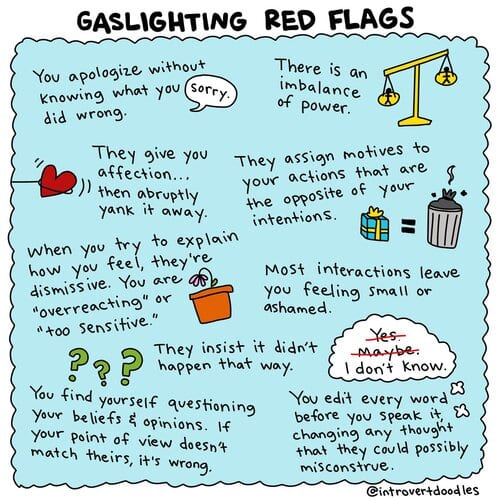
Gaslighting sucks. Photo from Introvert Doodles.
Boundaries
It is in the poem “Boundaries” that McKayla Robbin says: “No is a necessary magic. No draws a circle around you with chalk and says I have given enough.”
The best litmus test of a toxic personality type, according to Psychcentral.com, is to set a boundary and stick to it. Those who accept those boundaries with grace? Well, that’s a great sign. But if they respond by bombing you with sugary sweetness and a pat on the head while still pushing against those boundaries? And should you keep to those boundaries after all, resort to accusing, pouting, getting angry, discarding?
Well, now you know what they are.
While we’re on the topic, here’s some warning signs to keep an eye out for toxic personalities and concerning cult-like behavior. We might be ye olde witch cult, but we aren’t like, a cult-cult, ya know?

About Mortellus
Mortellus is a Gardnerian High Priestex, Mortician, and Necromantrix living in beautiful Western North Carolina. You can read more about the author here.
Previous Post

March 15, 2021
The Spring Riot
Next Post

April 3, 2021 Autonomy Over Integrity
Browse Our Archives
Select a Category Uncategorized
Select a Month June 2021 May 2021 April 2021 March 2021 February 2021 January 2021 December 2020 November 2020 October 2020 September 2020 August 2020 July 2020
Follow Us!
TAKE THE
Religious Wisdom Quiz
"A cheerful heart is good medicine" is found in what book?
Select your answer to see how you score.
Matthew Genesis Proverbs Psalms
Related posts from A Crow and The Dead

How We Can Support LGBTQIA+ Rights

Ambiguous Grief, Mourning Living Parents

TRENDING AT PATHEOS Pagan

I was recently chatting with someone on Instagram. She asked me what...

While there are many people who share their results, the end of...

On July 23, I saw Christopher Nolan's The Odyssey which is Homer’s...

As I write this two big events have just finished up. One...

Restoring the Watershed of Divine Love
Perhaps cooperation is not something we manufacture through legislation, ideology, or moral...

Many UUs don’t pray because of bad experiences in a previous religion,...
view all Pagan blogs
Ad-Free & Subscriber Log-In Subscription Support
- About Us
- 2026 Calendar
- Videos
- Podcasts
- Library of World Religions
- Faith In Media Tracker
- Advertise With Us
- Write for Us
- Privacy Policy
- Terms of Service
- Do Not Sell My Data
- Contact Us
- Radiant Digital
- Manage Newsletter Subscriptions
- Unsubscribe From Notifications
- Sitemap
Copyright 2008-2026, Patheos. All rights reserved.
Subscription Support Ad-Free & Subscriber Log-In
Follow Patheos