
BuddhistCatholicContemplativeEvangelicalGeneral ChristianHinduJewishLatter-day SaintMuslimNew VisionsProgressive Christian
Beliefs
- Buddhist
- Catholic
- Contemplative
- Evangelical
- General Christian
- Hindu
- Jewish
- Latter-day Saint
- More Voices
- Muslim
- New Visions
- Pagan
- Progressive Christian
Topics
- Religion News
- Food and Religion
- Sports and Religion
- Religious Art
- Religious Music and Entertainment
- Religious Events
- History and Religion
- Style and Religion
- Politics and Religion
- Women in Religion
- Recreation Outdoors and Religion
- Business Finance and Religion
- Careers Workplace and Religion
- Education and Religion
- Family Parenting and Religion
- Health Fitness and Religion
- Home and Religion
- Relationships and Religion
- Technology and Religion
- Travel and Religion
Columnists
- Buddhist Columnists
- Business Finance and Religion Columnists
- Careers Workplace and Religion Columnists
- Catholic Columnists
- Contemplative Columnists
- Education and Religion Columnists
- Evangelists Columnists
- Family Parenting and Religion Columnists
- General Christian Columnists
- Health Fitness and Religion Columnists
- Hindu Columnists
- History and Religion Columnists
- Home and Religion Columnists
- Jewish Columnists
- More Voices Columnists
- Latter Day Columnists
- Muslim Columnists
- New Visions Columnists
- Nonreligious Columnists
- Pagan Columnists
- Politics and Religion Columnists
- Progressive Columnists
- Recreation Outdoors and Religion Columnists
- Relationships and Religion Columnists
- Religion News Columnists
- Religious Art Columnists
- Religious Events Columnists
- Religious Music and Entertainment Columnists
- Sports and Religion Columnists
- Style and Religion Columnists
- Technology and Religion Columnists
- Travel and Religion Columnists
- Women in Religion Columnists
Resource Library
- 2026 Calendar
- Library of World Religions
- The 100 Most Holy Places on Earth
- Patheos Answers
- Podcasts
- Videos
- Faith Leaders Database
- Anglican Episcopalian
- Bahai
- Baptist
- Buddhism
- Christianity
- Confucianism
- Eastern Orthodoxy
- Hinduism
- Holiness and Pentecostal
- ISKCON
- Islam
- Judaism
- Lutheran
- Methodist
- The Church of Jesus Christ of Latter-day Saints
- New Age
- Paganism
- Presbytarian and Reformed
- Protestantism
- Religion Behind the Scenes
- Roman Catholic
- Scientology
- Shia Islam
- Sikhism
- Sufism
- Sunni Islam
- Taoism
- Zen
- See all religions
Research Tools
 Ad-Free & Subscriber Log-In Subscription Support
Ad-Free & Subscriber Log-In Subscription Support
Follow Patheos 

- Trending:
- Forgiveness
- |
- Marriage
- |
- Consciousness
- |
- Death Penalty
- |
- Election
- |
- Halloween
 A Catholic Thinker
- Home
- Catholic
- Memento Mori: Hope In a Year Heavy With Death
Memento Mori: Hope In a Year Heavy With Death
Last updated on: December 29, 2016 at 1:33 am by Tod Worner
Memento Mori: Hope In a Year Heavy With Death 2016-12-29T01:33:22-06:00 Tod Worner
Patheos Explore the world's faith through different perspectives on religion and spirituality! Patheos has the views of the prevalent religions and spiritualities of the world.
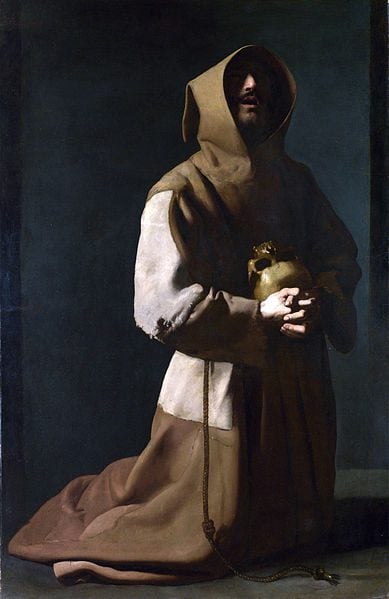
Saint Francis in Meditation by Francisco de Zurbarán
———–
“If you wish to live well, spend the remaining days of life with death before your eyes.”
– St. Alphonsus di Liguori
Sheesh.
If you’ve been paying attention, 2016 has been ruthless in its voracious claim on lives.
First, to those who have lost a spouse or child, mother or father, brother or sister, dear friend or close relative, no list of the famous dead will generate grief that even begins to compare. And, frankly, some of the chest-beating, hand-wringing lamentations from distant fans over the famous departed can often seem a hollow, self-indulgent affectation to someone rendered prostrate by the loss of a child, a spouse or a best friend.
Second, Death has rained down upon civilians in Aleppo, crushed people in a Berlin Christmas market, and executed an ambassador on live television in a Turkish art museum. Whether plane crashes or police-protestor street violence, abortions or suicides, cancers or infections, Death has smugly cut life short again and again and again.
And, finally, our iPhones, televisions and radios have alerted us repeatedly to yet another famous life finished. Whether timely or untimely, news of these deaths jolted us, if only for a second. Upon hearing the news, we were brought back to a favorite childhood song, a hilarious television show, a date movie, a compelling interview, an inspiring life or a favorite book. It made us pause when we heard about the passing of Prince or Carrie Fisher or Debbie Reynolds. It made us stand momentarily still for Antonin Scalia or Elie Wiesel or John Glenn. It made us look off in the distance for a mere second remembering Gene Wilder or Alan Rickman or Arnold Palmer.
And what came to mind – what we couldn’t escape – whether baldly articulated or vaguely felt was,
Memento mori.
Remember that you have to die.
We all forget it. Or we try to.
But the fact is: We are all going to die. And we need to remember that.
But why? Why must we, in this short life, spend any more time than necessary reminded that we too will die? Isn’t that morbid?
On the contrary. It is essential.
By encountering death (and thus being reminded that we have to die), our mind is concentrated. What matters in life? I mean, what truly matters? If our time is limited to live rightly and love deeply, what are we waiting for? What wrong should we right? What relationship should we mend? What sin should we confess? What calling should we answer with fervor and zeal without an ounce of self-consciousness? Time and again, when a person is asked how they would live differently if they knew they had a month, a week or a day left to live, their answer shows an exquisite, penetrating concentration of priorities. And then, as soon as the question has passed, they go on living unreformed – as if life, in fact, will never end.
Remembering that we have to die is not a novel concept. For centuries, great artistic masterpieces have shown saints wrestling with the ever-present reality (and certainty) of Death. Still life artwork has repeatedly portrayed a jarring skull intermingled with books, glasses and sumptuous bowls of fruit. Even Hamlet’s iconic pose holding and heavily contemplating the skull of a beloved childhood jester is a classic human moment remembering the ephemeral nature of time and life. The ultimate truth literally stared back at Hamlet with black eyeless sockets and crooked teeth. Hamlet…you too will have to die.
Death of our loved ones. Death in our news. Death in our art.
Memento mori.
It’s enough to make you depressed.
But, you see, as we remember the jarring truth that we are going to die, there is an even more enduring Truth. A hopeful one.
Death is not the end.
At the Last Supper, as the disciples began to catch glimpses of the horrible fate Christ would soon endure, Jesus reassured,
“Do not let your hearts be troubled. You have faith in God; have faith also in me. In my Father’s house there are many dwelling places. If there were not, would I have told you that I am going to prepare a place for you? And if I go and prepare a place for you, I will come back again and take you to myself, so that where I am you also may be.” (John 14:1-3)
Imagine. Jesus Christ, God Incarnate, with full knowledge of that brutal fate that awaited him was born for the express purpose of dying. His clear vision and full understanding made Death a dark companion at every turn of his life. And yet, Christ was superior to it. Though he had his dark night in the Garden of Gethsemane (and perhaps others unbeknownst to us), he never wavered from his salvific mission to die for our redemption. Jesus Christ remembered that he was going to die. He embodied memento mori. And yet, here he was reassuring the disciples.
And reassuring us.
“Do not let your hearts be troubled. You have faith in God; have faith also in me.”
St. Paul would believe it when he later exclaimed,
“Death is swallowed up in victory.
Where, O death, is your victory?
Where, O death, is your sting?” (I Corinthians 15:54-55)
St. Thomas More, imprisoned with death daily before his eyes, was comforted,
“Earth has no sorrow that heaven cannot heal.”
And Pope Francis would remind us,
“The right to weep must not be denied. Even Jesus was deeply moved and profoundly troubled by the bereavement of a family he loved. We can, instead, draw from the simple and powerful witness of many families who have known how to grasp, in the difficult passage of death, also the safe passage offered by the Lord, crucified and risen, with his irrevocable promise of the resurrection of the dead. The work of God’s love is stronger than the work of death. We must seek to be ‘accomplices’ to that love, with our faith. … Death was defeated by Jesus on the cross. Jesus will restore all of us to our families.”
Death has walked with us quite regularly this year. Yes, to be sure, the tragic wars, calamities and plagues of previous years have exceeded the claims of 2016. But regardless this year still seemed heavy with death. What, in those mournful moments, those pauses of deep reflection, are we to do? As we are stilled by the inescapable memento mori, the grim reminder that we too will have to die, what gives us hope?
Though we die…we will live again.
And be at peace.
—————————-
Photo credit:Wikimedia Commons

Previous Post

December 19, 2016
Advent: The Greatest Resistance Story of All Time
Browse Our Archives
Select a Category A Catholic Thinker's Story Uncategorized
Select a Month March 2017 February 2017 December 2016 November 2016 October 2016 September 2016 August 2016 July 2016 June 2016 May 2016 April 2016 March 2016 February 2016 January 2016 December 2015 November 2015 October 2015 September 2015 August 2015 July 2015 June 2015 May 2015 April 2015 March 2015 February 2015 January 2015 December 2014 November 2014 October 2014 September 2014 August 2014 July 2014 June 2014 May 2014 April 2014 March 2014 February 2014 January 2014 December 2013 November 2013 October 2013 September 2013 July 2013 June 2013 May 2013 April 2013 March 2013 February 2013 January 2013 December 2012 November 2012 October 2012 September 2012 August 2012 July 2012
Follow Us!
TAKE THE
Religious Wisdom Quiz
What animal is mentioned in Proverbs as having little strength but great wisdom?
Select your answer to see how you score.
Bear Ox Ant Lion
Related posts from A Catholic Thinker

"Something Absolutely Modern" - The Insincere Convert from...

Textualism vs. The Living Constitution: Justice Scalia, Judge...
Advent: The Greatest Resistance Story of All Time
A Reminder to Apologists For a Ruthless Man...
TRENDING AT PATHEOS Catholic

Rejecting Doom: Christian Hope And Human Action
Christianity is a religion of hope. We are to have hope and...

It’s What Comes From Within Which Matters
One of the most difficult things for us to understand is why...

Why I Choose the Eucharist Over the Sermon
Choose the Eucharist, Not the Sermon What are we supposed to get...

5 Design Elements Found in Spiritually Rooted Homes
Putting Spirituality Into Home Decor Our homes are more than our living...

Credo: A Story of God Told with the...
About 10 years ago, I began to imagine a personal "Credo" that...

The Anatomy of Divine Revelation in Catholic Thought
The claim that God has made Himself known to human beings is...
view all Catholic blogs
Ad-Free & Subscriber Log-In Subscription Support
- About Us
- 2026 Calendar
- Videos
- Podcasts
- Library of World Religions
- Faith In Media Tracker
- Advertise With Us
- Write for Us
- Privacy Policy
- Terms of Service
- Do Not Sell My Data
- Contact Us
- Radiant Digital
- Manage Newsletter Subscriptions
- Unsubscribe From Notifications
- Sitemap
Copyright 2008-2026, Patheos. All rights reserved.
Subscription Support Ad-Free & Subscriber Log-In
Follow Patheos