
BuddhistCatholicContemplativeEvangelicalGeneral ChristianHinduJewishLatter-day SaintMuslimNew VisionsProgressive Christian
Beliefs
- Buddhist
- Catholic
- Contemplative
- Evangelical
- General Christian
- Hindu
- Jewish
- Latter-day Saint
- More Voices
- Muslim
- New Visions
- Pagan
- Progressive Christian
Topics
- Religion News
- Food and Religion
- Sports and Religion
- Religious Art
- Religious Music and Entertainment
- Religious Events
- History and Religion
- Style and Religion
- Politics and Religion
- Women in Religion
- Recreation Outdoors and Religion
- Business Finance and Religion
- Careers Workplace and Religion
- Education and Religion
- Family Parenting and Religion
- Health Fitness and Religion
- Home and Religion
- Relationships and Religion
- Technology and Religion
- Travel and Religion
Columnists
- Buddhist Columnists
- Business Finance and Religion Columnists
- Careers Workplace and Religion Columnists
- Catholic Columnists
- Contemplative Columnists
- Education and Religion Columnists
- Evangelists Columnists
- Family Parenting and Religion Columnists
- General Christian Columnists
- Health Fitness and Religion Columnists
- Hindu Columnists
- History and Religion Columnists
- Home and Religion Columnists
- Jewish Columnists
- More Voices Columnists
- Latter Day Columnists
- Muslim Columnists
- New Visions Columnists
- Nonreligious Columnists
- Pagan Columnists
- Politics and Religion Columnists
- Progressive Columnists
- Recreation Outdoors and Religion Columnists
- Relationships and Religion Columnists
- Religion News Columnists
- Religious Art Columnists
- Religious Events Columnists
- Religious Music and Entertainment Columnists
- Sports and Religion Columnists
- Style and Religion Columnists
- Technology and Religion Columnists
- Travel and Religion Columnists
- Women in Religion Columnists
Resource Library
- 2026 Calendar
- Library of World Religions
- The 100 Most Holy Places on Earth
- Patheos Answers
- Podcasts
- Videos
- Faith Leaders Database
- Anglican Episcopalian
- Bahai
- Baptist
- Buddhism
- Christianity
- Confucianism
- Eastern Orthodoxy
- Hinduism
- Holiness and Pentecostal
- ISKCON
- Islam
- Judaism
- Lutheran
- Methodist
- The Church of Jesus Christ of Latter-day Saints
- New Age
- Paganism
- Presbytarian and Reformed
- Protestantism
- Religion Behind the Scenes
- Roman Catholic
- Scientology
- Shia Islam
- Sikhism
- Sufism
- Sunni Islam
- Taoism
- Zen
- See all religions
Research Tools
 Ad-Free & Subscriber Log-In Subscription Support
Ad-Free & Subscriber Log-In Subscription Support
Follow Patheos 

- Trending:
- Forgiveness
- |
- Marriage
- |
- Consciousness
- |
- Death Penalty
- |
- Election
- |
- Halloween
 A Catholic Thinker
- Home
- Catholic
- The Horrible Grace of King Lear
The Horrible Grace of King Lear
Last updated on: October 7, 2016 at 11:49 pm by Tod Worner
The Horrible Grace of King Lear 2016-10-07T23:49:59-06:00 Tod Worner
Patheos Explore the world's faith through different perspectives on religion and spirituality! Patheos has the views of the prevalent religions and spiritualities of the world.
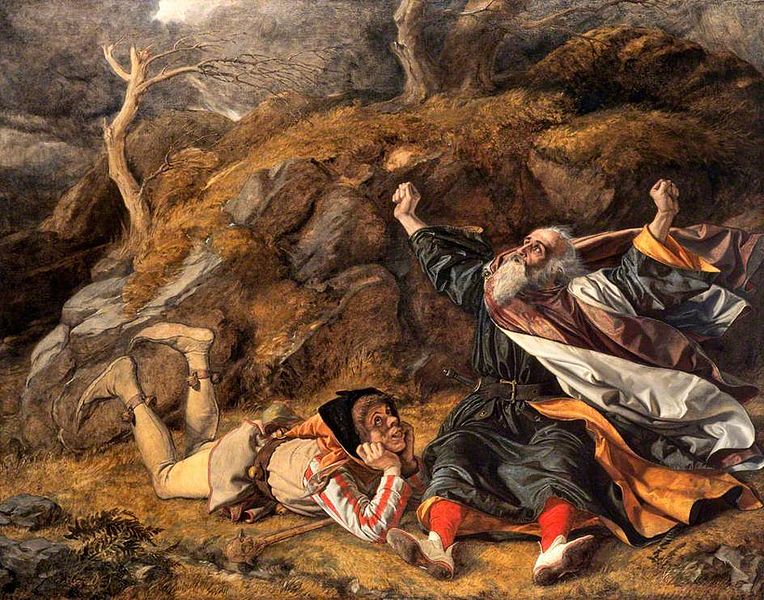
King Lear & the Fool in the Storm by William Dyce
“I don’t want it to storm.”
Her seven year-old voice quivered a bit as she leaned forward in her seat. My eyes caught hers in the rearview mirror. Anxiously, she followed the windshield wipers back and forth, back and forth.
“I don’t want it to storm.”
“It’s okay, baby. Just a little rain. I don’t think there’ll be any storm tonight.”
Sitting back, my daughter’s brow unfurrowed. Her countenance lightened as she peered out at the billowing clouds and grayness of the day.
Storms.
And then my thoughts began to wander. In my mind’s eye, I returned to the old man – a King – in the rain soaked fields of England. Buffeted by unforgiving winds and the sting of the storm’s angry rain, he was stumbling confused and erratic in the company of a disguised friend and a court jester. And he cursed the elements besieging him.
Blow, winds, and crack your cheeks! rage! blow!
You cataracts and hurricanoes, spout
Till you have drench’d our steeples, drown’d the cocks!
You sulphurous and thought-executing fires,
Vaunt-couriers to oak-cleaving thunderbolts,
Singe my white head! And thou, all-shaking thunder,
Strike flat the thick rotundity o’ the world!
This man in the storm was Britain’s King Lear. And William Shakespeare told his story.
An aged, but seasoned King seeks to relinquish his crown (“to crawl unburdened toward death”) and divide his kingdom between his three devoted daughters, Goneril, Reagan and Cordelia. In the midst of a ceremony of no little pomp and circumstance, the King asks each daughter for a public profession of love and fealty prior to receiving their respective third of the kingdom. Disingenuously, Goneril and Reagan seek to ingratiate themselves with their father and outdo one another’s affections, while Cordelia acknowledges a love due her father, but not to a false excess nor at the expense of her future husband. As a consequence, King Lear rages against Cordelia and banishes her, while heaping upon Goneril and Reagan further undue rewards otherwise belonging to Cordelia.
From this inauspicious family squabble begins the descent. Once the King has handed over his power to his two duplicitous daughters, his emasculation would begin. While Lear imagines he will remain the revered King and magnanimous father in the eyes of his “adoring” daughters, he soon learns that their wicked designs are to enlarge their power and shrink his. They callously whittle away his dignity just as they whittle away his retinue of knights. As Goneril derides,
Idle old man
That still would manage those authorities
That he hath given away! Now by my life,
Old fools are babes again and must be used
With checks as flatteries, when they are seen abused.
Coinciding with the unfolding drama of a once great King shrinking in size and stature is the drama of Edmund, Edgar and the Earl of Gloucester. Edmund, the bastard son of the Earl, connives to win his father’s affections at the expense of the true and devoted son, Edgar. By mischief and manipulation, Edmund convinces his father that Edgar conspires to kill him for inheritance and compels Edgar to believe his father angry and intent on punishing Edgar. This requires a most deft treachery. Edgar flees, soils himself in rags and dirt and adopts an alias as Poor Tom.
As the tragedy unfolds, the fortunes of the evildoers come into closer alliance and the fates of the heroes descend into a deeper abyss. A faithful companion hanged. A father’s eyes enucleated. A devoted son half-crazed. A king shivering in a rainstorm.
And upon the story’s end, we find five dead bodies littered across the stage.
True Shakespearean tragedy.
So why do I speak of Grace in my title? Where is the Grace in all of this loss? Where is the redemption in the midst of this betrayal? Where is the clutch of sanity deep within this madness?
The Grace is there, but it is almost completely obscured by the horrible.
The Fool, Lear’s truth-teller and faithful friend, was set upon by the sisters’ minions and ruthlessly lynched. And yet, it was his unswerving loyalty to the King that afforded him (in spite of a life of mirth and irony) the dignity and Grace to die an honorable martyr for his Sovereign. Edgar, relegated to a grimy, hateful existence on the run, was granted hours leading his sightless father culminating in the Grace of receiving Gloucester’s unwitting approbation. Cordelia, banished for her honesty, returned to Britain leading France to battle against the evil designs of her sisters. In the very hour before her own tragic death, she would welcome a long-desired Grace in the warm, forgiving embrace of her father. Even the treacherous Edmund, in his final moments before dying from a stab wound, received a Grace in knowing that, though a bastard, he is loved and lovable and seeks to do just one true thing before perishing. And finally, King Lear, awash in inconsolable tears at the death of Cordelia, had nonetheless felt the breath of Grace in reunion with his beloved and true daughter and the company of his long-suffering friend, the Earl of Kent.
To be sure, Death is all around. Everywhere and horrible. True Shakespearean tragedy.
But Grace is still there.
More rain pelted the windshield and I was suddenly brought back.
“I don’t want it to storm,” my daughter said again.
“It’s okay, baby. It’ll be okay.”
————————————
Photo credit courtesy of Wikimedia Commons
Previous Post
September 28, 2016
The Unheroic Heroism of the Disciples


Browse Our Archives
Select a Category A Catholic Thinker's Story Uncategorized
Select a Month March 2017 February 2017 December 2016 November 2016 October 2016 September 2016 August 2016 July 2016 June 2016 May 2016 April 2016 March 2016 February 2016 January 2016 December 2015 November 2015 October 2015 September 2015 August 2015 July 2015 June 2015 May 2015 April 2015 March 2015 February 2015 January 2015 December 2014 November 2014 October 2014 September 2014 August 2014 July 2014 June 2014 May 2014 April 2014 March 2014 February 2014 January 2014 December 2013 November 2013 October 2013 September 2013 July 2013 June 2013 May 2013 April 2013 March 2013 February 2013 January 2013 December 2012 November 2012 October 2012 September 2012 August 2012 July 2012
Follow Us!
TAKE THE
Religious Wisdom Quiz
Who is the "friend at midnight" in one of Jesus' parables?
Select your answer to see how you score.
An angel A fisherman A soldier A neighbor seeking bread
Related posts from A Catholic Thinker

How This Catholic Guy Will Approach The Election

"Something Absolutely Modern" - The Insincere Convert from...

Textualism vs. The Living Constitution: Justice Scalia, Judge...

Memento Mori: Hope In a Year Heavy With...
TRENDING AT PATHEOS Catholic

Rejecting Doom: Christian Hope And Human Action
Christianity is a religion of hope. We are to have hope and...

It’s What Comes From Within Which Matters
One of the most difficult things for us to understand is why...

Why I Choose the Eucharist Over the Sermon
Choose the Eucharist, Not the Sermon What are we supposed to get...

5 Design Elements Found in Spiritually Rooted Homes
Putting Spirituality Into Home Decor Our homes are more than our living...

Credo: A Story of God Told with the...
About 10 years ago, I began to imagine a personal "Credo" that...

The Anatomy of Divine Revelation in Catholic Thought
The claim that God has made Himself known to human beings is...
view all Catholic blogs
Ad-Free & Subscriber Log-In Subscription Support
- About Us
- 2026 Calendar
- Videos
- Podcasts
- Library of World Religions
- Faith In Media Tracker
- Advertise With Us
- Write for Us
- Privacy Policy
- Terms of Service
- Do Not Sell My Data
- Contact Us
- Radiant Digital
- Manage Newsletter Subscriptions
- Unsubscribe From Notifications
- Sitemap
Copyright 2008-2026, Patheos. All rights reserved.
Subscription Support Ad-Free & Subscriber Log-In
Follow Patheos