
BuddhistCatholicContemplativeEvangelicalGeneral ChristianHinduJewishLatter-day SaintMuslimNew VisionsProgressive Christian
Beliefs
- Buddhist
- Catholic
- Contemplative
- Evangelical
- General Christian
- Hindu
- Jewish
- Latter-day Saint
- More Voices
- Muslim
- New Visions
- Pagan
- Progressive Christian
Topics
- Religion News
- Food and Religion
- Sports and Religion
- Religious Art
- Religious Music and Entertainment
- Religious Events
- History and Religion
- Style and Religion
- Politics and Religion
- Women in Religion
- Recreation Outdoors and Religion
- Business Finance and Religion
- Careers Workplace and Religion
- Education and Religion
- Family Parenting and Religion
- Health Fitness and Religion
- Home and Religion
- Relationships and Religion
- Technology and Religion
- Travel and Religion
Columnists
- Buddhist Columnists
- Business Finance and Religion Columnists
- Careers Workplace and Religion Columnists
- Catholic Columnists
- Contemplative Columnists
- Education and Religion Columnists
- Evangelists Columnists
- Family Parenting and Religion Columnists
- General Christian Columnists
- Health Fitness and Religion Columnists
- Hindu Columnists
- History and Religion Columnists
- Home and Religion Columnists
- Jewish Columnists
- More Voices Columnists
- Latter Day Columnists
- Muslim Columnists
- New Visions Columnists
- Nonreligious Columnists
- Pagan Columnists
- Politics and Religion Columnists
- Progressive Columnists
- Recreation Outdoors and Religion Columnists
- Relationships and Religion Columnists
- Religion News Columnists
- Religious Art Columnists
- Religious Events Columnists
- Religious Music and Entertainment Columnists
- Sports and Religion Columnists
- Style and Religion Columnists
- Technology and Religion Columnists
- Travel and Religion Columnists
- Women in Religion Columnists
Resource Library
- 2026 Calendar
- Library of World Religions
- The 100 Most Holy Places on Earth
- Patheos Answers
- Podcasts
- Videos
- Faith Leaders Database
- Anglican Episcopalian
- Bahai
- Baptist
- Buddhism
- Christianity
- Confucianism
- Eastern Orthodoxy
- Hinduism
- Holiness and Pentecostal
- ISKCON
- Islam
- Judaism
- Lutheran
- Methodist
- The Church of Jesus Christ of Latter-day Saints
- New Age
- Paganism
- Presbytarian and Reformed
- Protestantism
- Religion Behind the Scenes
- Roman Catholic
- Scientology
- Shia Islam
- Sikhism
- Sufism
- Sunni Islam
- Taoism
- Zen
- See all religions
Research Tools
 Ad-Free & Subscriber Log-In Subscription Support
Ad-Free & Subscriber Log-In Subscription Support
Follow Patheos 

- Trending:
- Forgiveness
- |
- Marriage
- |
- Consciousness
- |
- Death Penalty
- |
- Election
- |
- Halloween
 A Catholic Thinker
- Home
- Catholic
- As a Physician, Here Is Why I Oppose Euthanasia
As a Physician, Here Is Why I Oppose Euthanasia
Last updated on: September 21, 2016 at 12:48 am by Tod Worner
As a Physician, Here Is Why I Oppose Euthanasia 2016-09-21T00:48:39-06:00 Tod Worner
Patheos Explore the world's faith through different perspectives on religion and spirituality! Patheos has the views of the prevalent religions and spiritualities of the world.
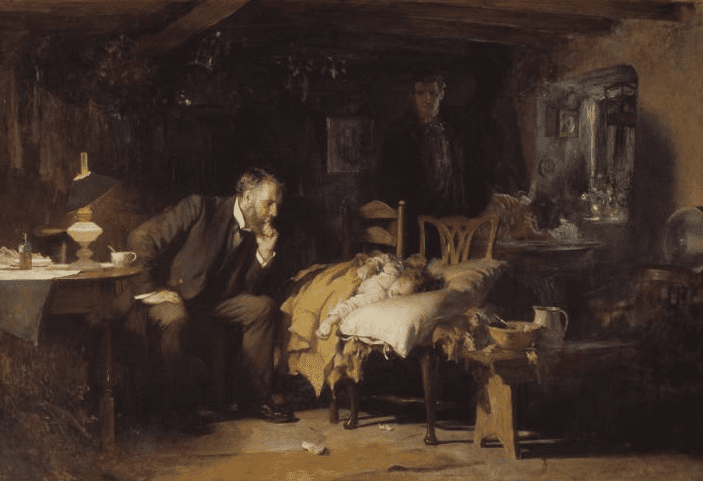
The Doctor by Luke Fildes
“Of all tyrannies, a tyranny sincerely exercised for the good of its victims may be the most oppressive.”
– C.S. Lewis
It seems almost surreal.
Only a few short days ago in Belgium, a teenager afflicted with a terminal illness was actively killed under the watchful eyes of the medical establishment. The chilling story of an act unprecedented in the modern age received widespread coverage. Surely, one might think, there would be repercussions for the premature death of a minor at the hands of trusted medical professionals.
But there would be none.
After all, it is completely legal.
In February, 2014, Belgium’s Parliament legalized the euthanasia of minors by lethal injection by a vote of 86-44 (with 12 abstentions). Though parental consent and medical/psychiatric deliberation is required, there is no age limit precluding the option (beyond the child’s ability to communicate in some form). The child simply has to have a terminal diagnosis, “unbearable physical suffering”, and request to die on several occasions. It has only been twelve years since Belgium had legalized euthanasia for adults and emancipated minors.
Belgium’s legislation, along with countries (Netherlands, Luxembourg, Colombia, Switzerland, Canada) and American states (Oregon, Washington, Vermont, Montana and California) with various euthanasia laws, has been heralded as the product of a self-actualized society trumpeting the dignity of the individual and championing the greatest of bioethics: autonomy. The modern movement favoring euthanasia has adopted an Orwellian shift in language away from Hemlock Societies and physician-assisted suicide toward the more pleasing and palatable euphemisms of Compassion & Choices and death with dignity. How could anyone be opposed to the relief of suffering, the right to choose, the preservation of dignity?
How indeed?
Only, it’s just not that simple.
To be opposed to euthanasia is not to be insensitive to the dignity, autonomy and suffering of a patient. Quite the contrary. To oppose euthanasia is to, instead, have a fuller view…to grapple with the value of that human life, to persevere in identifying thoughtful and humane measures (many, like palliative care and hospice, unconsidered) to alleviate suffering, and not simply to “cure” a burdened life by intentionally ending it.
Now, to be frank, I am a Catholic. And as a Catholic, I believe in the dignity of each individual as a child of God and the value of human life from conception to natural death. Naturally, this clearly informs my worldview on many matters of vital importance. The Catholic Church has addressed this issue worldwide and across cultures for centuries. As G.K. Chesterton once observed, “There is no other case of one continuous intelligent institution that has been thinking about thinking for two thousand years.” It has offered robust and clear spiritual, intellectual and psychological defenses of human life from sources such as the Bible, the Catechism, Church Fathers, Saints, Doctors of the Church and the Papacy. There are also no shortage of modern Catholic intellectuals, philosophers, bioethicists and medical practitioners who have spoken eloquently on this particular issue. Thus, I need not re-articulate the stance of the Church on euthanasia. But, I would invite the honest and fair-minded skeptics to explore the Church’s position lest they fall prey to shallow bias and unthinking obstinacy.
I am opposed to euthanasia.
But being a Catholic is not the only reason I am opposed. Far from it. And I know many fair-minded people considering the merits of euthanasia are not Catholic and, frankly, may feel a bit put off by Christianity in general and Catholicism in particular. They need more than a religious argument against euthanasia.
Fair enough.
Which is why the argument against euthanasia can easily be made from my perspective as a physician.
Let me explain.
As a physician, my daily practice is to uphold the dignity of each patient, treat them with respect, respect their confidence and work in partnership to achieve a rich quality of life in concert with a reasonable quantity of life. I recognize the value of autonomy to afford patient choice within reason as long as it comports simultaneously with the practice of safe, sound and ethical medicine. This means that a patient has many rights, but she does not have the right to demand that I assist her in killing herself any more than she can demand I prescribe her unnecessary narcotics, unwarranted antibiotics, or ill-considered surgery. To demand these measures indiscriminately would be to violate the dignity of the patient with risky (or fatal) outcomes as well as compromise my dignity as a physician to thoughtfully consider the best care for the patient.
That is why I would offer these three arguments against euthanasia:
1. It fundamentally transforms the very nature of the physician-patient relationship.
When Julius Caesar illegally led his army into Italy in defiance of the Roman Senate, he had to pass through a river known as the Rubicon which separated Italy from the province of Gaul. When he “crossed the Rubicon” and became a traitor to his state, he uttered “the die is cast” and knew there was no going back. Once medicine has transformed itself from a vocation whose first and only priority is to heal and comfort into a profession that is willing to kill, we have “crossed the Rubicon”. We have wandered away from the oath to “First, do no harm” and to “give no deadly medicine to any one if asked, nor suggest any such counsel”. Henceforth, the consequences could be both unintended and grave. We need to stop once again and reconsider just what it means to be physicians. We need to remember what it means to be healers.
2. It is a solution in search of a problem.
The popular press, judicial activists and enterprising legislators have grown increasingly sympathetic to the euthanasia movement. As such, anecdote after anecdote highlight people with grave medical maladies offering poignant interviews or writing last letters articulating their sincere fears of unremitting pain and incomparable suffering. They see only two alternatives: one is to suffer a prolonged, painful, humiliating death, while the other is to proactively commit “dignified” suicide under the sympathetic eyes of their physician. That’s it. What is striking, however, is how little conversation there is about Palliative Care and Hospice. Designed fully around the notion of providing dignity, autonomy and symptom management in the face of terminal illness, Palliative Care and Hospice provide extraordinary end of life care to the very people who feel they have no choice but suffering ahead. These physicians and clinicians are well-trained and deeply committed to the care of those very patients that euthanasia advocates specifically target. In my years of practice in internal medicine, I have had many patients enrolled in these services. I have yet to find one family who didn’t gratefully describe the deep dignity, loving kindness and tender management of pain, anxiety and breathing issues they witnessed in the waning days of their loved one’s life. Surely, that is not to say that there can’t be patients with symptoms that could be difficult to manage. There are exceptions to every rule. But does that mean that we should then move to a widespread, systemic legalization of physician-assisted killing? With the oft untapped and unrecognized virtues of Palliative Care and Hospice, I think we are rushing to provide a dangerous solution that is still in search of a problem.
3. The slippery slope is real.
Invariably, when legislation such as legalized euthanasia is considered, concerns are raised about the slippery slope, that is, the unintended consequences and abuses that result from permitting euthanasia at all. “Enlightened minds” that know better shake their heads and tut-tut that our concerns are overreactions. “We would have safeguards against abuses.” “We would have laws against minors or the mentally ill or the demented or the handicapped or others without terminal illness ever being considered for euthanasia.” “It would be a rare event.” “Economics would never enter into the consideration of a law so concerned with preserving the dignity of the individual.” All of these reassuring arguments have been made in countries and states that have legalized euthanasia. And they have been wrong. People with mental illness and no terminal disease have been allowed to die. Minors (see above) in Belgium and the Netherlands are now eligible. Physicians have been more aggressive in utilizing this option in the ill, but not terminally ill. Patients have reported fear of being hospitalized lest they become victims to a euthanasia-partial doctor’s zeal. Exploding costs for end of life care and budgets groaning under the weight of the perpetually ill have a conscious or unconscious impact on a system where euthanasia is an option. And as far as being rare, according to Law Professor Penney Lewis at King’s College in London, 2.8% of all deaths in the Netherlands (in 2010) were from euthanasia while in Belgium (in 2013) the number has reached 4.6% (that is 1 in 22 deaths). Most compelling, I want to ask those who reassure that laws will protect against abuses, “How is it that the small laws will protect us, when the big law (against euthanasia) has been able to fall?”
What happened days ago in Belgium seems surreal. But, even more, it is frightening.
It is hard not to ask, “What are we becoming?”
I have been practicing internal medicine for thirteen years. I love my patients, my colleagues and my calling. Medicine is and always has been a supremely fulfilling vocation of healing and comfort. But, sadly, that could all change. As my state and many respected colleagues engage in a debate of seismic importance about legalizing euthanasia, I would simply ask, “What does it mean to heal?”
Indeed.
What does it truly mean?
————————————–
Photo Credit: Wikimedia Commons


Next Post
September 28, 2016 The Unheroic Heroism of the Disciples
Browse Our Archives
Select a Category A Catholic Thinker's Story Uncategorized
Select a Month March 2017 February 2017 December 2016 November 2016 October 2016 September 2016 August 2016 July 2016 June 2016 May 2016 April 2016 March 2016 February 2016 January 2016 December 2015 November 2015 October 2015 September 2015 August 2015 July 2015 June 2015 May 2015 April 2015 March 2015 February 2015 January 2015 December 2014 November 2014 October 2014 September 2014 August 2014 July 2014 June 2014 May 2014 April 2014 March 2014 February 2014 January 2014 December 2013 November 2013 October 2013 September 2013 July 2013 June 2013 May 2013 April 2013 March 2013 February 2013 January 2013 December 2012 November 2012 October 2012 September 2012 August 2012 July 2012
Follow Us!
TAKE THE
Religious Wisdom Quiz
What does the name "Moses" mean?
Select your answer to see how you score.
Judge Delivered Saved Drawn out (of water)
Related posts from A Catholic Thinker

"Something Absolutely Modern" - The Insincere Convert from...

Textualism vs. The Living Constitution: Justice Scalia, Judge...

Memento Mori: Hope In a Year Heavy With...

Advent: The Greatest Resistance Story of All Time
TRENDING AT PATHEOS Catholic

Rejecting Doom: Christian Hope And Human Action
Christianity is a religion of hope. We are to have hope and...

It’s What Comes From Within Which Matters
One of the most difficult things for us to understand is why...

Why I Choose the Eucharist Over the Sermon
Choose the Eucharist, Not the Sermon What are we supposed to get...

5 Design Elements Found in Spiritually Rooted Homes
Putting Spirituality Into Home Decor Our homes are more than our living...

Credo: A Story of God Told with the...
About 10 years ago, I began to imagine a personal "Credo" that...

The Anatomy of Divine Revelation in Catholic Thought
The claim that God has made Himself known to human beings is...
view all Catholic blogs
Ad-Free & Subscriber Log-In Subscription Support
- About Us
- 2026 Calendar
- Videos
- Podcasts
- Library of World Religions
- Faith In Media Tracker
- Advertise With Us
- Write for Us
- Privacy Policy
- Terms of Service
- Do Not Sell My Data
- Contact Us
- Radiant Digital
- Manage Newsletter Subscriptions
- Unsubscribe From Notifications
- Sitemap
Copyright 2008-2026, Patheos. All rights reserved.
Subscription Support Ad-Free & Subscriber Log-In
Follow Patheos