
BuddhistCatholicContemplativeEvangelicalGeneral ChristianHinduJewishLatter-day SaintMuslimNew VisionsProgressive Christian
Beliefs
- Buddhist
- Catholic
- Contemplative
- Evangelical
- General Christian
- Hindu
- Jewish
- Latter-day Saint
- More Voices
- Muslim
- New Visions
- Pagan
- Progressive Christian
Topics
- Religion News
- Food and Religion
- Sports and Religion
- Religious Art
- Religious Music and Entertainment
- Religious Events
- History and Religion
- Style and Religion
- Politics and Religion
- Women in Religion
- Recreation Outdoors and Religion
- Business Finance and Religion
- Careers Workplace and Religion
- Education and Religion
- Family Parenting and Religion
- Health Fitness and Religion
- Home and Religion
- Relationships and Religion
- Technology and Religion
- Travel and Religion
Columnists
- Buddhist Columnists
- Business Finance and Religion Columnists
- Careers Workplace and Religion Columnists
- Catholic Columnists
- Contemplative Columnists
- Education and Religion Columnists
- Evangelists Columnists
- Family Parenting and Religion Columnists
- General Christian Columnists
- Health Fitness and Religion Columnists
- Hindu Columnists
- History and Religion Columnists
- Home and Religion Columnists
- Jewish Columnists
- More Voices Columnists
- Latter Day Columnists
- Muslim Columnists
- New Visions Columnists
- Nonreligious Columnists
- Pagan Columnists
- Politics and Religion Columnists
- Progressive Columnists
- Recreation Outdoors and Religion Columnists
- Relationships and Religion Columnists
- Religion News Columnists
- Religious Art Columnists
- Religious Events Columnists
- Religious Music and Entertainment Columnists
- Sports and Religion Columnists
- Style and Religion Columnists
- Technology and Religion Columnists
- Travel and Religion Columnists
- Women in Religion Columnists
Resource Library
- 2026 Calendar
- Library of World Religions
- The 100 Most Holy Places on Earth
- Patheos Answers
- Podcasts
- Videos
- Faith Leaders Database
- Anglican Episcopalian
- Bahai
- Baptist
- Buddhism
- Christianity
- Confucianism
- Eastern Orthodoxy
- Hinduism
- Holiness and Pentecostal
- ISKCON
- Islam
- Judaism
- Lutheran
- Methodist
- The Church of Jesus Christ of Latter-day Saints
- New Age
- Paganism
- Presbytarian and Reformed
- Protestantism
- Religion Behind the Scenes
- Roman Catholic
- Scientology
- Shia Islam
- Sikhism
- Sufism
- Sunni Islam
- Taoism
- Zen
- See all religions
Research Tools
 Ad-Free & Subscriber Log-In Subscription Support
Ad-Free & Subscriber Log-In Subscription Support
Follow Patheos 

- Trending:
- Forgiveness
- |
- Marriage
- |
- Consciousness
- |
- Death Penalty
- |
- Election
- |
- Halloween
 A Catholic Thinker
- Home
- Catholic
- “Until My Last Breath” – The Tragedy & Hope of Father Jacques Hamel
“Until My Last Breath” – The Tragedy & Hope of Father Jacques Hamel
Last updated on: July 26, 2016 at 10:51 pm by Tod Worner
“Until My Last Breath” – The Tragedy & Hope of Father Jacques Hamel 2016-07-26T22:51:47-06:00 Tod Worner
Patheos Explore the world's faith through different perspectives on religion and spirituality! Patheos has the views of the prevalent religions and spiritualities of the world.
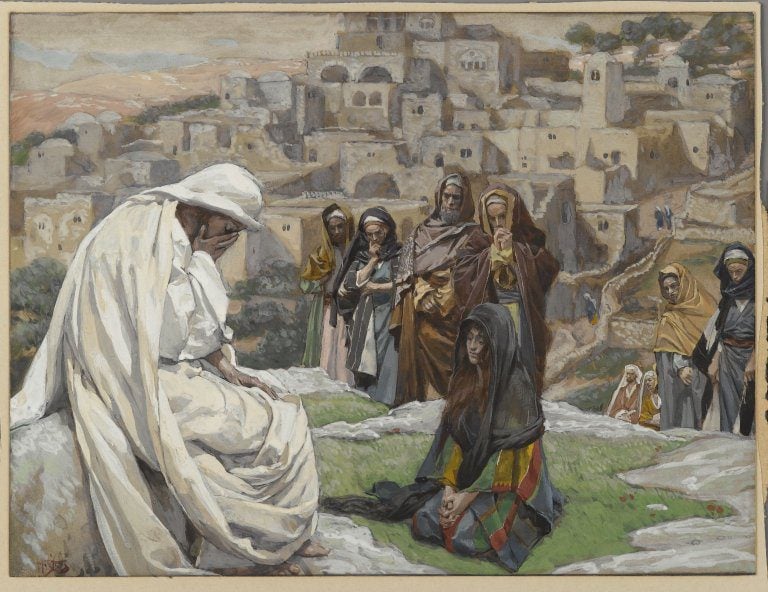
“Jesus Wept” by James Tissot
“I’ll work until my last breath,” he laughed.
And he honored those words.
Father Jacques Hamel, beloved 85 year-old priest for St.-Étienne-du-Rouvray parish in Normandy, France, was ruthlessly executed today by devotees of the Islamic State (ISIS) while he celebrated Mass. The murder was macabre in method, unconscionable in motive and has left both a small Catholic church and a larger world shaken with grief and anger.
When I heard this, there were no words. Simply no words.
So I dug into the prison writings of another persecuted and heartlessly executed priest, Alfred Delp, S.J. Deeply devoted to Christ and his Church, the 37 year-old priest refused to renounce his Jesuit faith and subsequently would be tortured and hanged by his Nazi captors in 1945.
But the reason I approached Fr. Delp’s story, like Fr. Jacques Hamel’s, was not his death.
The story was (and is) his life.
As I thumbed through Fr. Delp’s letters, I was struck. Though the letters had been spirited out of an unforgiving and merciless prison, they were filled with sublime reflections on faith, hope and love. In the midst of incomprehensible blackness, there was light. In the presence of inexplicable hopelessness, there was hope. In the depths of apparent Godlessness, there was (and is) the ever-present, endlessly loving Christ.
[The] phrase, hallowed be thy name, teaches us to pray for the worthy ideal, for the unassailable, holy, venerated standard. Unless they have something of supreme value, something at the center of their being which they can venerate, human beings gradually deteriorate. Human nature is so constituted that it must have something holy that it can worship, otherwise it becomes cramped and distorted, and instead of a holy object of veneration something else will take its place. I ought to know for I have just emerged from a murderous dialogue with such a self-appointed object of veneration. These substitute values are far more autocratic and demanding than the living God himself. They have no idea of courtesy or of waiting for their turn…All they know is demand, compulsion, force, threats and liquidation. And woe to anyone who does not conform.
The word of God should evoke and receive the great veneration this phrase suggests: praise, reverence, awe…The name of God is the holy of holies, the central silence, the thing that above all others calls for humble approach. We not only ought to believe in the truth at the center of our being, in the purpose of our existence, but we should also bear testimony to this belief by the proper fulfillment of our life’s purpose. We should subjugate everything to this law of holiness and reject everything that does not harmonize with it. God, the great object of our veneration, will then also be our whole life. “There is no healing in any other name” (Acts 4:12). How little there is to say once we have said this. And how much that is said is mere cant. We have so many pious phrases that are utterly without genuine reverence for God. Religious chastity and silence go well together.
Let us resume the practice of giving names to life and to things. I have been a mere number long enough to know what it means to be nameless and what effect it has on life. As long as life itself has no name, or at least none that it honors, people and things will continue to lose their identity in the dreadful regimentation and anonymity into which we have sunk. Life has a sensitive nervous system through which everything is connected. Since the name of God is no longer the first and foremost of all names in the land and the voice of the people, then everything else that was once precious and prized has lost its name and been subjected to false and falsifying labels. The cliché, the label, the uniform, the slogan, the “dominant trend of the masses” – these are our rulers. And pity the man who dares to differ, to proclaim his own thoughts or use his own name.
Prayer is our way to freedom and education in the method of prayer is the most valuable service that we can give to humankind. It makes it possible for the temple and the altar to again occupy their rightful place and for humanity to humble itself and measure its responsibilities in the name of God.
Let us mourn Fr. Hamel. Let us mourn.
But let us also hope. Let us not fear. Let us honor God…and work until our last breath.
After all, the story is not death.
The story is life.
Fr. Hamel & Fr. Delp, pray for us.
————————–
Photo credit: Wikimedia Commons

Previous Post

July 19, 2016
St. Thomas More's "Horrible Moral Squint"
Next Post

August 2, 2016 What This John Cusack Movie Taught Me About Fate and Freewill
Browse Our Archives
Select a Category A Catholic Thinker's Story Uncategorized
Select a Month March 2017 February 2017 December 2016 November 2016 October 2016 September 2016 August 2016 July 2016 June 2016 May 2016 April 2016 March 2016 February 2016 January 2016 December 2015 November 2015 October 2015 September 2015 August 2015 July 2015 June 2015 May 2015 April 2015 March 2015 February 2015 January 2015 December 2014 November 2014 October 2014 September 2014 August 2014 July 2014 June 2014 May 2014 April 2014 March 2014 February 2014 January 2014 December 2013 November 2013 October 2013 September 2013 July 2013 June 2013 May 2013 April 2013 March 2013 February 2013 January 2013 December 2012 November 2012 October 2012 September 2012 August 2012 July 2012
Follow Us!
TAKE THE
Religious Wisdom Quiz
Who said, "My Lord and my God!"?
Select your answer to see how you score.
Paul Thomas Peter John
Related posts from A Catholic Thinker

"Something Absolutely Modern" - The Insincere Convert from...

Textualism vs. The Living Constitution: Justice Scalia, Judge...

Memento Mori: Hope In a Year Heavy With...

Advent: The Greatest Resistance Story of All Time
TRENDING AT PATHEOS Catholic

Creation, Preservation, and Teleology in Catholic Theology
As I write this, it is very early Monday morning. Like millions...

The Parable Of The Sower And The Word...
One of Christ’s most famous parables is that of the sower who...

Rejecting Doom: Christian Hope And Human Action
Christianity is a religion of hope. We are to have hope and...

Why I Choose the Eucharist Over the Sermon
Choose the Eucharist, Not the Sermon What are we supposed to get...

5 Design Elements Found in Spiritually Rooted Homes
Putting Spirituality Into Home Decor Our homes are more than our living...

Credo: A Story of God Told with the...
About 10 years ago, I began to imagine a personal "Credo" that...
view all Catholic blogs
Ad-Free & Subscriber Log-In Subscription Support
- About Us
- 2026 Calendar
- Videos
- Podcasts
- Library of World Religions
- Faith In Media Tracker
- Advertise With Us
- Write for Us
- Privacy Policy
- Terms of Service
- Do Not Sell My Data
- Contact Us
- Radiant Digital
- Manage Newsletter Subscriptions
- Unsubscribe From Notifications
- Sitemap
Copyright 2008-2026, Patheos. All rights reserved.
Subscription Support Ad-Free & Subscriber Log-In
Follow Patheos