
BuddhistCatholicContemplativeEvangelicalGeneral ChristianHinduJewishLatter-day SaintMuslimNew VisionsProgressive Christian
Beliefs
- Buddhist
- Catholic
- Contemplative
- Evangelical
- General Christian
- Hindu
- Jewish
- Latter-day Saint
- More Voices
- Muslim
- New Visions
- Pagan
- Progressive Christian
Topics
- Religion News
- Food and Religion
- Sports and Religion
- Religious Art
- Religious Music and Entertainment
- Religious Events
- History and Religion
- Style and Religion
- Politics and Religion
- Women in Religion
- Recreation Outdoors and Religion
- Business Finance and Religion
- Careers Workplace and Religion
- Education and Religion
- Family Parenting and Religion
- Health Fitness and Religion
- Home and Religion
- Relationships and Religion
- Technology and Religion
- Travel and Religion
Columnists
- Buddhist Columnists
- Business Finance and Religion Columnists
- Careers Workplace and Religion Columnists
- Catholic Columnists
- Contemplative Columnists
- Education and Religion Columnists
- Evangelists Columnists
- Family Parenting and Religion Columnists
- General Christian Columnists
- Health Fitness and Religion Columnists
- Hindu Columnists
- History and Religion Columnists
- Home and Religion Columnists
- Jewish Columnists
- More Voices Columnists
- Latter Day Columnists
- Muslim Columnists
- New Visions Columnists
- Nonreligious Columnists
- Pagan Columnists
- Politics and Religion Columnists
- Progressive Columnists
- Recreation Outdoors and Religion Columnists
- Relationships and Religion Columnists
- Religion News Columnists
- Religious Art Columnists
- Religious Events Columnists
- Religious Music and Entertainment Columnists
- Sports and Religion Columnists
- Style and Religion Columnists
- Technology and Religion Columnists
- Travel and Religion Columnists
- Women in Religion Columnists
Resource Library
- 2026 Calendar
- Library of World Religions
- The 100 Most Holy Places on Earth
- Patheos Answers
- Podcasts
- Videos
- Faith Leaders Database
- Anglican Episcopalian
- Bahai
- Baptist
- Buddhism
- Christianity
- Confucianism
- Eastern Orthodoxy
- Hinduism
- Holiness and Pentecostal
- ISKCON
- Islam
- Judaism
- Lutheran
- Methodist
- The Church of Jesus Christ of Latter-day Saints
- New Age
- Paganism
- Presbytarian and Reformed
- Protestantism
- Religion Behind the Scenes
- Roman Catholic
- Scientology
- Shia Islam
- Sikhism
- Sufism
- Sunni Islam
- Taoism
- Zen
- See all religions
Research Tools
 Ad-Free & Subscriber Log-In Subscription Support
Ad-Free & Subscriber Log-In Subscription Support
Follow Patheos 

- Trending:
- Forgiveness
- |
- Marriage
- |
- Consciousness
- |
- Death Penalty
- |
- Election
- |
- Halloween
 A Catholic Thinker
- Home
- Catholic
- What Pope Benedict XVI & G.K. Chesterton Understood (But Science Misses) About Mystery
What Pope Benedict XVI & G.K. Chesterton Understood (But Science Misses) About Mystery
Last updated on: June 8, 2016 at 10:48 pm by Tod Worner
What Pope Benedict XVI & G.K. Chesterton Understood (But Science Misses) About Mystery 2016-06-08T22:48:05-06:00 Tod Worner
Patheos Explore the world's faith through different perspectives on religion and spirituality! Patheos has the views of the prevalent religions and spiritualities of the world.
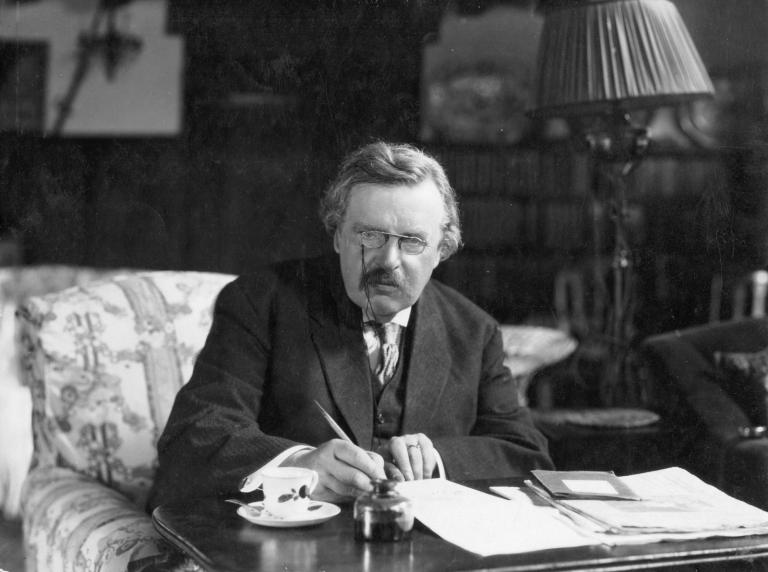
G.K. Chesterton
I’ve been thinking.
Does Science like Mystery? I mean, really and truly embrace it. Because if you think about it, the entire reason for Science’s existence is to answer questions, solve riddles…demystify. So what happens when Science can’t answer certain questions? How does Science grapple with enduring Mystery?
I know, I know. You’re going to say, “Science is neutral.”
Fair enough.
But Scientists aren’t. And the growing body of adherents to Scientism, where Science is transformed from tool to ideology, certainly aren’t neutral.
So, how do they handle Mystery?
Well, it motivates some to find answers. That is a good thing. But for others, Mystery is threatening, embarrassing, something to be conquered or swept under the rug. Because to admit to Mystery means that there are pieces missing in the puzzle. And an incomplete puzzle means that one must operate with assumptions, guesswork and (dare I say it?) faith.
But this shouldn’t surprise anyone – even the most hard-bitten disciple of Science. Our everyday lives are suffused with Mystery. Will that car approaching the opposing red light stop or run through and T-bone me? Can this bridge support the weight of my car and the rest of these cars? Will the forecast predicting a 70% chance of rain mean it will, indeed, rain or not? In spite of this woman’s extensive research invested on dating sites, will this chosen person be her true love? Will this specific chemotherapy cure this particular man’s cancer? Often, we believe we have certainty, when the best we can often live with is probability. And the difference between probability and certainty, is Mystery.
Think of the mathematical notion of an asymptote. An asymptote is a line (let us call it Truth, or what is) which another line tries to approximate, but quite simply never can (let us call that second line failing to reach the asymptote our perception of the Truth, or what we think is). There will always be a gap between what is the Truth and what we think is the Truth. And that gap is uncertainty, or Mystery. And whether it is in Science or Religion, in order to cope with that gap – to not be utterly paralyzed by uncertainty – we must have Faith.
But again, some are uncomfortable with this notion of Faith even thought they unconsciously rely on it innumerable times every day. They even lash out against it. Faith, feh…Illogical! Fanatical! Simple-minded!
But, in fact, it is common sense.
There will always be Mystery and the need to live life in the midst of uncertainty. The end of Mystery, the end of uncertainty means the end of Science. And it appears that Science is not going anywhere anytime soon.
So why can’t people embrace this uncertainty? Why not welcome Mystery?
Because we are proud. And a little scared. Mystery makes us feel vulnerable and dependent. And we want control – to be the masters of our own destiny, captains of our own ship. Mystery unnerves and gets in the way of that goal.
Indeed.
But we disregard Mystery and insist that we may achieve omniscience at our own peril.
G.K. Chesterton wisely observed that a Poet or Mystic welcomes Mystery while a strident Logician seeks to utterly conquer it.
“The general fact is simple. Poetry is sane because it floats easily in an infinite sea; reason seeks to cross the infinite sea, and so make it finite. The result is mental exhaustion… To accept everything is an exercise, to understand everything a strain. The poet only desires exaltation and expansion, a world to stretch himself in. The poet only asks to get his head into the heavens. It is the logician who seeks to get the heavens into his head. And it is his head that splits…”
“The whole secret of mysticism is this: that man can understand everything by the help of what he does not understand. The morbid logician seeks to make everything lucid, and succeeds in making everything mysterious. The mystic allows one thing to be mysterious, and everything else becomes lucid.”
And Pope Benedict XVI added this,
“Indeed, although a mystery, God is not absurd. If, in contemplating the mystery, reason sees only darkness, this is not because the mystery contains no light, rather because it contains too much. Just as when we turn our eyes directly to the sun, we see only shadow – who would say that the sun is not bright? Faith allows us to look at the ‘sun’ that is God, because it welcomes His revelation in history…”
“At the same time, God, with His grace, illuminates reason and opens up new horizons, immeasurable and infinite. Therefore, faith is a continuous stimulus to seek, never to cease or acquiesce in the inexhaustible search for truth and reality.”
Mystery, be assured, will always be with us. There will always be probability in the place of cocksure certainty. The steady asymptotic line of what is will not, in this life, be completely reached by what we think is.
We can wondrously put our heads into the heavens or split our skull impossibly putting the heavens into our heads.
Mystery. We can embrace it. Or fight it.
Chesterton knew the right answer. Pope Benedict XVI knew it too.
Do we?
————————–
Photo Credit: Wikimedia Commons
Previous Post

May 26, 2016
Who Gave the Year's Best Commencement Address?... Justice Antonin Scalia
Next Post

June 16, 2016 Don't Despair
Browse Our Archives
Select a Category A Catholic Thinker's Story Uncategorized
Select a Month March 2017 February 2017 December 2016 November 2016 October 2016 September 2016 August 2016 July 2016 June 2016 May 2016 April 2016 March 2016 February 2016 January 2016 December 2015 November 2015 October 2015 September 2015 August 2015 July 2015 June 2015 May 2015 April 2015 March 2015 February 2015 January 2015 December 2014 November 2014 October 2014 September 2014 August 2014 July 2014 June 2014 May 2014 April 2014 March 2014 February 2014 January 2014 December 2013 November 2013 October 2013 September 2013 July 2013 June 2013 May 2013 April 2013 March 2013 February 2013 January 2013 December 2012 November 2012 October 2012 September 2012 August 2012 July 2012
Follow Us!
TAKE THE
Religious Wisdom Quiz
Who was the Roman emperor during Jesus’ birth?
Select your answer to see how you score.
Tiberius Herod Nero Caesar Augustus
Related posts from A Catholic Thinker

Why It's Okay to Feel Ill At Ease
"Why I Am a Catholic" by G.K. Chesterton...

Are You Fair to the Catholic Church? (An...

"Something Absolutely Modern" - The Insincere Convert from...
TRENDING AT PATHEOS Catholic

Creation, Preservation, and Teleology in Catholic Theology
As I write this, it is very early Monday morning. Like millions...

The Parable Of The Sower And The Word...
One of Christ’s most famous parables is that of the sower who...

Rejecting Doom: Christian Hope And Human Action
Christianity is a religion of hope. We are to have hope and...

Why I Choose the Eucharist Over the Sermon
Choose the Eucharist, Not the Sermon What are we supposed to get...

5 Design Elements Found in Spiritually Rooted Homes
Putting Spirituality Into Home Decor Our homes are more than our living...

Credo: A Story of God Told with the...
About 10 years ago, I began to imagine a personal "Credo" that...
view all Catholic blogs
Ad-Free & Subscriber Log-In Subscription Support
- About Us
- 2026 Calendar
- Videos
- Podcasts
- Library of World Religions
- Faith In Media Tracker
- Advertise With Us
- Write for Us
- Privacy Policy
- Terms of Service
- Do Not Sell My Data
- Contact Us
- Radiant Digital
- Manage Newsletter Subscriptions
- Unsubscribe From Notifications
- Sitemap
Copyright 2008-2026, Patheos. All rights reserved.
Subscription Support Ad-Free & Subscriber Log-In
Follow Patheos